

Connect with us

Business

US emerges top supplier of crude to Nigeria — Report

Published

on

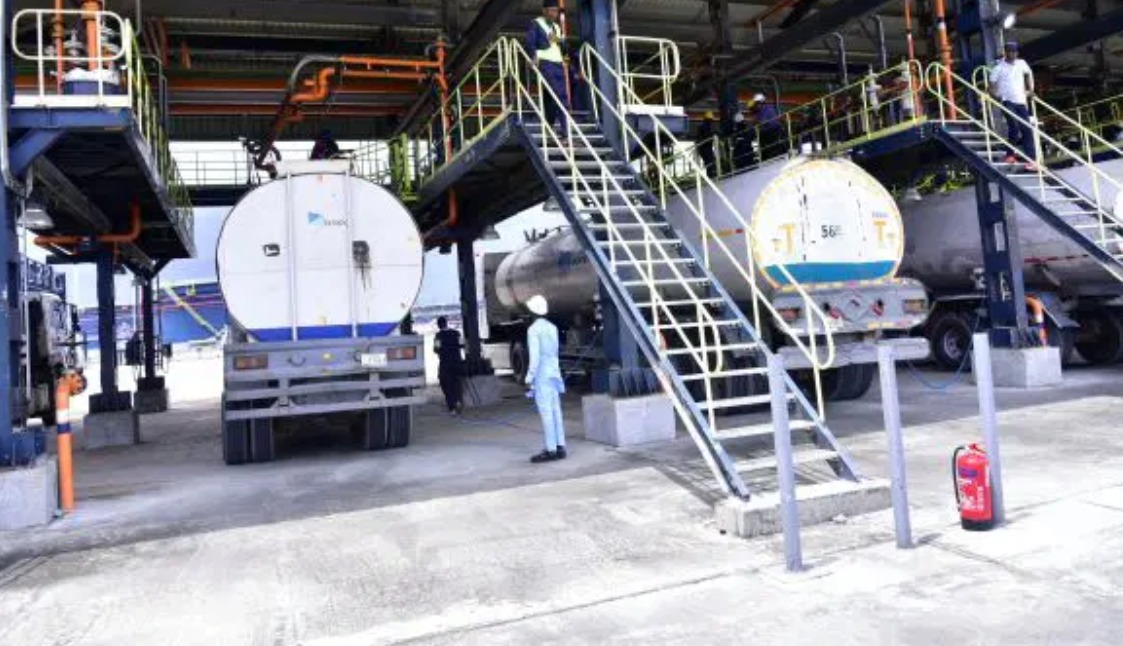
The United States became a net exporter of crude oil to Nigeria in February and March, as crude demand on the United States East Coast slowed due to refinery maintenance.

The US Energy Information Administration said in a note on Tuesday that the Dangote refinery drove up Nigeria’s demand for US crude. Reuters reports that this is the first time that the US has exported more crude oil to Nigeria than it imported.

Nigeria used to be generally considered a source for US crude oil imports, ranking ninth last year.

The Dangote refinery began processing crude in January 2024 after years of delays. The refinery is set to reach an upgraded capacity of 700,000 barrels per day by December.

It was said that Nigeria’s crude export to the US was 133,000bpd in January. But this dropped to 54,000bpd and 72,000bpd in February and March.

However, the crude from the US to Nigeria was 111,000 bpd in February and 169,000 bpd in March.

“Gross US exports of crude to Nigeria touched 111,000 bpd in February and 169,000 bpd in March. Imports, which were at 133,000 bpd in January, dropped to 54,000 bpd and 72,000 bpd in February and March, respectively,” the report said.

It was added that the decline in imports was largely due to maintenance at the Phillips 66 Bayway refinery in New Jersey, according to EIA.

“However, imports increased later in the year as the Bayway refinery resumed normal operations in April, and Dangote underwent some unplanned maintenance,” the report said.

See also  OPay secures double honours at Tech Innovation Awards

This trend seems more like a snapshot of a very fluid market, rather than a permanent realignment, according to a senior market strategist at RJO Futures, Eli Tesfaye.

“The new refinery in Nigeria and some issues in securing domestic supplies played a role in those unique flows earlier this year. But going forward, with the refinery now aiming to secure domestic flows, and probably looking at other crude grades, it is difficult to forecast if the volume flowing from the US to Nigeria will persist,“ agreed Giovanni Staunovo, an analyst at UBS.

The President of the Dangote Group, Aliko Dangote, said the refinery imported up to 10 million barrels of crude oil from the US monthly.

Continue Reading
Click to comment

Leave a Reply

Your email address will not be published. Required fields are marked *

Business

Oshiomhole seeks ban on MTN, DSTV, read why

Published

on

The senator representing Edo North, Adams Oshiomhole, on Tuesday called for the revocation of licences of South African companies operating in Nigeria, including MTN and MultiChoice, owners of DSTV, following renewed xenophobic attacks against Nigerians in South Africa.

The call came as the National Assembly condemned the latest wave of attacks, urging the Federal Government to take immediate diplomatic and protective measures to safeguard Nigerian citizens abroad.

Speaking during plenary, Oshiomhole said Nigeria must respond firmly, invoking the principle of reciprocity in international relations.

He said, “I don’t want this Senate to be shedding tears, to sympathise with those who have died. We didn’t come here to share tears.

“If you hit me, I’ll hit you. I think it is appropriate in diplomacy. It’s an economic struggle.”

The former Edo State governor proposed that Nigeria should nationalise MTN and withdraw its operating licence, arguing that the company repatriates significant revenue while Nigerians face hostility in South Africa.

“This Senate should adopt a position that MTN, a South African company that is cutting away millions of dollars from Nigeria every day, should have Nigeria nationalise it and withdraw its licence,” he said.

According to him, such action would not only serve as a deterrent but also create opportunities for indigenous firms, amid what he described as economic and social targeting of Nigerians abroad.

He extended the call to MultiChoice, urging the Federal Government to revoke DSTV’s licence over alleged exploitative practices.

“I call on the Federal Government to revoke DSTV, which is also a South African company that is cutting away millions of dollars,” he said.

See also  Wage arrears: Labour issues Friday ultimatum to FG

Oshiomhole linked the recurring tensions to domestic political dynamics in South Africa, noting that anti-immigrant rhetoric had become a feature of its politics and was shaping public attitudes toward foreign nationals, including Nigerians.

“When we hit back, the president of South Africa will go on his knees to recognise that Nigerians cannot be intimidated,” he said.

The senator made the remarks while contributing to a motion sponsored by Osita Izunaso, which was read on the floor by Aniekan Bassey under Senate rules on matters of urgent public importance.

Titled “A call for urgent national diplomatic and humanitarian action to defend the dignity, safety and honour of Nigerian citizens,” the motion highlighted growing concerns over the safety of Nigerians in South Africa.

Also speaking, Senator Victor Umeh described the situation as alarming, warning that Nigerians were living in fear.

“It is worrisome. They are hiding for their lives. They can’t move freely. This is a situation where people are paying good with evil,” he said, referencing Nigeria’s historical support for the anti-apartheid struggle.

Umeh called on the African Union to intervene and impose sanctions, warning that Nigeria could no longer tolerate attacks on its citizens.

“The AU, of which South Africa is a member, should rise now and impose necessary sanctions,” he said, adding that “we cannot allow this to continue.”

Oshiomhole, however, doubled down on calls for economic retaliation, arguing that Nigeria must move beyond rhetoric.

“I don’t want this Senate to be shedding tears to sympathise with those who have died. We didn’t come here to shed tears. I am not going to shed tears. If you hit me, I hit you. I think it is appropriate in diplomacy. It is an economic struggle,” Oshiomhole said.

See also  Shettima pushes for proactive disaster preparedness over costly relief

He further argued that Nigerians should take advantage of opportunities in the local economy, currently dominated by foreign firms.

Senator Abdul Ningi warned South Africans over recent attacks on Nigerians, threatening that the country would take the fight to their territory.

“If a crime has been committed under the South African law, they have the right to bring any such person to justice, but to kill our people as if we are helpless, we will not allow that.

“If these things continue, we have alternatives, we have options, and therefore, these words should be sent across South Africa. We know where South Africans are, not only in Nigeria but all over Africa, and we can take this fight to their territory,” he said.

Speaking, the Senate President, Godswill Akpabio, decried the attack, adding that the National Assembly would send a joint team to meet with the South-African parliament on the matter.

“This is just not acceptable, this is barbaric, this is cruel, this is unheard of, this is strange behaviour, and we’re not seeing action from the government of South Africa. These are aspects that annoy me,” Akpabio said.

The development underscores mounting pressure on the Federal Government to adopt a tougher stance, as recurring xenophobic violence in South Africa continues to strain diplomatic relations and provoke calls for both economic countermeasures and stronger protections for Nigerians abroad.

Continue Reading

Business

Naira gains, trades 1,365/$ at official FX market

Published

on

…NFEM rate — N1,365.2474/$

…Naira strengthens by at least N9

…Black market (Buying and selling rates) — N1,390 — N1,400

The Nigerian naira strengthened against the United States (US) dollar, trading at N1,365.2474 at the Central Bank of Nigeria (CBN) official foreign exchange window on Monday, 4th May, 2026.

According to the data shared on the official platform of the Central Bank of Nigeria (CBN), the naira traded at the Nigerian Foreign Exchange Market (NFEM) rate of N1,365.2474 per dollar and closed at N1,367.5000 per dollar.

Tribune Online reports that the Nigerian currency traded at an NFEM rate of N1,374.9431 on 30th April 2026, which was the previous trading date. Comparing this with the trading rate on Monday, the naira strengthened by at least N9.

At the parallel market, the naira-to-dollar buying rate decreased by N3, while the selling rate increased by N2, compared with the previous trading rate on 30th April, 2026.

According to Aboki FX, the Naira-to-dollar exchange rate at the black market on Monday, 4th May, 2026, was N1,390 for the buying rate and N1,400 per dollar for the selling rate.

See also  CBN, NCC to combat SIM-related fraud
Continue Reading

Business

Experts promote rabbit value chain investment

Published

on

Experts in animal production have identified rabbit farming as a viable avenue for economic growth, job creation, and improved nutrition in Nigeria.

The experts made this known during a public lecture held at the Bauchi State College of Agriculture on Friday as part of activities marking Rabbit Appetite Day.

Speaking at the event, a registered animal scientist and lecturer at the Federal Polytechnic Damaturu, Sani Muazu, said there was a need to promote both the consumption and commercial production of rabbits across the country.

He described rabbit production as a largely untapped but promising sector capable of contributing significantly to Nigeria’s economy.

“Rabbit farming in Nigeria is still underdeveloped, with only about three to five per cent of the population engaged in the enterprise, mostly at small-scale family levels where farmers keep an average of two to seven breeding females. Despite this, the sector offers vast opportunities for expansion and commercialisation,” he said.

Muazu noted that rabbits are highly productive animals, with a gestation period of about 30 days and the capacity to produce up to 20 or more offspring annually.

He added that their low feeding and housing requirements make them suitable for students, smallholder farmers, and urban residents seeking alternative sources of income.

According to him, rabbit production extends beyond farming to other economic activities such as breeding, feed supply, veterinary services, processing, and marketing.

He also highlighted the nutritional value of rabbit meat, describing it as rich in protein, low in fat, and suitable for addressing protein deficiency in the country.

See also  Wage arrears: Labour issues Friday ultimatum to FG

On environmental sustainability, Muazu said rabbits require less land and water and emit fewer greenhouse gases compared to larger livestock, making them suitable for climate-smart agriculture, particularly in semi-arid regions.

However, he identified low public awareness and high mortality rates among young rabbits as major challenges hindering the sector’s growth.

He urged students and youths to take advantage of opportunities in rabbit farming by starting small-scale ventures that could grow into profitable agribusinesses, while calling on government and private sector players to invest in the development of the rabbit value chain.

In his remarks, the Provost of the Bauchi State College of Agriculture, Dr Ahmed Isah, described the event as timely and impactful, noting that it would encourage students to embrace self-employment through agriculture.

“Such initiatives are critical in addressing unemployment. Graduates can become employers of labour through ventures like rabbit farming,” he said.

He also encouraged members of the public to engage in rabbit production, describing it as a profitable and easy-to-start enterprise with the potential to improve livelihoods and boost the nation’s economy.

punch.ng

FOLLOW US ON:

FACEBOOK

TWITTER

PINTEREST

TIKTOK

YOUTUBE

LINKEDIN

INSTAGRAM

Continue Reading

Trending