


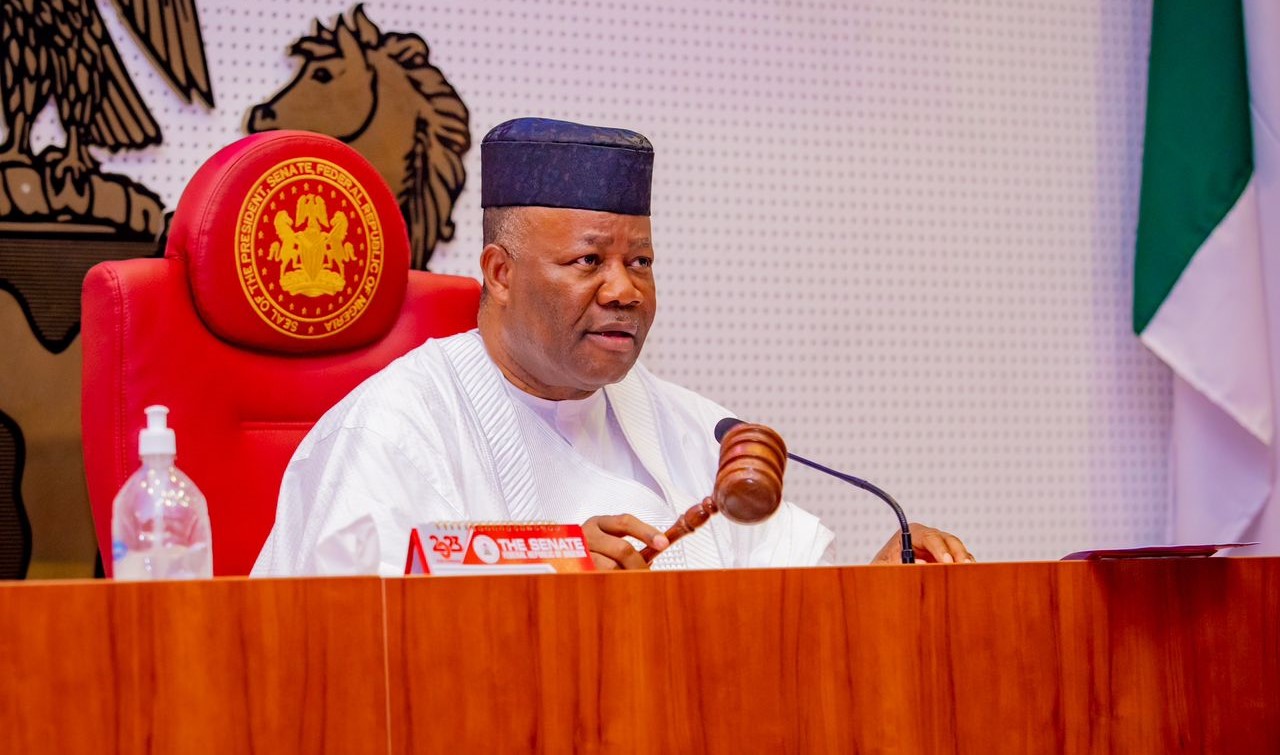
Senate President Godswill Akpabio has defended his remarks on the proposed suicide bill, insisting on his position amid growing criticism from psychiatrists, who have demanded an apology.
The psychiatrists faulted Akpabio’s comments, warning that they could reinforce stigma against people experiencing suicidal thoughts and discourage those struggling with mental health challenges from seeking professional help.
Akpabio was quoted as saying during the Senate debate on October 13, 2026, that, “If you attempt it [suicide], you better succeed. If you don’t succeed, we will send you to prison.”
However, the Association of Psychiatrists in Nigeria, in a statement signed by its President, Dr Veronica Nyamali, and Secretary, Prof Mayowa Okonoda, said its statement was prompted by reports that the Senate was considering a bill by Senator Asuquo Ekpenyong seeking to establish a framework for suicide prevention, decriminalise attempted suicide, and provide support for survivors, with Sections 327 and 231 of Nigeria’s Criminal Code and Penal Code, respectively, identified as provisions currently used to criminalise attempted suicide.
The association maintained that a person who survived a suicide attempt should be regarded first and foremost as an individual experiencing severe psychological distress, and that the appropriate response was urgent medical care, compassionate assessment, treatment, safety planning, and follow-up care, not a threat of imprisonment.
“APN respectfully but firmly rejects the proposition that a person who survives a suicide attempt should be punished for surviving. Public officials have a particular responsibility to communicate in ways that protect life, reduce stigma and encourage people at risk to seek help.
“The association acknowledges that suicide and attempted suicide are serious public health concerns requiring urgent and comprehensive intervention.
“However, a person who survives a suicide attempt should be regarded first and foremost as an individual experiencing severe psychological distress.
“The appropriate response is urgent medical care, compassionate assessment, treatment, safety planning and follow-up—not a threat of imprisonment,” the association said.
Continuing, the APN warned that threatening imprisonment for surviving a suicide attempt could deter people from seeking help, discourage families from disclosing attempts, delay access to emergency medical and psychiatric care, and intensify the stigma that already made help-seeking difficult in Nigeria, all of which would undermine rather than strengthen suicide prevention.
“The APN respectfully calls upon the National Assembly to give careful consideration to the evidence and international public-health guidance concerning the criminalisation of attempted suicide and to engage mental health professionals, people with lived experience, human-rights experts and other stakeholders in the legislative process,” the statement noted.
The association called on the National Assembly to enact legislation removing criminal penalties for attempted suicide and called on the Senate President to retract and apologise for the reported statement.
It added, “The National Assembly should enact legislation that removes criminal penalties for attempted suicide and establishes a clear, funded framework for prevention, care, rehabilitation and continuing support.
“The Senate President and all public office holders should use language that protects life, avoids stigma and encourages people in distress to seek help; APN calls for a clarification or retraction of the reported statement by the Senate President and an apology to Nigerians.”
The APN said public officials had a particular responsibility to use language that protected lives, reduced stigma and encouraged people at risk to seek help.
The association cited a landmark 2008 study by Omigbodun, Dogra, Esan and Adeodun, which studied 1,429 adolescents aged 10 to 17 years attending secondary schools in south-west Nigeria and found that more than one in five reported suicidal ideation, with approximately 12 per cent reporting a suicide attempt in the preceding year.
It said the study associated suicidal behaviour in adolescents with sexual abuse, exposure to physical violence, hunger, parental divorce, and living in a polygamous family, and that the authors had called on Nigerian policymakers and health providers to address the problem urgently.
The APN also cited global data showing that suicide was responsible for approximately 727,000 deaths worldwide in 2021 and remained among the leading causes of death for young people.
It said the World Health Organisation’s 2023 Policy Brief on the Health Aspects of Decriminalisation of Suicide and Suicide Attempts recommended that countries identify and repeal legislation and policies that criminalised suicide and suicide attempts, noting that decriminalisation was not the same as endorsing suicide but was intended to reduce barriers to help-seeking and enable a person in crisis to receive care rather than punishment.
The association further said children and adolescents required particular protection because their mental health and coping skills were still developing.
The statement said, “A child or young person who survives an attempt should be supported and assessed, with safeguarding measures where abuse, exploitation or other risks are suspected.”
Among its specific recommendations, the association called on the National Assembly to enact legislation establishing a clear, funded framework for prevention, care, rehabilitation, and continuing support for survivors.
It also called on federal and state authorities to strengthen access to mental health care in primary care, emergency departments, schools, and communities; and on families, schools, faith leaders, community organisations, the media, and civil society to be supported to recognise warning signs, respond without blame, and connect people at risk with professional help.
Speaking on the development, Akpabio warned Nigerians against taking lawmakers’ contributions during plenary out of context, insisting that individual opinions expressed during debates should not be mistaken for the Senate’s final position.
His response followed public reactions to his opposition to a bill seeking to decriminalise attempted suicide and replace imprisonment with medical treatment, rehabilitation and psychological support.
The bill, sponsored by Ekpenyong, scaled second reading during Tuesday’s plenary, triggering debate over whether survivors of suicide attempts should be prosecuted or treated as people requiring medical and mental health intervention.
Akpabio had opposed the proposed decriminalisation, insisting that attempted suicide should remain a criminal offence, a position that drew attention and criticism following his remarks that survivors should be jailed.
Addressing the issue during Thursday’s plenary, the Senate President said legislative debates were characterised by opposing views, adding that public commentators should wait for the chamber’s final decisions before concluding.
“When we discuss here, we discuss for and against, and in the course of our discussions, whatever we say should not anger anybody outside this chamber, because at the end, what matters is our final decision,” he said.
He added that lawmakers must be allowed to disagree during deliberations without their contributions being misrepresented or used to damage their reputations.
“We want to make the best laws, so we are bound to oppose each other, and we are also bound to support each other,” he said.
Akpabio specifically cautioned television panellists and other public commentators against interpreting legislative proceedings through political considerations rather than the substance of the issues under consideration.
“No matter the discussion, please consider the final decision of the Senate. Don’t go and sit down in panels and try to do politically motivated discussions,” he added.
The Senate President also addressed the relationship between terrorism and religion, rejecting attempts to associate violent acts with any particular faith.
“Terrorists are not Muslims. Terrorists are not Christians. Terrorists are human beings who believe in taking their lives and the lives of others,” he said.
Akpabio maintained that Islam prohibits suicide and killing, arguing that claims about suicide bombers expecting rewards in paradise should not be used to misrepresent the religion.
He further argued that discussions on suicide legislation should distinguish between people experiencing mental health challenges and those who deliberately take their own lives or kill others.
“You have to distinguish between suicide committed by people who are mentally disturbed and suicide intentionally committed by people who are physically sound,” Akpabio said.
He said the Senate’s responsibility was to make laws that addressed societal challenges while taking relevant circumstances into account.
To reinforce his position on religious tolerance, Akpabio cited his record of supporting both Muslim and Christian pilgrims during his tenure as governor, saying he had sponsored 5,800 Muslims to the Holy Land and more than 10,000 Christians to Rome and Jerusalem.
He also referred to his longstanding relationship with Muslim members of his staff, saying he regarded them as family rather than defining them by their religious affiliations.
“My ADC for 19 years is a Muslim. I don’t recognise him as a Muslim. I recognise him as a brother,” he said.
Akpabio added that more than 65 per cent of his staff were Muslims, insisting that he had no reason to speak disparagingly of Islam.
“There’s no way I will talk down on Muslim religion,” he said.
The Suicide Prevention Bill 2026 seeks to address what its sponsor described as inconsistencies in Nigeria’s legal framework, under which the National Mental Health Act recognises attempted suicide as a psychiatric emergency requiring intervention, while provisions of the Criminal Code and Penal Code continue to criminalise the act.
Presenting the bill, Ekpenyong argued that survivors should receive medical assessment, treatment, rehabilitation and follow-up support rather than face imprisonment.
The proposed legislation also seeks to establish crisis helplines, promote public awareness, train police officers, teachers and health workers, and create a national data system to strengthen suicide prevention efforts.
The bill has been referred to the Senate Committees on Judiciary and Health for further legislative action, including a public hearing.
Source: punchng.com
FOLLOW US ON: