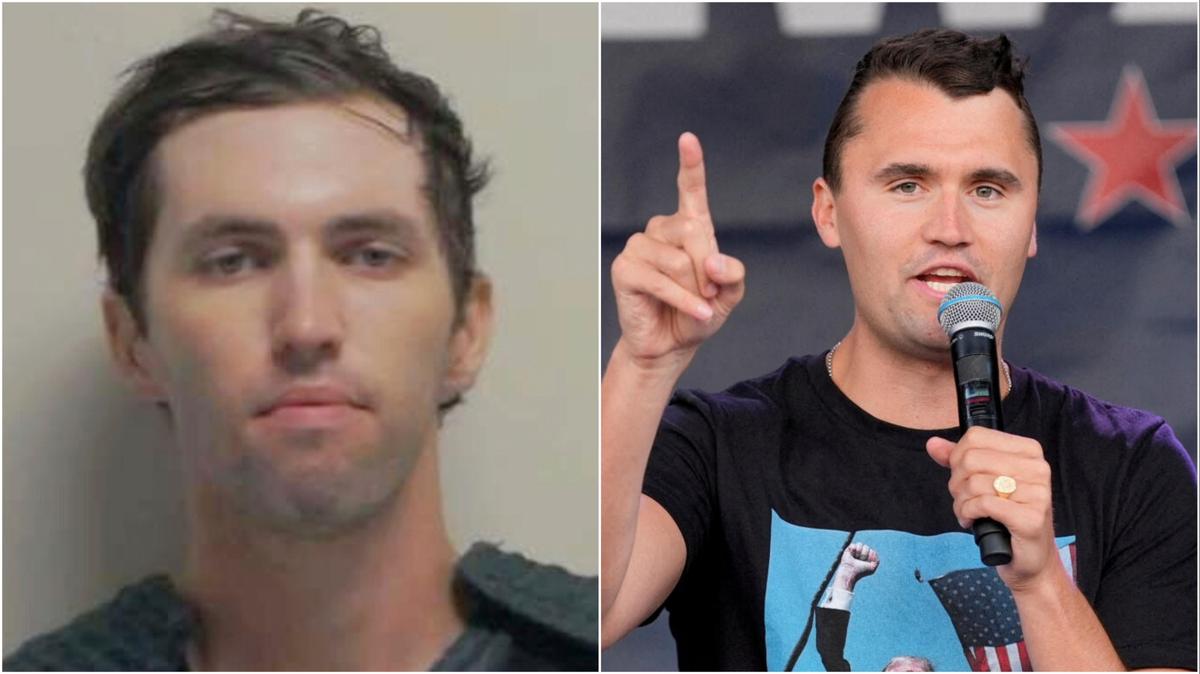
Court documents and witness accounts reported by CNN on Tuesday have revealed chilling details of how Tyler Robinson, the 22-year-old accused of killing American conservative commentator Charlie Kirk, confessed after his parents urged him to surrender.
According to court documents obtained by the network, Robinson was identified by his mother after the FBI released surveillance photos of the suspected shooter.
She told investigators the images looked like her son, and when she confronted him by phone, he insisted he was “home sick.”
But his parents’ suspicions deepened when they recognised a rifle in the investigation as similar to one gifted to him by his grandfather.
Court documents and witness accounts reported by CNN on Tuesday have revealed chilling details of how Tyler Robinson, the 22-year-old accused of killing American conservative commentator Charlie Kirk, confessed after his parents urged him to surrender.
According to court documents obtained by the network, Robinson was identified by his mother after the FBI released surveillance photos of the suspected shooter.
She told investigators the images looked like her son, and when she confronted him by phone, he insisted he was “home sick.”
But his parents’ suspicions deepened when they recognised a rifle in the investigation as similar to one gifted to him by his grandfather.
The roommate had responded, “What? You’re joking, right?”

Gray explained that Kirk was answering a question about mass shootings involving transgender individuals when Robinson fired a shot that struck him in the neck.
The bullet narrowly missed several bystanders, including children close to the stage.
Kirk collapsed immediately and was later pronounced dead in the hospital.
Robinson’s mother told investigators that her son had become more political in recent years, leaning left and supporting gay and transgender rights.
She also disclosed that he was dating his roommate, “a biological male who was transitioning genders,” according to the filings.
Gray stated, “On the evening of September 11, 2025, as law enforcement continued their investigation, Tyler James Robinson went to the Washington County sheriff’s office with his parents and a family friend to turn himself in. Robinson’s mother stated the following to police: On September 11, 2025, the day after the shooting, Robinson’s mother saw the photo of the shooter in the news and thought the shooter looked like her son.
“Robinson’s mother called her son and asked him where he was. He said he was at home sick and that he had also been at home sick on September 10. Robinson’s mother expressed concern to her husband that the suspect shooter looked like Robinson. Robinson’s father agreed.”
Describing the killing as “an American tragedy,” Gray said Kirk was murdered while engaging in “the free exchange of ideas, the bedrock of our democratic republic.”
FBI Director Kash Patel told a Senate hearing that investigators are probing more than 20 people who were in an online chat with Robinson.
Robinson has been charged with aggravated murder, obstruction of justice, witness tampering, and discharging a firearm in the presence of children. He remains in custody without bail.
Two Nigerian nationals have been sentenced to seven years in prison for armed robbery in Kuwait.
The Kuwait General Department of Criminal Investigation in Ahmadi Governorate arrested the two individuals over alleged involvement in an armed robbery and theft of a currency exchange shop in Mahboula, in January 2025.
The Court of Appeal on Monday, July 20, 2026 upheld the imprisonment of the defendants for seven years and six months in connection with the robbery and theft.
The Second Circuit of the Court of Appeal, headed by Counselor Nasr Salem Al-Haid and comprising Counselors Mutaib Al-Aradhi and Saud Al-Sane, upheld the ruling against members of a Nigerian gang involved in the robbery and theft of the money exchange shop.
The Public Prosecution had charged the first four defendants with stealing money from the exchange shop, with the second defendant using a fake gun and enabling the third and fourth defendants to steal the money with the assistance of the first defendant.
The fifth defendant was charged with participating with the defendants, agreeing to commit the crime, helping them conceal the stolen goods, and supplying them with the money obtained from the robbery and theft.
The Criminal Court had sentenced the first and fifth defendants in person, while the remaining defendants were sentenced in absentia.
The court had initially sentenced the first four defendants to seven years’ imprisonment and the fifth defendant to six months’ imprisonment after amending the description and charges.
The Court of Appeal later upheld the ruling, according to a report published by Al Rai newspaper.
The Cross River State Police Command has arrested one Udeme Emmanuel Ekpeme, “m”aged 39, over allegations of impersonation, obtaining money by false pretence, and the unlawful use of medical equipment.
The suspect was arrested by Police officers attached to Uwanse Division ,Calabar South following a complaint lodged by Mrs. Edemawan Samuel, 45, who alleged that the suspect falsely presented himself as a medical doctor and fraudulently obtained the sum of Five Hundred Thousand Naira (N500,000) from her under the false promise of securing employment for her children at the University of Calabar Teaching Hospital (UCTH).
Preliminary investigations indicate that the suspect allegedly used the false representation to deceive the complainant into parting with the money. Relevant exhibits believed to be connected to the case were recovered during the investigation, and the suspect is currently in police custody.
Confirming his arrest to newsmen, the spokesperson of the command, ASP Eitokpah Akata, said state Commissioner of Police, has directed that a thorough investigation be carried out to establish the full circumstances surrounding the case and determine whether there are other victims. Akata added that upon the conclusion of investigations, the suspect will be charged to court if sufficient evidence is established.
He mentioned that the command is actively conducting a discreet investigation into the matter to uncover the full extent of the suspect’s activities and identify any other possible victims or accomplices. Members of the public are assured that further updates will be provided as investigations progress.
The Nigeria Security and Civil Defence Corps, NSCDC, Badagry Area Command, has uncovered an alleged fake university operating from a three-bedroom apartment in Ilado, Olorunda Local Council Development Area, of Lagos State, and rescued 106 youths allegedly lured into the scheme. AkwaIbom News
The Corps also arrested the alleged proprietor of the institution, which reportedly recruited young people from different parts of Nigeria and neighbouring West African countries with promises of admission into a foreign university.
The operation, carried out in the early hours of Monday after days of intelligence gathering and covert surveillance, exposed what security officials described as an alleged fraudulent academic and recruitment scheme.
The youths, mostly aged between 19 and 24, were taken into protective custody by the NSCDC for profiling and further investigation.
Confirming their arrest to newsmen, the Badagry Area Commander of the NSCDC, Chief Superintendent Gbenga Ekunola, said the operation followed credible intelligence received by the command on activities at the apartment.
“We got reliable intelligence about the activities going on there. Our officers monitored the place for days before moving in. We have arrested the proprietor, who is assisting with our investigation, while the students have been taken into our protective custody.”
Preliminary investigations indicated that unsuspecting young people were allegedly persuaded to pay admission and processing fees after being promised admission into a foreign tertiary institution.
The victims reportedly paid between N200,000 and N1.5 million, while some foreign nationals and other participants allegedly paid between $400 and $500.
However, the alleged admission scheme reportedly came with a recruitment condition, with participants encouraged to bring in more people in return for commissions.
The arrangement allegedly operated like a chain marketing or Ponzi scheme, with participants promised increasing financial rewards based on the number of new students they recruited.