Connect with us

Lifestyle

Directors Guild of Nigeria appoints Akwa Ibom gov patron

Published

on

Akwa Ibom State Governor, Pastor Umo Eno, has been formally confirmed as the Patron of the Directors Guild of Nigeria.

The DGN, founded in 1999, is the professional body representing directors in the Nigerian film and television industry.

Over the years, the Guild has played a pivotal role in shaping Nollywood, now regarded as the second-largest film industry in the world.

Its 25th anniversary celebration, held alongside the Akwa Ibom Entertainment Week, marked a major milestone in the Guild’s efforts to strengthen collaboration with government and stakeholders for the growth of the creative industry.

A statement issued by the Guild’s Public Relations Officer, Emmanuel Eyaba, on Friday, noted that the confirmation was made during a special dinner held in Uyo in honour of a DGN delegation in the state, as part of activities to mark the Guild’s 25th anniversary celebration and to participate in the ongoing Akwa Ibom Entertainment Week.

The statement noted that while speaking at the event, Eno urged members of the DGN to be intentional about mentorship for young talents in the creative industry, stressing that sustainability and growth in Nollywood can only be achieved through deliberate capacity building.

“Let the industry understand that your power is in your multiplication. The more we watch you perform, the more we see the people you have mentored, the happier we will be, and the more the industry will thrive,” the statement quoted Eno as saying.

It added that speaking further, Eno expressed concern that without strategic mentorship, Nollywood risks losing its audience to foreign competition. It noted that he specifically tasked the Akwa Ibom State Chairman of DGN, Mr Moses Eskor, to explore ways of bringing back indigenous stars to support and mentor upcoming professionals.

See also  THE EFFECT OF LAYING CURSES ON YOUR CHILDREN

Eno, who has remained consistent in promoting human capacity development, announced plans to expand the State Creative Academy into a Creative Village, designed to provide broader opportunities for training and innovation in the industry.

“If we really want to empower our young people, we should have a Creative Village where the Academy would be a component,” he added.

The Governor also commended the DGN for choosing Akwa Ibom as the host state for its landmark anniversary, assuring his administration’s readiness to partner with the Guild in training and empowering young people to thrive in the creative space.

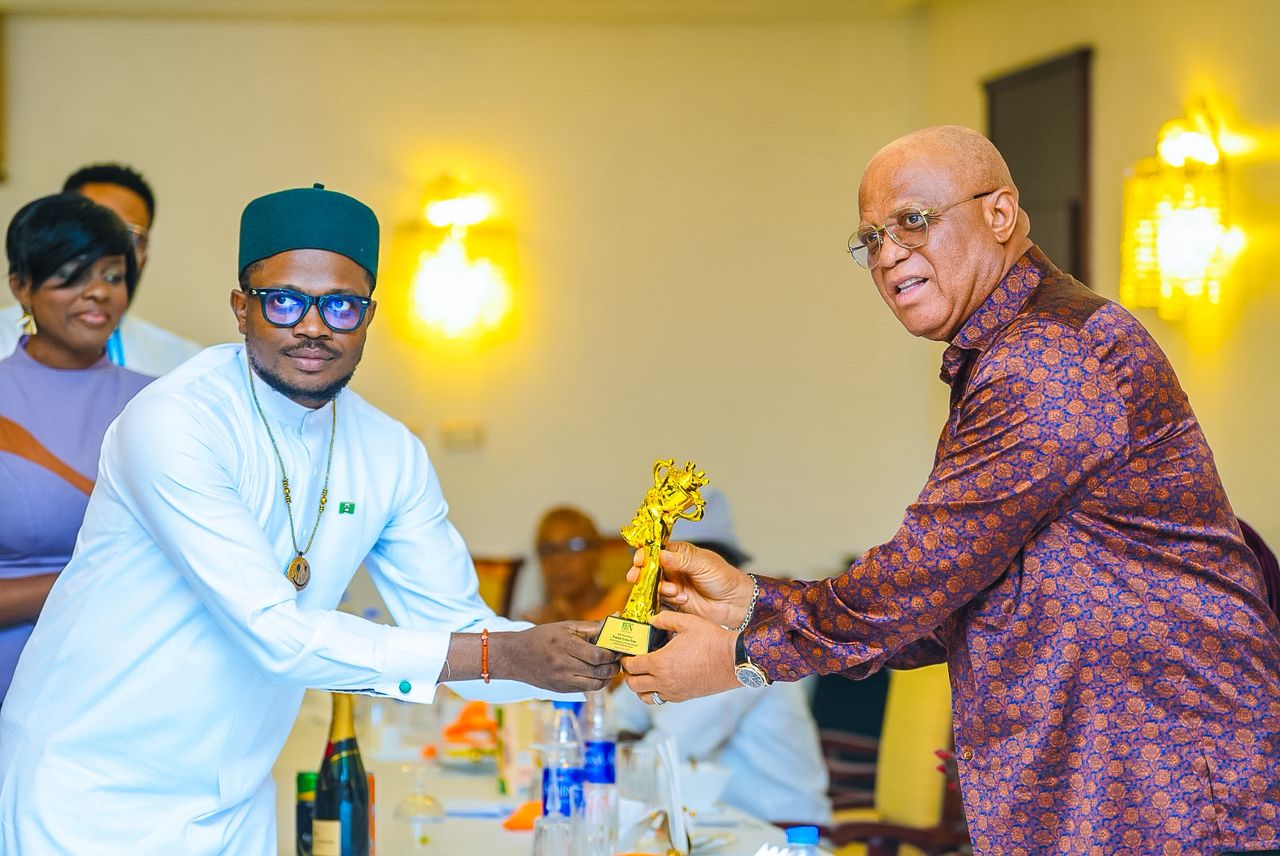
In recognition of his unwavering support for the arts, DGN President, Mr Uche Agbo, presented an award to the governor as Champion and Patron of the Guild. Agbo applauded Eno’s investment in the creative industry, noting his engagement of several Guild members as aides in entertainment and cultural development.

He further assured that DGN would deepen collaboration with the Akwa Ibom State Government to build capacity for young Nigerians interested in working behind the scenes in Nollywood.

The Commissioner for Culture and Tourism, Dr Anietie Udofia, in his remarks, appreciated the governor for hosting the Guild and highlighted the serene, safe, and culturally rich ambience of the State as the reason DGN chose Akwa Ibom for its anniversary celebration.

Also present at the event were Nollywood actress, Ms Ebenezer Eno, who thanked the Governor for his support to creatives, and the Senior Special Assistant to the Governor on Entertainment, Mr David Sergeant (Utang Akwa Ibom), who commended the governor for his consistent commitment to the growth of the industry.

See also  Things to know about Bernard Doro, Tinubu’s ministerial nominee from Plateau

By confirming Eno as its Patron, the Directors Guild not only recognises his contributions to the creative industry but also formalises a partnership that is expected to boost Nollywood’s sustainability through mentorship, capacity building, and cultural promotion.

FOLLOW US ON:

FACEBOOK

TWITTER

PINTEREST

TIKTOK

YOUTUBE

LINKEDIN

TUMBLR

INSTAGRAM

Continue Reading
Click to comment

Leave a Reply

Your email address will not be published. Required fields are marked *

Lifestyle

Women Who Love and Listen to Their Pastors More Than Their Husbands Should Be the Pastor’s Second Wife

Published

on

This statement may sound funny, provocative, or even offensive, but it raises an important question about priorities in marriage and religion.

A pastor is a spiritual leader, but he is not supposed to replace a woman’s husband. If a married woman consistently values her pastor’s opinions above her husband’s, obeys her pastor while dismissing her husband, or shows greater loyalty and admiration toward her pastor than toward her spouse, then something may be seriously wrong with the balance in that marriage.

Marriage requires communication, mutual respect, trust, and understanding. A pastor can provide spiritual guidance, but that guidance should not become a reason for a husband and wife to lose respect for each other.

At the same time, husbands should not expect their wives to obey them blindly. Both husband and wife should seek God’s wisdom, communicate openly, and make decisions with love and respect.

So perhaps the real question is not whether such a woman should become the pastor’s “second wife,” but why has the pastor become more important in her marriage than her own husband?

Put God first. Respect your spouse. And never allow a spiritual leader to become a substitute for your marriage partner.

FOLLOW US ON:

FACEBOOK

TWITTER

PINTEREST

TIKTOK

YOUTUBE

LINKEDIN

INSTAGRAM

See also  Every Nigerian believes their problem is Tinubu - BBNaija star, Tacha calls on Nigerians to also hold governors, lawmakers accountable
Continue Reading

Lifestyle

Why is it only in Africa that we hear so much about “generational curses”?

Published

on

This is a question worth asking—not to insult African traditions or dismiss anyone’s beliefs, but to encourage honest reflection.

Across Africa, it is common to hear people explain repeated family problems as a “generational curse.” When poverty, broken relationships, addiction, failure, sickness, family conflict or misfortune appears to repeat from one generation to another, some people immediately conclude that an ancestor, spiritual force or past wrongdoing is responsible.

But is every repeated family problem truly a curse?

If a child grows up in poverty, has limited access to quality education, receives little financial support and then struggles as an adult, is that necessarily a spiritual curse—or could it be the result of circumstances that have been passed from one generation to another?

If children grow up watching violence, substance abuse, unhealthy relationships or constant conflict, they may unknowingly repeat those patterns. That does not necessarily mean they are cursed. Sometimes behaviour is inherited through environment, not through supernatural forces.

And Africa is certainly not the only place where people believe in supernatural explanations for suffering or misfortune. Different societies around the world have their own concepts of inherited wrongdoing, family misfortune, ancestral consequences, fate and spiritual punishment.

So perhaps the more important question is not:

“Who cursed my family?”

But:

“What pattern has been passed down to me, and what can I do to stop passing it to the next generation?”

We should be careful not to use the idea of a curse to discourage people from taking action. A family facing poverty may need education, opportunity and financial planning. A family experiencing repeated conflict may need healthier communication. A person struggling with addiction may need professional support and a strong recovery environment. Communities facing injustice may need better institutions, accountability and opportunity.

See also  Sir Samuel Layinka Ayodeji Manuwa (1903–1976): Nigeria’s Pioneer of Modern Surgery and Medical Administration

Faith and spirituality are deeply meaningful to many people, and everyone has the right to hold their beliefs. But faith should not prevent us from examining the practical causes of our problems.

We cannot change the past, but we can change what we pass forward.

Instead of teaching our children that they are victims of an unavoidable family curse, let us also teach them knowledge, discipline, emotional strength, financial responsibility, education, healthy relationships and the courage to break destructive patterns.

Maybe the greatest “curse” is not something mysterious placed upon a family.

Maybe sometimes it is simply a problem that nobody stopped long enough to understand and change.

And the greatest inheritance we can give the next generation is not fear of a curse—but the knowledge and courage to build a better future.

FOLLOW US ON:

FACEBOOK

TWITTER

PINTEREST

TIKTOK

YOUTUBE

LINKEDIN

INSTAGRAM

Continue Reading

Lifestyle

You are very proud to speak big English, but yet you cannot speak your own language?

Published

on

There is nothing wrong with speaking English fluently. In fact, being able to communicate confidently in different languages is a valuable skill. But we should ask ourselves a deeper question: while learning to speak the language of another culture, are we slowly losing the language that connects us to our own roots?

Your mother tongue is more than just words. It carries the stories of your ancestors, the wisdom of your grandparents, the jokes that only your people understand, the traditional greetings, the names, the songs, the history and the identity of your community.

Imagine being able to speak perfect English, but struggling to have a simple conversation with your own grandmother because you do not understand the language she grew up speaking. Imagine your children knowing foreign languages but being unable to understand the language of their own heritage.

That should make us pause.

Speaking English does not make you more intelligent, and speaking your indigenous language does not make you less educated. One is a communication skill; the other can be a connection to your heritage. We should not have to choose between being educated and preserving our identity.

Learn English. Speak it confidently. Learn French, Dutch, Spanish or any other language that opens doors for you.

But don’t let the pursuit of foreign languages close the door to your own.

Teach your children your language. Speak it at home. Ask your parents and grandparents to teach you the words you never learned. If you have forgotten it, it is never too late to start again.

See also  Guinness World Record reacts to BBNaija Queen’s bread-inspired outfit at the 12th AMVCA

Because when a language disappears from a family, something precious disappears with it.

Be proud of your education. Be proud of your ability to speak English. But also be proud of where you come from.

Your language is not something to be ashamed of. It is a part of your story. Preserve it before the next generation only knows it as something their ancestors once spoke.

FOLLOW US ON:

FACEBOOK

TWITTER

PINTEREST

TIKTOK

YOUTUBE

LINKEDIN

INSTAGRAM
Continue Reading

Trending