Connect with us

Lifestyle

The Statue of Obatalá in Costa do Sauípe: A Living Symbol of Yoruba Heritage in Brazil

Published

on

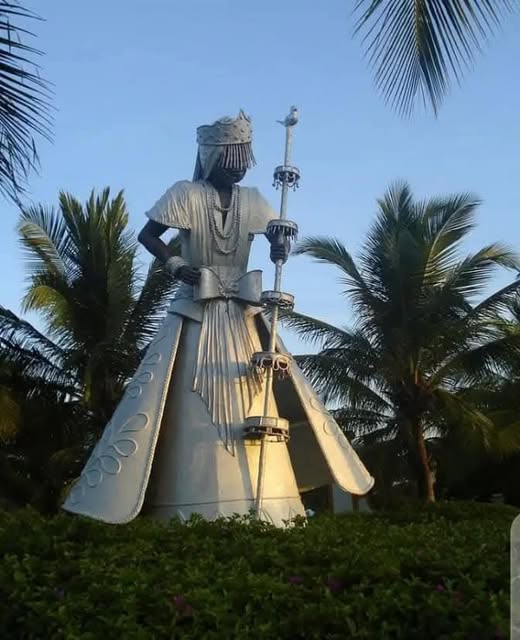
Along the breezy coast of Costa do Sauípe in Bahía, Brazil, a striking modern monument honors Obatalá—known in Brazil as Oxalá—the revered Yoruba deity of creation and purity. More than an eye-catching work of art, this statue stands as a contemporary tribute to centuries of cultural resilience, reflecting the enduring spiritual bridge between West Africa and the African diaspora in the Americas.

Obatalá: The Yoruba Deity of Creation and Purity

In the traditional Yoruba religion of southwestern Nigeria, Obatalá is regarded as the òrìṣà (divine spirit) of creation, wisdom, and spiritual balance.

Yoruba cosmology recounts that Olódùmarè, the Supreme Being, entrusted Obatalá with shaping the first humans from clay. Dressed in white—symbolizing clarity, peace, and justice—Obatalá embodies the ideals of compassion, fairness, and cosmic harmony.

When millions of Africans were forced across the Atlantic during the transatlantic slave trade, devotees of Obatalá carried his worship to the Americas. Despite the brutal realities of enslavement and colonial repression, Yoruba spirituality survived, adapting to new environments and sustaining a powerful cultural memory.

The Brazilian Transformation: Oxalá in Candomblé

In Brazil, Obatalá became widely known by the Portuguese name Oxalá and took a central place in Candomblé, the Afro-Brazilian religion born from the blending of Yoruba traditions and Catholic influences.

In many Candomblé communities, Oxalá is associated with Jesus Christ or the Senhor do Bonfim, illustrating the creative syncretism that allowed enslaved Africans to preserve their faith under colonial scrutiny.

Feast days in honor of Oxalá remain among the most moving religious events in Bahía. Processions of devotees dressed in white—Oxalá’s sacred color—fill the streets of Salvador and surrounding towns, offering a vivid celebration of African heritage.

See also  VIDEO: I’m Married But Not In My Husband’s House; I Didn’t Have The Experience Of Living Happily Ever After – Singer Shola Allyson Reveals

The Modern Monument at Costa do Sauípe

The statue of Oxalá at Costa do Sauípe is a modern homage, not a relic from the slavery era. Typically depicted in flowing white robes and holding the opaxorô (a staff symbolizing authority and spiritual guidance), the sculpture radiates serenity and the creative force of life itself.

White doves—traditional symbols of peace—often surround artistic representations of Oxalá, reinforcing his association with wisdom and tranquility.

Located in a region that is the spiritual heart of Afro-Brazilian culture, the monument functions both as a cultural landmark and a devotional site. For worshippers, scholars, and travelers, it is a visible reminder of the living links between Yoruba spirituality and Brazilian identity.

Legacy and Cultural Significance

The Costa do Sauípe statue speaks to more than religious devotion: it is a symbol of resilience, celebrating how African descendants in Brazil safeguarded their ancestral beliefs despite centuries of oppression.

By honoring Oxalá, Bahía pays tribute to both the Yoruba homeland and the Afro-Brazilian communities that continue to keep this ancient faith alive.

Today, the monument draws pilgrims and researchers alike, offering a powerful encounter with the transatlantic heritage that continues to shape Brazilian culture.

It stands as a spiritual bridge across the Atlantic, linking Nigeria’s sacred traditions with the vibrant Afro-Brazilian practices of the present.

Sources

Verger, Pierre Fatumbi. Orixás: Deuses Iorubás na África e no Novo Mundo. Corrupio, 1981.

Matory, J. Lorand. Black Atlantic Religion: Tradition, Transnationalism, and Matriarchy in the Afro-Brazilian Candomblé. Princeton University Press, 2005.

FOLLOW US ON:

FACEBOOK

TWITTER

PINTEREST

TIKTOK

YOUTUBE

LINKEDIN

TUMBLR

INSTAGRAM

Continue Reading
Click to comment

Leave a Reply

Your email address will not be published. Required fields are marked *

Lifestyle

Declare Your Lineage – Royal Family Tells Musician KWAM 1 Over His Interest In Becoming Next Awujale Of Ijebuland

Published

on

KWAM 1, in a letter dated December 3, 2025, addressed to the chairman of the Fusengbuwa Ruling House in Agunsebi Quarters, Ijebu-Ode, announced his interest in the stool, describing himself as a “bonafide son” of the ruling house.

The Fusengbuwa ruling house of Ijebu-Ode, next in line to produce the new Awujale of Ijebuland, Ogun State, has instructed Fuji musician Wasiu Ayinde, popularly known as KWAM 1, to confirm his family’s royal lineage to validate his membership in the ruling house.

KWAM 1, in a letter dated December 3, 2025, addressed to the chairman of the Fusengbuwa Ruling House in Agunsebi Quarters, Ijebu-Ode, announced his interest in the stool, describing himself as a “bonafide son” of the ruling house.

KWAM 1 also stated that his candidacy aligns with Ijebu customary law and the Ogun State Chieftaincy Laws.

In an interview with Punch, the Chairman of the ruling house and former National President of the Institute of Chartered Accountants of Nigeria, Abdulateef Owoyemi, said only bonafide members of the family would be allowed to participate in the selection process.

Owoyemi explained that KWAM 1, Olori Omooba of Ijebu land and others interested in the stool have been directed to complete the Fusengbuwa ruling house royal lineage data form.

According to him, the form, which requires contenders to trace their genealogy back seven generations, ensures that only genuine princes from the family can participate, thereby blocking “strangers” from claiming the throne.

He said, “The first step for anyone interested in contesting for the Awujale throne is to declare their lineage by filling the standard Fusengbuwa ruling house royal lineage data form. Once confirmed as a legitimate member of the ruling house, they can then apply for the expression of interest form.

See also  Video - Sunday Igboho Visits Yoruba Traditional Rulers

“We have told him, just like everyone else interested in the Awujale throne, that the first step is to declare his lineage. He will do this by completing the royal lineage data form, showing his full name, which parent and grandparent he descends from, and continuing up to seven generations.

“The completed form will be signed and submitted to the head of the ruling house unit of the Fusengbuwa ruling house, who will affirm that he is a genuine member. Only then will the process move forward.”

Owoyemi emphasised that although the application window for the throne officially closed on December 5, KWAM 1 had been given a five-day extension, which would lapse on December 10.

He noted, “We won’t shut anybody out of picking the next Awujale, but we must ensure that you are a legitimate member of Fusengbuwa. Every right comes with responsibilities. For a royal family, everyone must prove their legitimacy by completing the royal lineage data form.

“When we receive the form, we will review it meticulously. If clarification is needed, we will contact the applicant. We welcome men of influence who will use their influence to enhance the throne, not to claim it, ensuring that what truly belongs to our family is preserved.”

Owoyemi explained that the local government has given them 14 days to select candidates, and the ruling house hopes to have a new Awujale by the second or third week of January 2026.

He added, “The local government has given us 14 days to select candidates, which expires on December 18. After that, the kingmakers have seven days to deliberate and choose one candidate, whose name will be forwarded to the governor.

See also  PHOTOS: Haunting photographs of Patrice Lumumba, Congo’s first Prime Minister, alongside his closest allies, Maurice Mpolo and Joseph Okito

“Legally, the government then has 21 days to conduct background checks and security clearance, allowing for objections or protests. After this period, the State Executive Council will ratify the nominee, and the governor will announce the next Awujale, after which coronation rites will commence.

“So, combining the candidate selection, kingmakers’ deliberation, and legal objection period, we are looking at around 42 days. Therefore, we expect the next Awujale to emerge between the second and third week of January.”

FOLLOW US ON:

FACEBOOK

TWITTER

PINTEREST

TIKTOK

YOUTUBE

LINKEDIN

TUMBLR

INSTAGRAM

Continue Reading

Lifestyle

VIDEO: I’m Married But Not In My Husband’s House; I Didn’t Have The Experience Of Living Happily Ever After – Singer Shola Allyson Reveals

Published

on

While speaking about her love life, the 54-year-old who came into limelight with a love album ‘Eji Owuro’, revealed that she is married but not living with her husband.

Sola Allyson, the popular Nigerian gospel singer, has revealed that she is not currently living with her husband.

The musician made this known in her latest interview on Oyinmomo TV.

While speaking about her love life, the 54-year-old who came into limelight with a love album ‘Eji Owuro’, revealed that she is married but not living with her husband.

Sharing her marital experience, the singer said she has never enjoyed the kind of happiness many people describe.

“I’m married, but I’m not in my husband’s house. We live separately. He in his house and I in mine.”

The interviewer asked: “You sang ‘Eji Owuro’, did you experience genuine love from your husband?

She replied, “We lied before. Those older than us didn’t inform us that it’s tough. They made us believe that so long as you both love each other, you will live happily ever after, but it’s a lie.

“That’s not the experience I have. I didn’t have the experience of living happily ever after. I did all I could to make it work.

“Marriage has been a big challenge. I hear people talk about joy in marriage, but I have never experienced it.”

CLICK TO WATCH THE VIDEO

FOLLOW US ON:

FACEBOOK

TWITTER

PINTEREST

TIKTOK

YOUTUBE

LINKEDIN

TUMBLR

INSTAGRAM

See also  VIDEO: I’m Married But Not In My Husband’s House; I Didn’t Have The Experience Of Living Happily Ever After – Singer Shola Allyson Reveals
Continue Reading

Lifestyle

VIDEO: Shola Allyson Finally Opens Up, Reveals Why She Does Not Reference Jesus In Her Songs

Published

on

Recall that Allyson, who is regarded as a gospel singer, was dragged on social media in March 2025 for not directly referencing ‘Jesus’ in all her songs.

Shola Allyson, the renowned Nigerian songstress, has opened up on the real reason she avoids mentioning the name of Jesus in all her songs.

Recall that Allyson, who is regarded as a gospel singer, was dragged on social media in March 2025 for not directly referencing ‘Jesus’ in all her songs.

Reacting to her critics in a post on X, the songstress stated that “No one can bully me into joining their darkness that looks like light because indolent souls find comfort in it”.

Finally revealing her reason for not mentioning Jesus in her songs, Shola Allyson on Saturday during her latest interview on Oyinmomo TV, stated that Jesus did not ask her to do PR for him.

She said “I’m not a religious singer. As I am, I have never introduced myself as a gospel singer. My name is Shola Allyson. I’m a singer”.

Interviewer; “Some people said you don’t mention ‘Jesus’ name’ in all your songs”.

She quickly responded “Jesus did not instruct us to mention his name in songs nor did Jesus ask us to do PR for Him”.

CLICK TO WATCH THE VIDEO

FOLLOW US ON:

FACEBOOK

TWITTER

PINTEREST

TIKTOK

YOUTUBE

LINKEDIN

TUMBLR

INSTAGRAM

See also  VIDEO: I’m Married But Not In My Husband’s House; I Didn’t Have The Experience Of Living Happily Ever After – Singer Shola Allyson Reveals
Continue Reading

Trending