Connect with us

Lifestyle

History of the Lagos National Stadium, Surulere

Published

on

The Lagos National Stadium, located in Surulere, Lagos State, Nigeria, is one of the country’s most iconic sports monuments. Constructed in 1972, the stadium was envisioned as a symbol of national pride and unity during the post-independence era when Nigeria was eager to establish its identity through sports and infrastructure development.

Construction and Early Years

The stadium’s construction began in the early 1970s under the administration of then Head of State, General Yakubu Gowon, as part of Nigeria’s preparation to host international sporting events. Designed as a multi-purpose sports complex, the Lagos National Stadium included facilities for football, track and field, boxing, basketball, and tennis.

Upon its completion in 1972, it was the most modern sporting facility in West Africa, showcasing Nigeria’s growing influence on the continent. The official opening marked the beginning of a golden era in Nigerian sports, making the stadium the heartbeat of the country’s athletic and football activities.

Major Sporting Events

One of the stadium’s most memorable moments came in 1980, when Nigeria hosted and won its first African Cup of Nations (AFCON), defeating Algeria 3–0 in the final. The victory remains one of the proudest moments in Nigerian sports history, with the stadium filled to capacity and celebrations spreading across the nation.

Over the years, the stadium also hosted several World Cup qualifying matches, All-Africa Games, and national festivals. It became a training and performance ground for many of Nigeria’s legendary athletes, including track stars and football icons.

Decline and Abandonment

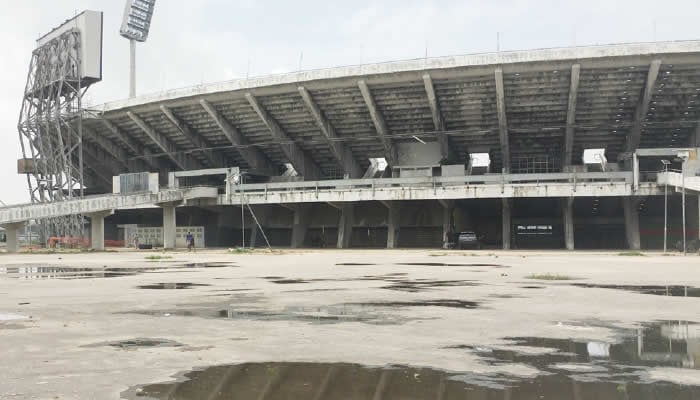
By the early 2000s, the Lagos National Stadium began to suffer from neglect and poor maintenance. The rise of newer facilities, particularly the Abuja National Stadium (now Moshood Abiola Stadium), led to the gradual decline of the Surulere complex.

See also  Ned Nwoko opens up on Regina Daniels’ alleged drug addiction struggles, says ‘I’ve accepted nonsense’

In 2004, the stadium was officially abandoned, and its once vibrant stands became overtaken by rust, vegetation, and disuse. Despite its decay, the stadium continued to hold emotional significance for Nigerians who remembered it as a place of triumph and unity.

Renovation Efforts

In 2020, the Federal Government of Nigeria, in collaboration with private partners like billionaire businessman Aliko Dangote, announced plans to renovate and restore the Lagos National Stadium to its former glory. The renovation aimed to modernize the facilities to meet international standards and revive its use for major sporting and entertainment events.

The stadium’s original seating capacity of 55,000 was reduced to 45,000 in 1999 to comply with FIFA safety regulations, ensuring better visibility and security for spectators.

Legacy and Cultural Importance

Beyond sports, the Lagos National Stadium has hosted countless cultural and political events, including concerts, national celebrations, and rallies. It stands as a symbol of Nigeria’s sporting heritage, a reminder of past glory, and a beacon of hope for the nation’s youth and future athletes.

Even in its years of neglect, the stadium remains deeply embedded in Nigeria’s cultural memory—representing resilience, pride, and the unifying power of sports.

Quick Facts

Location: Surulere, Lagos State, Nigeria

Year Built: 1972

Opened: 1972

Capacity: Initially 55,000; later adjusted to 45,000

Major Event: 1980 African Cup of Nations (Nigeria’s first AFCON victory)

Current Status: Undergoing renovation

Sources

1. Federal Ministry of Youth and Sports Development – National Stadium Rehabilitation Reports (2020–2024)

2. The Guardian Nigeria – “Dangote to Renovate National Stadium, Surulere” (2020)

See also  Tears, drama, strategies, What you missed on first week of BBNaija S10

FOLLOW US ON:

FACEBOOK

TWITTER

PINTEREST

TIKTOK

YOUTUBE

LINKEDIN

TUMBLR

INSTAGRAM

Continue Reading
Click to comment

Leave a Reply

Your email address will not be published. Required fields are marked *

Lifestyle

Declare Your Lineage – Royal Family Tells Musician KWAM 1 Over His Interest In Becoming Next Awujale Of Ijebuland

Published

on

KWAM 1, in a letter dated December 3, 2025, addressed to the chairman of the Fusengbuwa Ruling House in Agunsebi Quarters, Ijebu-Ode, announced his interest in the stool, describing himself as a “bonafide son” of the ruling house.

The Fusengbuwa ruling house of Ijebu-Ode, next in line to produce the new Awujale of Ijebuland, Ogun State, has instructed Fuji musician Wasiu Ayinde, popularly known as KWAM 1, to confirm his family’s royal lineage to validate his membership in the ruling house.

KWAM 1, in a letter dated December 3, 2025, addressed to the chairman of the Fusengbuwa Ruling House in Agunsebi Quarters, Ijebu-Ode, announced his interest in the stool, describing himself as a “bonafide son” of the ruling house.

KWAM 1 also stated that his candidacy aligns with Ijebu customary law and the Ogun State Chieftaincy Laws.

In an interview with Punch, the Chairman of the ruling house and former National President of the Institute of Chartered Accountants of Nigeria, Abdulateef Owoyemi, said only bonafide members of the family would be allowed to participate in the selection process.

Owoyemi explained that KWAM 1, Olori Omooba of Ijebu land and others interested in the stool have been directed to complete the Fusengbuwa ruling house royal lineage data form.

According to him, the form, which requires contenders to trace their genealogy back seven generations, ensures that only genuine princes from the family can participate, thereby blocking “strangers” from claiming the throne.

He said, “The first step for anyone interested in contesting for the Awujale throne is to declare their lineage by filling the standard Fusengbuwa ruling house royal lineage data form. Once confirmed as a legitimate member of the ruling house, they can then apply for the expression of interest form.

See also  Ladoja’s 32-year journey to Olubadan throne

“We have told him, just like everyone else interested in the Awujale throne, that the first step is to declare his lineage. He will do this by completing the royal lineage data form, showing his full name, which parent and grandparent he descends from, and continuing up to seven generations.

“The completed form will be signed and submitted to the head of the ruling house unit of the Fusengbuwa ruling house, who will affirm that he is a genuine member. Only then will the process move forward.”

Owoyemi emphasised that although the application window for the throne officially closed on December 5, KWAM 1 had been given a five-day extension, which would lapse on December 10.

He noted, “We won’t shut anybody out of picking the next Awujale, but we must ensure that you are a legitimate member of Fusengbuwa. Every right comes with responsibilities. For a royal family, everyone must prove their legitimacy by completing the royal lineage data form.

“When we receive the form, we will review it meticulously. If clarification is needed, we will contact the applicant. We welcome men of influence who will use their influence to enhance the throne, not to claim it, ensuring that what truly belongs to our family is preserved.”

Owoyemi explained that the local government has given them 14 days to select candidates, and the ruling house hopes to have a new Awujale by the second or third week of January 2026.

He added, “The local government has given us 14 days to select candidates, which expires on December 18. After that, the kingmakers have seven days to deliberate and choose one candidate, whose name will be forwarded to the governor.

See also  My account of Mohbad’s story, Naira Marley speaks out on Mohbad's Death

“Legally, the government then has 21 days to conduct background checks and security clearance, allowing for objections or protests. After this period, the State Executive Council will ratify the nominee, and the governor will announce the next Awujale, after which coronation rites will commence.

“So, combining the candidate selection, kingmakers’ deliberation, and legal objection period, we are looking at around 42 days. Therefore, we expect the next Awujale to emerge between the second and third week of January.”

FOLLOW US ON:

FACEBOOK

TWITTER

PINTEREST

TIKTOK

YOUTUBE

LINKEDIN

TUMBLR

INSTAGRAM

Continue Reading

Lifestyle

VIDEO: I’m Married But Not In My Husband’s House; I Didn’t Have The Experience Of Living Happily Ever After – Singer Shola Allyson Reveals

Published

on

While speaking about her love life, the 54-year-old who came into limelight with a love album ‘Eji Owuro’, revealed that she is married but not living with her husband.

Sola Allyson, the popular Nigerian gospel singer, has revealed that she is not currently living with her husband.

The musician made this known in her latest interview on Oyinmomo TV.

While speaking about her love life, the 54-year-old who came into limelight with a love album ‘Eji Owuro’, revealed that she is married but not living with her husband.

Sharing her marital experience, the singer said she has never enjoyed the kind of happiness many people describe.

“I’m married, but I’m not in my husband’s house. We live separately. He in his house and I in mine.”

The interviewer asked: “You sang ‘Eji Owuro’, did you experience genuine love from your husband?

She replied, “We lied before. Those older than us didn’t inform us that it’s tough. They made us believe that so long as you both love each other, you will live happily ever after, but it’s a lie.

“That’s not the experience I have. I didn’t have the experience of living happily ever after. I did all I could to make it work.

“Marriage has been a big challenge. I hear people talk about joy in marriage, but I have never experienced it.”

CLICK TO WATCH THE VIDEO

FOLLOW US ON:

FACEBOOK

TWITTER

PINTEREST

TIKTOK

YOUTUBE

LINKEDIN

TUMBLR

INSTAGRAM

See also  Ned Nwoko opens up on Regina Daniels’ alleged drug addiction struggles, says ‘I’ve accepted nonsense’
Continue Reading

Lifestyle

VIDEO: Shola Allyson Finally Opens Up, Reveals Why She Does Not Reference Jesus In Her Songs

Published

on

Recall that Allyson, who is regarded as a gospel singer, was dragged on social media in March 2025 for not directly referencing ‘Jesus’ in all her songs.

Shola Allyson, the renowned Nigerian songstress, has opened up on the real reason she avoids mentioning the name of Jesus in all her songs.

Recall that Allyson, who is regarded as a gospel singer, was dragged on social media in March 2025 for not directly referencing ‘Jesus’ in all her songs.

Reacting to her critics in a post on X, the songstress stated that “No one can bully me into joining their darkness that looks like light because indolent souls find comfort in it”.

Finally revealing her reason for not mentioning Jesus in her songs, Shola Allyson on Saturday during her latest interview on Oyinmomo TV, stated that Jesus did not ask her to do PR for him.

She said “I’m not a religious singer. As I am, I have never introduced myself as a gospel singer. My name is Shola Allyson. I’m a singer”.

Interviewer; “Some people said you don’t mention ‘Jesus’ name’ in all your songs”.

She quickly responded “Jesus did not instruct us to mention his name in songs nor did Jesus ask us to do PR for Him”.

CLICK TO WATCH THE VIDEO

FOLLOW US ON:

FACEBOOK

TWITTER

PINTEREST

TIKTOK

YOUTUBE

LINKEDIN

TUMBLR

INSTAGRAM

See also  Ladoja’s 32-year journey to Olubadan throne
Continue Reading

Trending