Pounded yam holds a sacred place in the heart of Ekiti State, Nigeria. More than a meal, it is a cultural emblem — a symbol of unity, hospitality, and pride deeply rooted in the traditions of the Ekiti people. Known for their strong attachment to yam as both a crop and a cultural symbol, the Ekiti have preserved the art of preparing pounded yam for centuries, passing it down as a cherished legacy from one generation to the next.
Origins and Historical Background
The history of pounded yam in Ekiti is intertwined with the region’s long-standing relationship with yam cultivation, which dates back to precolonial times. Ekiti State, located in the southwestern part of Nigeria, is part of the Yoruba cultural region, where yam has always been regarded as the “king of crops.”
In ancient Ekiti communities, the wealth and social status of an individual were often determined by the size of their yam barn. Yams were not only food but a measure of prosperity and hard work. Festivals such as the New Yam Festival (Odun Ijesu) celebrated the harvest and honored the earth for fertility. From these traditions emerged pounded yam — a dish that became both a daily meal and a ceremonial delicacy.
Cultural Significance
1. A Staple Food and Identity Marker
In Ekiti, pounded yam is not just the most popular food; it is an identity marker. Locals often say, “No Ekiti man without pounded yam.” The dish embodies the essence of the people — resilient, grounded, and proud of their roots.
Historically, the size of a man’s yam barn reflected his social status. During harvest, wealthy farmers displayed their yams publicly, and pounded yam made from these harvests became a source of prestige. Hosting visitors or dignitaries without serving pounded yam was considered disrespectful.
3. A Dish for Celebration
From weddings to naming ceremonies and festivals, pounded yam occupies the center of every Ekiti celebration. It is traditionally served with soups such as egusi, efo riro, or gbegiri, depending on the occasion.
4. A Family and Communal Bond
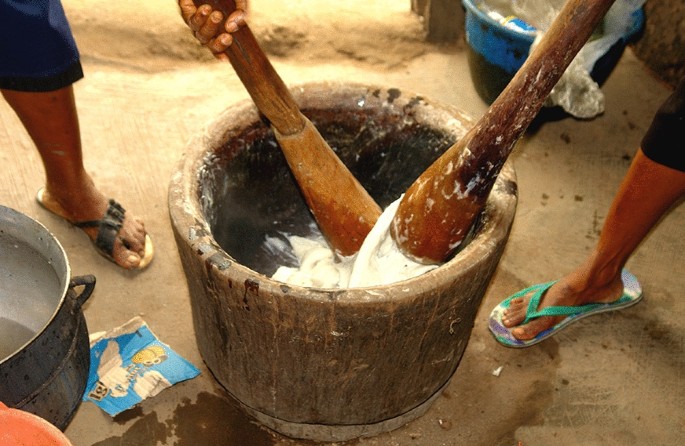
The preparation of pounded yam traditionally involved more than one person — usually women or young men — taking turns with the pestle while others turned the yam in the mortar. This teamwork made it an act of bonding, laughter, and rhythm — a moment that reinforced family and community ties.
Traditional Preparation
The traditional method of making pounded yam involves boiling peeled yam tubers until soft and then pounding them in a wooden mortar with a pestle until they form a smooth, stretchy dough. In Ekiti, the pestle is usually long, allowing two or more people to pound simultaneously while standing, creating a synchronized rhythm that is both musical and communal.
A unique Ekiti tradition is the belief that “yesterday’s pounded yam” — that is, pounded yam left overnight — tastes better when reheated the next day. This practice has persisted for generations, though its exact origin remains unknown.
Modern Evolution
With modernization, new technologies have emerged to make the process easier. Today, many households use yam pounders, mixers, or blenders to achieve the same smooth texture. Despite this convenience, traditionalists argue that no machine can truly replicate the taste and texture of hand-pounded yam made in a wooden mortar.
Ekiti State has also recognized the dish’s tourism and economic potential. In recent years, the Ekiti State Council for Arts and Culture announced plans to market pounded yam internationally as part of the state’s cultural export, promoting it as a unique identity of the Ekiti people.
Pounded Yam in Modern Ekiti Life
In Ekiti homes today, pounded yam remains a symbol of family warmth and cultural continuity. It bridges the past and present — served at weddings, royal events, and even in restaurants across Nigeria and the diaspora. To eat pounded yam in Ekiti is to taste history, community, and pride.
The story of pounded yam in Ekiti State is the story of a people who found culture in cuisine. It transcends being a meal to become a medium of identity, honor, and heritage. Whether made with mortar and pestle or electric pounder, pounded yam continues to remind every Ekiti son and daughter of where they come from — a land rich in yam, unity, and cultural dignity.
Some people are no longer simply living their lives—they are performing them for an audience.
On social media, it can sometimes appear as though everyone is rich, successful, connected and living their dream life. Luxury cars, expensive holidays, designer clothes, private jets and stacks of cash dominate countless posts.
But behind some of those carefully edited pictures can be a very different reality.
When Image Becomes More Important Than Reality
There is nothing wrong with wanting success or celebrating genuine achievements. The problem begins when people deliberately create an image that does not reflect their real circumstances.
Some people may pretend to be wealthy while struggling financially. Others may exaggerate their careers, relationships, business connections or achievements simply because they want admiration from others.
Social media makes this easier than ever.
A carefully chosen photograph, an expensive-looking location or a borrowed luxury item can create an impression of success within seconds. What viewers may not see is what happened before or after the photograph was taken.
Why Do People Pretend?
The reasons can vary.
For some, it may be pressure to fit into a particular social circle. For others, it may be a desire for recognition, admiration or validation.
There is also the fear of appearing unsuccessful in front of friends, family members or followers.
When people constantly compare themselves with carefully presented versions of other people’s lives, it can create unrealistic expectations about what success is supposed to look like.
The Cost of Maintaining a False Image
Living behind a false image can come with consequences.
A person who constantly tells people they are financially successful may eventually feel pressure to maintain that appearance. Someone who exaggerates their achievements may constantly worry about being exposed.
The pursuit of appearances can also distract people from building the real things that matter: financial stability, meaningful relationships, personal development, skills and genuine accomplishments.
Looking successful and actually building a successful life are not always the same thing.
Social Media Is Not Always Reality
It is important to remember that social media usually shows selected moments rather than someone’s complete life.
A photograph can capture a beautiful holiday without showing the financial sacrifices behind it. A smiling picture can hide personal difficulties. A luxury setting may belong to someone else or simply be a temporary experience.
That does not mean every impressive social-media post is fake. Many people genuinely work hard and achieve remarkable things.
The lesson is simply this: don’t automatically mistake presentation for reality.
Build a Life You Don’t Have to Pretend About
Real success does not require constant explanation.
You don’t have to convince everyone that you are rich. You don’t have to pretend to know important people. You don’t have to manufacture achievements just to receive applause.
Build something real.
Let your progress speak for itself.
Because eventually, an online image may disappear from people’s feeds—but reality remains.
What Do You Think?
Why do you think some people feel pressured to present a lifestyle that is very different from their actual circumstances?
Is social media encouraging people to live for appearances rather than reality?
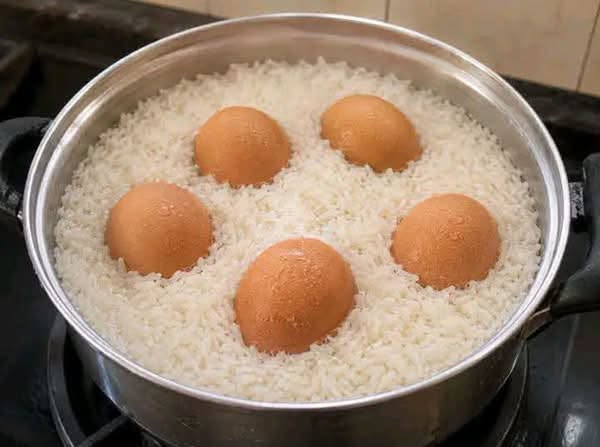
To reduce the risk of cross-contamination and foodborne infections, registered dietician-nutritionists have urged Nigerians to desist from boiling unpeeled and unwashed eggs and rice together in the same pot.
The food experts explained that bacteria, such as Salmonella and E. coli, may be present on eggshells and could contaminate the rice as the egg and rice cook together.
They noted that although boiling can destroy bacteria, because the water goes from a warm stage before reaching boiling point, it provides an opportunity for bacteria to survive and be transferred to the rice.
In exclusive interviews with PUNCH Healthwise, the nutritionists noted that eggshells can crack during cooking, allowing parts of the egg to spill into the rice and alter its appearance, taste and odour.
While the nutritionists acknowledged that some people combine the foods to save cooking time and reduce gas consumption, they maintained that food safety should take priority because a foodborne infection could result in medical expenses, lost work time and reduced productivity.
The experts’ warning comes on the heels of a recent viral tweet on X, where netizens shared their experiences of food contamination after consuming a meal in which rice and egg were boiled together in the same pot.
Further online findings reveal that many Nigerians engage in these practices to save time, water, cooking utensils, and fuel.
Providing expert insight into the matter, an experienced nutrition and public health practitioner, Registered Dietitian-Nutritionist, James Oloyede, said boiling eggs together with rice could expose the rice to Salmonella bacteria that may be present on the eggshell, even after washing.
He explained that although Salmonella could be destroyed at boiling temperature, it could survive for some time while the water was still warm before reaching boiling point.
Oloyede, who is the former Director of Nutrition Services and Health Education at the Osun State Primary Health Care Development Board, said, “Cooking egg and rice together in the same pot has been found to be a risk factor in cross-contamination of certain bacteria, especially Salmonella, that can be found on the shell of the egg even after washing with the rice that is being cooked.”
Oloyede said the risk was heightened because rice begins absorbing water as soon as it is placed in the pot, meaning bacteria present in contaminated water could be absorbed along with it.
“The challenge with rice is that absorption begins to take place the moment you put your rice in the water. When the water begins to warm up, we see the rice grain begin to swell. What makes it swell is the absorption of the water. And if the egg contains Salmonella bacteria, the tendency is that when the rice is absorbing water, then the bacteria can also be absorbed together with the water and can remain throughout the process of the boiling,” he said.
The nutritionist further advised Nigerians to cook eggs and rice separately as the safest way of avoiding cross-contamination.
“So it is important that, in a way to ensure food safety, we do not boil eggs together with rice in the same pot,” he said.
The registered dietician-nutritionist also noted that eggs could crack during cooking, allowing parts of the egg to spill into the rice.
“Apart from that, in most cases, even when you boil an egg in water, you see that at times the shell can crack. You see some of the white parts of the egg coming out from the shell. And if that happens with rice that has been boiled together, definitely some of those white particles will spread on the rice that has been boiled,” he said.
Oloyede said the spilt egg could also alter the taste, appearance and odour of the rice.
He said some people combined the two foods to reduce cooking time or save gas, particularly because of the high cost of cooking gas.
“You know, by boiling the two together, now that the price of gas is very high, we start tying the egg in nylon. If you tie the egg in nylon and put it in the rice that wants to boil, that will ensure that leakage is prevented, either from the eggshell or even when the egg cracks; those things will not spill on the rice,” Oloyede said.
He, however, maintained that cooking the two foods separately remained the safest option.
“But of course, the safest way of cooking egg and rice is to boil them separately. That’s the safest way,” Oloyede said.
He stressed that food safety should take priority over the time or gas saved by cooking the foods together.
He added that Salmonella infection could result in medical expenses, lost work time and reduced productivity, potentially affecting the income of daily paid workers and increasing household expenses.
“And whatever we do, we must think of food safety first, because if there’s a cross-contamination, the cost of treating a food infection from Salmonella, then the time you waste in going to the hospital, then the time you will take off work and productivity, outweigh the cost of gas or the time you are trying to save by cooking both together,” Oloyede said.
Also, a registered dietician-nutritionist, Charles Oguikpe, warned against cooking eggs in the same pot with rice, saying contaminants on eggshells could be transferred to the rice.
“So the reason why we consider boiling eggs in the same pot while cooking rice on a sieve is that some contaminants in eggshells can cause harm to the human body because these contaminants will be dropped off on the rice. Contaminants like Salmonella or E.coli can drop off on the rice. That’s what we call cross-contamination,” Oguikpe said.
He said such cross-contamination could cause stomach cramps, diarrhoea and fever, while severe cases could result in kidney complications.
“So it is something that we really need to avoid. Boiling your eggs at the same time with rice,” Oguikpe warned.
The nutritionist explained that the contaminants could originate from poultry droppings from the chickens that lay the eggs, adding that washing the eggshells might not eliminate the risk.
“These contaminants are from poultry droppings from the chickens that lay these eggs. No matter how you wash it, you might not be very sure 100 per cent that it has gone off,” he said.
He therefore advised people to cook eggs and rice separately.
“So it is advisable that you boil your eggs separately and cook your rice separately. And when the egg has been boiled, the shells are removed. It becomes edible for us to eat,” Oguikpe said.
JUSTICE OKAMGBA follows 10-year-old Ojo Ibukun and explores how poverty, migration, and informal apprenticeship can take children from neigbouring Republic of Benin to Lagos construction sites, where work replaces school and protection becomes harder to enforce
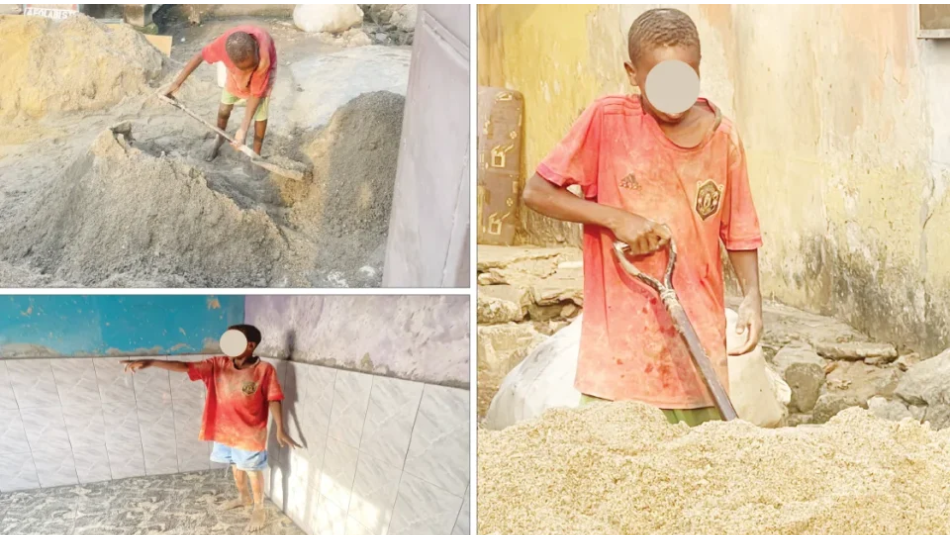
In Nigeria, one of Africa’s biggest economies, childhood can begin with a workday. While many children his age are getting ready for school, 10-year-old Ibukun Oluwa is already at an unfinished building in Ilasamaja, a low-income neighbourhood in Lagos, pushing a shovel through a mixture of sand and cement. The shovel is almost as tall as he is.
Ibukun crossed into Lagos to learn tiling but found himself carrying cement, mixing mortar and sleeping on cardboard at an unfinished building—raising difficult questions about poverty, migration, informal apprenticeship and child labour.
On a sunny morning in May 2026, he leans forward, gripping the shovel with both hands as he struggles to break through the heavy mixture on the concrete floor. Around him are bare walls, and unfinished rooms, a common sight across Lagos.
Ibukun is an apprentice working under a tiler, Kilamuwaye Alexandre, who brought him from Ifangni in southeastern Benin to Lagos. The two are from the same town, and Alexandre says most of their jobs are in Lagos.
When the work takes them across the border, they move between Nigeria and Benin through established routes. As citizens of ECOWAS member states, Beninese nationals can enter Nigeria without a visa for visits of up to 90 days through official entry points under the regional free-movement protocol. However, the rules governing longer stays and residence are more complicated.
For Ibukun, however, the journey to Lagos has led not to a classroom but to a construction site.
“Young man, why are you not in school? What are you doing here?” our correspondent, who lives close to the site, asked him. “I don’t go to school,” he replied in pidgin English.
When the working day ends, he finds time to play with other kids who have returned from school. As night falls, Ibukun goes back to the site. The unfinished building is both his workplace and his temporary home.
Inside an empty room on the ground floor, a piece of cardboard lies on the cement floor. There is no mattress, mosquito net, or electricity. “I sleep here,” the kid told this reporter, pointing to a corner of the room.
He lies on the cardboard at night and wakes up to another day of work. The routine starts the next morning again. His story shows how poverty, migration, and informal apprenticeships can push children into work in a city where construction sites are a common sight.
From Benin Republic to Lagos
Alexandre said Ibukun had expressed a desire to become a tiler instead of continuing with school, and that his parents agreed to let him accompany him to Lagos.
“The lad prefers to become a tiler to going to school,” he told The PUNCH.
Alexandre described the arrangement as an apprenticeship that was influenced by the family’s circumstances rather than a deliberate decision to keep the boy out of school.
“So instead of allowing the boy to stay home and become a nuisance, the parents agreed to work with me to learn the tiling profession,” he said.
He acknowledged that Ibukun was too young to be working on a construction site. That admission captures one of the difficult questions surrounding informal apprenticeship in Nigeria and across West Africa, when does learning a trade become child labour?
Apprenticeship has a long history in Nigeria, including the Igbo apprenticeship system, commonly known as Igba-Boi. The model, which developed in south-eastern Nigeria, has been widely studied as a form of informal education in which young people learn trades and business skills by working closely with experienced masters. Through observation and practical work, apprentices gradually acquire the skills and knowledge needed to earn a living and, in many cases, eventually establish their own businesses.
The system has been credited with helping build businesses and create employment, particularly in commercial centres such as Onitsha. It has also attracted international interest as an indigenous model of entrepreneurship and skills development.
But apprenticeship becomes more complicated when the learner is a child. There is a clear difference between acquiring a trade and being removed from school to perform physically demanding work. When a child is exposed to hazardous conditions, works for long periods, or lives at the workplace, what is described as apprenticeship can begin to resemble child labour.
The International Labour Organization defines child labour in terms of work that is harmful to children’s well-being and development, interferes with education, or involves children who are too young to perform it. Not every task performed by a child automatically amounts to child labour, making the circumstances in which the work occurs important.
Ibukun’s circumstances raise precisely that question. He is not simply observing an experienced tiler. He carries materials, mixes cement and works on an active construction site. The building where he is learning a trade is also where he sleeps.
Another tiler working at one of the sites, Koku Tosin, is from Togo and has spent more than a decade working in Lagos confirmed the development.
He said Ibukun was not an isolated case. “The boy is too small but hard-working,” Tosin told our reporter.
“I have seen many cases like this. Small boys from Benin Republic come to Lagos to do these jobs. Their way of thinking is different. Economic necessity shapes it.”
Tosin’s account points to a wider pattern of economic migration between Lagos and neighbouring countries. Lagos attracts workers with its large market, busy construction industry and concentration of businesses.
For people from communities close to Nigeria’s borders, travelling to Lagos for work can be part of an established pattern rather than a one-off journey. But when children are part of that movement, the same routes that provide adults with economic opportunities can also expose them to informal work and exploitation.
Children working on a palm kernel farm in Itapaji, Ikole LG, Ekiti State. Photo: Elliot Ovadje
ECOWAS has recognised free movement as a central part of regional integration since adopting its Protocol on Free Movement of Persons, Residence and Establishment in 1979. The protocol was designed to allow citizens of member states to move across the region without visas for short visits, although implementation and longer-term residence rules have evolved.
That regional mobility is important for trade and livelihoods. It can also create gaps in child protection when children move with adults into informal work arrangements that are difficult for authorities to monitor.
The same regional system that allows adults to cross borders in search of opportunity can also make it easier for a child to move from one country into a workplace where his age, education, and welfare may not receive adequate scrutiny.
The construction economy
A few houses away from the first building where the tilers had worked, another residential project was nearing completion.
The Founder of Afatech Mechanic, Jamiu Ibrahim, said he first noticed Ibukun at the site. “This one is too small for this type of job,” the engineer told The PUNCH. “He should be in school.”
When the first project ended, the tilers moved to another building nearby, and Ibukun went with his boss. The new site was another unfinished residential building, where workers moved from room to room preparing floors and laying tiles.
This is common in Lagos, a state of more than 20 million people under Governor Babajide Sanwo-Olu. As the city grows, construction projects are spread across established neighbourhoods and new communities. Masons, electricians, carpenters, painters and tilers often move from one project to another.
At the Ilasamaja site, the line is difficult to ignore. Ibukun works on an active construction site, carries materials, and works alongside adults. The risk goes beyond possible injuries. A child who spends the day working and the night sleeping at a construction site is also missing out on school, recreation, and the stability of a proper home.
The borders
The movement is not limited to the Seme border along the Lagos-Badagry road, which Ibukun and his boss used to travel to Lagos.
Olabisi Akande, a vulcaniser from the Republic of Benin who has lived in Lagos for more than 15 years, told The PUNCH that travelling between Nigeria and Benin was relatively easy.
Akande said he usually travelled through Idiroko in Ipokia Local Government Area of Ogun State, along Nigeria’s western border with Benin.
“I usually pass through Idiroko in Ipokia Local Government Area in Ogun State. It’s the same when I return. I travel once every two weeks from Lagos to my village, where I have a building project going on. I don’t like using the Badagry-Seme border axis,” said Akande, a married father of two.
For workers such as Akande, travelling between the two countries has become part of everyday life. He can work in Lagos while keeping his family and other interests in Benin.
For children, however, the situation can be different. Once they enter an informal workplace, there may be little paperwork or monitoring to show where they came from, who brought them, or what work they are doing.
This is where the movement of people can intersect with child labour. Migration does not cause child labour, but children who travel with adults or are brought into informal jobs can be harder to identify and protect.
Ibukun’s story is part of a much larger national picture. Nigeria’s 2022 National Child Labour Survey, conducted by the National Bureau of Statistics in collaboration with the ILO and the Federal Ministry of Labour and Employment, estimated that 24.7 million children aged between five and 17 were engaged in child labour.
The survey found that 14.39 million were involved in hazardous work. Construction was among the hazardous industries identified in the survey, while hazardous work also includes activities involving long hours, dangerous tools, unhealthy environments, and other conditions that can threaten children’s health and development.
The problem is also closely connected to household economic conditions. The ILO has identified poverty and limited livelihood opportunities as major factors behind child labour in Nigeria. Its work in the country has increasingly focused not only on removing children from harmful work but also on addressing the economic pressures that push households towards relying on children’s labour.
Experts say simply taking a child away from a workplace does not necessarily remove the economic pressure that brought the child there.
If a family cannot afford school-related costs, lacks stable income or sees apprenticeship as the more practical route into employment, the child may eventually return to work.
In Ibukun’s case, Alexandre’s explanation points to that tension. The boy wanted to learn a trade, he said, while his parents agreed to the arrangement. But a child’s preference for a trade does not erase the responsibility to ensure that the work does not deprive him of education or expose him to harmful conditions.
The Nigerian law
Nigeria has several legal protections intended to prevent children from being exploited at work. The Child Rights Act, enacted in 2003, prohibits practices including the use of children for exploitative labour and activities that deprive them of the opportunity to attend school. It also prohibits the use of children in hazardous work and provides broader protections against trafficking, forced labour and other forms of exploitation.
The Labour Act also places restrictions on the employment of children and young persons. Its provisions distinguish between different forms and conditions of work rather than establishing one simple age at which every form of employment becomes lawful.
Under Section 59, children under 15 are restricted from industrial work except in specified educational or training circumstances, while children under 16 face additional restrictions, including work underground, machine work and certain other activities. The law also prohibits employment that is injurious to health or dangerous.
The ILO’s current country profile notes that Nigeria’s legal framework does not clearly establish one general minimum age for admission to work, while the Labour Act contains specific thresholds for different categories of work and apprenticeship. It lists 12 as the statutory minimum age for admission to apprenticeship under Article 49 of the Labour Act, while also noting proposed changes in the revised Labour Standards Bill.
Calling Ibukun an apprentice does not by itself settle whether his work is lawful. The nature of the work, his age, the conditions under which he performs it, the hours involved, and whether the arrangement interferes with his education all matter.
In his case, the construction site is not merely a training environment. It is where he spends his working day. It is also where he sleeps.
Government’s efforts
Nigeria has not ignored the problem, as it has developed national policies and action plans aimed at eliminating child labour, with support from the ILO and other development partners.
The National Steering Committee on the Elimination of Child Labour provides a platform for government institutions, workers’ and employers’ organisations, civil society and development partners to coordinate the national response.
In 2021, Nigeria validated a National Policy on the Elimination of Child Labour and a National Action Plan covering 2021–2025.
As that framework approached the end of its implementation period, the Federal Ministry of Labour and Employment, working with the ILO and the National Steering Committee, began reviewing the policy and developing a new five-year action plan.
The review process included a strategic development workshop held in Abuja from April 27 to 30, 2026, bringing together government, workers’ and employers’ organisations and other stakeholders.
The process culminated on June 2 and 3, when the National Steering Committee formally validated Nigeria’s third National Child Labour Policy and the National Action Plan for 2026–2030.
The new framework is intended to strengthen institutions, reduce hazardous child labour and create conditions that allow children to remain in school and move into decent work when they reach adulthood. The validation was jointly convened by the Federal Ministry of Labour and Employment and the ILO, with support from the ECOWAS Commission.
Speaking during the validation meeting, ILO Country Director for Nigeria, Ghana, Liberia and Sierra Leone and Liaison Office for ECOWAS, Dr Vanessa Phala, said the policy needed to translate into improvements in children’s lives.
“Child labour is a violation of fundamental human rights and compromises children’s future,” Phala said.
She stressed that implementation would require sustained financing, effective monitoring and collaboration among government institutions, workers’ and employers’ organisations, civil society, communities and the private sector.
Nigeria can adopt policies and laws, but enforcement becomes harder when children work in dispersed informal businesses, construction sites, private homes, farms and markets where inspectors may not routinely reach.
The informal nature of the economy also means that the people responsible for a child’s welfare may not always be the same people responsible for the workplace.
A child may arrive with a parent, relative or master. Once at the workplace, the child can become part of an informal chain of labour in which responsibility is difficult to trace.
Beyond Nigeria
Nigeria’s struggle is part of a wider problem concentrated in some of the world’s poorest and most vulnerable communities.
The ILO and UNICEF’s 2024 global estimates, released in 2025, found that nearly 138 million children were engaged in child labour worldwide, including about 54 million in hazardous work.
The figures showed progress from 2020, with more than 22 million fewer children in child labour, but the world still missed its target of eliminating child labour by 2025.
Sub-Saharan Africa, where Nigeria belongs, carries the largest burden, as about 87 million children in the region are in child labour, accounting for nearly two-thirds of the global total.
Although the prevalence rate fell to about 22 per cent, the number of children affected remained broadly stagnant amid population growth, conflict, poverty and stretched social protection systems.
The region’s economic realities make the challenge particularly persistent.
Agriculture remains the largest sector for child labour globally, accounting for 61 per cent of cases, followed by services at 27 per cent and industry at 13 per cent. Services include domestic work and selling goods in markets, while industry includes mining and manufacturing.
In Nigeria, the sectors differ from community to community. Children work on farms and in markets, while others are found in workshops, domestic employment, construction and other informal activities.
ILO Director-General Gilbert Houngbo said the latest global figures showed that progress was possible but warned that much more needed to be done.
“The findings of our report offer hope and show that progress is possible. Children belong in school, not in work,” Houngbo said.
He linked the fight against child labour to the economic conditions facing parents, arguing that families need access to decent work so they can keep their children in school rather than rely on their labour.
That connection is particularly relevant to Nigeria because removing a child from work without strengthening the household’s ability to survive can leave the underlying problem untouched.
Solutions
The global recommendations are familiar but difficult to implement at scale. The ILO and UNICEF have called for stronger social protection, universal access to quality education, stronger child protection systems and decent work for adults.
UNICEF Executive Director Catherine Russell said legal safeguards, social protection, investment in education and better employment opportunities for adults were essential to sustaining progress.
“The world has made significant progress in reducing the number of children forced into labour. Yet far too many children continue to toil in mines, factories or fields, often doing hazardous work to survive,” Russell said.
For Lagos, the response also requires attention to the informal economy through which many migrant workers find employment.
That means labour inspections cannot focus only on large companies and formal workplaces. Construction sites, workshops, domestic workplaces and other small businesses can be just as important to the fight against child labour.
Cross-border workers are not inherently a child protection problem. Regional mobility is an established part of West Africa’s economic system and remains important to trade, employment and family livelihoods.
The challenge is to ensure that the movement of people does not make children invisible, experts say. That requires cooperation between labour authorities, border officials, child protection agencies and communities in countries of origin and destination.
It also requires clearer information for families about what constitutes lawful apprenticeship, what work children can perform and where the protections of the law begin and end.