Connect with us

Lifestyle

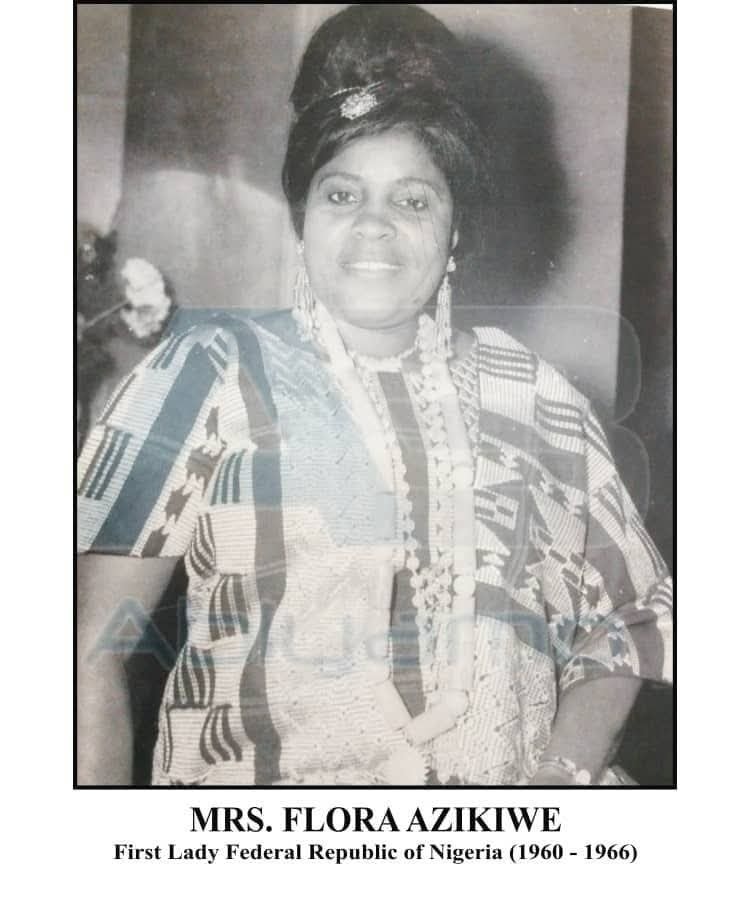
Flora Azikiwe: Nigeria’s First First Lady and Pillar of Early Nationhood

Published

on

Remembering Flora Ogbenyeanu Ogoegbunam Azikiwe — the graceful wife of Dr. Nnamdi Azikiwe and the woman who quietly shaped Nigeria’s political beginnings.

Early Life and Background

Flora Ogbenyeanu Ogoegbunam Azikiwe (née Ogoegbunam) was born on 7 August 1917 in Onitsha, present-day Anambra State, Nigeria. She hailed from a respected Igbo Christian family known for its educational and civic-minded values. Her father, Chief Ogoegbunam, was a traditional leader and community elder who played a vital role in Onitsha’s socio-cultural development during the early 20th century.

Flora grew up in a disciplined and faith-oriented environment. Her early exposure to education and Western values shaped her into a woman of grace, intellect, and strong moral conviction — qualities that would later define her public life as Nigeria’s first First Lady.

Education and Early Life Aspirations

Though specific records about her schooling are limited, it is known that Flora received formal education at mission schools established by the Church Missionary Society (CMS) in Eastern Nigeria. These schools were among the earliest centres of Western education for Nigerian women. Her literacy, poise, and confidence reflected the missionary emphasis on both academic and moral instruction, preparing her for life alongside one of Africa’s greatest nationalist leaders.

Her education and cultural exposure made her one of the early educated Igbo women who could confidently engage in social discourse, which later proved vital as she assumed public roles alongside her husband.

Marriage to Dr. Nnamdi Azikiwe

Flora married Dr. Nnamdi Azikiwe — affectionately known as “Zik of Africa” — in the late 1930s, long before he rose to national prominence. Their marriage was built on deep companionship and mutual respect. Together, they raised four children: Chukwuma, Uwakwe, Njideka, and Molokwu Azikiwe.

See also  Adewale Ayuba: The Bonsue Fuji Maestro

Throughout their marriage, Flora served as both a partner and moral support to her husband. As Zik pursued his political ambitions — leading movements for independence and serving as Nigeria’s first Governor-General (1960–1963) and first President (1963–1966) — Flora remained his constant source of strength and counsel.

Role as Nigeria’s First Lady

Flora Azikiwe became Nigeria’s first official First Lady when her husband assumed office as President of the Federal Republic of Nigeria on 1 October 1963, following the country’s transition into a republic. She served in this capacity until 16 January 1966, when the First Republic was overthrown by the military coup that marked the beginning of years of political instability.

As First Lady, Flora maintained a modest but dignified public image. Unlike modern First Ladies who often take on visible advocacy roles, her era demanded discretion and decorum. She represented the emerging image of the Nigerian woman — educated, cultured, and supportive of national unity.

She was deeply involved in community service, church activities, and women’s associations, particularly within the Eastern region. Through quiet diplomacy, she fostered goodwill and respect among Nigeria’s early political families and the wider public.

Personality and Values

Flora Azikiwe was known for her humility, calmness, and quiet confidence. Those who knew her described her as a woman of prayer, discipline, and graceful influence. She believed in the power of education and good upbringing, often encouraging women to balance family responsibilities with civic engagement.

Her personal style — elegant yet conservative — reflected both her Christian upbringing and her understanding of the symbolic weight of her position as the first lady of an independent African nation.

See also  Ọmọ n'Ọba n'Ẹdo Uku Akpolokpolo, Oba Akenzua II (1899–1978): The 37th Oba of Benin

Later Years and Death

After her husband’s removal from office in 1966, Flora withdrew from public life. She spent her later years focusing on her family and faith, occasionally attending public events in Onitsha and Enugu.

She passed away on 22 August 1983, at the age of 66, and was buried in Onitsha, Anambra State. Her death marked the end of an era for many who saw her as a symbol of dignity in Nigeria’s early political history.

Legacy

Flora Azikiwe’s legacy lies not in fiery speeches or political movements, but in her symbolic role as the mother of a young nation. As the first First Lady of Nigeria, she set the tone for future occupants of that office — embodying modesty, cultural pride, and quiet strength.

Her contribution to the image of the Nigerian woman during the 1960s remains significant. She represented an ideal of womanhood that combined tradition, education, and faith — qualities that resonated deeply in the post-independence years when Nigeria sought to define its identity.

Today, Flora Azikiwe is remembered alongside her husband, Dr. Nnamdi Azikiwe, as part of the generation that laid the foundation for Nigeria’s independence and nationhood.

References:

Vanguard Nigeria (2023). “Remembering Flora Azikiwe: Nigeria’s First First Lady.”

Premium Times Nigeria (2022). “Nigeria’s First Ladies: The Women Behind the Power.”

The Guardian Nigeria (2019). “Zik’s Family Legacy and the Quiet Strength of Flora Azikiwe.”

FOLLOW US ON:

FACEBOOK

TWITTER

PINTEREST

TIKTOK

YOUTUBE

LINKEDIN

TUMBLR

INSTAGRAM

Continue Reading
Click to comment

Leave a Reply

Your email address will not be published. Required fields are marked *

Lifestyle

Declare Your Lineage – Royal Family Tells Musician KWAM 1 Over His Interest In Becoming Next Awujale Of Ijebuland

Published

on

KWAM 1, in a letter dated December 3, 2025, addressed to the chairman of the Fusengbuwa Ruling House in Agunsebi Quarters, Ijebu-Ode, announced his interest in the stool, describing himself as a “bonafide son” of the ruling house.

The Fusengbuwa ruling house of Ijebu-Ode, next in line to produce the new Awujale of Ijebuland, Ogun State, has instructed Fuji musician Wasiu Ayinde, popularly known as KWAM 1, to confirm his family’s royal lineage to validate his membership in the ruling house.

KWAM 1, in a letter dated December 3, 2025, addressed to the chairman of the Fusengbuwa Ruling House in Agunsebi Quarters, Ijebu-Ode, announced his interest in the stool, describing himself as a “bonafide son” of the ruling house.

KWAM 1 also stated that his candidacy aligns with Ijebu customary law and the Ogun State Chieftaincy Laws.

In an interview with Punch, the Chairman of the ruling house and former National President of the Institute of Chartered Accountants of Nigeria, Abdulateef Owoyemi, said only bonafide members of the family would be allowed to participate in the selection process.

Owoyemi explained that KWAM 1, Olori Omooba of Ijebu land and others interested in the stool have been directed to complete the Fusengbuwa ruling house royal lineage data form.

According to him, the form, which requires contenders to trace their genealogy back seven generations, ensures that only genuine princes from the family can participate, thereby blocking “strangers” from claiming the throne.

He said, “The first step for anyone interested in contesting for the Awujale throne is to declare their lineage by filling the standard Fusengbuwa ruling house royal lineage data form. Once confirmed as a legitimate member of the ruling house, they can then apply for the expression of interest form.

See also  Ọmọ n'Ọba n'Ẹdo Uku Akpolokpolo, Oba Akenzua II (1899–1978): The 37th Oba of Benin

“We have told him, just like everyone else interested in the Awujale throne, that the first step is to declare his lineage. He will do this by completing the royal lineage data form, showing his full name, which parent and grandparent he descends from, and continuing up to seven generations.

“The completed form will be signed and submitted to the head of the ruling house unit of the Fusengbuwa ruling house, who will affirm that he is a genuine member. Only then will the process move forward.”

Owoyemi emphasised that although the application window for the throne officially closed on December 5, KWAM 1 had been given a five-day extension, which would lapse on December 10.

He noted, “We won’t shut anybody out of picking the next Awujale, but we must ensure that you are a legitimate member of Fusengbuwa. Every right comes with responsibilities. For a royal family, everyone must prove their legitimacy by completing the royal lineage data form.

“When we receive the form, we will review it meticulously. If clarification is needed, we will contact the applicant. We welcome men of influence who will use their influence to enhance the throne, not to claim it, ensuring that what truly belongs to our family is preserved.”

Owoyemi explained that the local government has given them 14 days to select candidates, and the ruling house hopes to have a new Awujale by the second or third week of January 2026.

He added, “The local government has given us 14 days to select candidates, which expires on December 18. After that, the kingmakers have seven days to deliberate and choose one candidate, whose name will be forwarded to the governor.

See also  Onyeka Onwenu (1952–2024): The Elegant Stallion of Nigerian Arts and Advocacy

“Legally, the government then has 21 days to conduct background checks and security clearance, allowing for objections or protests. After this period, the State Executive Council will ratify the nominee, and the governor will announce the next Awujale, after which coronation rites will commence.

“So, combining the candidate selection, kingmakers’ deliberation, and legal objection period, we are looking at around 42 days. Therefore, we expect the next Awujale to emerge between the second and third week of January.”

FOLLOW US ON:

FACEBOOK

TWITTER

PINTEREST

TIKTOK

YOUTUBE

LINKEDIN

TUMBLR

INSTAGRAM

Continue Reading

Lifestyle

VIDEO: I’m Married But Not In My Husband’s House; I Didn’t Have The Experience Of Living Happily Ever After – Singer Shola Allyson Reveals

Published

on

While speaking about her love life, the 54-year-old who came into limelight with a love album ‘Eji Owuro’, revealed that she is married but not living with her husband.

Sola Allyson, the popular Nigerian gospel singer, has revealed that she is not currently living with her husband.

The musician made this known in her latest interview on Oyinmomo TV.

While speaking about her love life, the 54-year-old who came into limelight with a love album ‘Eji Owuro’, revealed that she is married but not living with her husband.

Sharing her marital experience, the singer said she has never enjoyed the kind of happiness many people describe.

“I’m married, but I’m not in my husband’s house. We live separately. He in his house and I in mine.”

The interviewer asked: “You sang ‘Eji Owuro’, did you experience genuine love from your husband?

She replied, “We lied before. Those older than us didn’t inform us that it’s tough. They made us believe that so long as you both love each other, you will live happily ever after, but it’s a lie.

“That’s not the experience I have. I didn’t have the experience of living happily ever after. I did all I could to make it work.

“Marriage has been a big challenge. I hear people talk about joy in marriage, but I have never experienced it.”

CLICK TO WATCH THE VIDEO

FOLLOW US ON:

FACEBOOK

TWITTER

PINTEREST

TIKTOK

YOUTUBE

LINKEDIN

TUMBLR

INSTAGRAM

See also  Failed Maths exam led me to music – Zlatan
Continue Reading

Lifestyle

VIDEO: Shola Allyson Finally Opens Up, Reveals Why She Does Not Reference Jesus In Her Songs

Published

on

Recall that Allyson, who is regarded as a gospel singer, was dragged on social media in March 2025 for not directly referencing ‘Jesus’ in all her songs.

Shola Allyson, the renowned Nigerian songstress, has opened up on the real reason she avoids mentioning the name of Jesus in all her songs.

Recall that Allyson, who is regarded as a gospel singer, was dragged on social media in March 2025 for not directly referencing ‘Jesus’ in all her songs.

Reacting to her critics in a post on X, the songstress stated that “No one can bully me into joining their darkness that looks like light because indolent souls find comfort in it”.

Finally revealing her reason for not mentioning Jesus in her songs, Shola Allyson on Saturday during her latest interview on Oyinmomo TV, stated that Jesus did not ask her to do PR for him.

She said “I’m not a religious singer. As I am, I have never introduced myself as a gospel singer. My name is Shola Allyson. I’m a singer”.

Interviewer; “Some people said you don’t mention ‘Jesus’ name’ in all your songs”.

She quickly responded “Jesus did not instruct us to mention his name in songs nor did Jesus ask us to do PR for Him”.

CLICK TO WATCH THE VIDEO

FOLLOW US ON:

FACEBOOK

TWITTER

PINTEREST

TIKTOK

YOUTUBE

LINKEDIN

TUMBLR

INSTAGRAM

See also  Kajuru Castle: Nigeria’s Bavarian-Style Hilltop Retreat (PHOTOS)
Continue Reading

Trending