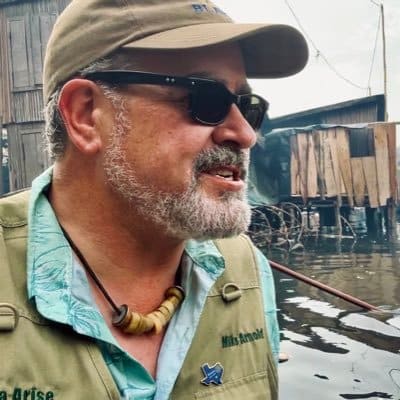
In this interview with OLUFEMI ADEDIRAN, a former Mayor of Blanco City, Texas, United States of America, Mike Arnold accuses the Federal Government of complicity in the killing of Christians — a claim he says is backed by years of research and on-the-ground investigations in Internally Displaced Persons camps across the country.
What prompted your fact-finding mission on insecurity in Nigeria?
I received a call penultimate Sunday morning from Reno Omokri and Nuhu Ribadu. It was unexpected. Omokri asked if I could come to Nigeria quickly, as he was going to set a meeting with key people, including the Sultan of Sokoto, the Senate President, and FFK (Femi Fani-Kayode), and meet with the press so that we could share our findings.
I agreed to come, and we were all on the airplane one week later. He paid for the trip; we didn’t get any compensation otherwise. I didn’t ask for it. It was 30 hours of travel, and when we got to the hotel, we were not even taken to our hotel rooms. We were taken to a different room to meet with people. We sat down with the chairman of CAN (Christian Association of Nigeria) and three Muslim leaders; people were taking pictures of us. After that, we were taken straight to the studios of Arise TV, which is in the same hotel. After that, he said nothing else until the press conference the following day. Mr. Omokri pressured us to announce our findings, and he wanted us to agree with him 100 per cent. He just assumed that we were going to agree with his plan. But I felt that this was not going to happen.
How did you gather your findings?
I have been investigating this since 2019. I have been to Nigeria for the past 15 years; I have been all over the country. We have a team that went undercover to numerous IDP (Internally Displaced Persons) camps. We have been to numerous IDP camps and got to know many IDPs personally, and the reason why I connected with them was because of this issue.
At that time, he (Omokri) was out there talking about Christian genocide. I reached out to him because he wrote a book on Goodluck Jonathan’s administration. He did not bother to look at any of my social media posts or my blogs where I had been talking about Nigeria’s genocide. But I guess he thought he was so smart that I was going to feed the propaganda lie to the people. He thought I would just smile and agree with him.
I never told him that I would agree with him. I never told him that I would toe his line. He asked me what I was going to say, and I asked what he expected me to say. The only reason I agreed to come was that he said I should just come and speak the truth. I never said otherwise. I came to speak the truth, and that was exactly what I said 100 per cent.
I have been doing this research for a long time, and I spoke with many frontline journalists and prepared a factual and verifiable report that the ambassador personally signed off on with me. If you look at the Arise TV interview, Omokri was trying to corner me right there. It was a PR stunt, and he was trying to use us — the American voice — to parade his line. And he tried to pressure me right there on live TV.
How did that feel for you?
Reading into this, people told me that what I was doing was extremely dangerous, that I could be surveilled and my life could be threatened or bribed. I truly believed that there was a good chance that I would be killed for speaking the truth. Genuinely, I updated my will, and we had a final dinner with my family, and we spoke about the possibility that I might not be coming back home. But I was willing to lay down my life if it would stop the genocide. I got on the airplane not knowing whether I would come back home.
Those threats would not have deterred me because there was nothing they could threaten me with since I was prepared to die to speak the truth. Going into the press conference, I can’t imagine that this is the best PR agent the government can retain. Reno Omokri 100 per cent put this in motion. I never deceived him; I never said anything to him.
Are you saying only Christians are targets of insurgents?
Indeed, there were points we agreed on — like there are Muslims getting killed and Christians getting killed. He (Omokri) did not ask me what I was going to say. He just assumed, because of his dubious personality, that I would change everything I had been saying for years. Now, the truth is out; everything is out there. God used him like Balaam’s donkey.
The truth is that Nigeria is experiencing genocide, and he wanted me to lie. He invited one of the world’s most passionate advocates for the exposure of genocide in Nigeria; he invited me to do a press conference and get the world’s attention to it — what was he expecting me to say? He caused this out of his arrogance.
What would you say to officials who dismissed your report as “foreign propaganda” or “missionary sensationalism”?
I will accuse them of being complicit in genocide because the facts are obvious. All they need to do is walk through an IDP camp and ask for stories. All they need to do is to do what I have done and go to Borno, Gwoza, and read the reports made by frontline journalists who go to the blood-stained grounds, where the grounds are still wet, and talk to victims. They know the facts, and the government is trying to eradicate that too.
There are at least six IDP camps in Abuja with almost 30,000 IDPs. The government officially calls them criminals and vagrants and denies their camps exist, and they bulldozed the camps. These are Nigerians, and the government tries to take them down, and you know why. I’m convinced it is witness repression. There are at least four to 10 million IDPs who are eyewitnesses to genocide, and the government lies to them and labels them criminals. This is witness suppression.
What I have firsthand knowledge of is that this government is 100 per cent complicit in the ongoing genocide in the IDP camps. They are being killed; they are dying of preventable illnesses and malnutrition. They are being abducted; they live in absolute squalor, denied by the government intentionally and in many ways. To me, that is more gruesome than the genocide itself.
If there is no intervention to stop the recruitment of young boys into banditry and terrorism, Nigeria will have a generation of radicals, and that will be the end of Nigeria. It doesn’t take much for the government to end this.
We have supported orphanages in Jos — 286 orphans who saw their parents massacred. These kids wanted to get guns and go back to kill, but after their education now, they want to go back and rebuild. That is breaking the circle of death, and it doesn’t take much; it just takes something, and this government denies them that intentionally.
They have the blood, the horror, and the trauma of millions of Nigerians actively on their hands every single day, and they do nothing about it. All of them are guilty and should be on trial for crimes against humanity. Anybody in this government who does not speak up or do something about this is guilty of crimes against humanity.
Reno Omokri knows all about it. Our first conversation when I called him was because his book talks about it, and I asked how many they were, and he said they were more than nine million. He knows, and he does nothing. That, to me, is worse than Adolf Hitler himself. He knows what is happening; he talked about it not long ago; he was really charged about the Nigerian Christian genocide, and yet he lies about it. He is complicit in aiding and abetting.
Anybody in government who knows about the ongoing Christian genocide in Nigeria and is covering it up or not saying anything about it should go on trial at the International Criminal Court for aiding and abetting genocide. Anybody in government that knows about it but does not do something about it is guilty, and that includes the President himself. He may not be committing the genocide, but he is surely aiding and abetting it through a strategic campaign to suppress four million or more witnesses. It is a crime against humanity. I accuse this government today of crimes against humanity and, at the very least, aiding and abetting genocide.
Don’t you think that your report might strain US–Nigeria diplomatic relations, given the sensitivity of your conclusions?
Are you kidding? It is obvious that what strains relationships is trying to hide the truth; what strains relationships are the lies and the spins — trying to take an American and put him in front of a camera to lie is what strains relationships.
Being transparent and honest is how great relationships are built.
The press conference was a small firecracker compared to what I’m prepared to drop: the truth — unvarnished, fully documented, verifiable, firsthand truth of the genocide and the intentional grinding down of the Internally Displaced Persons.
But more importantly, what I have are the stories of the heroes on the frontlines, the bright lights who have given everything they have, sacrificing their lives to save these children. They are the true Nigerians I know. In prayer in the hotel room before going down to the press conference, thinking it might be my last breath on this earth, I told God to take control. I don’t take credit for any of this. I’m a simple man; I’m not a wealthy man, but God used my lips to communicate that day, and the glory goes back to Him. I don’t feel like I did anything; I just spoke the truth. I just did what I was asked to do.
Are you not concerned that your focus on Christian persecution might fuel sectarian division rather than empathy across religious lines?
In my report, I said repeatedly that there are radical Muslims killing Christians and also Muslims. What I called for is for both Muslims and Christians to stand together against the common enemy. Yes, it is a Christian genocide and a Muslim genocide. The established protocol for these people is that when they attack people — maybe a bus — and pull people out, they separate Christian and Muslim men and women first. They kill the Christian men and tell the Muslim men that they must either join them or die, and they kill all the ones who don’t join them and sell the women into sex slavery.
For example, when they went into Gwoza, they burnt all the churches, not one mosque. The last church they went to, the villagers there — all they had left were bows and arrows — stood guarding the church. When the military came, the villagers were celebrating, but the military shot and killed them. They had been told that the Christians were the problem. They brought out their guns, went AWOL, shot the villagers, and left. Their commanders told them to kill the Christians. Yes, this is targeted.
The reason they don’t do it in the South is because it is guarded. They want to be able to loot and raid. If they go all the way to do it across Nigeria, the country will just be a hellish wasteland, hence the North.
Are you aware of any ongoing plan by the U.S. to designate Nigeria a Country of Particular Concern?
I don’t know about the U.S. plan. My communication with them has been one-way. I have been sending them reports and trying to get their attention. I have received no special information. I have no special access to the U.S. government, and I don’t know the details of what the U.S. may be proposing. By next week, I will finally be able to talk to some people.
Since 2019, when I started my research, I have been trying to tell the story. I have been trying to raise awareness, but I haven’t met with representatives of the U.S. government, and I have not had a two-way conversation with anybody on the issue.
Some people have described your claim and that of Senator Ted Cruz as a calculated effort by the U.S. to unseat President Tinubu and ensure he does not win re-election. What is your response to this?
I have met some of the ministers in this administration, and I find them very engaging. I have seen an improvement in the atmosphere ever since the President was elected. His government is as brutal as that of former President Muhammadu Buhari, where documentary filmmakers were arrested and tortured. So, I had hope and I still have hope. I think the only way for him to survive is to become a champion for justice. That is the only way his power can survive.
Nigeria is about to be subject to the most intense international scrutiny that it has ever seen, and I encourage the leaders. I don’t care who the President is and who is not. I know the names of some of the political parties, but I cannot tell you what they stand for or who is who. I have intentionally remained unconcerned about the politics of Nigeria.
I will go for anybody that champions the cause of human rights, and for anybody that will end this genocide. Anybody that will bring restoration to the Internally Displaced People — whether that is Tinubu or Obi (Peter Obi) or a dog on the street — I believe whoever champions the cause of IDPs will be the next president of Nigeria, and I will back that person with everything I’ve got if they are genuine about it.
I’m not trying to unseat anybody. I’m trying to bring justice and peace to the nation I grew up to know as my second home. I have not been involved in politics. Nigerian politics is only good if it works in the right direction. I will swing the sword of truth, and if you get in the way, you are going to get cut, like Omokri. I have known him well. I have been with him on his birthday safari; he has visited me in my home in Blanco; I know his home well. I have never met a more self-deluded, pathological liar than him.
Do you think the arms deal Nigeria has with the U.S. will continue considering your weighty allegation?
I have no idea, and you know why — with what I know about the Nigerian military in the North, the worst thing we can do is give them arms. I have never even thought about this because I’m not political; I’m a missionary. I’m not a politician. Some are blaming the U.S. for cutting off aid, but it won’t take much for Nigeria to restore the IDPs. Nigeria is a wealthy nation; all the billions they said Tinubu has saved can be used for something good. It won’t take much. All it takes is the recognition, respect, and dignity of the IDPs.
Yes, you go with your beggar’s hands to Uncle Sam, but Uncle Sam cannot ask you any questions. You had aid coming in for years for drugs, and you don’t have accountability. I think every donor should stop aid to Nigeria. You caused the problem, so you should fix it. You want help fixing it? We stand ready — the world stands ready — to help you establish justice, but you must show transparency and accountability.
When I first got back after 2019, I went to Kontagora. I spoke to my friend, the U.S. ambassador; he is a former board member of the World Bank food programme, and I told him that we found IDP camps where people didn’t have any sanitation or housing or health care, food, water, or education. But he said that was impossible. He said the country, through international aid, had the means and the mandate to take care of IDPs. The money is there to help these people, but the government has refused to acknowledge them because they are eyewitnesses, and it is entirely a campaign of witness suppression.
The Nigerian people are the most honourable people I know. There are bad apples, for sure, but the heart of Nigeria is one of integrity, righteousness, and hope.
What is Senator Ted Cruz’s position on this?
I have never talked to Ted Cruz. I shook his hand once 10 years ago. But I intend to meet him soon.