Connect with us

Lifestyle

Malcolm X’s Visit to Nigeria: The Homecoming of “Omowale”

Published

on

How the 1964 visit of Malcolm X to Nigeria deepened his connection to Africa and shaped his global vision of justice

In May 1964, one of the most influential figures of the 20th century, Malcolm X, set foot on Nigerian soil during a transformative journey across Africa and the Middle East. His visit was more than a diplomatic or cultural exchange — it was a spiritual homecoming, one that forged an enduring bond between the African-American struggle and the African continent.

The African Pilgrimage

Having recently left the Nation of Islam, Malcolm X embarked on a global tour that took him through Egypt, Ghana, Nigeria, Ethiopia, and several other nations. This journey marked the rebirth of his worldview — from one rooted in racial separatism to a more inclusive call for global human rights.

Arriving from Egypt on May 6, 1964, Malcolm X was welcomed warmly in Nigeria. His presence captured the imagination of many students and intellectuals who saw him as a symbol of Black pride and resistance.

During his stay, he visited the University of Ibadan, where he addressed students about African unity, racial identity, and liberation. It was here that he was bestowed the Yoruba name “Omowale,” meaning “the child has returned home.”

Malcolm later recalled the moment with deep emotion:

> “When I was in Ibadan at the University of Ibadan last Friday night, the students there gave me a new name, Omowale, which they say means in Yoruba ‘The child has returned.’ It was an honor.”

The gesture resonated deeply with him — it symbolised his reconnection with the continent from which his ancestors had been torn centuries earlier.

See also  Don’t derail Awujale selection, council warns ruling houses

Encounters in Nigeria

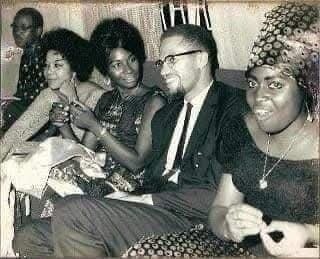
Photographs from the visit show Malcolm X interacting with Nigerian students and intellectuals, including Iyabo Attah (left) and Ronke Ademola (right). The warmth of his reception and the intellectual exchange he experienced in Nigeria profoundly influenced his thinking.

At the University of Ibadan, Malcolm’s discussions revolved around pan-Africanism, the importance of solidarity between Africans and the African diaspora, and the need for unity in the fight against oppression.

His Nigerian hosts admired his fearlessness and eloquence, while he admired their pride in African identity and their commitment to independence and progress. The meeting between Malcolm and Nigerian students became a symbolic bridge linking African and African-American struggles for dignity and equality.

A Shift in Vision

Before his trip, Malcolm X’s activism had largely been framed within the context of Black nationalism in America. However, his experiences in Africa — particularly in Nigeria — reshaped his philosophy.

He began to see racism not as an isolated American issue but as part of a global system of oppression. Nigeria’s newly independent society, full of optimism and self-determination, inspired him to imagine a future where Africans and African descendants worldwide could stand united in political and spiritual strength.

Following his visit to Africa and his pilgrimage to Mecca, Malcolm embraced Sunni Islam and adopted the name El-Hajj Malik El-Shabazz. His message evolved to emphasise universal human rights, global justice, and solidarity among oppressed peoples.

Legacy of “Omowale”

Malcolm X’s visit to Nigeria remains one of the most historically significant connections between African-Americans and Nigeria. The name Omowale became not just a title but a symbol of return, reconciliation, and belonging.

See also  Youths hold prayer session in Kano to celebrate Seyi Tinubu at 40

In the years that followed, his life and assassination in 1965 inspired many Nigerian intellectuals, writers, and activists who viewed him as a brother whose journey completed the spiritual circle of the African diaspora.

Today, Malcolm X’s legacy continues to live in Nigeria — in classrooms, among civil rights advocates, and within the shared narrative of global Black identity. His 1964 visit stands as a timeless reminder that Africa is not only a geographical origin but a spiritual home for its scattered children.

References

ANTe Archives

The Autobiography of Malcolm X, as told to Alex Haley.

FOLLOW US ON:

FACEBOOK

TWITTER

PINTEREST

TIKTOK

YOUTUBE

LINKEDIN

TUMBLR

INSTAGRAM

Continue Reading
Click to comment

Leave a Reply

Your email address will not be published. Required fields are marked *

Lifestyle

Declare Your Lineage – Royal Family Tells Musician KWAM 1 Over His Interest In Becoming Next Awujale Of Ijebuland

Published

on

KWAM 1, in a letter dated December 3, 2025, addressed to the chairman of the Fusengbuwa Ruling House in Agunsebi Quarters, Ijebu-Ode, announced his interest in the stool, describing himself as a “bonafide son” of the ruling house.

The Fusengbuwa ruling house of Ijebu-Ode, next in line to produce the new Awujale of Ijebuland, Ogun State, has instructed Fuji musician Wasiu Ayinde, popularly known as KWAM 1, to confirm his family’s royal lineage to validate his membership in the ruling house.

KWAM 1, in a letter dated December 3, 2025, addressed to the chairman of the Fusengbuwa Ruling House in Agunsebi Quarters, Ijebu-Ode, announced his interest in the stool, describing himself as a “bonafide son” of the ruling house.

KWAM 1 also stated that his candidacy aligns with Ijebu customary law and the Ogun State Chieftaincy Laws.

In an interview with Punch, the Chairman of the ruling house and former National President of the Institute of Chartered Accountants of Nigeria, Abdulateef Owoyemi, said only bonafide members of the family would be allowed to participate in the selection process.

Owoyemi explained that KWAM 1, Olori Omooba of Ijebu land and others interested in the stool have been directed to complete the Fusengbuwa ruling house royal lineage data form.

According to him, the form, which requires contenders to trace their genealogy back seven generations, ensures that only genuine princes from the family can participate, thereby blocking “strangers” from claiming the throne.

He said, “The first step for anyone interested in contesting for the Awujale throne is to declare their lineage by filling the standard Fusengbuwa ruling house royal lineage data form. Once confirmed as a legitimate member of the ruling house, they can then apply for the expression of interest form.

See also  Moji Olaiya: The Graceful Star of Nollywood's Golden Generation

“We have told him, just like everyone else interested in the Awujale throne, that the first step is to declare his lineage. He will do this by completing the royal lineage data form, showing his full name, which parent and grandparent he descends from, and continuing up to seven generations.

“The completed form will be signed and submitted to the head of the ruling house unit of the Fusengbuwa ruling house, who will affirm that he is a genuine member. Only then will the process move forward.”

Owoyemi emphasised that although the application window for the throne officially closed on December 5, KWAM 1 had been given a five-day extension, which would lapse on December 10.

He noted, “We won’t shut anybody out of picking the next Awujale, but we must ensure that you are a legitimate member of Fusengbuwa. Every right comes with responsibilities. For a royal family, everyone must prove their legitimacy by completing the royal lineage data form.

“When we receive the form, we will review it meticulously. If clarification is needed, we will contact the applicant. We welcome men of influence who will use their influence to enhance the throne, not to claim it, ensuring that what truly belongs to our family is preserved.”

Owoyemi explained that the local government has given them 14 days to select candidates, and the ruling house hopes to have a new Awujale by the second or third week of January 2026.

He added, “The local government has given us 14 days to select candidates, which expires on December 18. After that, the kingmakers have seven days to deliberate and choose one candidate, whose name will be forwarded to the governor.

See also  What we’re experiencing bears every mark of genocide – Benue Catholic priests

“Legally, the government then has 21 days to conduct background checks and security clearance, allowing for objections or protests. After this period, the State Executive Council will ratify the nominee, and the governor will announce the next Awujale, after which coronation rites will commence.

“So, combining the candidate selection, kingmakers’ deliberation, and legal objection period, we are looking at around 42 days. Therefore, we expect the next Awujale to emerge between the second and third week of January.”

FOLLOW US ON:

FACEBOOK

TWITTER

PINTEREST

TIKTOK

YOUTUBE

LINKEDIN

TUMBLR

INSTAGRAM

Continue Reading

Lifestyle

VIDEO: I’m Married But Not In My Husband’s House; I Didn’t Have The Experience Of Living Happily Ever After – Singer Shola Allyson Reveals

Published

on

While speaking about her love life, the 54-year-old who came into limelight with a love album ‘Eji Owuro’, revealed that she is married but not living with her husband.

Sola Allyson, the popular Nigerian gospel singer, has revealed that she is not currently living with her husband.

The musician made this known in her latest interview on Oyinmomo TV.

While speaking about her love life, the 54-year-old who came into limelight with a love album ‘Eji Owuro’, revealed that she is married but not living with her husband.

Sharing her marital experience, the singer said she has never enjoyed the kind of happiness many people describe.

“I’m married, but I’m not in my husband’s house. We live separately. He in his house and I in mine.”

The interviewer asked: “You sang ‘Eji Owuro’, did you experience genuine love from your husband?

She replied, “We lied before. Those older than us didn’t inform us that it’s tough. They made us believe that so long as you both love each other, you will live happily ever after, but it’s a lie.

“That’s not the experience I have. I didn’t have the experience of living happily ever after. I did all I could to make it work.

“Marriage has been a big challenge. I hear people talk about joy in marriage, but I have never experienced it.”

CLICK TO WATCH THE VIDEO

FOLLOW US ON:

FACEBOOK

TWITTER

PINTEREST

TIKTOK

YOUTUBE

LINKEDIN

TUMBLR

INSTAGRAM

See also  El Mafrex (born Mfreke Obong Ibanga; 14 May 1984)
Continue Reading

Lifestyle

VIDEO: Shola Allyson Finally Opens Up, Reveals Why She Does Not Reference Jesus In Her Songs

Published

on

Recall that Allyson, who is regarded as a gospel singer, was dragged on social media in March 2025 for not directly referencing ‘Jesus’ in all her songs.

Shola Allyson, the renowned Nigerian songstress, has opened up on the real reason she avoids mentioning the name of Jesus in all her songs.

Recall that Allyson, who is regarded as a gospel singer, was dragged on social media in March 2025 for not directly referencing ‘Jesus’ in all her songs.

Reacting to her critics in a post on X, the songstress stated that “No one can bully me into joining their darkness that looks like light because indolent souls find comfort in it”.

Finally revealing her reason for not mentioning Jesus in her songs, Shola Allyson on Saturday during her latest interview on Oyinmomo TV, stated that Jesus did not ask her to do PR for him.

She said “I’m not a religious singer. As I am, I have never introduced myself as a gospel singer. My name is Shola Allyson. I’m a singer”.

Interviewer; “Some people said you don’t mention ‘Jesus’ name’ in all your songs”.

She quickly responded “Jesus did not instruct us to mention his name in songs nor did Jesus ask us to do PR for Him”.

CLICK TO WATCH THE VIDEO

FOLLOW US ON:

FACEBOOK

TWITTER

PINTEREST

TIKTOK

YOUTUBE

LINKEDIN

TUMBLR

INSTAGRAM

See also  El Mafrex (born Mfreke Obong Ibanga; 14 May 1984)
Continue Reading

Trending