Connect with us

Lifestyle

Malcolm X’s Visit to Nigeria: The Homecoming of “Omowale”

Published

on

How the 1964 visit of Malcolm X to Nigeria deepened his connection to Africa and shaped his global vision of justice

In May 1964, one of the most influential figures of the 20th century, Malcolm X, set foot on Nigerian soil during a transformative journey across Africa and the Middle East. His visit was more than a diplomatic or cultural exchange — it was a spiritual homecoming, one that forged an enduring bond between the African-American struggle and the African continent.

The African Pilgrimage

Having recently left the Nation of Islam, Malcolm X embarked on a global tour that took him through Egypt, Ghana, Nigeria, Ethiopia, and several other nations. This journey marked the rebirth of his worldview — from one rooted in racial separatism to a more inclusive call for global human rights.

Arriving from Egypt on May 6, 1964, Malcolm X was welcomed warmly in Nigeria. His presence captured the imagination of many students and intellectuals who saw him as a symbol of Black pride and resistance.

During his stay, he visited the University of Ibadan, where he addressed students about African unity, racial identity, and liberation. It was here that he was bestowed the Yoruba name “Omowale,” meaning “the child has returned home.”

Malcolm later recalled the moment with deep emotion:

> “When I was in Ibadan at the University of Ibadan last Friday night, the students there gave me a new name, Omowale, which they say means in Yoruba ‘The child has returned.’ It was an honor.”

The gesture resonated deeply with him — it symbolised his reconnection with the continent from which his ancestors had been torn centuries earlier.

See also  The Prestigious Awzaw Title Among the Igbos — As Documented by George T. Basden (1921)

Encounters in Nigeria

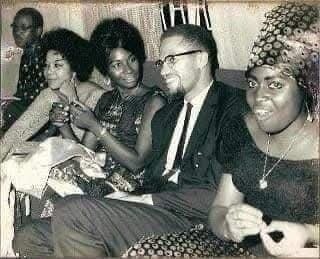
Photographs from the visit show Malcolm X interacting with Nigerian students and intellectuals, including Iyabo Attah (left) and Ronke Ademola (right). The warmth of his reception and the intellectual exchange he experienced in Nigeria profoundly influenced his thinking.
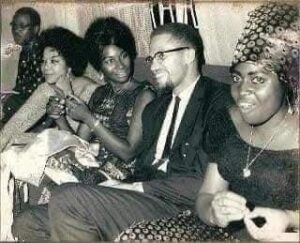
At the University of Ibadan, Malcolm’s discussions revolved around pan-Africanism, the importance of solidarity between Africans and the African diaspora, and the need for unity in the fight against oppression.

His Nigerian hosts admired his fearlessness and eloquence, while he admired their pride in African identity and their commitment to independence and progress. The meeting between Malcolm and Nigerian students became a symbolic bridge linking African and African-American struggles for dignity and equality.

A Shift in Vision

Before his trip, Malcolm X’s activism had largely been framed within the context of Black nationalism in America. However, his experiences in Africa — particularly in Nigeria — reshaped his philosophy.

He began to see racism not as an isolated American issue but as part of a global system of oppression. Nigeria’s newly independent society, full of optimism and self-determination, inspired him to imagine a future where Africans and African descendants worldwide could stand united in political and spiritual strength.

Following his visit to Africa and his pilgrimage to Mecca, Malcolm embraced Sunni Islam and adopted the name El-Hajj Malik El-Shabazz. His message evolved to emphasise universal human rights, global justice, and solidarity among oppressed peoples.

Legacy of “Omowale”

Malcolm X’s visit to Nigeria remains one of the most historically significant connections between African-Americans and Nigeria. The name Omowale became not just a title but a symbol of return, reconciliation, and belonging.

See also  VIDEO: South African pastor claims the rapture is happening today and Internet users are sharing tips on how one can be ‘saved’

In the years that followed, his life and assassination in 1965 inspired many Nigerian intellectuals, writers, and activists who viewed him as a brother whose journey completed the spiritual circle of the African diaspora.

Today, Malcolm X’s legacy continues to live in Nigeria — in classrooms, among civil rights advocates, and within the shared narrative of global Black identity. His 1964 visit stands as a timeless reminder that Africa is not only a geographical origin but a spiritual home for its scattered children.

References

ANTe Archives

The Autobiography of Malcolm X, as told to Alex Haley.

FOLLOW US ON:

FACEBOOK

TWITTER

PINTEREST

TIKTOK

YOUTUBE

LINKEDIN

TUMBLR

INSTAGRAM

Continue Reading
Click to comment

Leave a Reply

Your email address will not be published. Required fields are marked *

Lifestyle

Women Who Love and Listen to Their Pastors More Than Their Husbands Should Be the Pastor’s Second Wife

Published

on

This statement may sound funny, provocative, or even offensive, but it raises an important question about priorities in marriage and religion.

A pastor is a spiritual leader, but he is not supposed to replace a woman’s husband. If a married woman consistently values her pastor’s opinions above her husband’s, obeys her pastor while dismissing her husband, or shows greater loyalty and admiration toward her pastor than toward her spouse, then something may be seriously wrong with the balance in that marriage.

Marriage requires communication, mutual respect, trust, and understanding. A pastor can provide spiritual guidance, but that guidance should not become a reason for a husband and wife to lose respect for each other.

At the same time, husbands should not expect their wives to obey them blindly. Both husband and wife should seek God’s wisdom, communicate openly, and make decisions with love and respect.

So perhaps the real question is not whether such a woman should become the pastor’s “second wife,” but why has the pastor become more important in her marriage than her own husband?

Put God first. Respect your spouse. And never allow a spiritual leader to become a substitute for your marriage partner.

FOLLOW US ON:

FACEBOOK

TWITTER

PINTEREST

TIKTOK

YOUTUBE

LINKEDIN

INSTAGRAM

See also  Toyosi Arigbabuwo: Veteran of Yoruba Cinema and Faithful Community Leader (PHOTOS)
Continue Reading

Lifestyle

Why is it only in Africa that we hear so much about “generational curses”?

Published

on

This is a question worth asking—not to insult African traditions or dismiss anyone’s beliefs, but to encourage honest reflection.

Across Africa, it is common to hear people explain repeated family problems as a “generational curse.” When poverty, broken relationships, addiction, failure, sickness, family conflict or misfortune appears to repeat from one generation to another, some people immediately conclude that an ancestor, spiritual force or past wrongdoing is responsible.

But is every repeated family problem truly a curse?

If a child grows up in poverty, has limited access to quality education, receives little financial support and then struggles as an adult, is that necessarily a spiritual curse—or could it be the result of circumstances that have been passed from one generation to another?

If children grow up watching violence, substance abuse, unhealthy relationships or constant conflict, they may unknowingly repeat those patterns. That does not necessarily mean they are cursed. Sometimes behaviour is inherited through environment, not through supernatural forces.

And Africa is certainly not the only place where people believe in supernatural explanations for suffering or misfortune. Different societies around the world have their own concepts of inherited wrongdoing, family misfortune, ancestral consequences, fate and spiritual punishment.

So perhaps the more important question is not:

“Who cursed my family?”

But:

“What pattern has been passed down to me, and what can I do to stop passing it to the next generation?”

We should be careful not to use the idea of a curse to discourage people from taking action. A family facing poverty may need education, opportunity and financial planning. A family experiencing repeated conflict may need healthier communication. A person struggling with addiction may need professional support and a strong recovery environment. Communities facing injustice may need better institutions, accountability and opportunity.

See also  How the European powers shared Africa in the 1884-1885 Berlin Conference.

Faith and spirituality are deeply meaningful to many people, and everyone has the right to hold their beliefs. But faith should not prevent us from examining the practical causes of our problems.

We cannot change the past, but we can change what we pass forward.

Instead of teaching our children that they are victims of an unavoidable family curse, let us also teach them knowledge, discipline, emotional strength, financial responsibility, education, healthy relationships and the courage to break destructive patterns.

Maybe the greatest “curse” is not something mysterious placed upon a family.

Maybe sometimes it is simply a problem that nobody stopped long enough to understand and change.

And the greatest inheritance we can give the next generation is not fear of a curse—but the knowledge and courage to build a better future.

FOLLOW US ON:

FACEBOOK

TWITTER

PINTEREST

TIKTOK

YOUTUBE

LINKEDIN

INSTAGRAM

Continue Reading

Lifestyle

You are very proud to speak big English, but yet you cannot speak your own language?

Published

on

There is nothing wrong with speaking English fluently. In fact, being able to communicate confidently in different languages is a valuable skill. But we should ask ourselves a deeper question: while learning to speak the language of another culture, are we slowly losing the language that connects us to our own roots?

Your mother tongue is more than just words. It carries the stories of your ancestors, the wisdom of your grandparents, the jokes that only your people understand, the traditional greetings, the names, the songs, the history and the identity of your community.

Imagine being able to speak perfect English, but struggling to have a simple conversation with your own grandmother because you do not understand the language she grew up speaking. Imagine your children knowing foreign languages but being unable to understand the language of their own heritage.

That should make us pause.

Speaking English does not make you more intelligent, and speaking your indigenous language does not make you less educated. One is a communication skill; the other can be a connection to your heritage. We should not have to choose between being educated and preserving our identity.

Learn English. Speak it confidently. Learn French, Dutch, Spanish or any other language that opens doors for you.

But don’t let the pursuit of foreign languages close the door to your own.

Teach your children your language. Speak it at home. Ask your parents and grandparents to teach you the words you never learned. If you have forgotten it, it is never too late to start again.

See also  Colonel Shittu Alao: Pioneer of the Nigerian Air Force and Hero of the Civil War

Because when a language disappears from a family, something precious disappears with it.

Be proud of your education. Be proud of your ability to speak English. But also be proud of where you come from.

Your language is not something to be ashamed of. It is a part of your story. Preserve it before the next generation only knows it as something their ancestors once spoke.

FOLLOW US ON:

FACEBOOK

TWITTER

PINTEREST

TIKTOK

YOUTUBE

LINKEDIN

INSTAGRAM

Continue Reading

Trending