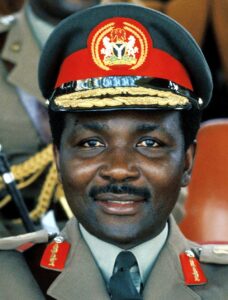
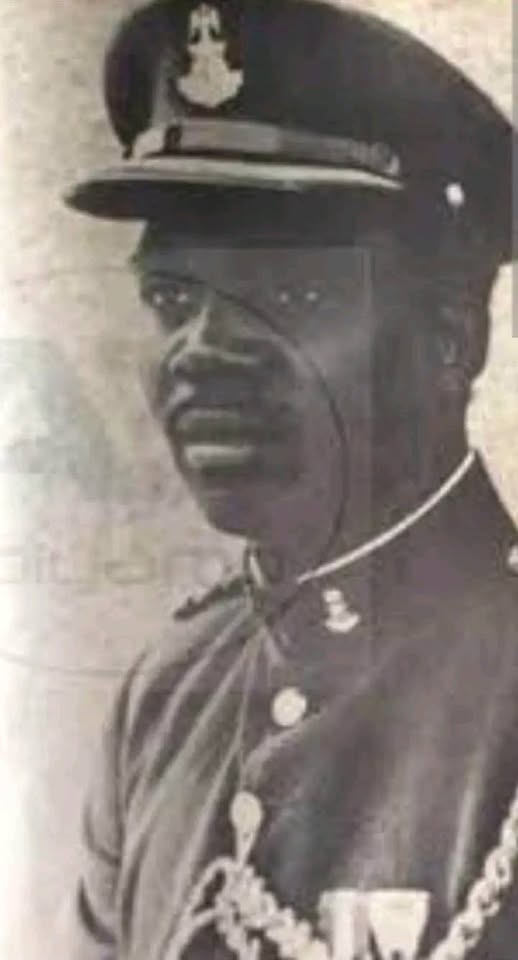
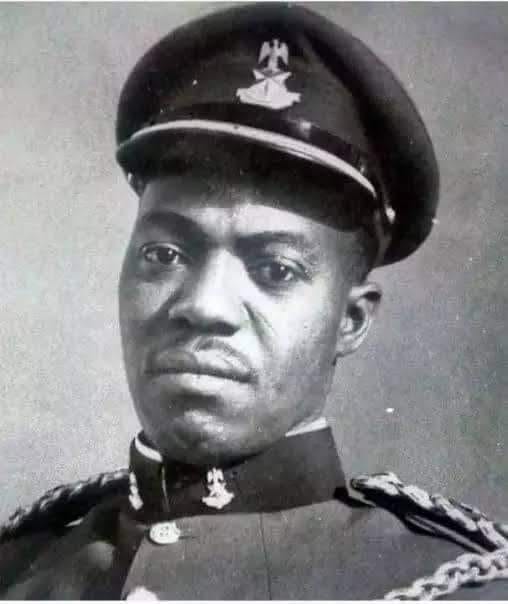
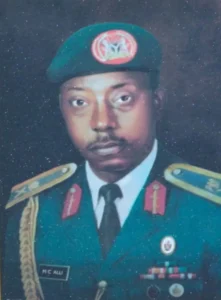
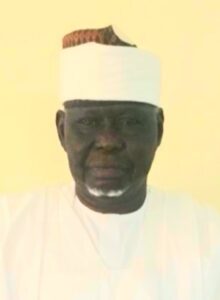
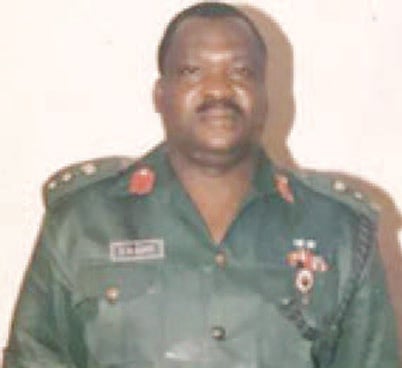
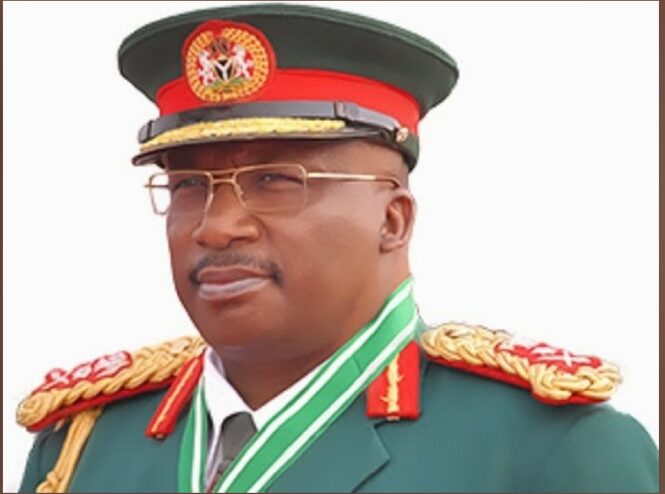
In a nation where the military has played a pivotal role in shaping political and national identity, the appointment of Major General Waidi Shuaibu as Nigeria’s new Chief of Army Staff (COAS) by President Bola Ahmed Tinubu marks the latest chapter in a storied lineage of military leadership.
In this report, the names of the army chiefs — from colonial-era generals to indigenous commanders navigating coups, civil war, and democratic transitions —the office of the COAS has mirrored Nigeria’s evolving history.
From Colonial Command to Indigenous Control
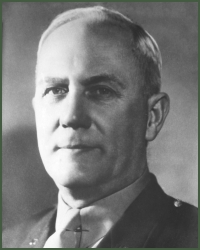
Major General Norman Foster (1960–1962)
Major general Norman L. Foster CB DSO (born 1909) was a British Army General Officer Commanding (GOC) in Duke of Wellington’s Regiment of the Royal Nigerian Military Forces between 1959 and 1962
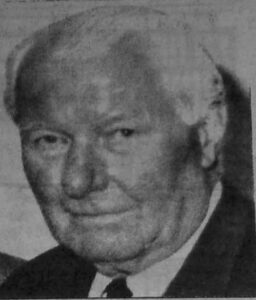
Major General Sir Christopher Welby-Everard (1962–1965)
From 1962 to 1965 Welby-Everard was the General Officer Commanding the Nigerian Army; the last British officer to hold the role after Nigerian independence. Advanced as Knight Commander of the Most Excellent Order of the British Empire in the 1965 New Year Honours, he retired from active military service on 1 May 1965.
Were British officers who led the Nigerian Army during the early post-independence years under the civilian government and Prime Minister Tafawa Balewa.
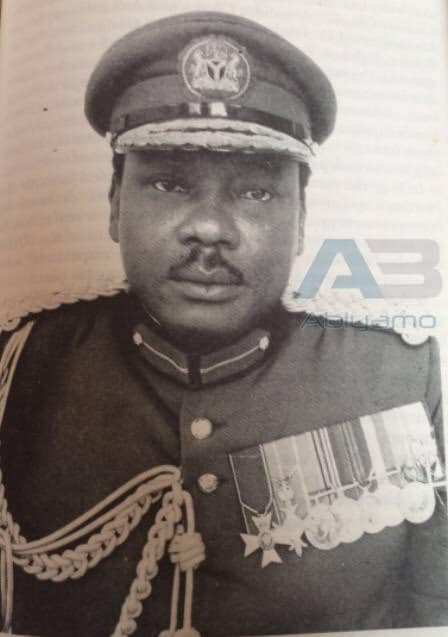
Major General Johnson Aguiyi-Ironsi (Feb 1965–Jan 1966)
Johnson Thomas Umunnakwe Aguiyi-Ironsi GCFR MVO MBE (3 March 1924 – 29 July 1966) was a Nigerian military officer who served as the first military dictator and head of state of Nigeria. He seized power during the ensuing chaos after the 15 January 1966 military coup. Ironsi ruled from 16 January, until his assassination on 29 July 1966 during the July counter-coup. He was assassinated by a group of military officers from the Northern Region led by Murtala Mohammed
Early life
Aguiyi-Ironsi was born on 3 March 1924 in Ibeku, Umuahia, British Nigeria to Igbo Catholics. His father was Ezeugo Aguiyi.He took the last name of his brother-in-law as his first name in admiration of Mr. Johnson for the father-figure role that he played in his life.
Aguiyi-Ironsi had his primary and secondary school education in Umuahia and Kano, respectively. At the age of 18, he joined the Nigeria Regiment against the wishes of his sister, Anyamma.
Military career
In 1942, Aguiyi-Ironsi joined the Nigerian Regiment, as a private with the seventh battalion. He was promoted in 1946 to company sergeant major. Also in 1946, Aguiyi-Ironsi was sent on an officer training course in Staff College, Camberley, England. On 12 June 1949, after completion of his course at Camberley, he received a short-service commission as a second lieutenant in the Royal West African Frontier Force, with a subsequent retroactive promotion to lieutenant effective from the same date.
Aguiyi-Ironsi was granted a regular commission on 16 May 1953 (seniority from 8 October 1947), and was promoted to captain with effect from the same date (seniority from 8 October 1951).[10]
Aguiyi-Ironsi was one of the officers who served as equerry for Queen Elizabeth II of the United Kingdom and Nigeria when she visited Nigeria in 1956 and so he was appointed a Member of the Royal Victorian Order (MVO).He was promoted to Major on 8 October 1958.
In 1960, Aguiyi-Ironsi was made commanding officer of the fifth battalion in Kano, Nigeria, with the rank of lieutenant colonel.
Later in 1960, Aguiyi-Ironsi headed the Nigerian contingent force of the United Nations Operation in the Congo. From 1961 to 1962, Aguiyi-Ironsi served as the military attaché to the Nigeria High Commission in London, United Kingdom. During that period he was promoted to the rank of brigadier. During his tenure as military attaché, he attended courses at the Imperial Defence college (renamed Royal College of Defence Studies in 1961), Seaford House, Belgrave Square. He was appointed a Member of the Order of the British Empire, Military Division (MBE) in the 1962 New Year Honours list.
In 1964, he was appointed as the commandant of the entire United Nations peace keeping force in the Congo.
In 1965, Aguiyi-Ironsi was promoted to the rank of major general. The same year, Major General C.B. Welby-Everard handed over his position as the general officer Commanding, GOC of the entire Nigerian Army to Major General Johnson Thomas Umunnakwe Aguiyi-Ironsi, which made him the first Nigeria indigenous officer to head the entire Nigerian Army.
In January 1966, a group of army officers, led by Major Chukwuma Nzeogwu, overthrew the central and regional governments of Nigeria, killed the prime minister and tried to take control of the government in a failed coup d’état. Nzeogwu was countered, captured and imprisoned by Major General Aguiyi-Ironsi.
Aguiyi-Ironsi was named military head of state on 17 January 1966, a position he held until 29 July 1966, when a group of Northern army officers revolted against the government and killed Aguiyi-Ironsi
The Era of Coups and Civil War
Lt. Col. Yakubu Gowon (Jan–July 1966)
Yakubu Dan-Yumma “Jack” Gowon[1] GCFR (born 19 October 1934) is a Nigerian general and statesman who served as the military head of state of Nigeria from 1966 to 1975.
Gowon was Nigeria’s leader during the Nigerian Civil War where he delivered the famous “no victor, no vanquished” speech at the war’s end to promote healing and reconciliation. The Nigerian Civil War is listed as one of the deadliest in modern history, with some accusing Gowon of crimes against humanity and genocide. Gowon has maintained that he committed no wrongdoing during the war and that his leadership saved the country.
An Anglican Christian[6] from a minority Ngas ethnic group of Northern Nigeria, Gowon is a Nigerian nationalistand a believer in the unity and oneness of Nigeria. His rise to power followed the July 1966 counter-coup and cemented military rule in Nigeria. Consequently, Gowon served for the longest continuous period as head of state of Nigeria, ruling for almost nine years until his overthrow in the coup d’état of 1975 by Brigadier Murtala Mohammed.
Early life
Gowon is an Ngas (Angas) from Lur, a small village in the present Kanke Local Government Area of Plateau State. His parents, Nde Yohanna and Matwok Kurnyang, left for Wusasa, Zaria, as Church Missionary Society (CMS) missionaries in the early days of Gowon’s life. His father took pride in the fact that he married on 26 April 1923, the same day as the wedding of Prince Albert and Lady Elizabeth Bowes-Lyon (later King George VI and Queen Elizabeth The Queen Mother). Gowon was the fifth of eleven children. He grew up in Zaria and had his early life and education there. At school, Gowon proved to be a remarkable athlete: he was the school football goalkeeper, pole vaulter, and long-distance runner. He broke the school mile record in his first year. He was also the boxing captain.
Early career
Gowon joined the Nigerian Army in 1954 and received his commission as a second lieutenant on 19 October 1955, his 21st birthday.[13] He was trained in the prestigious Royal Military Academy Sandhurst, UK (1955–56), Staff College, Camberley, UK (1962) as well as the Joint Staff College, Latimer, 1965. He saw action in the Congo as part of the United Nations Peacekeeping Force, both in 1960–61 and in 1963. He advanced to battalion commander position by 1966, at which time he was still a lieutenant colonel.
Briefly served as COAS before becoming Head of State.
Lt. Col. Joseph Akahan (1966–1968)
Late former Chief of Army Staff Joseph Akaahan Agbo, also known as Joseph Akahan, was a Nigerian military officer from Benue State. Born on April 12, 1937, in Gboko Local Government Area, he attended Government College Keffi and later trained at the Royal Military Academy Sandhurst in the United Kingdom ¹.
Akahan served with the Nigerian Contingent during the United Nations Peacekeeping Operations in Congo and played a significant role in the January 1966 coup that brought Major General Johnson Aguiyi-Ironsi to power ¹. He was one of the leaders of the Nigerian counter-coup of 1966, which resulted in the death of Aguiyi-Ironsi and the appointment of General Yakubu Gowon as Head of State.
Akahan was appointed Chief of Army Staff in May 1967, shortly before the outbreak of the Nigerian Civil War ¹. He was instrumental in conceptualizing the sea-borne operations led by Colonel Benjamin Adekunle, which captured Bonny in July 1967 ¹.
Tragically, Akahan’s life was cut short in a helicopter crash on August 6, 1967, during the Nigerian Civil War ². He was replaced as Chief of Army Staff by Hassan Katsina. Joe Akahan Barracks in Makurdi, Benue State, was named in his honor ¹.
Maj. Gen. Hassan Katsina (1968–1971)
Major General Hassan Usman Katsina: The Last Governor of Northern Nigeria and a Pillar of Post-Colonial Military Leadership
Major General Hassan Usman Katsina was one of Nigeria’s most influential military and political figures during the formative years following independence. As the last Governor of the Northern Region and a key player in Nigeria’s military and political evolution, his life reflects the complexities of leadership in a time of national transition and crisis.
Royal Roots and Early Life
Born in 1933 in Katsina into the royal Sullubawa clan, Hassan Usman Katsina was the son of Emir Usman Nagogo, the 48th Emir of Katsina. His noble lineage placed him in the upper echelons of northern Nigerian society from birth. Despite his royal status, he chose a military career path that would define his role in shaping Nigeria’s post-independence history.
Military Career and Rise to Power
Hassan joined the Nigerian Army in 1956, a time when Nigeria was on the cusp of independence and building its indigenous officer corps. He trained at the Mons Officer Cadet School in the UK and quickly rose through the ranks. His dedication and leadership earned him widespread respect in the armed forces.
First and Last Military Governor of the Northern Region (1966)
In the aftermath of the January 15, 1966 military coup that overthrew Nigeria’s First Republic, Hassan Usman Katsina was appointed Military Governor of the Northern Region on January 17, 1966. His appointment made history for two key reasons:
He was the first military governor of the Northern Region.
He was also the last, as Nigeria transitioned to a new administrative structure that broke the regions into states in 1967.
Katsina’s tenure came at a critical moment, marked by intense ethnic and regional tensions that led to the July 1966 counter-coup and, eventually, the Nigerian Civil War.
Role in the Nigerian Civil War (1967–1970)
During the Nigerian Civil War, Hassan Usman Katsina played a central military role in defending national unity:
He served as Chief of Staff, Army, overseeing military operations during the conflict.
Later, he became Deputy Chief of Staff, Supreme Headquarters, effectively functioning as the second-in-command to the Head of State, General Yakubu Gowon.
His influence during the war was crucial in managing the North’s military strength and strategy, contributing to the eventual defeat of the secessionist Biafran forces.
Post-Military Political Engagement
After retiring from the military, Katsina did not completely withdraw from national affairs. He remained active in politics and played a quiet but impactful role in shaping Nigeria’s return to civilian rule. He was instrumental in the formation of the National Party of Nigeria (NPN) — the dominant party in Nigeria’s
Second Republic (1979–1983).
Though he never sought elective office himself, his stature and connections within the military and political elite gave him significant behind-the-scenes influence.
Legacy
General Hassan Usman Katsina is remembered as:
A symbol of northern unity and leadership during a turbulent time in Nigeria’s history.
A military tactician and strategist who held some of the highest positions in the Nigerian armed forces.
A bridge between royal heritage and modern governance, combining traditional authority with contemporary state leadership.
A moderate political voice who influenced the formation of democratic institutions after years of military rule.
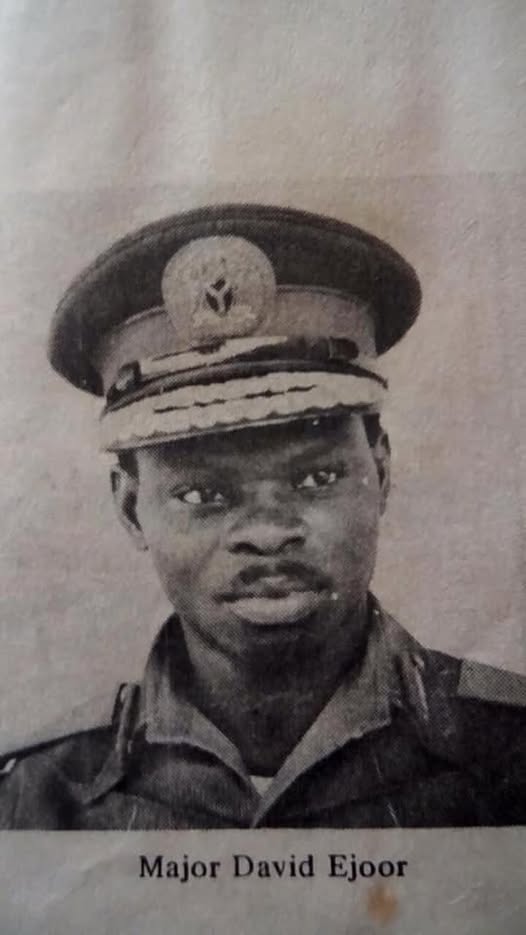
Maj. Gen. David Ejoor (1971–1975)
David Akpode Ejoor RCDS, PSC, (10 January 1932 – 10 February 2019) was a Nigerian military officer who served as Chief of Army Staff (COAS).
Continued under Gowon and briefly under Murtala Muhammed.
Military Rule and Transition
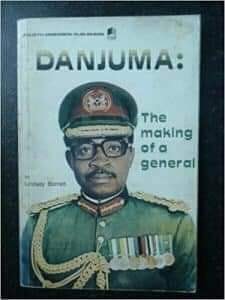
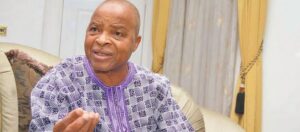
Lt. Gen. Theophilus Danjuma (1975–1979)
LT. GEN. TY DANJUMA (RTD)
The 7th Chief of Army Staff
~1975 – Oct 1979
TY Danjuma’s Military And Political career..
General TY Danjuma Is one of the most significant figures in the Nigerian army. Aside that, he is a political leader and a multi-billionaire businessman.
Early years and education
General TY Danjuma, who was born as Theophilus Yakubu Danjuma on December 9th, 1938, is a soldier, businessman, politician, and philanthropist, who always managed to combine all of his careers. His native town is Takum in Taraba State. He was born to into the family of Kuru Danjuma, the farmer who was also specialized in metal parts trade for farming purposes, and his wife Rufkatu Asibi.
The birth town of Theophilus Danjuma, Takum, was a farming community, where the crops like rice, yams, ]and cassava were widely cultivated all around the neighborhood. There were clans and families who were involved in the production of crops.
Theophilus came from the respectable family – his father was very highly respected in the society for being a hardworking and dedicated peasant, and all the ancestors of his family were also very important people for Takum.
The young Theophilus Danjuma first started his basic education at the St. Bartholomew’s Primary School, which was situated in Wusasa. Later, he moved on to study at the Benue Provincian Secondary School, located in Katsina-Ala.
In this school, he was very popular among his classmates and teachers. He did sports and even was a captain of the school cricket team. In 1958, Theophilus received the Higher School Certificate. The young man decided to enroll at the Nigerian College of Arts, Science, and Technology, situated in Zaria (Ahmadu Bello University).
In this school, he made a decision to study History, by also receiving the Northern Nigeria Scholarship. Still, Theophilus Danjuma was forced to leave the university halfway through studies, in 1960. He went on to enroll in the Nigerian Army, where his amazing military career took a start.
General TY Danjuma, his army career, and business ventures…
Theophilus Danjuma first arrived into the Nigerian Army being a second lieutenant, as well as the platoon commander in the Republic of Congo. In 1963, Danjuma joined the peace-keeping forces in Katanga Province, one of the Congo regions. Three years later, he managed to get promoted to the title of captain. 1966 was the year when Captain Theophilus Yakubu Danjuma was participating in the Nigerian Counter-Coup, leading the fourth battalion in the town of Mokola, Ibadan.
Only a year later, in 1967, Danjuma succeeded in getting a promotion to the lieutenant colonel. This was the time when civil war campaign started towards Enugu, the city which was later captured. Around the ending of Nigerian Civil War, Theophilus Danjuma once again led the battalion, which freed a few important people from detention, which was coming from the Ojukwu government. Among those, there were the first Speaker of the House of Representatives – Jaja Wachuku, as well as the first Foreign
Affairs Minister and Ambassador to the United Nations.
1970 was a prominent year for Theophilus Danjuma – he paid a visit to the International Court Martial, which was held in Trinidad and Tobago. He was the official representative of Nigeria. TY Danjuma was appointed as a tribunal president in the important case. This case was brought against the failed coup attempt members, which happened in Trinidad and Tobago.
In 1971, Theophilus Danjuma was promoted to Colonel, and the next two years he spent in huge responsibility, court marshaling the officers of Army, who were proven to be guilty of the crimes like indiscipline and corruption.
After a few years of hard work, Theophilus Danjuma was once again promoted to Brigadier. He was also given an important position of General Officer Commanding. The next year, he became Chief of Army Staff, working along the Head of State, Olusegun Obasanjo.
TY Danjuma played a very important part in the support of the President in resistance to the Dimka Coup, which took place in 1976. In 1979, Theophilus Danjuma finally decided to retire from the Nigerian army.
TY Danjuma leading the army in 1976.
This was the full career path of TY Danjuma in the military. However, after his army retirement, he took up entrepreneurship and developed a few profitable businesses, which are still thriving. Here are the descriptions of the well-known business ventures which were lead by Theophilus Danjuma:
Nigeria America Line (NAL). This business was established in 1979, shortly after General TY Danjuma retired from the Nigerian army. This is a sea trade business, which has grown bigger over the years.
Initially, it started with the release of the ship named “Hannatu”, which was used to trade between Lagos and the Brazilian city Santos, when the trade agreement in Nigeria opened the main economic sea routes to the markets of South America. Later, NAL won the patronage from NNSC (Nigeria’s National Supply Company), which it brought the government goods from.
The client base of NAL kept expanding throughout the years, including the Nigerian and international customers. It also became an official member of a few important conferences in Nigeria, North America, and South America. NAL started out with a staff of twelve people in 1979, all of whom were core indigenous.
In 2009, the staff was close to 250 people. Nowadays, it is called the NAL-COMET Group, and it has the main office in Lagos and the branch offices in Port Harcourt, serving the seaports of Calabar, Onne, and Warri.
COMET Shipping Agencies Nigeria LTD. This organization was established by Theophilus Danjuma in 1984, and the first purpose of it was acting as the agent of NAL. However, with time, COMET has grown and expanded. In 2005, this operator managed to acquire a “roll-in, roll-out” port in Lagos, and this made COMET the largest port operator in Africa which acts independently.
South Atlantic Petroleum Ltd (SAPETRO). This is a company which specializes in exploring and producing oil in Nigeria. It was founded by General Danjuma in 1995. In February 1998, this company was awarded with the Oil Prospecting License 246 by the Nigerian Ministry of Petroleum Resources.
NatCom Development & Investment Ltd. NatCom was created in 2016, and the General was announced to be a chairman during the board meeting. This is the network connection company, which provides internet connections in Nigeria, called Ntel.
TY Danjuma political career….
General Danjuma has been in Nigerian politics for about twenty years. He first stepped on Nigerian political arena in 1999, and a few of the key points in his career have been:
The appointment as the Minister of Defense in the cabinet of President Olusegun Obasanjo (1999)
The appointment as Chairman for the investigative committee on the conflict in Warri (2003)
The nomination for the Chairman of Presidential Advisory Council, under the active President Goodluck Jonathan (2010)
He always stood for democracy, as well as the Rule of Law. TY Danjuma was responsible for renaming the barracks and cantons in Nigeria after the civilian and living people.
TY Danjuma is Chairman of Victims’ Support Fund Committee. The main aim of this organization is supporting terrorism victims.
TY Danjuma Foundation
General Theophilus Yakubu Danjuma also has his own foundation, which he established in December 2008.
The main purposes of this organization are providing durable advantages by implementing various programs of development.
The TY Danjuma Foundation battles poverty in the Nigerian communities. The organization provides the basic amenities to people, as well as helps children, teenagers, and young adults get the necessary education that they need. It also provides the primary medical care to the indigent people.
Currently, the TY Danjuma Foundation is closely cooperating with more than fifty non-governmental organizations from all over Nigeria.
TY Danjuma’s family….
Theophilus Danjuma has a very influential younger brother, whose name is Musa. Musa Danjuma is a very famous businessman, who works with his brother on some projects – for instance, COMET Shipping Agencies and Nigerian America Line Ltd.
Musa Danjuma is a billionaire who has managed to set his own business empire and balance it with his personal life. He was married to the gorgeous Nigerian actress Caroline Danjuma, and they have three children.
General TY Danjuma has a loving family. His wife is a very influential woman, just like him. TY Danjuma wife is called Daisy Ukpomwan Ehanire Danjuma (she goes by just Daisy Danjuma), and she is a senator.
She was born on August 6th, 1952, and her native city is Benin City, Edo State.
In 1976, Daisy graduated from the Ahmadu Bello University, where she studied Law. She also was a student of the Lagos Business School. 1977 was the year when Daisy was called to Nigerian Bar. After serving her NYSC, she became an Executive Assistant to the Nigerian Acceptances Ltd, where she served from 1977 to 1978. For ten years, from 1982 to 1992, Daisy was a Company Secretary and Legal Adviser at the Nigerian Television Authority.
She later ventured into politics and was elected as a Senator of Nigeria, the Representative of Edo South. During her time at the Senate, she was a member of CPA (Commonwealth Parliamentary Association), as well as many other parliament groups.
TY and Daisy Danjuma have been together for a very long time. They both are each other’s second marriage. Both TY and Daisy have children from their previous marriages. Their children are already grown and are establishing their own families. For instance, Yuki Omenai, Daisy’s son from his ex-husband Henry Omenai had a luxurious wedding ceremony with his sweetheart Omobolanle Moriam Rotimi a few years ago.
Another son of the senator, Osagie Omenai, also got married. And TY Danjuma’s son Ishaya got married to the beauty queen, Agbani Asenite Darego, who was the first African woman to win the Miss World competition in 2001. All of their children are closely involved in different kinds of business and are influential people in their respective fields.
It should also be mentioned that one of TY Danjuma’s sons, Theo, is a very talented artist. He studied art in London, and now he has opened a lot of successful exhibitions in cooperation with other artists.
Served under Gen. Olusegun Obasanjo’s military government.
Lt. Gen. Ipoola Akinrinade (1979–1980)
Lieutenant general Ipoola Alani Akinrinade CFR FSS (born 3 October 1939) is a retired Nigerian military officer who was Chief of Army Staff (COAS) from October 1979 to April 1980, and then Chief of Defence Staff until 1981 during the Nigerian Second Republic.
Birth and education
Akinrinade was born on 3 October 1939 at Yakoyo near Ile Ife, Osun State old Oyo State.
He attended Offa Grammar School for his secondary education (1954–1958).
He worked at the Ministry of Agriculture in the Western Region, Ibadan (1959–1960).
Joining the army, he began officer cadet training at the Royal Nigeria Military Forces Training College, Kaduna in April 1960, then went to the Royal Military Academy Sandhurst in the United Kingdom (August 1960).
He was commissioned as second lieutenant in the Infantry Corps on 20 December 1962.
Later he took the Infantry Officer Career/Airborne Course in the USA (August 1965 – July 1966), attended Staff College Camberley (January – December 1971) and attended the Royal College of Defence Studies in the United Kingdom (January – December 1978).
Military career
Akinrinade rose steadily through the ranks. He was promoted lieutenant on 29 March 1963, captain on 29 Mar 1965, major on 10 June 1967, lieutenant colonel on 11 May 1968, colonel on 1 October 1972, brigadier general on 1 October 1974 and major general on 1 January 1976.
He held various infantry appointments, becoming commander of the Ibadan Garrison (1970–1971) and GOC of 1 Infantry Division (1975–1979).
He was a member of the Supreme Military Council during the military regime of General Murtala Muhammed and Olusegun Obasanjo (1975–1979).
He was promoted to lieutenant general on 2 October 1979 and appointed Chief of Army Staff, and then became Chief of Defence Staff in 1980, during the civilian administration of Shehu Shagari.
He voluntarily retired from service with effect from 2 October 1981.
Later career
After retirement, Akinrinade engaged in large-scale farming and was chairman of Niger Feeds and Agriculture Operations (1982–1985).
In General Ibrahim Babangida’s government he was appointed Minister of Agriculture, Water Resources and Rural Development (1985–1986), Minister of Industries (1988 – February 1989) and Minister of Transport (1989).
He became a member of the National Democratic Coalition (NADECO), a pro-democracy group, during the Sani Abacha regime
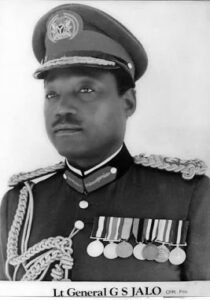
Lt. Gen. Gibson Jalo (1980–1981)
Lieutenant General Gibson Sanda Jalo, CFR, FSS (1 March 1939 – 10 January 2000), was one of Nigeria’s finest military officers, remembered for his discipline, professionalism, and quiet leadership. He served as Chief of Army Staff from April 1980 to October 1981 and later as the country’s second Chief of Defence Staff from October 1981 until December 1983. His military career, which began in 1959, spanned more than two decades of dedicated service, from the early days of independence through the turbulence of the Nigerian Civil War and the nation’s post-war rebuilding.
Born into the royal family of Demsa in Adamawa Province (then part of British Northern Nigeria), Gibson Jalo was the son of Chief Zaro (Jalo) Kpanti, the Hama Batta, Paramount Ruler of the Batta people, and Madam Kukulu Laiyatu Jalo. His royal upbringing instilled in him a sense of discipline, service, and responsibility that shaped his later life in the military.
Jalo began his education at Numan Elementary School (1946–1950) and continued at Yola Middle School (1951–1952). He later attended the prestigious Keffi Government College (1953–1958), where he became known for his intelligence and leadership. He remained an active member of the Keffi Old Boys Association (KOBA) and maintained lifelong friendships with classmates who later became prominent Nigerians, including the late Wantaregh Paul Unongo and Dr. Nuhu Andeyaba.
In September 1959, Jalo enlisted in the Infantry Corps of the Royal Nigerian Military Force and was commissioned as a Second Lieutenant on 4 November 1960 after training at the Regular Officers’ Training School, Teshie, Ghana, and the Mons Officer Cadet School, Aldershot, United Kingdom. His early service years were marked by steady progress and professionalism — from Platoon Commander to Battalion Adjutant, Company Commander, and eventually Battalion Commander.
During the Nigerian Civil War (1967–1970), Jalo played a significant role. He served first as Second-in-Command of the 2nd Division and later as its Commander in Benin, where he demonstrated strategic skill and leadership under pressure. After the war, he held several key positions: Garrison Commander, Lagos (1971–1972); Deputy Commandant of the Nigerian Defence Academy (1973–1974); and later Commandant of the Academy (1975–1977), where he helped shape a generation of young Nigerian officers.
His rise continued as he became General Officer Commanding (GOC) the 3rd Infantry Division (later 3rd Armoured Division) in Jos from 1977 to 1979, and then Deputy Chief of Army Staff. In April 1980, he was appointed Chief of Army Staff, and in 1981, he succeeded Lieutenant General Ipoola Alani Akinrinade as Chief of Defence Staff — a position he held until the end of the Second Republic in 1983. He was succeeded by General Domkat Bali.
Jalo also served on the Supreme Military Council and the National Defence Council, and at one point in the 1970s, briefly acted as the Military Governor of Lagos State. His professional development included studies at the Joint Services Staff College, Latimer House, United Kingdom, and the National Defence College, India — experiences that broadened his global military perspective.
After voluntarily retiring from the Nigerian Army on 3 January 1984, Jalo ventured into the private sector with remarkable success. He chaired several companies, including Société Bancaire Nigeria Limited, Mix and Bake Flour Mills Limited, and Sea Trucks Group Nigeria. He was also a Non-Executive Director of Union Bank of Nigeria and Chairman of Jason Oilfield Ventures Limited. Beyond business, he continued to contribute to national development as a member of the Traditional Rulers and Leaders of Thought Committee and later chaired the Sub-Committee on Solid Minerals within Nigeria’s Vision 2010 initiative.
For his service and contributions, Jalo received numerous honours, including the Commander of the Federal Republic (CFR) and the Force Service Star (FSS).
Outside his official duties, he was known as a lover of sports, particularly field hockey and football, earning the affectionate nickname “7 Miles” for his stamina on the field.
Lieutenant General Gibson Sanda Jalo passed away in London on 10 January 2000, leaving behind a legacy of honour, discipline, and national service. From the quiet town of Demsa to the pinnacle of Nigeria’s military leadership, his life embodied dedication to country and commitment to excellence.
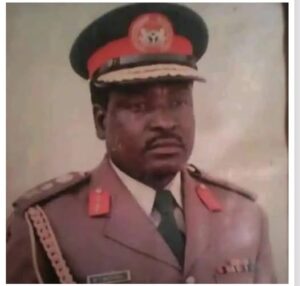
Lt. Gen. Mohammed Wushishi (1981–1983)
Mohammed Inuwa Wushishi born to a Nupe Family with honored CFR GCON (1 January 1940 – 4 December 2021) was a Nigerian Army Lieutenant general who served as Chief of Army Staff (COAS), Nigeria from October 1981 to October 1983 during the Nigerian Second Republic.
Lieutenant general Mohammed Inuwa Wushishi who was a Nigeria Chief of Army Staff In office from October 1981 – October 1983 Preceded by Gibson Jalo Succeeded by Ibrahim Babangida
– Personal details:
Born 1 January 1940 at Wushishi, Northern Nigeria, Nigeria
– Died on 4th December 2021 (aged 81) in London, England
– Nationality: Nigerian
– Military service: Allegiance Nigeria, Branch service, Nigerian Army
– Years of service: 1961-1984
– Rank: Lieutenant general
Inuwa Wushishi was born in Wushishi, North Nigeria, and was a Nupe Muslim from Niger State.
Army career
Wushishi joined the army on 21 April 1961, and attended the Nigerian Military Training College, Kaduna, and then the Mons Officer Cadet School, Aldershot in the United Kingdom. Kazaure Technical School.
He was commissioned as a second lieutenant on 12 January 1962.[4] He later attended the United States War College, Carlisle, Pennsylvania.
Wushishi served as a member of the United Nations Peace Keeping force in Congo in the early 1960s.
He was appointed Deputy Commandant, Army School of Infantry in July 1975.
He served as Federal Commissioner for Industries (January 1975 – March 1976) and was a member of the Supreme Military Council from 1976 to 1978.
He was Chief of Army Staff (COAS) from October 1981 to October 1983 during the Shehu Shagari administration.
Later career
Wushishi was required to retire on 3 January 1984, after the 31 December 1983 coup in which General Muhammadu Buhari came to power.
After retirement, he entered business. He became chairman of the board of directors of UAC of Nigeria, retiring on 1 January 2010 at age 70.
He was also Chairman of the board of UPDC (property development), a director of Stanbic IBTC Bank and MTS first Wireless, and a member of the board of Acorn Petroleum.
He received the national honour of Grand Commander of the Order of the Niger.
Wushishi died on 4 December 2021 in London, at the age of 81.
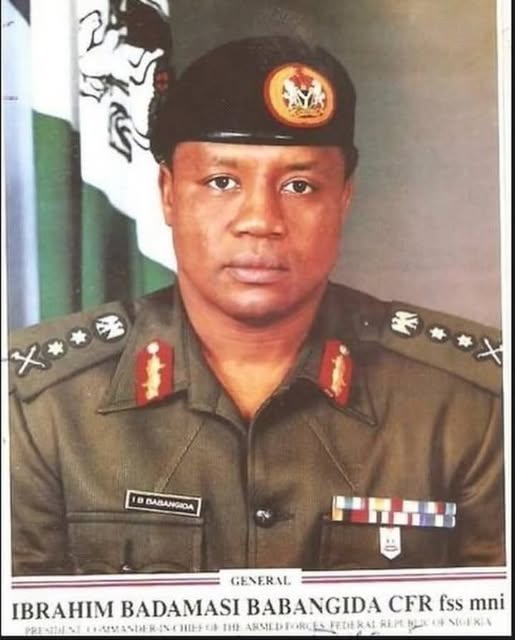
Maj. Gen. Ibrahim Babangida (1984–1985)
Became COAS under Gen. Muhammadu Buhari before seizing power himself.
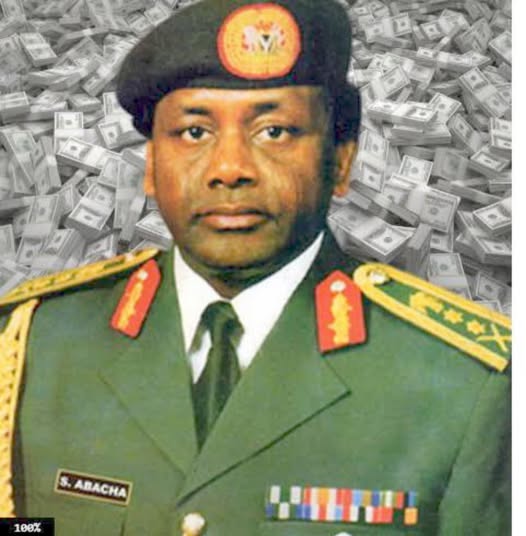
Lt. Gen. Sani Abacha (1985–1990)
Abacha served as Chief of Army Staff from 1985 to 1990, as Chief of Defence Staff from 1990 to 1993, and as Minister of Defence. Abacha is noted for having been the first Nigerian Army officer to attain the rank of general without skipping a single rank
Lt. Gen. Salihu Ibrahim (1990–1993)
Lt. General Salihu Ibrahim (retired) was born on June 25, 1925 in Kaduna, Kaduna State, Nigeria.
was a Nigerian army general who was Chief of Army Staff during the military regime of Ibrahim Babangida.
Lt. Gen. Aliyu Gusau (1993)
Aliyu Mohammed Gusau (born 18 May 1943) in Gusau, Zamfara State is a Nigerian general and statesman. He has held several high level national security, military and intelligence offices, and has participated in several military coups, playing a central role in founding the Fourth Nigerian Republic.
He was most recently the Minister of Defence, and has served as National Security Adviser to three presidents; he was also the Chief of Army Staff during Ernest Shonekan and briefly Sani Abacha’s regime, headed different intelligence agencies, and was commandant of the Nigerian Defence Academy.
Maj. Gen. Chris Alli (1993–1994)
Mohammed Chris Alli (25 December 1944 – 19 November 2023) was a Nigerian Army major general who served as Chief of Army Staff from 1993 to 1994 under General Sani Abacha’s regime and was military governor of Plateau State Nigeria from August 1985 to 1986 during the military regime of General Ibrahim Babangida. Many years later, he was appointed interim administrator of the state during a 2004 crisis in the state following ethno-religious killings in Shendam, Yelwa Local Government.
Maj. Gen. Alwali Kazir (1994–1996)
Major General Alwali Jauji Kazir an indigene of Bade Emirate in Jakusko Local Government of Yobe State, was born to the family of Usman Jauji Kazir and Salamatu Gagiyo Kazir, on 2 August 1947 at Kazir Bula.
EDUCATIONAL BACKGROUND
He enrolled into Amshi Primary School, just eight kilometres from his village, Kazir, where he lived with an Aunt for part of the three years he spent there, save for a brief period, when the Headmaster, Mallam Kaigama Gambo asked him to stay with him as an errand boy.
In 1958 he was sent to Central Primary School Gashua, where two of them that excelled in the class were to further their education. There they lived in a boarding house. Senior Primary School Potiskum was the next destination in 1959, from there moving to Government College (now Barewa College) Zaria in 1962 was to gladly follow.
MILITARY CAREER
While military service had been in the family, as Alwali’s uncle and a cousin participated in the Second World War, his interest in the military was rekindled in Barewa College where he joined the Cadets Corps unit in 1964. Just as he had done very well in all the previous schools he had attended, he showed his potential for a good military officer where he exhibited leadership qualities and attributes of successful Military Officers. There he heard about the Gowons, the Maimalaris, the Hassans, and the Murtalas. In the Cadets Corps he rose to the rank of Cadet Sergeant Major, thus becoming the most senior cadet in the Unit. Being a Cadet Sergeant Major encouraged him further, and in particular when he observed the orderliness, discipline and smartness in the military, which was again strengthened by the encouragement he received from serving military officers, other ranks and the PSI (Permanent Staff Instructor), a Veteran of the Second World War that were training them at that level. He was particularly encouraged by Capt. Paul Turton the physics teacher, a Retired British Army Officer of the Corps of Artillery. That interest in the military saw Alwali proceeding to the Nigerian Defence Academy, at a time when Barewa College had already lost four senior military officers from the Alma-mater, as a result of the 1966 coup; the urge to replace those lost officers and also answer the clarion call, TO KEEP NIGERIA ONE WAS A TASK THAT MUST BE DONE, gingered him to take up the challenge. At the Academy, he joined the Third Regular in 1967 offering maths, physics, and chemistry, as combination against what he had offered in the Barewa High School Certificate Course (HSC), where he had offered Maths, Geography and History. His performance at the Academy offered him the opportunity to gain some day’s seniority on commission when his seniority was back dated to 27 August 1967, instead of 3 September the date the course commenced training.
APPOINTMENTS HELD
On commission on 14/15 March 1970, he was posted to 3 Artillery Regiment, 3 Marine Commando Port-Harcourt, where he was straight away appointed as a Battery Commander and, a year later he was appointed Adjutant of the Unit.
Military postings took him to Ikoh-Ekpene, Bauchi, Lagos, School of Artillery Kachia, Kaduna, Jos; holding Artillery appointments, and finally his appointment as CCA (Commander Corps of Artillery) based in the Bonny Camp, Victoria Island Lagos, after holding a brief appointment at the Presidency Dodan Barracks as Principal Staff Officer to the President, General Babangida in 1987, immediately his return from US Army War College (USAWC).
Alwali’s appointment as Military Governor of Kwara State came to him as a surprise, as he had never expected that, especially as he had served in the Army Headquarters department of Special Duties (SD) and Plans, now Policy and Plans as General Staff Officer One and Colonel General Staff. In Kwara, he performed very well, earning for himself the appellation, “Action Governor”, given to him by Kwarans who appealed against his posting after one year in the State.
Alwali was Director Army Faculty at Command and Staff College (now Armed Forces Command and Staff College) Jaji, in Kaduna State. After the unfortunate Charlie 130 (C-130) accident at Ejigbo in 1992 , all exercises and TEWTS (Tactical Exercises Without Troops) in the college were reviewed, taking into account contemporary situation and changes in the security situation in the country and globally.
All Alwali’s appointments were in accordance with military traditions of attending relevant courses at home as well as abroad. In fact, he attended more courses abroad than at home; Artillery Basic Course in USA, Artillery locating course in Nowshera, Pakistan; Battery Commanders Course on 122mm Howitzer in the old Soviet Union. Long Gunnery Staff Course UK, and Regimental Commanders Course in Jaji; culminating in the United States of America War College Carlisle in 1986/87.
General concluded his eventful military career, by holding the enviable post of the Chief of Army Staff (COAS), after gaining useful experiences as the General Officer Commanding 1 Division, Kaduna (GOC) and the Military Secretary (MS) of the Nigerian Army (NA).
In all appointments he held, Alwali performed creditably well, bringing about changes for the benefit of the NA and the Nation in general. As COAS, he saw to the evacuation of casualties to Egypt for medical treatment, which was successfully carried out.
He visualized the problems of the NA and set to solve them first by articulating his ideas in three handouts; “My Philosophy for the Nigeria Army, and realistic training in the contemporary environment”.
Alwali could be said to be a visionary; he produced a booklet, “The Low Intensity Conflict in the Contemporary Nigeria in 1995”, bringing to the fore new threats that had to be faced using different approaches from the conventional way of fighting; that is what is being referred to today as “Asymmetrical warfare” or the latest;” fourth Generation Warfare”.
Having rose through the ranks and became the COAS and contributed his quota to the development of the NA. The Obasanjo’s administration in 2003 awarded Gen Alwali the National Award of the Commander of the Order of the Federal Republic (CFR).
ACHIEVEMENTS AS CHIEF OF ARMY STAFF (COAS)
Worthy of note are the following that Alwali initiated / carried out during his tenure as COAS, from Aug’1994 to March 1996:
General renovation of dilapidated barracks in various locations.
Laying the foundation stone for the Small Scale Drug Manufacturing Unit.
Introduction of the Post Housing Scheme for Officers and Soldiers.
Enhancement of Soldiers take home emoluments and allowances peculiar to service personnel.
Commissioning of the Warrant Officers Academy, Jaji.
General re-kitting of Officers and Soldiers, complete from head to toe.
Medical evacuation of Officers and Soldiers overseas for medical treatment.
Morale boosting visit of troops in Mission area in Rwanda and Sierra Leone.
Alwali participated in the Political Reform Conference convened by President Olusegun Obasanjo in 2005 as Vice Chairman of the Security Committee. Thereafter, he was appointed member of NIPSS Board of Governors from 2009 to 2015. He is currently a member of Barewa Old Boys Association as its first vice President and Chairman Fund Raising Committee for running the Association. Alwali is the Vice Chairman Alumni Association of the 3rd Regular Course and the Chairman Planning Committee for the Course’s Golden Jubilee Celebration in 2017. In recognition of his contributions to the development of the Country while holding many extra regimental offices, Governor of Kwara State (1990-1991), Principal Staff Officer to Mr. President in 1987, and finally the Abuja University honored him with Doctor of Political Science in Feb’ 2020. On 28 Sep 21, the President and Commander in Chief of the Armed Forces Federal Republic of Nigeria appointed Gen Alwali Jauji Kazir through the Minister of Defence the Chairman of the Committee on the Reform of Ministry of Defence and the Armed Forces of Nigeria. A role he carried out diligently. He is also a member of the Boards of Private Companies whose focus is the development of the NA in particular and the Armed Forces in general with a view to improving the wellbeing of service personnel. He was an Independent Director Board of Kano Electricity Distribution Company (KEDCO) from 2013 – 2022. Major General Alwali Jauji Kazir during his illustrious Military career was awarded the following Army Medals:
Forces Service Star (FSS)
Meritorious Service Star (MSS)
Distinguish Service Star (DSS)
Command Medal (CM)
Grand Service Star (GSS)
Corps Medal of Honour (CMH)
General Alwali Jauji Kazir (Rtd) received accolades during his career as well as on retirement. He was awarded Doctor of Political Science Degree by University of Abuja 15th February, 2020. Similarly on 4th October, 2022 the prestigious Nigerian Defense Academy awarded him a Doctor of Military Science Degree. So many other routine activities too numerous to enumerate. Alwali is a holder of a traditional title, the “MADAKIN BADE”, in addition to so many other titles bestowed on him in Kwara State especially the Honorary Son and Chief (Agba Akin) of Erin-Ile. He is happily married to Hajiya Hajara and they have seven children.
Maj. Gen. Ishaya Bamaiyi (1996–1999)
Ishaya Rizi Bamaiyi, GCON (born 21 September 1949) is a retired Nigerian Army lieutenant general who served as Chief of Army Staff from 1996 to 1999 during the military regime of Generals Sani Abacha and Abdulsalami Abubakar.[1] His older brother was Major General Musa Bamaiyi, former Head of the National Drug Law Enforcement Agency (NDLEA).
He was born in Kebbi State, Northwestern Nigeria. He was Short serviced commissioned into the Nigerian Army infantry Corps in 1968 as a member of SSC 4 he attended the following courses:
Nigerian Defence Academy, Kaduna, 1968
Young Officers infantry Course 1971
Advanced Infantry Company Commanders Course, UK, 1976
Command and General Staff College, United States 1981-82
International Management Course, USA, 1986
Snr. Executive Course, National Institute for Policy and Strategic Studies, Kuru, Jos. 1992
Military career:
General Bamaiyi prior to becoming the Chief of Army Staff held the following posts:
Adjutant. 182 Infantry Battalion. 1968-70
Commanding Officer 70 Infantry Battalion, 1972–77
Directing Staff, Command and Staff College, Jaji, 1982–84
Commander. 9 Mechanised Brigade, 1986–90
Commander, Brigade of Guards, 1990–92
Director Training, Army Headquarters, Department of Operations, 1992–93
Commander. Lagos Garrison Command. 1993-96
General Bamaiyi was appointed Chief of Army Staff (COAS) in March 1996 by General Sanni Abacha. He served as COAS for 3 years until his retirement in May 1999.
On 10 December 1999 Gen. Bamaiya was charged with the attempted Murder of Guardian Newspaper Publisher Alex Ibru on 2 February 1996 alongside the former Chief Security Officer (CSO) to Gen Abacha, Major Hamza al-Mustapha, and others by the Lagos state government. Bamaiyi who served under the military administration of late General Sani Abacha was arraigned by the Lagos state government of the attempted murder of publisher of the Guardian newspaper, Mr. Alex Ibru, and an eminent Delta state indigene, Mr. Isaac Porbeni. He was discharged and acquitted on 2 April 2008 of any wrongdoing in the saga after nine years in detention.
Ishaya and his older brother, Musa Bamaiyi reportedly feuded for years leading to Musa seeking redress from the Human Rights Violation Investigation Commission (HRVIC) Panel, headed by Justice Chukwudifu Oputa.
Served under Abacha’s authoritarian regime and later Gen. Abdulsalami Abubakar.
Democratic Era and Modernisation
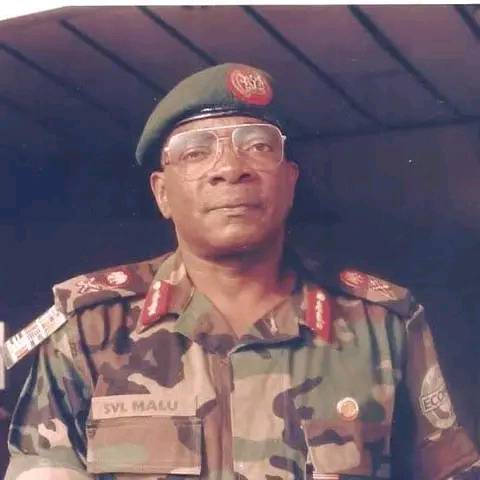
Lt. Gen. Victor Malu (1999–2001)
Victor Samuel Leonard Malu (15 January 1947 – 9 October 2017)[1] DSS mni fwc psc was Nigeria’s Chief of Army Staff (COAS) from 1999 to 2001 and Force Commander of the ECOMOG peace-keeping force in Liberia from 1996 to 1998.
Malu was born on 15 January 1947 at Katsina-Ala, Benue State of Tiv origins. He enrolled in the Nigerian Defence Academy, Kaduna in 1967 as part of the 3rd Regular Course and was commissioned as a 2nd Lieutenant enlisted upon graduation in 1970.
Lt. Gen. Alexander Ogomudia (2001–2003)
Alexander Odeareduo Ogomudia CFR DSS fwc psc(+) MSc FNSE (born 29 December 1949) is a retired Nigerian army general who served as Chief of Defence Staff of Nigeria from 2003 to 2006 and Chief of Army Staff from 2001 to 2003.
The Nigerian Army officially described the four star Service Chief as “General” Alexander Odeareduo Ogomudia who was born on 29 December 1949, at Uzere in Isoko South Local Government Area in Delta State of Nigeria.
Lt. Gen. Martin Agwai (2003–2006)
Martin Luther Agwai CFR FSS MSS DSS fwc (born 8 November 1948) is a retired Nigerian Army general who served as Chief of Defence Staff and Chief of Army Staff. He was the 13th Pro-Chancellor and Chairman of Governing Council of the University of Calabar
Early life and education
Agwai was born on November 8, 1948, in Kagoro a city in Southern Kaduna Kaduna, a city in Northern Nigeria, to the family of Agwai Gidan Mana, a Police Constable and Shera Agwai, a housewife. He hailed from Gidan Mana in Kachia Local Government Area of present day Kaduna state.
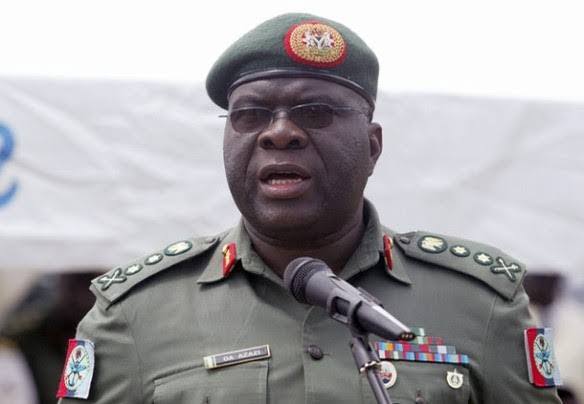
Lt. Gen. Owoye Azazi (2006–2007)
Owoye Andrew Azazi CFR FSS GSS DSS MSS CMH (1 February 1952 – 15 December 2012) was a Nigerian army general who served as National Security Adviser to President Goodluck Jonathan, was Chief of Defence Staff (CDS) of Nigeria, and Chief of Army Staff (COAS).[1] Before his first service chief appointment (COAS), he was General Officer Commanding (GOC) 1 Division, Kaduna State
Azazi was born at Peretorugbene in present Bayelsa State on 1 February 1952
Served under President Obasanjo’s democratic government.
Luka Nyeh Yusuf CFR GSS GPP DSO psc(+) fwc Msc (22 September 1952 – 2 June 2009) was a Nigerian army lieutenant general who served as Chief of Army Staff (COAS) from 2007 to 2008. He succeeded Owoye Andrew Azazi as Chief of Army Staff.
Yusuf was born on September 22, 1952, in Bara-Kagoma, Kaduna State. He attended the Nigerian Defence Academy (NDA) and was commissioned as a 2nd Lieutenant into the Nigerian Army Artillery Corps in 1975 and was a member of the Nigerian Defence Academy (NDA) Course 14. Others in his NDA class were officers such as former Chief of Defence Staff, Air Chief Marshal Paul Dike
Yusuf served as Commander of the Nigerian military contingent to United Nations Mission in Sierra Leone (UNAMSIL) before being appointed in 2006 as Commander in Charge of the Armed Forces of Liberia by Liberian President Ellen Johnson Sirleaf. Upon Yusuf’s appointment as Nigeria’s Chief of Army Staff by President Umaru Yar Adua in 2007, Liberia’s President awarded General Yusuf with Liberia’s Honor of Distinguished Service. He will always be remembered for his contributions in the area of bringing peace to the troubled Niger Delta Region where he described the militants as misguided children. He said that though the Nigerian Army has the wherewithal to deal with the militants, it was better for the nation to take the path of dialogue than confronting the militants in an all out offensive.
He also said all soldiers had the right to sue the army if they felt they had been slighted in any way and if any judgment was given in favour of the complainants, the army would abide by any court ruling.
His words, “I am a fulfilled man, we have been able to achieve monumental feats because, compared to the last 30 years, the difference in the last one year has been immense. We set the Army on a transformation path, we beefed up training, Eagle Ex-Ring 1V 2007 and NADCEL 2008 is an attestation to this fact. In addition to several unit level trainings, preparations are currently on for others now. My appeal, however, is that the maintenance of our equipment should not be compromised.’’
He said, “we were 101 that got admission into NDA in 1973; only 67 came through two years later. Today, 28th of August 2008, I am the last man standing among the 14th Regular Course. I am an extremely fulfilled man. I am proud to have tasted battles and commanded the Nigerian Army, the pride of every soldier”.
Yusuf was very particular about the welfare of his men. “Never in the history of the Army have barracks been renovated enblock as five barracks are slated for renovation, meaning that in four years, all Army barracks in the country would have been renovated. We also made sure that our troops on peace support operations get their full allowances as stipulated by the United Nations. It has never happened before”.
He also launched the Barracks Youth Foundation for the upliftment of the teeming youngsters in the barracks.
He also cherished the transformation of the Army and he put so much energy into the realisation of that dream.
Yusuf died in London on June 2, 2009, after a protracted illness at the age of 56.
Lt. Gen. Abdulrahman Danbazau (2008–2010)
Lt. Gen. Abdulrahman Bello Dambazau (retd) CFR, GSS, PSC, NDC, FWC (born 14 March 1954) is a retired Nigerian army general and politician who served as Chief of Army Staff between 2008 and 2010 and in President Muhammadu Buhari‘s Cabinet as Minister of the Interior from 2015 to 2019.
Lt. Gen. Abdulrahman Bello Dambazau (retd) was born into an aristocratic military class family of the Fulani Dambazawa clan. His father served in the Colonial Army, and his brothers held senior posts in the army. He also holds the traditional title of Baraden Kano.
Served under President Umaru Musa Yar’Adua.
Lt. Gen. Azubuike Ihejirika (2010–2014)
Lieutenant General Azubuike Ihejirika(Rtd) is a distinguished retired Nigerian Army officer who served as the Chief of Army Staff from September 2010 to January 2014. Born on February 13, 1956, in Isuikwuato, Abia State, Ihejirika had a notable military career marked by his efforts to combat Boko Haram terrorists and other security challenges.
During his tenure, Ihejirika led the Nigerian Army’s efforts to stem the tide of Boko Haram insurgency, particularly in the North-East region. He emphasized the need for a proactive combat approach, stating that amnesty or dialogue with the sect was not the army’s primary concern, but rather protecting human lives. Ihejirika also established new army brigades and counter-terrorism schools to enhance the military’s capacity to tackle security threats. Additionally, his leadership helped crush the notorious kidnap kingpin, “Osisikankwu,” who had been terrorizing Abia State.
However, Ihejirika faced controversies and allegations, including being falsely accused by Australian negotiator Stephen Davis of sponsoring Boko Haram in August 2014. The State Security Service (SSS) later absolved him of these claims, confirming his innocence. Ihejirika also accused Nasir El-Rufai, a former Minister of the Federal Capital Territory, of being a key supporter of Boko Haram, alleging that El-Rufai hindered the military’s efforts to procure necessary equipment to combat the insurgency.
Throughout his career, Ihejirika received numerous awards and honors, including the Commander of the Federal Republic (CFR), Forces Service Star (FSS), Meritorious Service Star (MSS), Distinguished Service Star (DSS), Grand Service Star (GSS), Passed Staff College Dagger (psc(+)), and Fellow National War College (FOC), awarded by President Goodluck Jonathan and the Nigerian Army.
Lt. Gen. Kenneth Minimah (2014–2015)
Kenneth Minimah, CFR GSS, psc(+), fwc (born 27 July 1959) is a retired Nigerian army lieutenant general who served as Nigeria’s Chief of Army Staff (COAS)
Kenneth T. J. Minimah was born on 27 July 1959 in Opobo Kingdom, Rivers State, Nigeria.
Served under President Goodluck Jonathan.
Counterinsurgency and Continuity
Lt. Gen. Tukur Buratai (2015–2021)
Nigeria’s Army Chief , Buratai was born on 24th November 1960 In Biu Local Gov’t Of Borno State.
His honours and awards include;
✔ Forces Service Star (FSS)
✔ Meritorious Service Star (MSS)
✔ Distinguished Service Star (DSS)
✔ Grand Service Star (GSS).
✔ Pass Staff Course Dagger (psc(+))
✔ Field Command Medal
✔ Training Support Medal
✔ United Nations Medal for Angolan
✔Verification Medal II.
Buratai’s promotion dates are:
✔ Lieutenant (January 1985)
✔ Captain (January 1989)
✔ Major (January 1994)
✔ Lieutenant Colonel (January 1998)
✔ Colonel (January 2004)
✔ Brigadier General (January 2009)
✔ Major General (January 2012)
✔ Lieutenant General (August 2015)
Background and education..
His father, Yusuf Buratai, was a non commissioned officer in the Royal West African Frontier Force and World War II veteran who fought in Burma.
General Buratai had his primary education at Buratai town and thereafter gained admission to Government Teachers College Potiskum , Yobe State, where he graduated with distinction.
Military career…..
In January 1981, Buratai attended the Nigerian Defence Academy Kaduna as a member of the 29 Regular Combatant Course (29 RC) where he was given the prestigious appointment of Cadet Sergeant Major (CSM). On successful completion of his Officer Cadet training, he was commissioned as a Second Lieutenant on 17 December 1983 into the Infantry Corps of the Nigerian Army.
Buratai has a degree in History from University of Maiduguri and a degree in Philosophy from Bangladesh University of Professionals , Dhaka. He is also a graduate of National Defence College, Mirpur , Bangladesh.
Position Held:
He served
✔in 26 Amphibious Battalion Elele, Port Harcourt, Military Observer at the United Nations Verification Mission II in Angola;
✔ In 26 Guards Battalion, Lagos; Lagos Garrison Command Camp.
✔ Lt Gen Buratai also served as administrative officer at the State House, Abuja; 82 Motorized Battalion; 81 Battalion, Bakassi Peninsular; Army Headquarters Garrison, Abuja
✔Directing Staff at the Armed Forces Command and Staff College,
Jaji, earning the prestigious “Pass Staff College Dagger” (psc(+)) appellation.
✔ he served at AHQ Dept of Army Policy and Plans, Abuja; Assistant Chief of Staff Administrative Matters, HQ Infantry Centre Jaji.
✔ at the Armed Forces Command and Staff College as Director Dept of Land Warfare from where he was appointed Commander 2 Brigade, Port Harcourt, doubling as Commander, Sector 2 JTF Operation PULO SHIELD.
✔ Upon promotion to the rank of Major General, he was appointed Commandant, Nigerian Army School of Infantry, Jaji; thereafter he was appointed Director of Procurement DHQ .
✔ Force Commander of the newly reconstituted Multinational Joint Task Force (MJTNF) under the auspices of the Lake Chad Basin Commission and Benin Republic, an appointment he held till he became Chief of Army Staff.
His operational deployments include Military Observer at the United Nations Verification Mission II in Angola, Op HARMONY IV in the Bakassi Peninsular, OP MESA, Op PULO SHIELD, Op SAFE CONDUCT, MNJTF, Op ZAMAN LAFIYA and Op LAFIYA DOLE. He was appointed Chief of Army Staff on 13 July 2015.
Led the army through a critical phase of counterinsurgency under President Buhari.
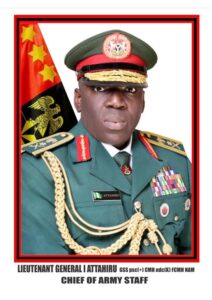
Lt. Gen. Ibrahim Attahiru (Jan–May 2021)
Late Lieutenant General Ibrahim Attahiru was born on 10 August 1966 in Doka, Kaduna North Local Government Area, Kaduna State. He is a graduate of the Nigerian Defence Academy, Armed Forces Command and Staff College and Nigerian Army School of Infantry.
He commenced cadets training in January 1984 and was commissioned in the rank of Second Lieutenant in December 1986 as an Infantry Officer.
General Attahiru has held several appointments on the staff, instructional and in command in the course of his military career. He had a tour of duty with the United Nations in Sierra Leone as a Military Observer, where he facilitated United Kingdom military engagement, Operation BARASS in September 2000.
He was an Operations Officer and later Company Commander in NIBATT 19 ECOMOG Operations in Liberia. Also, he had the unique privilege of having commanded with distinction all through the chain of command in the Nigerian Army. Prominent among these appointments are Commanding Officer 146 Battalion Nigerian Army (Operation HARMONY IV) in the Bakassi Peninsula, Commander 13 Brigade Nigerian Army (Operation PULO SHIELD), General Officer Commanding 82 Division Nigerian Army.
He was one time Theatre Commander Operation LAFIA DOLE (the Counter Terrorism and Counter Insurgency Outfit in North Eastern Nigeria). It is on record that he brought relative stability to the region with the surrender of several Boko Haram combatants.
On the staff, he was unit Adjutant, 7 Battalion Nigerian Army, Sarti. Chief of Staff, 1 Brigade Nigerian Army, Sokoto. General Staff Officer Grade 1 Training/Operations and as well as Staff Duties/Plans at the Headquarters 1, 2 and 81 Divisions of the Nigerian Army. He was Deputy Director Military Secretary 2 at the AHQ MS (A) and one-time Director Army Public Relations and Spokesperson of the Nigerian Army.
He was later Director Staff Duties and Deputy Chief of Policy and Plans at the Army Headquarters. He was equally privileged to serve as Chief of Defence Transformation and Innovation and Chief of Defence Logistics at the apex organ of the Armed Forces of Nigeria, Defence Headquarters Abuja. In that position he worked with the US Defence Logistics Agency on the Vertically Integrated Logistics Approach (VILA) Programme towards enhancing the operational readiness in the Armed Forces of Nigeria.
On the Instructional, he was privileged to be an Instructor at the Depot Nigerian Army, Nigerian Defence Academy and the Nigerian Army School of Infantry.
He was later a Directing Staff and Chief Instructor at the Armed Forces Command and Staff College, Jaji-Nigeria.
General Attahiru has been exposed to leadership and professional development programmes at globally renowned institutions. He was at the National Defence College Kenya for the National Defence Management and Security Studies Course and at the Chinese Peoples Liberation Army Special Forces Academy Shijiazhuang-Hubei Province, China for the Basic and Advanced Special/Operations Commando Forces Courses.
He has undertaken leadership and security policy courses at the prestigious Kennedy School of Government, Harvard University USA, Graduate School of Media and Communication, Agha Khan University Kenya, Bournemouth University Disaster Management Center and the Geneva Centre for Security Policy.
The General has several honours and awards to his credit. He holds a Masters degree in Strategic Management and Policy Studies from the Nigerian Defence Academy, Masters of Science in Human Resources Management and Development from Salford University in the United Kingdom and Graduate Diploma in International Studies from the University of Nairobi, Kenya.
Tragically died in a plane crash shortly after his appointment.
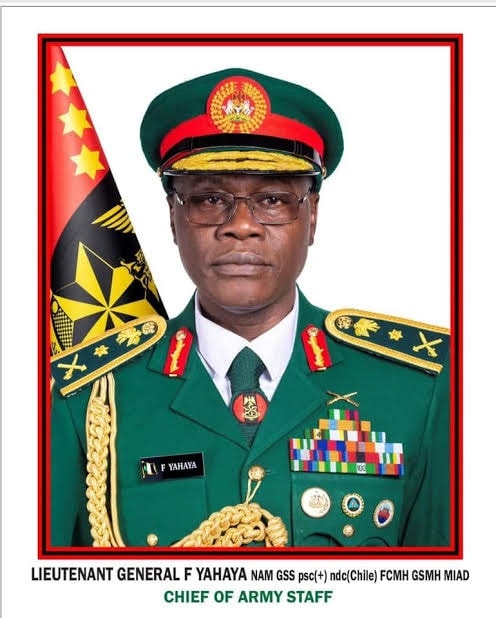
Lt. Gen. Farouk Yahaya (2021–2023)
Lieutenant General Faruk Yahaya (Rtd) was born on 5th January 1966 in Sifawa, Bodinga Sokoto State. He graduated from the Nigerian Defence Academy, Army School of Infantry and was commissioned into the Nigerian Army Corps of Infantry as a Second lieutenant on 27 December 1990, he holds a master’s degree in International Affairs and Diplomacy.
Lieutenant General Faruk Yahayaa was appointed as the COAS by President Muhammadu Buhari on May 2021 after the death of Ibrahim Attahiru. Lt Gen Faruk Yahaya was also the Director Manpower at the Army Headquarter, Military Secretary Army Headquarters and General Officer Commanding 1 Division of the Nigerian Army.
LT Gen Faruk Yahaya was the Theatre Commander of the Operation “Hadin Kai”, responsible for Counter Terrorism and Counter Insurgency operations in North East Nigeria.
Succeeded him, also under Buhari.
Tinubu’s Era: A New Generation
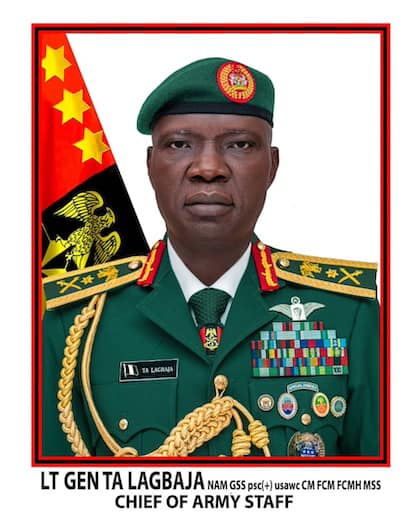
Lt. Gen. Taoreed Lagbaja (2023–Nov 2024)
Taoreed Abiodun Lagbaja CFR (28 February 1968 – 5 November 2024) was a Nigerian Army lieutenant general who served as the Chief of Army Staff of Nigeria from June 2023 to November 2024.[1][2][3] He was appointed on 19 June 2023 by President Bola Tinubu to succeed Lieutenant General Faruk Yahaya.
Lagbaja was born in the town of Ilobu in Irepodun, present day Osun State on 28 February 1968.
Was appointed by President Tinubu but died in office.
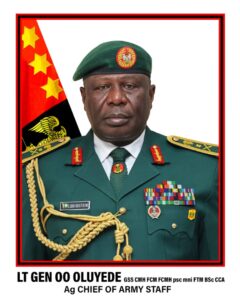
Lt. Gen. Olufemi Oluyede (Nov 2024–Oct 2025)
General Olufemi Olatubosun Oluyede (born 1968) is Nigerian Army officer who is the Chief of Defence Staff of Nigeria since 30 October 2025. He had previously served as the Chief of Army Staff from 30 October 2024 before being elevated to the role of CDS.
Oluyede was born in Ikere, Ekiti State in 1968
Briefly held the position before being succeeded.
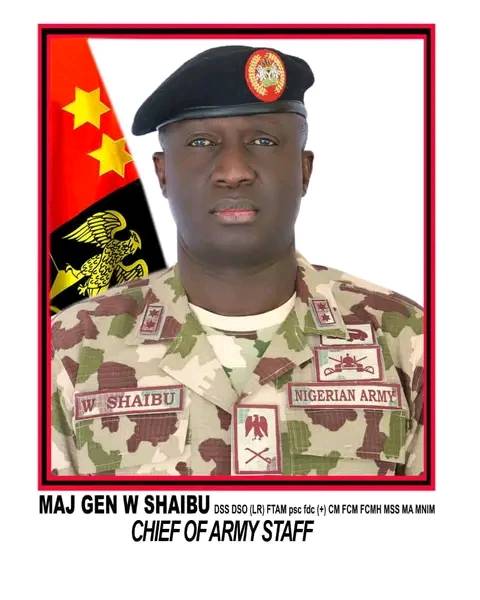
Maj. Gen. Waidi Shuaibu (Oct 2025–present)
Major General Waidi Shaibu, Nigeria’s newly appointed Chief of Army Staff (COAS), embodies the rare fusion of intellect, tactical brilliance, and operational courage that defines the modern Nigerian military leadership. His career, marked by academic excellence and frontline distinction, has made him one of the most respected officers in the Armed Forces of Nigeria.
Born on December 18, 1971, in Olamaboro Local Government Area of Kogi State, Major General Shaibu joined the Nigerian Defence Academy (NDA) in 1989 as a member of the 41 Regular Course and was commissioned into the Nigerian Army Armour Corps on September 17, 1994, as a Second Lieutenant.
Is the current COAS, ushering in a new phase of leadership under President Tinubu.
From colonial command to contemporary challenges, Nigeria’s Chiefs of Army Staff have been central to the country’s security and political evolution. As Major General Shuaibu assumes command, the nation watches closely, hopeful for a future of stability, professionalism, and reform in the armed forces.
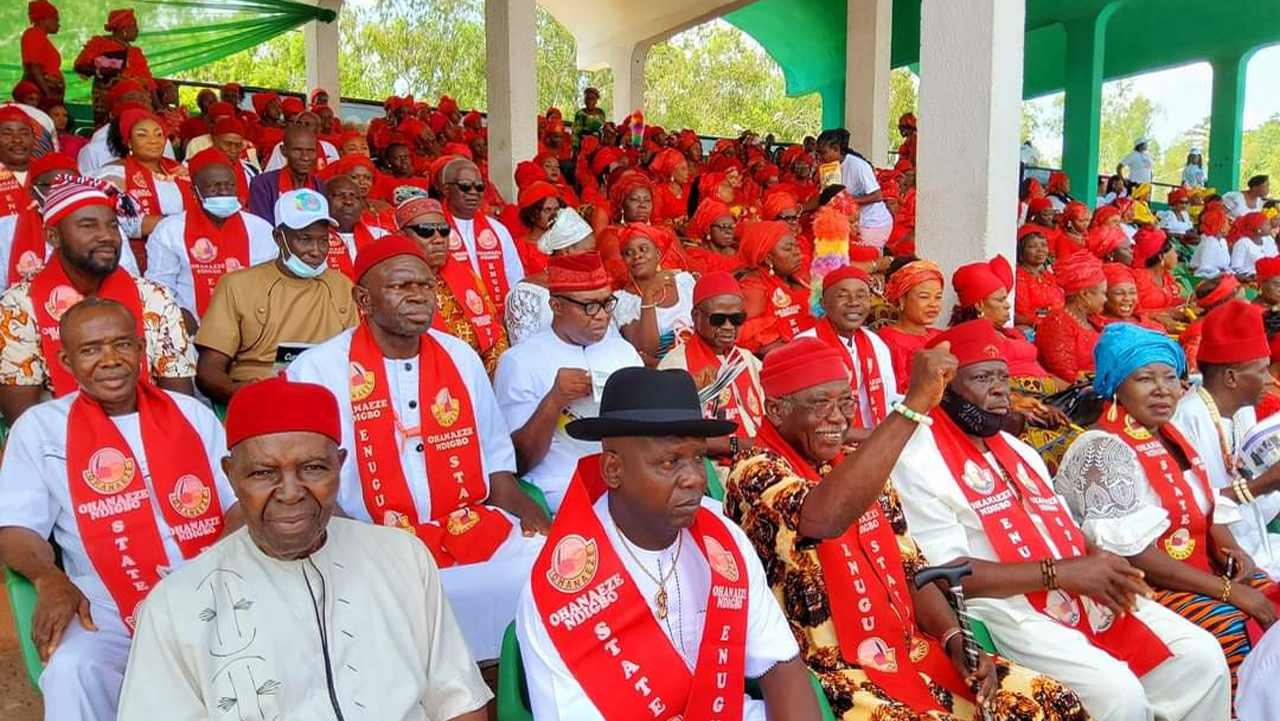
The Ohanaeze Ndigbo Worldwide has rejected the controversial installation of an “Igwe Ndigbo na East London” in East London, South Africa.
It stated that the title is not recognised and lacks legal backing.
The PUNCH had earlier reported that violent unrest broke out on Monday in the Eastern Cape Province of South Africa following protests against the coronation, with demonstrators torching vehicles and looting shops owned by foreign nationals.
Video evidence shared on X showed protesters setting several vehicles and buildings allegedly belonging to foreigners ablaze, as security forces intensified efforts to restore order.
The outrage has continued to grow, with foreign-owned properties becoming primary targets.
However, in a statement by its National Publicity Secretary, Ezechi Chukwu, the group expressed concern over tensions triggered by the development, noting reports of attacks on innocent persons and destruction of property.
The statement read, “We express deep concern over the resulting disturbances, condemn the unwarranted attacks on innocent persons and destruction of property and call on relevant authorities to take necessary steps to prevent further escalation.”
The organisation condemned the violence and urged South African authorities to act swiftly to prevent further breakdown of law and order.
Ohanaeze stressed that the Igbo are globally known for their peaceful disposition, enterprise and respect for the laws of their host communities, as it dissociated itself from any conduct that contravenes local customs and traditions.
It clarified that the purported installation in East London “only amounts to a mere nominal observance since it is not backed by any law.”
The group further noted that, in line with the position of the South East Council of Traditional Rulers, it did not recognise the conferment of the “Eze Ndigbo” title outside Igbo land.
Ohanaeze advised Igbo communities in the diaspora to adopt non-kingship titles such as “Onyendu” for internal coordination to avoid misrepresentation.
It also urged Igbo residents abroad to conduct themselves with discipline and respect for the laws of their host countries, while calling on the South African government and citizens to uphold peaceful coexistence.
The group appealed for calm, mutual respect and constructive engagement among all parties involved.
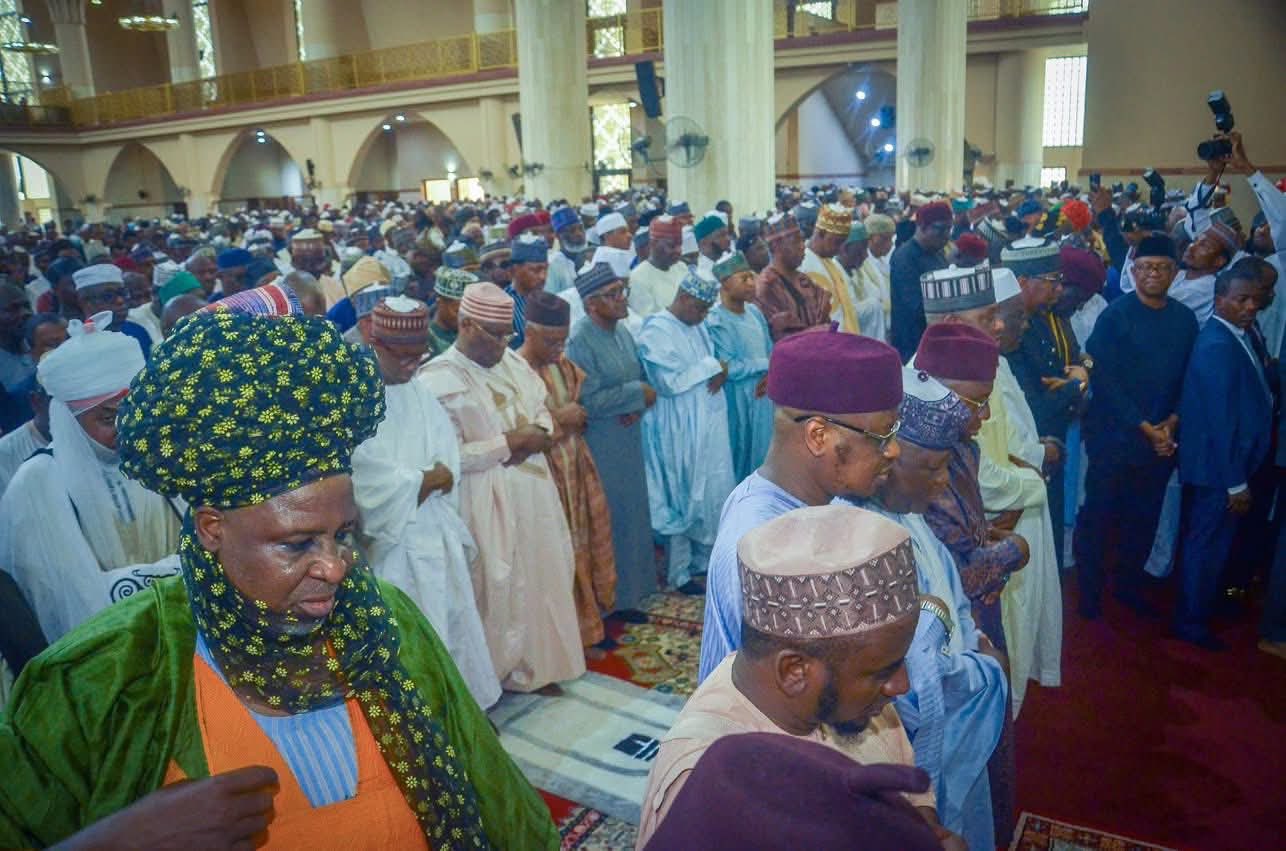
On Sunday, dignitaries from different political divides were present at the Central Mosque, Abuja, in honour of Hajiya Umma El-Rufai, the deceased mother of the former governor of Kaduna State, Mallam Nasir El-Rufai.
From his residence in Abuja to the mosque and lastly to the Gudu cemetery, both members of the opposition parties and the ruling party were present to offer condolences.
Specifically, his successor, Governor Uba Sani, the National Security Adviser, Mallam Nuhu Ribadu, were present in his house and at the funeral prayers.
The two had parted ways politically with El-Rufai, though they were mutual friends before.
Also present were former Vice President Atiku Abubakar, 2023 Labour Party presidential candidate, Peter Obi, former governor of Rivers State, Rotimi Amaechi, former governor of Sokoto State, Aminu Tambuwal, and ex-Adamawa State governor, Jibrilla Bindow.
All Progressives Congress governors were also in attendance, including Governors Babagana Zulum (Borno) and Mohammed Bago (Niger); former national chairman of APC, Abdullahi Ganduje; former Minister of Interior, Abdulrahman Dambazau, among others.
The 16th Emir of Kano, Lamido Sanusi, a former Zamfara State governor, Abdulaziz Yari, Senator Shehu Sani and billionaire businessman, Aliko Dangote, were also present.
At the interment of Hajiya El-Rufai at the Gudu Cemetery, Abuja, on Sunday, the former Minister of Communications and Digital Economy, Isa Pantami, held the two estranged friends (El-Rufai and Sani) by their shoulders and spoke a few words capable of melting the hardest of hearts.
Looking across his shoulders, he said, “Let us focus on the things that unite us because they are more than the things that divide us.
This life and everything it contains will end, and the grave is our end. No matter how you strive, you won’t get anything until Allah (God) grants it to you.”
Atiku had earlier announced his attendance in a post on his verified X handle, saying, “Today, I joined family, friends and associates of Mallam Nasir El-Rufai and the extended El-Rufai family at the Janazah (funeral prayer) of the matriarch of the family, Hajiya Umma El-Rufai.
“May God continue to comfort the family and all who mourn her. And may Allah grant her Aljannah Firdaus. Amin.”
Prominent Nigerians, including President Bola Tinubu, had earlier paid tributes to the deceased.
Tinubu, in a statement signed by his spokesman, Bayo Onanuga, commiserated with El-Rufai, urging him to find the strength to move on in the absence of his beloved mother.
“Nasir, please accept my heartfelt condolences on the passing of your beloved mother, Hajiya Umma, which happened today (Friday) in Cairo. As someone who had also lost an old mother, I share in your grief,” Onanuga wrote on behalf of President Tinubu.
Sani also earlier extended condolences on behalf of the Kaduna State Government and its people, describing the late Hajiya Umma as “a devoted mother and matriarch, a woman of rare grace, moral clarity, and quiet strength,” who embodied faith, patience, generosity, and community reconciliation.
“On behalf of the government and people of Kaduna State, I extend my deepest condolences to His Excellency, Mallam Nasir El-Rufai, and the entire El-Rufai family on the passing of their beloved mother, Hajiya Umma El-Rufai,” Sani said.
The National Chairman of the APC, Prof Nentawe Yilwatda, visited El-Rufai and his family, urging them to put their faith in God at all times.
He posted, “I visited the home of Mallam Nasir El-Rufai to commiserate with him and the entire family on the painful loss of his beloved mother, Hajiya Umma El-Rufai, who passed away yesterday (Friday).
“The death of a mother is a deeply personal and irreplaceable loss. It is a moment of profound grief not only for the immediate family, but also for all who understand the priceless role of a mother in the life of her children and family.
“Mama lived a fulfilled life and, by the grace of God, leaves behind a legacy through her children, family and all those whose lives she touched.
“At this difficult time, I pray that Almighty Allah forgives her shortcomings, grants her Aljannatul Firdaus, and comforts Mallam Nasir El-Rufai, the entire El-Rufai family, and all loved ones she left behind. May Allah grant the family the strength, patience and fortitude to bear this painful loss,” the APC Chairman wrote.
Also, the immediate past governor of Ekiti State and former Chairman of the Nigerian Governors’ Forum, Dr Kayode Fayemi, expressed deep sorrow over the passing of Hajiya Umma.
In a statement issued on Sunday by the Fayemi Media Office, the ex-governor described her death as a profound loss, not only to the El-Rufai family but also to all who were touched by her life of humility, faith, and service.
He noted that the late Hajiya Umma lived a life defined by strong moral values, devotion to family, and commitment to community—qualities he said are reflected in her son’s life and public service.
“I received with deep sadness the news of the passing of Hajiya Umma El-Rufai. Her departure is a painful loss, but we take solace in the exemplary life she lived and the legacy she leaves behind,” Fayemi said.
The death came at a time when El-Rufai was in the custody of the Independent Corrupt Practices and Other Related Offences Commission following his arrest over allegations of corruption and money laundering.
He was arraigned before a Federal High Court in Kaduna on March 24 on a 10-count charge, with the case adjourned until March 31, 2026, for hearing of pending applications, including his bail request.
He was released temporarily from the ICPC custody, reportedly to witness the burial rites of his mother.
According to Adenuga, the actor was initially removed from the role due to serious misconduct, including attempts to claim ownership of the Papa Ajasco brand.
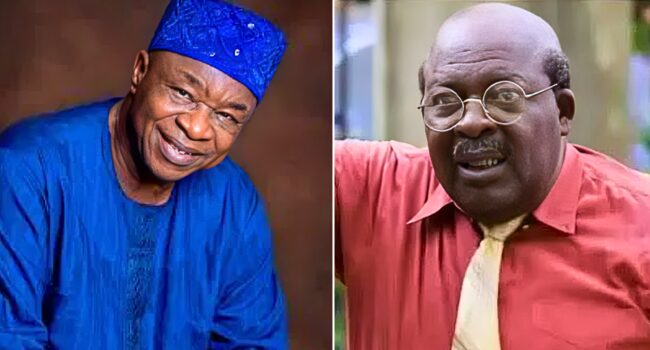
Veteran filmmaker Wale Adenuga has revealed the reasons behind the removal and subsequent return of Abiodun Ayoyinka in his role as Papa Ajasco.
According to Adenuga, the actor was initially removed from the role due to serious misconduct, including attempts to claim ownership of the Papa Ajasco brand.
The conflict reportedly began when Ayoyinka organised a tour using the Papa Ajasco name without informing the production team.
The situation escalated after the Nigerian Copyright Commission discovered that he had tried to register the brand under his name, even though the producers already held the legal rights.
Adenuga, in an interview with Punch, described this act as a betrayal that led to the actor’s dismissal.
Despite the controversy, Ayoyinka was later brought back to the role, a decision Adenuga said was based on practicality and the actor’s talent rather than personal feelings.
He noted that while talented actors can be challenging, their skills sometimes make them indispensable.
The producer also discussed changes in the entertainment industry, mentioning that his productions have adapted to digital platforms.
Shows like Akpan and Oduma are now distributed mainly on YouTube, while WAPTV maintains an online presence and mobile app to reach audiences.
On the topic of royalties and actor welfare, Adenuga said the current system needs reform and that responsibility should not rest solely on producers.
He suggested that a well-structured industry could ensure fair compensation and long-term support for actors, reducing the burden on individual production teams.
He said, “That level of betrayal led to his dismissal. I understand the psychology of actors. Sometimes the most talented can also be the most difficult. As a producer, you sometimes have to choose between talent and temperament. Despite everything, I would still work with him because he is a good actor. Our content is now on social media.
“Some productions like Akpan and Oduma are distributed primarily on YouTube, while WAPTV also has an online presence and app. I agree that actors should benefit more in a structured system. It is not the sole responsibility of producers to manage long-term welfare. A proper industry structure would ensure that everyone is taken care of.”