Connect with us

Education

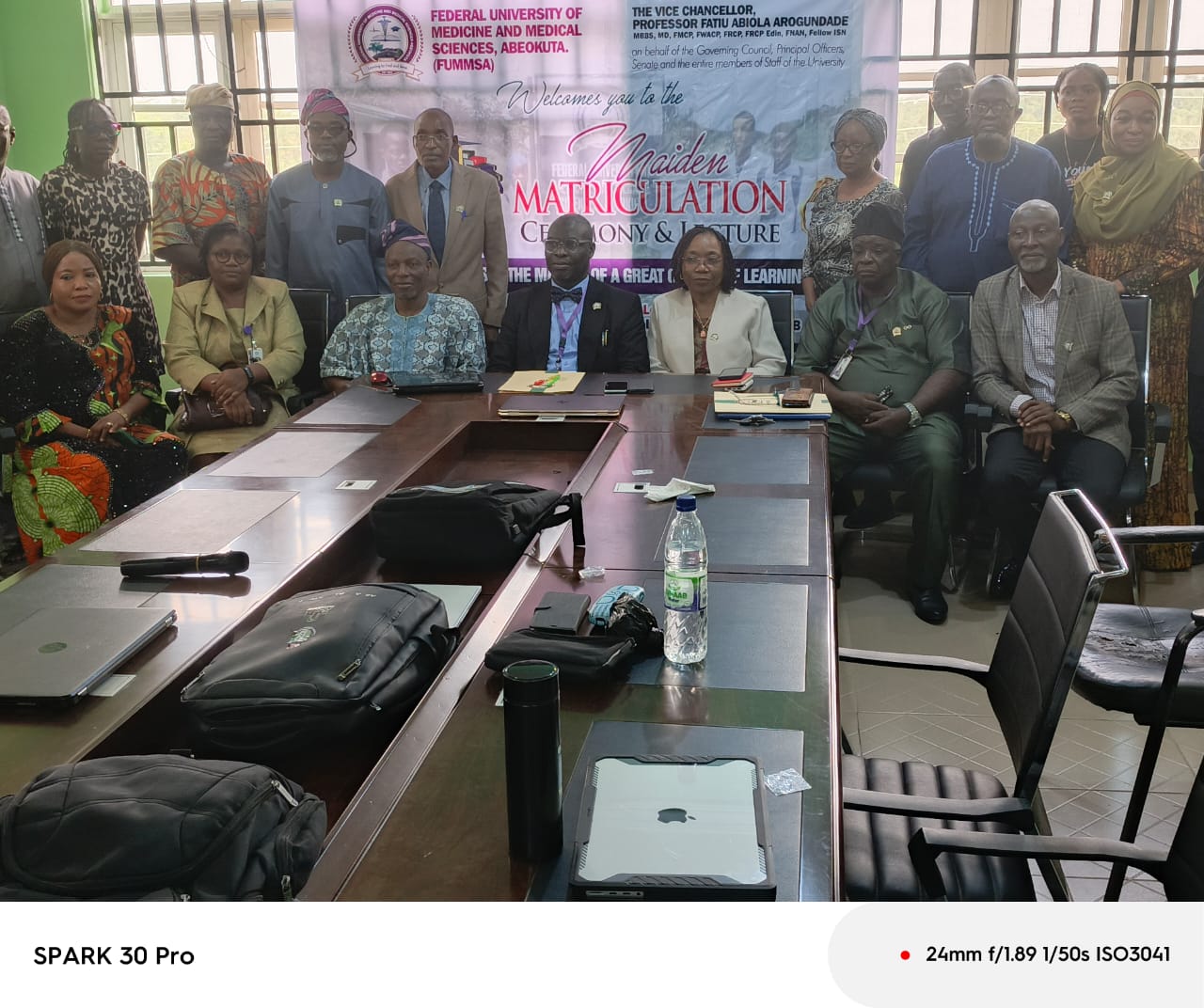
VC seeks support as new medical varsity holds maiden matriculation

Published

on

The Vice-Chancellor of the Federal University of Medicine and Medical Sciences, Abeokuta, Prof. Fatiu Arogundade, on Tuesday, called for the support of public-spirited individuals and corporate organisations to enhance the growth of the university, which began operations about five months ago.

Arogundade said the cost of funding a university is huge and should not be left for the government alone to bear.

The Vice-Chancellor praised President Bola Tinubu for establishing specialised universities of medical sciences across the six geopolitical zones, explaining that the initiative would significantly increase the production of manpower needed to strengthen qualitative healthcare delivery across the country.

He added that the intervention would also help to reduce the impact of the Japa syndrome due to the expected rise in the number of health workers the specialised universities would produce annually.

Arogundade stated this at a briefing held to announce the university’s forthcoming maiden matriculation scheduled for Thursday.

The VC said that after successful resource verification, the institution was awarded a carrying capacity of 1,000 students based on available resources, and that over 850 pioneer students, admitted through the Joint Admissions and Matriculation Board, would be formally inducted into the university on Thursday during its maiden matriculation.

He stated that the university currently runs programmes such as Nursing Science, Medicine, Biology, Microbiology, Biochemistry, Pharmacy, and Medical Laboratory Science, among others.

He added that the university, which commenced operations about five months ago, is currently using the campus of the Federal University of Agriculture, Abeokuta, as its temporary site, with plans to move to its permanent 170-hectare site at Ajibayo town along the Idi Aba–Ajebo Road, which is under construction.

See also  Lagos NANS demands ban on unregistered trucks after student deaths

Arogundade disclosed that relevant regulatory bodies — including the National Universities Commission, Medical and Dental Council of Nigeria, Nursing and Midwifery Council of Nigeria, and Pharmacy Council of Nigeria — have, however, required that the permanent site be reasonably developed for academic activities in the next few months in order to secure accreditation for its eight faculties within the next two years.

He explained that while the university has enjoyed tremendous support from the federal and state governments, as well as prominent indigenes, a great deal still needs to be done to ensure the rapid growth and development of the institution.

Arogundade said, “There is a lot more support that is urgently needed to secure a fully functional FUMMSA, as envisioned by the distinguished sons and daughters of Egbaland, Ogun State, and Nigeria.

“There is no gainsaying the fact that the Federal Government of Nigeria cannot alone shoulder the enormous cost of providing all requisite facilities for a specialised university.

“In this light, the university will welcome endowments, donations, and facilities or equipment, which may be named after the donor if desired. Meanwhile, the hostels will be developed through a public-private partnership model, and this will be advertised shortly.”

He explained that at FUMMSA, the management believes that medical education is not merely the transmission of skills but a fusion of intellect, empathy and innovation.

The VC said the university’s mission is to foster and train competent healthcare professionals equipped to respond to national and global health challenges through appropriate, creative and technology-driven solutions.

The university also strongly believes that “every programme, partnership and act of service reflects the founding conviction that knowledge is most powerful when it heals and serves.”

See also  FG gets $25.35m Kuwait loan to tackle Kaduna out-of-school crisis

Arogundade commended Tinubu, the Ogun State Government, the Vice-Chancellor of FUNAAB, Prof. Olusola Kehinde, as well as the Alake and Paramount Ruler of Egbaland, Oba Adedotun Gbadebo, among others, for their notable support in ensuring the smooth take-off of the university, while calling for further cooperation from all stakeholders to ensure that the institution fulfils its founding goals and vision.

Government-owned universities in the country face numerous challenges, particularly underfunding, which results in poor infrastructure and a high student-to-lecturer ratio.

This has frequently led to disruptions in the academic calendar, occasioned by strikes usually embarked upon by university lecturers under the Academic Staff Union of Universities to demand better funding for university education by both state and federal governments.

punch.ng

FOLLOW US ON:

FACEBOOK

TWITTER

PINTEREST

TIKTOK

YOUTUBE

LINKEDIN

TUMBLR

INSTAGRAM

Continue Reading
Click to comment

Leave a Reply

Your email address will not be published. Required fields are marked *

Education

Technical education, Nigeria’s fastest job creation route – NABTEB

Published

on

The Chief Executive Officer of the National Business and Technical Examinations Board (NABTEB), Dr Muhammed Aminu Muhammed, has declared that technical education remains Nigeria’s strongest pathway to employment, entrepreneurship and national economic growth.

Speaking during an inspection of the 2026 May/June NABTEB examinations at the Federal Technical College, Awka, Anambra State capital, Muhammed said the future of Nigeria depends on equipping young people with practical skills that will enable them to create jobs.

His visit to the Awka centre is part of a nationwide monitoring exercise covering examination centres across Nigeria.

He said, “Technical education remains the Nigeria’s strongest pathway to employment, entrepreneurship and national economic growth.

“The future of Nigeria depends on equipping young people with practical skills that will enable them to create jobs rather than wait endlessly for white-collar jobs.

“Effective leadership within a school naturally reflects in students’ performance and the quality of teaching and learning.”

Muhammed disclosed that more than 167,000 candidates are sitting for this year’s examinations nationwide, while 226 candidates are taking their papers at the Federal Technical College, Awka.

During the exercise, the NABTEB Registrar inspected the Physics practical examination, monitored the organisation of candidates, interacted with officials supervising the exercise and assessed the overall conduct of the examination.

He expressed satisfaction with what he witnessed at the Awka centre, describing it as one of the most organised technical colleges visited during his nationwide assessment tour.

He commended the way the practical examination was organised, noting that candidates were carefully grouped to ensure the exercise ran smoothly despite the large number of students involved.

See also  JAMB unveils admission scrutiny panel for underage candidates

Reflecting on the nationwide exercise, Muhammed said this year’s examinations have shown remarkable improvement over those conducted in 2025.

He attributed the progress to stronger supervision by school principals, better coordination by NABTEB officials and increased support from security agencies working to safeguard the examination process.

“In every area, this year’s examination is better than last year’s,” he added.

The Registrar stressed that the practical component of NABTEB examinations remains central to the Board’s mission of producing graduates with employable skills that can transform their lives and contribute meaningfully to the nation’s economy.

He maintained that expanding technical education is essential if Nigeria hopes to reduce unemployment, empower young people and build a more productive economy.

punch.ng

FOLLOW US ON:

FACEBOOK

TWITTER

PINTEREST

TIKTOK

YOUTUBE

LINKEDIN

Continue Reading

Education

US exchange programmes boosting Nigeria-US economic ties — US Mission

Published

on

The United States Mission in Nigeria has reaffirmed its commitment to strengthening bilateral relations through educational and professional exchange programmes, saying investments in people continue to deliver lasting benefits for both Nigeria and the United States.

The mission said Nigerian beneficiaries of US-sponsored exchange programmes had returned home with new skills, wider professional networks and a renewed commitment to promoting good governance, entrepreneurship and innovation.

The position was contained in a statement issued by the US Mission in Nigeria on Tuesday following a #Freedom250 event held to celebrate Nigerian alumni of various US exchange programmes.

According to the mission, the event formed part of activities marking the 250th anniversary of the United States’ independence, while reaffirming America’s commitment to partnerships built on mutual benefit.

The mission also explained that the exchange programmes were designed not only to expose participants to educational and professional opportunities in the United States but also to equip them with knowledge and networks that contribute to Nigeria’s development.

The mission’s statement partly read, “What an outstanding #Freedom250 event with our U.S. exchange alumni here in Nigeria! Fulbright scholars, YALI Fellows, IVLP participants, and other exchange programs gathered to demonstrate something the United States has always known: investment in people delivers lasting returns – for Nigeria, and for America.

“These alumni didn’t just visit the United States. They returned home with new skills, expanded networks, and a commitment to the kind of transparent governance, entrepreneurship, and innovation that drives real economic growth, benefiting both countries.

See also  How blind UNILAG freshman beat brain tumour to top JAMB

“As the United States marks 250 years of independence, events like this one make clear that U.S. engagement in Africa is about building capable, sovereign partners who choose to work with us because it works for them.”

The mission further noted that the US Country Public Affairs Counsellor, Lee McManis, highlighted the role of Nigerian exchange alumni in deepening bilateral relations during his welcome remarks. The mission also praised the leadership demonstrated by the alumni, saying it reflected the enduring value of educational and professional exchanges.

It stated, “In Country Public Affairs Counsellor Lee McManis’s welcome remarks, he underscored how the values imbued in America’s 250th celebratory year are reflected in our thousands of Nigerian exchange alumni, always working to make the U.S.-Nigeria relationship stronger. To our exchange alumni: your leadership is proof that diplomacy delivers results.”

The statement added that the Chargé d’Affaires of the US Mission in Nigeria, Keith Heffern, encouraged participants to continue serving as ambassadors of stronger US-Nigeria cooperation.

In Charge d’Affaires Keith Heffern’s address to the participants, he emphasised, “Your success is the argument for why more Nigerians should choose to partner with the United States in business, tech, agriculture, and the creative economy. So keep building. Keep leading.”

The United States has maintained a long-standing partnership with Nigeria through a range of educational, leadership and professional exchange programmes, including the Fulbright Programme, the Young African Leaders Initiative and the International Visitor Leadership Program.

Thousands of Nigerians have participated in these initiatives over the years, with many going on to occupy leadership positions in government, business, academia, civil society and the creative industry.

See also  JAMB unveils admission scrutiny panel for underage candidates

The programmes form part of broader U.S. efforts to promote people-to-people diplomacy, economic cooperation and democratic governance between the two countries.

punch.ng

FOLLOW US ON:

FACEBOOK

TWITTER

PINTEREST

TIKTOK

YOUTUBE

LINKEDIN

Continue Reading

Education

Atiku condemns increase in WAEC, NECO fees

Published

on

Former Vice President Atiku Abubakar has described the recent increase in fees for Federal Unity Colleges and the reported approval of a uniform ₦50,000 examination fee for WAEC and NECO candidates from 2027 as cruel, economically insensitive, and fundamentally incompatible with the government’s constitutional responsibility to make education accessible to every Nigerian child.

Reacting to the development on Sunday through his Senior Special Assistant on Public Communication, Phrank Shaibu, Atiku condemned the Federal Government’s continued escalation of the cost of public education.

The presidential candidate of the African Democratic Congress (ADC) said it is unconscionable that at a time when Nigerian families are battling record inflation, soaring food prices, rising transportation costs, crippling electricity tariffs, stagnant incomes and widespread unemployment, the Tinubu administration has chosen to make education even more expensive.

He noted that education remains the greatest instrument of social mobility and the surest pathway out of poverty for millions of children from humble backgrounds.

According to him, every additional financial burden imposed on parents translates into another child being denied the opportunity to learn, dream, and contribute meaningfully to society.

Atiku therefore called on President Bola Ahmed Tinubu to immediately reverse the increase in Unity School fees and the proposed ₦50,000 WAEC and NECO examination fee and convene an urgent stakeholders’ dialogue on sustainable financing for public education.

He urged the Federal Government to invest more in public schools, strengthen educational infrastructure, recruit more qualified teachers, expand the carrying capacity of tertiary institutions, and ensure that no Nigerian child is denied education because of poverty.

“By the grace of Almighty God, I remain confident that Nigerians will reject policies that punish their children and make education the exclusive preserve of those who can afford it. The African Democratic Congress is committed to restoring education as a public good, not a privilege. An ADC-led government will not permit the implementation of this unjust and punitive increase in examination fees. Instead, we shall reverse policies that place education beyond the reach of ordinary families, expand access to quality education at every level, increase the carrying capacity of our tertiary institutions, and ensure that every Nigerian child, regardless of background, has a fair opportunity to learn, excel and fulfil his or her God-given potential.”

See also  Oyebanji inspects EKSUTH 80-bed hospital ward construction

Atiku argued that education should never become another avenue through which citizens are made to bear the cost of government policy failures.

“No nation has ever taxed its way into educational excellence. Countries that aspire to economic greatness invest more—not less—in education during difficult times because they understand that human capital is the engine of sustainable development. Nigeria cannot build a globally competitive economy while systematically pricing millions of its children out of classrooms.”

He said the administration’s economic choices reveal a troubling pattern in which the burden of governance is repeatedly transferred to ordinary Nigerians.

“When families are being asked to pay more for food, more for transportation, more for electricity, more for healthcare and now significantly more for education, government cannot honestly claim to be protecting the vulnerable. Reform without compassion becomes punishment.”

“A government that genuinely believes in the future of its people does not erect financial barriers between children and education. It removes them. Education is not a privilege reserved for the wealthy; it is the birthright of every Nigerian child and the foundation upon which prosperous nations are built.”

Atiku described the latest decisions as particularly alarming because they come against the backdrop of Nigeria’s worsening education crisis.

“Nigeria already bears the painful distinction of having one of the largest populations of out-of-school children in the world. Depending on the methodology and age group measured, between 10.5 million and about 15 million Nigerian children and young people are already outside the classroom. Any government confronted with such a national emergency should be investing aggressively to bring these children back into school. Instead, this administration is choosing policies that will inevitably swell those numbers.”

See also  JAMB unveils admission scrutiny panel for underage candidates

He warned that increasing fees in Federal Unity Colleges while imposing a significantly higher cost on WAEC and NECO examinations would disproportionately affect children from poor and middle-income families whose parents are already making impossible choices between food, healthcare, transportation, and education.

“The consequences of these policies extend far beyond school gates. Every child priced out of education today becomes tomorrow’s victim of unemployment, poverty, child labour, criminal exploitation, drug abuse or insecurity. Nations do not become prosperous by making education more expensive; they prosper by making education more accessible.”

The former Vice President said the recent increase in WAEC and NECO examination fees represents far more than another financial burden on parents.

“It is a systemic filter that will inevitably restrict access to tertiary education for thousands of indigent but academically qualified Nigerian students. For many children from low-income families, the journey to university does not end at the admission gate—it is terminated long before then by the inability to afford the qualifying examinations that determine their future.”

He said the contradiction becomes even more glaring when viewed against the reality of Nigeria’s tertiary education system.

“Instead of investing massively in expanding lecture theatres, laboratories, hostels, libraries, and other critical infrastructure to boost the carrying capacity of our public universities, this administration is making access to education even more difficult. Today, Nigerian universities can admit only about 500,000 to 700,000 students annually, even though more than two million young Nigerians seek admission every year. The inevitable consequence is that well over one million qualified candidates are denied university admission annually—not because they lack the merit or the desire to learn—but because available spaces fall far below national demand. Rather than addressing this structural deficit by expanding infrastructure and increasing admission capacity, the government is effectively constricting access even further through higher Unity School fees and the proposed ₦50,000 WAEC and NECO examination fees.

See also  FG opens applications for 2026 overseas scholarship

“The result is a cruel double punishment: first, millions of qualified young Nigerians cannot secure admission because there are insufficient spaces; second, many will now be priced out of even competing for those limited spaces. That is not educational reform; it is the systematic rationing of opportunity and the gradual exclusion of the children of the poor from the promise of higher education.”

Atiku said the irony in the administration’s education policy is impossible to ignore.

“The same administration whose policies are progressively narrowing access to public tertiary education continues to project the Nigerian Education Loan Fund (NELFUND) as one of its flagship achievements. Yet, a university loan offers little comfort to a child who has already been priced out of secondary education or cannot afford the qualifying examination required to secure admission. A government cannot credibly claim to be expanding access to higher education while simultaneously erecting financial barriers that prevent millions of young Nigerians from ever reaching the university gates.”

He added that, in the view of many Nigerians, NELFUND has yet to address the structural barriers confronting access to education.

“Genuine educational reform begins by making education affordable from the primary and secondary levels, expanding the carrying capacity of our tertiary institutions, and ensuring that poverty never becomes the reason a child is denied the opportunity to learn. A government that truly believes in education invests in classrooms before it invests in loans.”

tribuneonlineng.com

FOLLOW US ON:

FACEBOOK

TWITTER

PINTEREST

TIKTOK

YOUTUBE

LINKEDIN

Continue Reading

Trending