Connect with us

News

Senate backs death penalty for kidnappers, informants, others

Published

on

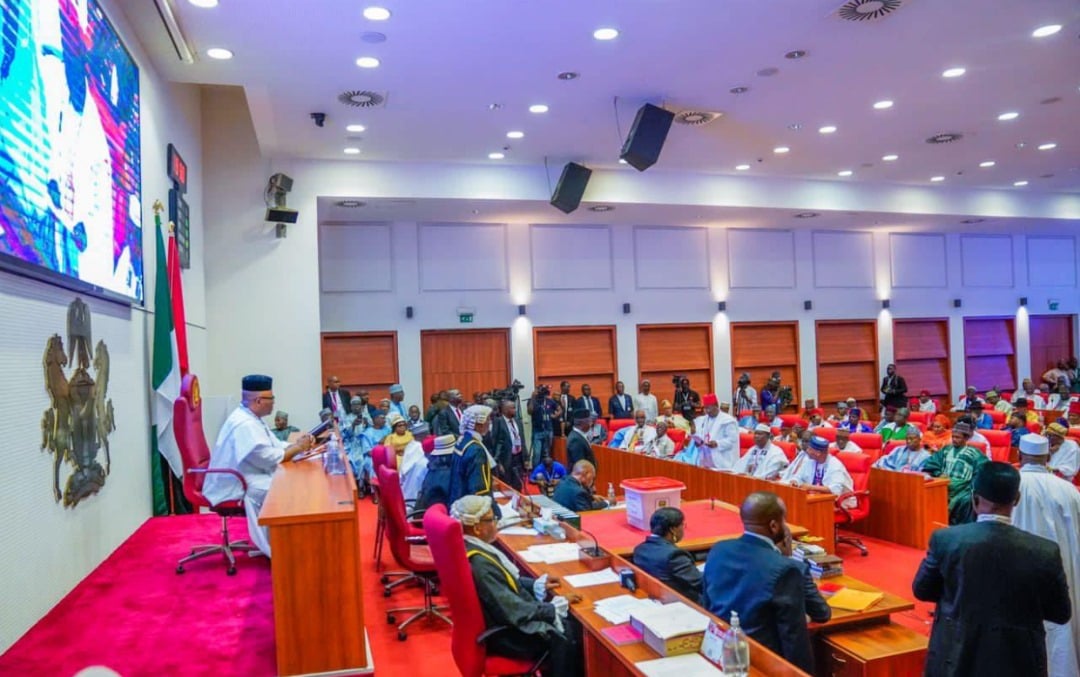
The Senate on Wednesday moved to tighten Nigeria’s anti-kidnapping laws by pushing for the death penalty for kidnappers — and anyone who finances, enables, or provides information to them — as lawmakers debated amendments to the 2022 Terrorism (Prevention and Prohibition) Act.

The proposal, sponsored by the Leader of the Senate, Opeyemi Bamidele, seeks to classify kidnapping, hostage-taking, and related crimes as terrorism, giving security agencies wider powers to track, disrupt, and prosecute criminal networks across the country.

The debate dominated Wednesday’s plenary, drawing contributions from key senators including Adams Oshiomhole, Orji Uzor Kalu, and Minority Leader Abba Moro.

The session was presided over by Senate President Godswill Akpabio.

After hours of deliberation, the Senate unanimously approved the amendment bill for further legislative work and referred it to the Committees on Judiciary, Human Rights and Legal Matters (lead committee), National Security and Intelligence, and Interior.

The committees are expected to report back within two weeks.

Leading debate on the bill, Bamidele said the purpose was to “designate kidnapping, hostage-taking and related offences as acts of terrorism and prescribe the death penalty for such offences without option of fine or alternative sentence.”

He warned that kidnapping had evolved into “coordinated, commercialised and militarised acts of violence perpetrated by organised criminal groups.”

“Kidnapping has instilled widespread fear in communities; undermined national economic activities and agricultural output; interrupted children’s education; bankrupted families forced to pay ransom; overstretched our security forces, and claimed countless innocent lives,” the Senate leader lamented.

See also  Under pressure: Tinubu may drop controversial names from pardon list

According to him, the patterns of brutality associated with kidnapping “now carry all the characteristics of terrorism,” making it necessary to treat the offence under the counter-terrorism framework.

Bamidele added that the bill would empower security agencies with “broader operational authority, intelligence capabilities, and prosecutorial tools” to pursue terrorists and their enablers.

He stressed that the death penalty would apply not only to kidnappers but also to “their informants, logistics providers, harbourers, transporters, and anyone who knowingly assists, facilitates, or supports kidnapping operations,” adding that “attempt, conspiracy or incitement to kidnap attracts the same penalty.”

“Nigerians are kidnapped on highways, in schools, in homes, on farms and in markets,” he said. “This is not a mere crime. It is terrorism in its purest form.”

Backing the amendment, Oshiomhole criticised deradicalisation programmes for terror suspects, arguing that many offenders returned to crime.

“We should not continue with deradicalisation programmes again,” he said. “No more de-radicalisation. If you are caught and convicted for acts of terrorism, then the penalty should be death.”

Kalu also supported the bill, insisting that informants and sponsors of kidnappers must “face the consequence.”

“Nigerians have suffered at the hands of kidnappers. Young girls have been raped. Women have become widows for no reason. This must not continue again,” he said.

Senate Minority Leader Moro described the bill as “a unanimous decision of the Senate,” noting that it was necessary to impose capital punishment “with the hope that kidnappers will face the penalty.”

Senator Victor Umeh, in his contribution, condemned the rising trend of abductions and the killing of victims even after ransom payments. He said financial institutions aiding such crimes must also be scrutinised.

See also  KWAM 1’s Airport conduct amounts to terrorism in most climes – NCAA

Last week, the Senate took a similarly tough stance as it debated a motion following the November 18 attack on Christ Apostolic Church, Eruku, in Ekiti LGA of Kwara State, where gunmen killed two worshippers and abducted 38 others.

Although all victims were later rescued, lawmakers said the incident exposed the spread of insurgent cells into the South and worsening insecurity in rural communities.

The debate stemmed from a motion by Senator Yisa Ashiru titled ‘Urgent Need to Address Escalating Insecurity in Kwara, Kebbi, and Niger States and Strengthen National Security Frameworks.’

Senators also raised concerns over rising school abductions, which have led to shutdowns in parts of Kebbi, Niger, Kwara, and all 47 Federal Unity Colleges nationwide.

The latest amendment effort signals a tougher legislative push as insecurity — particularly kidnapping for ransom — continues to devastate communities across the country.

punch.ng

FOLLOW US ON:

FACEBOOK

TWITTER

PINTEREST

TIKTOK

YOUTUBE

LINKEDIN

TUMBLR

INSTAGRAM

Continue Reading
Click to comment

Leave a Reply

Your email address will not be published. Required fields are marked *

News

What Nigeria’s 6 geo-political zones contributed to VAT & received in October 2025

Published

on

1. South-west
Contributed: N333.01bn
Received: N91.88bn (27.59%)

2. South-south
Contributed: N80.48bn
Received: N53.79bn (66.84%)

3. North-west
Contributed: N41.82bn
Received: N64.07bn (153.20%)

4. North-central
Contributed: N20.51bn
Received: N44.32bn (216.09%)

5. North-east
Contributed: N18.94bn
Received: N44.17bn (233.21%)

6. South-east
Contributed: N13.26bn
Received: N36.91bn (278.36%)
Source: FAAC/TheCableIndex

Credit: Ethnic African Stories

FOLLOW US ON:

FACEBOOK

TWITTER

PINTEREST

TIKTOK

YOUTUBE

LINKEDIN

TUMBLR

INSTAGRAM

See also  Presidential order fails to curb soaring drug prices
Continue Reading

News

See real reason ex-defence minister, Badaru resigned

Published

on

Details have emerged on the reason behind the sudden resignation of a former Minister of Defence, Badaru Abubakar, after two years in office.

Badaru resigned his position on Monday, citing health concerns.

In his place, President Bola Tinubu swore in a former Chief of Defence Staff, General Christopher Musa (retd.) as the new Minister of Defence.

Announcing Badaru’s resignation, the Special Adviser on Information and Strategy to the President, Bayo Onanuga, said in a statement that the former minister stepped down on account of “poor health.”

However, findings by Saturday PUNCH showed that the former minister was compelled to resign following a protracted cold war between him and the Minister of State for Defence, Bello Matawalle, a rift that had been carefully kept away from the media for months.

Badaru was appointed on August 21, 2023, months after completing his two term tenure as Jigawa State governor.

His appointment reportedly rested on his administrative credentials and regional influence in the North West, a region grappling with escalating banditry and insurgency.

After being sworn in alongside other ministers, Badaru was said to have prioritised military modernisation, intelligence reforms and counter terrorism operations.

Tinubu also appointed Matawalle on the same day to support Badaru, the senior minister, in executing defence policies.

However, in recent weeks, the two men came under intense public scrutiny following the resurgence of bandit and terror attacks, which prompted Tinubu to declare a nationwide security emergency.

The worsening insecurity snowballed into mass abductions of schoolchildren, with dozens of pupils and students kidnapped across several northern states.

The student kidnappings heightened pressure on the former defence minister, with some analysts calling for his removal on the grounds that he was failing to lead the ministry effectively.

The security crisis also renewed global scrutiny of Nigeria’s security posture, especially from the Trump administration which, in late October, re-designated Nigeria as a Country of Particular Concern over the alleged mass killing of Christians.

Amid mounting public outrage, the defence minister tendered his resignation on December 1.

In separate interviews with Saturday PUNCH, credible military sources within the defence ministry said Badaru’s long-running animosity with Matawalle, rather than health concerns, ultimately forced him out.

See also  Qatar denies visa restrictions on Nigerians

An official of the ministry, who requested anonymity because he was not authorised to speak publicly, said the two ministers maintained a cordial appearance in public but had a “frosty relationship” behind the scenes.

“Matawalle and Badaru had a frosty relationship for most of the period he was minister, although they appeared cool with each other in public. But it is a known fact here that they had something against themselves,” the official said.

According to him, the tension affected some aspects of the ministry’s work, including media coordination.

“This affected some of their work. Even as a journalist, does the media unit look coordinated to you? Was this how it was being run before they came?

“Pairing the two together as ministers is something that ought not to have happened in the first place,” he added.

Another military source said it was believed that Matawale had a strong relationship with the presidency and was becoming domineering within the ministry.

The source noted that some party leaders within the All Progressives Congress considered Matawale as a political asset for the current administration, particularly within the north-western parts of the country.

“Matawale is from Zamfara State, and he has a very strong political presence in the state. The APC leaders see him as an asset for the 2027 election. So, they’re always on his side. He has the political backing and connection.

“But Badaru is weak, politically. The presidency does not actually reckon with him when it comes to power play and politics,” the source explained.

Calls for Matawalle’s resignation

Since Badaru resigned last week, some Nigerians, including activists and political commentators have amplified calls for Matawalle’s removal as Minister of State for Defence over the country’s security crisis.

Matawalle, a former Zamfara State governor, has faced periodic calls to step down, particularly from opponents in his home state.

In September 2024, Zamfara Governor Dauda Lawal publicly urged him to resign over alleged links to bandit groups, allegations Matawalle has repeatedly denied.

At the time, Lawal demanded that the minister cleared his name or resign.

Earlier, a petition by the APC Akida Forum also asked authorities to suspend Matawalle pending investigations into claims of collusion with criminal networks.

See also  See 175 Beneficiaries of Tinubu’s Pardons (Full List)

In November 2025, the Good Governance and Accountability Monitoring Group asked the President to fire the minister, accusing him of “complicity” and “poor performance” as insecurity persisted.

Despite the clamour, officials within the ministry said Matawalle might retain his office amid shakeups in the security establishment in the past two months.

Also, officials in the Presidency, who confided in our correspondent, said Matawalle was appointed as part of a broader, coordinated response to banditry.

They cited his recent assignment to Kebbi State after the abduction of 24 students from Government Girls Comprehensive Secondary School, Maga, where a joint operation led to the girls’ release.

Meanwhile, Matawalle was notably absent on Friday when Gen. Musa (retd.) formally assumed office at the Ministry of Defence, Abuja.

There was no official explanation for his absence as of press time.

Musa, who was sworn in on Thursday by President Tinubu, arrived at the ministry to a reception dominated by the service chiefs, the permanent secretary and other senior officials.

Musa to review theatre commands

The new defence minister announced that one of his first actions in office would be a comprehensive review of all theatre commands and inter-service operational structures across the country.

Musa spoke on Friday while addressing officials of the Ministry of Defence during his maiden briefing on assumption of office.

The former Chief of Defence Staff said the review was necessary to strengthen jointness among the services, close operational gaps and ensure strategic alignment between policy and field operations.

The minister also stressed that welfare would be treated as a strategic priority, not an administrative task.

He listed prompt payment of allowances, timely issuance of kits, improved accommodation, quality medical care and support for families of fallen heroes as areas that would receive urgent attention.

Musa said, “We must also confront a critical truth: welfare is not administrative; it is strategic. Morale is a force multiplier. Our personnel must receive their kits on time. Their operational allowances must be paid promptly.

“Accommodation, medical care, and support for injured personnel and families of the fallen must be priorities. Those on the frontlines watch how we treat their colleagues. If they feel abandoned, they cannot give their best. Anyone who risks his or her life for Nigeria deserves nothing but utmost respect.”

See also  Demolished Lekki Property Doesn’t Belong To Ola Of Lagos — Firm

Musa said Nigeria could no longer afford disjointed or siloed security operations, emphasising that effective collaboration among the Army, Navy, Air Force and other security agencies was the only path to lasting success.

According to him, the ministry under his leadership would be guided by three pillars—operational effectiveness, unified action and strategic foresight.

“The threats we face are complex, but our spirit is stronger. No individual and no single service can achieve success alone. We must work as one Nigeria,” Musa added.

Musa promised zero tolerance for corruption, indiscipline and inefficiency within the ministry, noting that professionalism and integrity would define his tenure.

“I expect the highest standards of professionalism, integrity, and urgency. We do not have time to waste. We must respect human rights, avoid mistakes where possible, and when they occur, correct them decisively. I will always welcome candid advice and robust debate, but once a decision is made, we must move as one team.”

He also pledged to deepen the use of technology, intelligence and data-driven planning in defence operations while strengthening partnerships with allies and domestic security agencies.

“I am not here to preside. I am here to lead, to work and to deliver,” he declared.

He assured the service chiefs of his full cooperation and urged the civil service structure of the ministry to uphold diligence in translating military objectives into implementable policies.

Musa added that Nigerians were yearning for peace, security and stability, stressing that children must return to school and farmers to their farms.

“The shedding of innocent blood must end. Our children deserve to return to school. Farmers must return to their farms. Many of these issues require both kinetic and non-kinetic solutions—justice, equity, fairness, and good governance. We will pursue a comprehensive, balanced approach. The Nigerian people are looking to us for results—and we must deliver,” he said.

punch.ng

FOLLOW US ON:

FACEBOOK

TWITTER

PINTEREST

TIKTOK

YOUTUBE

LINKEDIN

TUMBLR

INSTAGRAM

Continue Reading

News

Ondo council chair seeks monarchs’ support to fight insecurity

Published

on

The Chairman of Akure North Local Government Area of Ondo State, Mr. Johnson Ogunbolude, has appealed to traditional rulers in the council area to support government efforts in combating insecurity, as he distributed official vehicles to the monarchs.

PUNCH Online had earlier reported that suspected armed men attacked four communities in Akure North months ago, killing more than 20 farmers.

The midnight attacks affected Pastor Camp, Sunday Village, Ademekun Camp, and Alajido Camp in the Ala-Elefosan area of the council.

Speaking on Friday at the vehicle distribution ceremony held in Ita Ogbolu, the council headquarters, Ogunbolude said, his administration remained committed to improving security and the welfare of residents.

He explained that providing vehicles for the monarchs would boost security surveillance in their domains.

“This gesture is part of our renewed push to strengthen community security and address past cases of herdsmen attacks. These official vehicles for traditional rulers will enhance surveillance, rapid response, and improve local intelligence gathering within the council area,” he said.

“This initiative aligns with strategic measures to support Governor Lucky Aiyedatiwa’s drive to secure lives and property across Ondo State. Akure North, known for its vast farmlands and dispersed settlements, requires strengthened grassroots security.”

Ogunbolude emphasised that traditional rulers play a critical role in intelligence gathering, peacebuilding, and community vigilance.

According to him, the vehicles will improve monarchs’ mobility, enable closer monitoring of rural communities, and foster stronger collaboration with security agencies for prompt intervention.

The chairman also disclosed that the council would soon unveil additional security measures to further safeguard residents.

See also  Raila Odinga, Former Kenyan Prime Minister, Dies at 80 in India

At the event, Ogunbolude distributed N20,000 each to 300 elderly women under the council’s Elderly Welfare Scheme.

“Each of the 300 beneficiaries will receive monthly stipends of N20,000. Today, they collected N60,000 as arrears for two months.

“Protecting vulnerable groups helps sustain community harmony and reduces socio-economic stress linked to insecurity,” he added.

Continue Reading

Trending