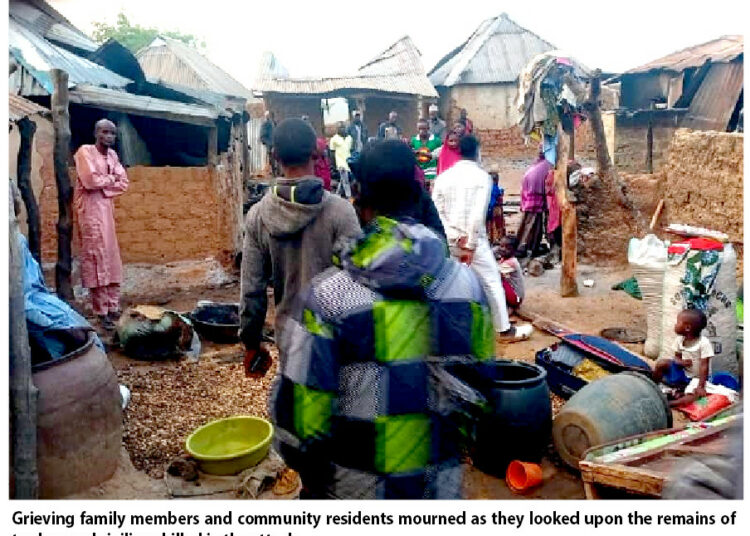
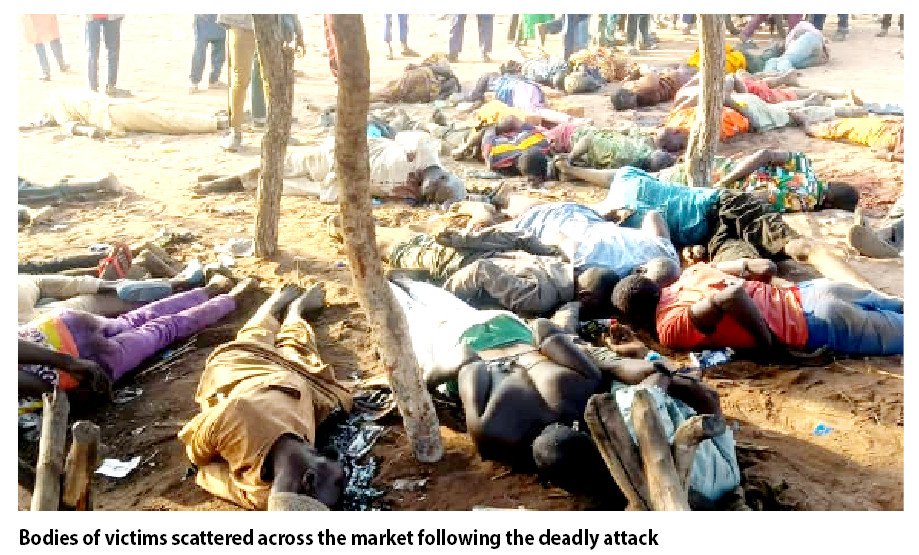
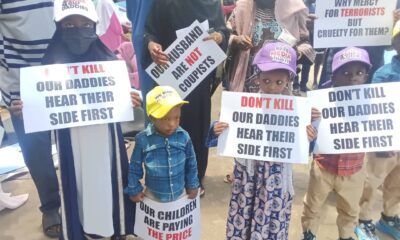
For the families of the victims of the January 3 terrorist attack on Kasuwan Daji Market, the trauma may never fade. What began as a regular market day in Borgu Local Government Area, Niger State, descended into a nightmare of screams and chaos. Survivors recount the horror of seeing their loved ones struck down as suspected bandits moved through the market, leaving destruction and fear in their wake. ABU NMODU reports.
Residents of Kasuwan Daji in Borgu local government area, Niger State, are still reeling after a brutal terrorist attack on Saturday, January 3, 2026, that claimed the lives of 30 people. Eyewitnesses and bereaved family members have narrated scenes of panic, bloodshed, and desperate flight, painting a grim picture of fear and devastation that has gripped the community.
One can only imagine the screams and wailing that filled the air at the Kasuwan Daji Market as suspected bandits, believed to be operating from the Kainji National Park forest near Kabe district, moved through the stalls, opening fire on innocent men and women, majorly breadwinners who had gone out to earn a living for their families.
Shops were looted, the market set ablaze, and fear now hangs over the entire community. When visited the community, it discovered that many residents have fled their homes, unsure if safety will ever return despite repeated assurances from authorities.
The attack left a trail of blood and destruction beyond the market itself. In the surrounding villages, 12 more people were slaughtered, and dozens were abducted as the assailants rampaged unchecked. Grieving families have described scenes of the unimaginable horror, as homes were ransacked and prized possessions destroyed, leaving survivors struggling to comprehend the scale of the violence.
In spite of the fact that local authorities and security operatives have been called upon to respond, the community remains on edge, with whispers of more attacks circulating among the frightened residents. The once-bustling Kasuwan Daji Market, a vital hub of trade and social life, now stands in ruins, a stark reminder of the terror that erupted in broad daylight.
The incident at Kasuwan Daji, located at the borders of Borgu and Agwara local government areas is just a few kilometres from Papiri, where children and staff of St Mary Catholic School were abducted recently brought back harrowing memories for villagers in both areas. Many recalled the emotional trauma their children endured before being released last month.
Families of the victims who pleaded anonymity told our reporter that the casualty of the attack, which now stands at 45 deaths, was both dastardly and cruel.
For them, beyond the heartbreak of losing loved ones, residents are grappling with the uncertainty surrounding family members who were abducted, as well as the destruction of property looted and set ablaze during the assault.
On the mode of operation of the terrorists, Mallam Farouk Musa from Borgu said that “they come from the Kainji National Park and game reserve forest, move through the Kabe Hills, attack the villagers, and then vanish into the forest, leaving the villagers to pick up the pieces.”
A woman popularly known as Madam Titi, who owns a shop in the market, said she lost four of her relatives in the attack on Kasuwan Daji, forcing her and other villagers to relocate. She said in an interview: “They killed four of my family members. We had to abandon the village and run away. We don’t know what to do. There is nobody left in our compound now. We are up to 100 people living in the same house where we have relocated to, in a neighbouring town in Kofanti. It is safer for us.”
Madam Titi added that her village, Babelu, close to Kasuwan Daji, saw no fewer than 42 villagers killed on that fateful day. She recalled that at the market, they were caught completely off guard, shot at randomly, and that she barely escaped the bandits’ bullets and possible abduction by quickly going into hiding. By the time she returned, 30 bodies were counted dead in the market.
“They also went into the villages, tied people’s hands, and slaughtered our people like animals. At least 12 of them were killed like that,” Titi recalled.
She called on the government to provide adequate security for the area, saying, “Only when that is done can we go back home. For now, there is danger everywhere, and there is no guarantee they will not come back.”
“How do you expect me to be alright going back to that village when I just buried four of my relatives, those I eat, sleep, and wake up with?” she asked rhetorically, adding that the lack of security presence, even after the Papiri attack, made it easier for the bandits to repeatedly overrun the villages.
Another villager, Dauda Baka-Aure, said he also lost four of his relatives during the attack on Kasuwan Daji Market, prompting him and other residents to relocate to Kofanti, a safer community.
“Now we are in this neighbouring village, where we sleep outside. We abandoned our village to become beggars, sleeping in the cold,” he told LEADERSHIP Weekend. He added that the few rooms provided by their hosts were reserved for the children, while the adults had to sleep outside in the harsh weather.
Painting a similarly gruesome picture of the attack, Dauda said the bandits opened fire at the market and went into surrounding villages, slaughtering people “like animals.”
He called on the government to take deliberate action and find a lasting solution to the repeated attacks, saying, “We are truly traumatised.”
Another market woman, Asebe, recounted her ordeal: “I was in my shop when I heard gunshots. I ran for my life, but by the time I returned after the bandits left, I saw some of the people who were just alive a moment ago lying in pools of their blood. It was unbelievable. People were going about their usual business, and the next minute you saw them like that.”
Mallam Umar Kwana said none of his relatives were directly killed during the attack, but five of his children were among the scores abducted from the market. “Some people from our area were slaughtered by the terrorists. I am very sad. Five of my children have been abducted. When the bandits came, there was confusion everywhere, and later I could not find my children. It is clear they were taken into the forest with the others abducted from the market,” he said.
The director of Communications for the Catholic Diocese of Kontagora, Reverend Father Matthew Kabirat, confirmed the severity of the situation, noting that
parishioners and priests are also relocating due to fear of further attacks.
He added, “As I am talking to you, our parishioners and priests are leaving for fear of possible attacks. The security personnel who came after the incident cannot be found, and there are no signs of help for the people. These terrorists had a field day, and our people are moving from that axis for fear of either being killed or kidnapped.”
Reverend Kabirat said the attackers did not only kill but also abducted an unknown number of women and children and set the market ablaze. “The fire was so intense that the smoke could be seen 15 kilometres away at Papiri,” he said.
A villager, who gave his name as Abuka, said communities in Papiri, Kwana, and Tugan Salama, both in Agwara and Borgu local government areas were living in constant fear. He said, “Between Sunday, December 28, 2025, and Saturday, January 3, 2026, this group of bandits roamed freely without being challenged. The Papiri school children, who were recently released from captivity, including my daughter, have been further traumatised, forced to hide whenever the terrorists are nearby, both day and night.”
He added, “People are evacuating the area in large numbers, abandoning their homes and property.”
The Niger State Police public relations officer, Wasiu Abiodun, confirmed the attack, stating that security forces were on the trail of the terrorists. However, he provided no updates on the rescue of the abducted victims or any arrests made.
Similarly, the Niger State government extended condolences to the families of the victims and assured the public that it was working to prevent further attacks, pledging to collaborate with the federal government to bring the perpetrators to justice. Yet, for now, villagers continue to live in fear, mourning their killed and abducted family members.
It was reports that despite President Bola Ahmed Tinubu’s directive for security agencies to coordinate an immediate manhunt to rescue the abducted victims, the situation in the affected communities remains precarious and in urgent need of attention.
The escalating insecurity has also drawn the concern of the Son of the late Emir of Borgu, Murtala Haliru Dantoro, who appealed directly to President Tinubu to rescue the people of the Borgu Emirate, reminding him of his traditional title, Jagaban Borgu.
The prince said the persistent killings and insecurity in Borgu and Agwara local government areas, which comprise the Emirate, had reached an unbearable level, leaving residents in constant fear. “I am deeply troubled by the continuous loss of innocent lives in our communities. Families are being torn apart, livelihoods destroyed, and our people are gradually losing hope in the ability of leadership to protect them,” he said.
He urged both President Tinubu and Niger State Governor Mohammed Umar Bago to intervene urgently and provide lasting solutions. “Our people deserve to live without fear, to farm their lands, and to sleep peacefully in their homes. This is not just a local crisis; it is a humanitarian emergency that demands immediate and decisive action from the highest levels of government,” he added.
The accounts reflect the deep frustration and anguish of the once peaceful Borgu Emirate, a region of strategic national importance that hosts major investments, including Nigeria’s foremost hydroelectric dam.
Therefore reiterate that as the smoke clears over Kasuwan Daji and surrounding villages, the grief, fear, and displacement linger, painting a stark reminder of the human cost of insecurity in Niger State.
Families mourn the loss of loved ones, communities struggle to rebuild, and the shadow of further attacks hangs over every home and market.
The urgent call for decisive action, from local authorities to the highest levels of government, resounds louder than ever, for the safety, dignity, and future of the Borgu Emirate and its people depend on it.
A Magistrate Court sitting at Nomansland in Fagge Local Government Area of Kano State has ordered the remand of a driver and two others over the alleged theft of jewellery, cash, and a mobile phone belonging to the wife of the 16th Emir of Kano, Muhammadu Sanusi II.
The defendants, Sulaiman Yakubu Kulkude, Idris Musa, and Abdullahi Usaini, were arraigned on a three-count charge of conspiracy, theft and receiving stolen property.
Prosecuting counsel, Barrister Abubakar Ibrahim, told the court that Sulaiman Yakubu, who serves as the driver of the Emir’s wife, unlawfully entered her room and made away with jewellery reportedly valued at N60 million, alongside cash and a mobile phone.
When the charges were read, Sulaiman pleaded guilty to all counts, while the two other defendants pleaded not guilty.
Counsel to the defendants, Barrister A.A. Abdullahi, filed a bail application.
In his ruling, the presiding Magistrate, Halilu Abdurahman, granted bail to the defendants with conditions, including the provision of a surety who must be either a father or brother, a civil servant not below Grade Level 15, and a bail sum of N10 million each.
The case was adjourned to April 14 for further hearing, while the defendants were remanded pending the fulfilment of their bail conditions.
Two adult males have been killed in separate suspected cult-related attacks in Lagos and Ogun States.
PUNCH Metro learnt that the first incident occurred on Saturday around the Federal College of Education (Technical), Akoka, in Yaba, while the second took place in the Magboro area of Ogun State.
The victim in the Akoka incident was reportedly hacked to death after being attacked by about six suspected cultists.
A police source, speaking on condition of anonymity due to lack of authorization to speak for the command, described the attack on Tuesday as a suspected reprisal.
“The victim was accosted along the axis leading to the school gate, and what started as a confrontation led to a fight. He was stabbed in the head in the process. It was later discovered that the assailants were suspected cultists,” the source said.
In a video seen by PUNCH Metro on Tuesday, the deceased’s body was lying by the roadside.
The state Police Public Relations Officer, Abimbola Adebisi, confirmed the incident, adding that one suspect had been arrested.
“One suspect has been arrested in connection with the incident. Investigation is ongoing,” she said.
In Magboro, PUNCH Metro gathered that the victim in the Gas Line area was a suspected Eiye cult member identified as Cegaga.
According to insiders, he was stabbed to death during a clash involving rival cult groups in the community.
The incident, our correspondents gathered, occurred on Saturday around 11pm, following a disagreement between the deceased and a suspected Buccaneer member identified as Corner over money issues.
A suspected Vikings member, identified as Troup, who was reportedly at the scene, allegedly took sides in the dispute and stabbed the victim.
Residents said the victim’s body was discovered the following morning.
A resident who requested anonymity for security reasons said, “I didn’t witness the clash. I only came back to see that someone had been killed.”
Also speaking, a trader who asked not to be named said, “We had closed for the day.” It happened at midnight, and we only saw the body when we resumed work the next morning.”
It was gathered that tension had heightened in the community due to recurring cult-related violence in recent weeks.
Another resident, who identified himself as Suleiman, told PUNCH Metro on Tuesday that such incidents had become frequent.
He said, “We have been experiencing a series of cult attacks in the area over the past few weeks. The one that happened on Saturday is just one of many incidents.
“We rarely experience situations like this, but it is now becoming regular. We need the intervention of the authorities before it escalates.”
The Ogun State Police Command spokesperson, Oluseyi Babaseyi, could not be reached for comment, as calls to his telephone lines went unanswered.
A text message sent to him had not been replied to at the time of filing this report.
PUNCH Metro had reported on March 3 that two suspected cultists, identified as Monday and Efe, were shot dead in a fresh wave of cult-related violence in the Ojo area of Lagos State.
The operation, disclosed in a statement issued on Sunday by NDLEA’s Director of Media and Advocacy, Femi Babafemi, followed intelligence on trans-border criminal activities.
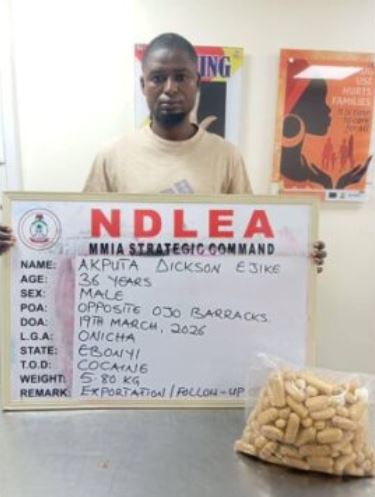
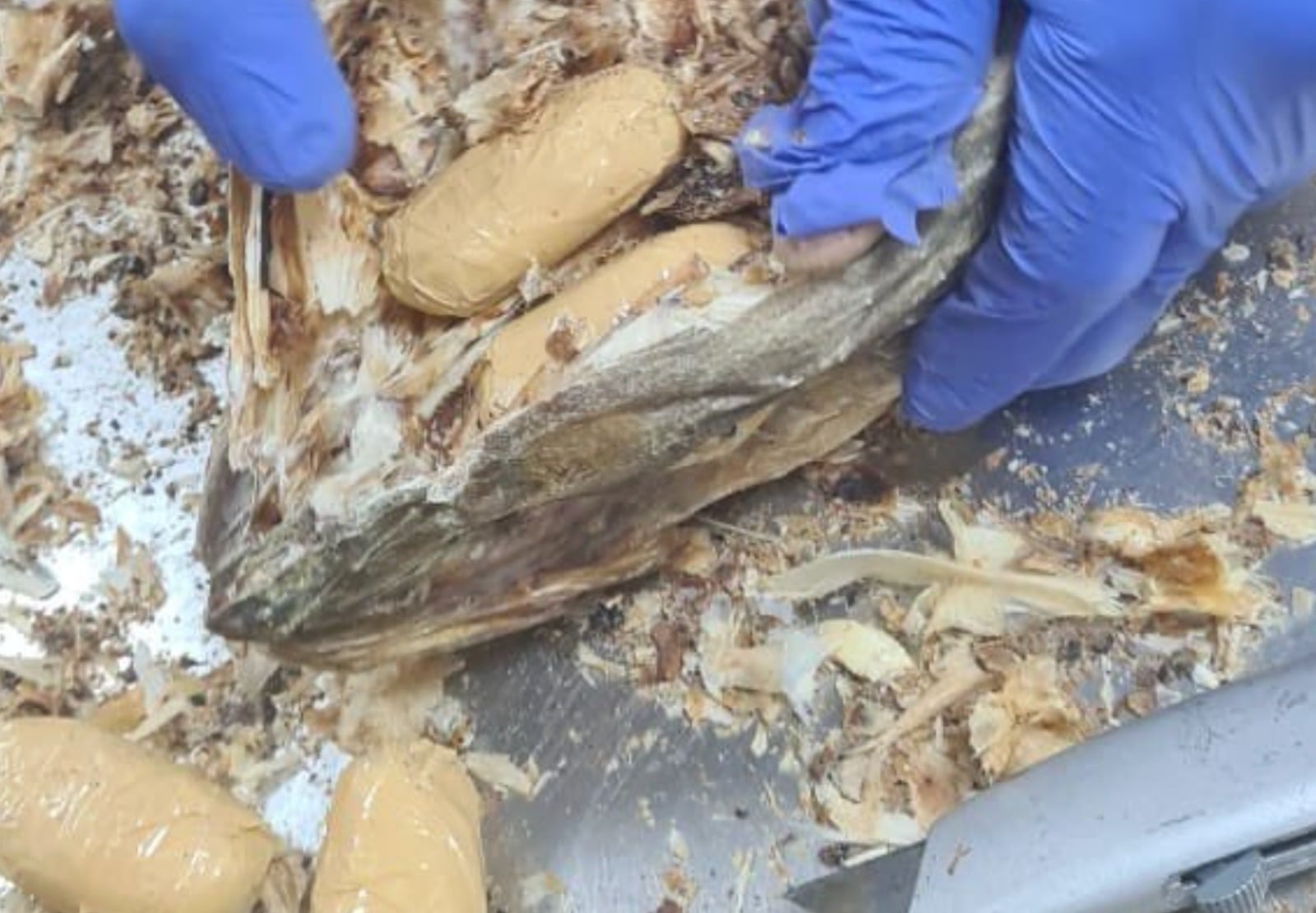
The National Drug Law Enforcement Agency (NDLEA) has intercepted a large shipment of cocaine hidden inside the heads of imported dry stockfish and arrested a key member of the syndicate linked to trafficking the drugs abroad.
The operation, disclosed in a statement issued on Sunday by NDLEA’s Director of Media and Advocacy, Femi Babafemi, followed intelligence on trans-border criminal activities.
Babafemi said the intelligence led to a sting operation by operatives of the Murtala Muhammed International Airport Strategic Command of the Agency at the Ojo area of Lagos on Thursday, March 19, 2026.
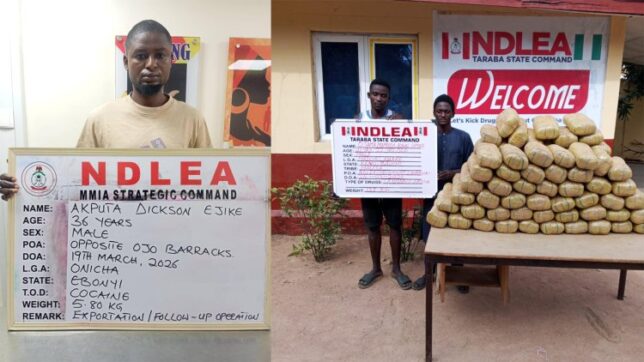
“In the course of the operation, three jumbo size bags were found in possession of the kingpin 36-year-old Akputa Dickson Ejike.
“A search of the bags led to the recovery of Two Hundred and Thirty-Seven (237) wraps of cocaine buried in the heads of imported dry stock fish locally known as ‘Okporoko.’
“The cocaine pellets have a gross weight of 5.80 kilograms. The consignment was intended for export to Delhi, India,” the statement read.
In a separate operation on Wednesday, March 25, NDLEA operatives from the Directorate of Operations and General Investigation (DOGI) intercepted two consignments bound for the United Kingdom at a courier company in Lagos.
“In one of the shipments that originated from Cotonou, Benin Republic, 1.9 kilograms of methamphetamine were found concealed in automobile filters while the second parcel contains 40 ampoules of Morphine Sulphate and nine ampoules of Fentanyl.”
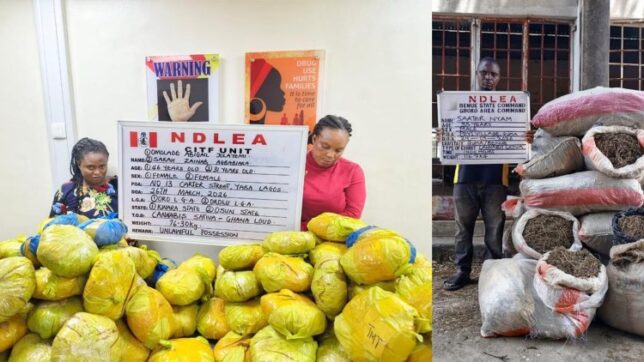
Babafemi added that on March 26, a Special Operations Unit (SOU) raided the home of 46-year-old Omolade Abigail Jolayemi, known as “Iya Ghana,” at 13 Carter Street, Yaba, Lagos.
She and her associate, 31-year-old Sarah Zainab Agbabiaka, were arrested after operatives recovered 135 blocks of cannabis weighing 76.30 kilograms.
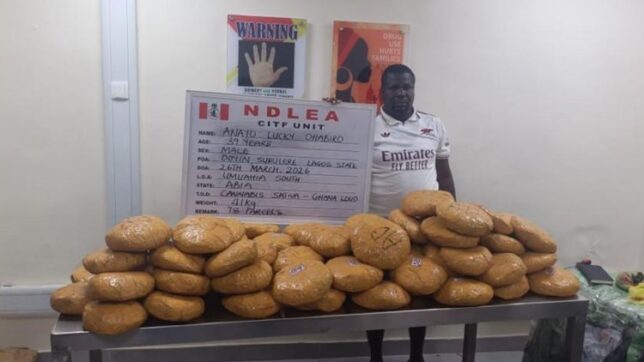
“Same day, the SOU operatives also arrested Anayo Lucky Ohabiro, 39, at Doyin bus stop, Surulere, Lagos following credible intelligence. A total of 78 blocks of Ghana Loud weighing 41kg were seized from him.”
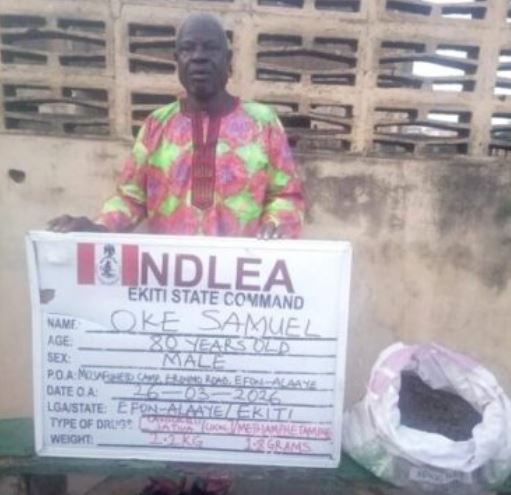
In Ekiti State, the statement added that “an 80-year-old grandpa, Oke Samuel, was on Thursday 26th March arrested by NDLEA operatives during a special raid operation at Mosafuneto camp, Erinmo road, Efon-Alaaye Ekiti. A total of 2.2kg skunk and 1.8grams of methamphetamine were recovered from him.”
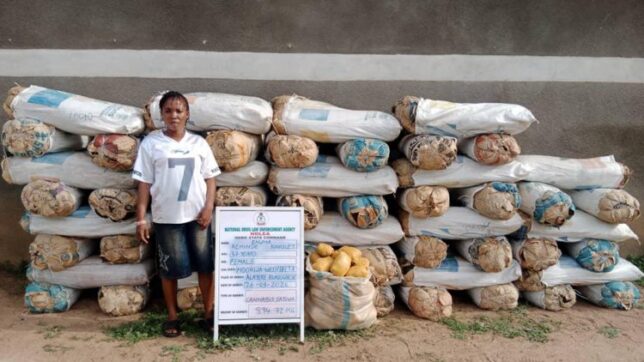
Another suspect, 37-year-old Enuwa Kehinde Kingsley, had 894.72 kilograms of skunk seized from an uncompleted building in Ogbese, Akure North, Ondo State.
Elsewhere, 35-year-old Saater Nyam was apprehended at Pevi village, Guma LGA, Benue State, with 116.7 kilograms of skunk on Tuesday, March 24.
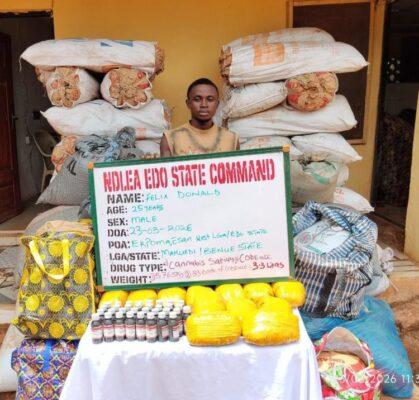
In Edo State, a warehouse raid in Ekpoma town, Esan West LGA, on Monday, March 23, led to the arrest of 25-year-old Felix Donald and the seizure of 576.5 kilograms of skunk and 33 bottles of codeine-based syrup.
In Taraba State, Babafemi said NDLEA officers intercepted a truck carrying 100 blocks of compressed skunk weighing 135 kilograms concealed in animal feed bags from Garbachede to Gombe State on Tuesday, March 24.
Two suspects, 21-year-old Osama Mamuda and 22-year-old Auwal Umar, were arrested in connection with the seizure.
Babafemi noted that the agency has also continued its War Against Drug Abuse social advocacy, conducting sensitisation lectures in schools across Cross River, Adamawa, Oyo, Kano, and Lagos states.
Chairman and Chief Executive Officer of NDLEA, Brig. Gen. Mohamed Marwa (Rtd), commended operatives from MMIA, SOU, DOGI, Ekiti, Ondo, Benue, Edo, and Taraba Commands for their efforts and praised all commands nationwide for balancing drug supply reduction with drug demand reduction initiatives.