Connect with us

News

Awujale stool battle: Ogun halts process, police storm palace

Published

on

Ogun State government on Wednesday halted the selection process for the new Awujale of Ijebu land, the second suspension in less than a month, with a heavy deployment of security forces at the palace.

Our correspondent at Ijebu Ode observed heavy  presence of  policemen and officers of the Nigeria Security and Civil Defence Corps, following the government’s directive.

The Awujale stool became vacant in July 2025 after the death of 91-year-old Oba Sikiru Adetona, who reigned for 65 years.

In a statement signed by Commissioner for Local Government and Chieftaincy Affairs, Ganiyu Hamzat, the government said the decision to halt the process was to protect public order, safeguard the integrity of the selection, and maintain the prestige of the stool.

He said,“Given the reports at its disposal, the government has elected to act proactively without further delay in the interest of peace, order and good government by halting the process in its entirety. The Fusengbuwa Ruling House should await further directives regarding the selection process.”

Earlier, on December 18, 2025, the state government suspended the process over procedural errors that could trigger litigation.

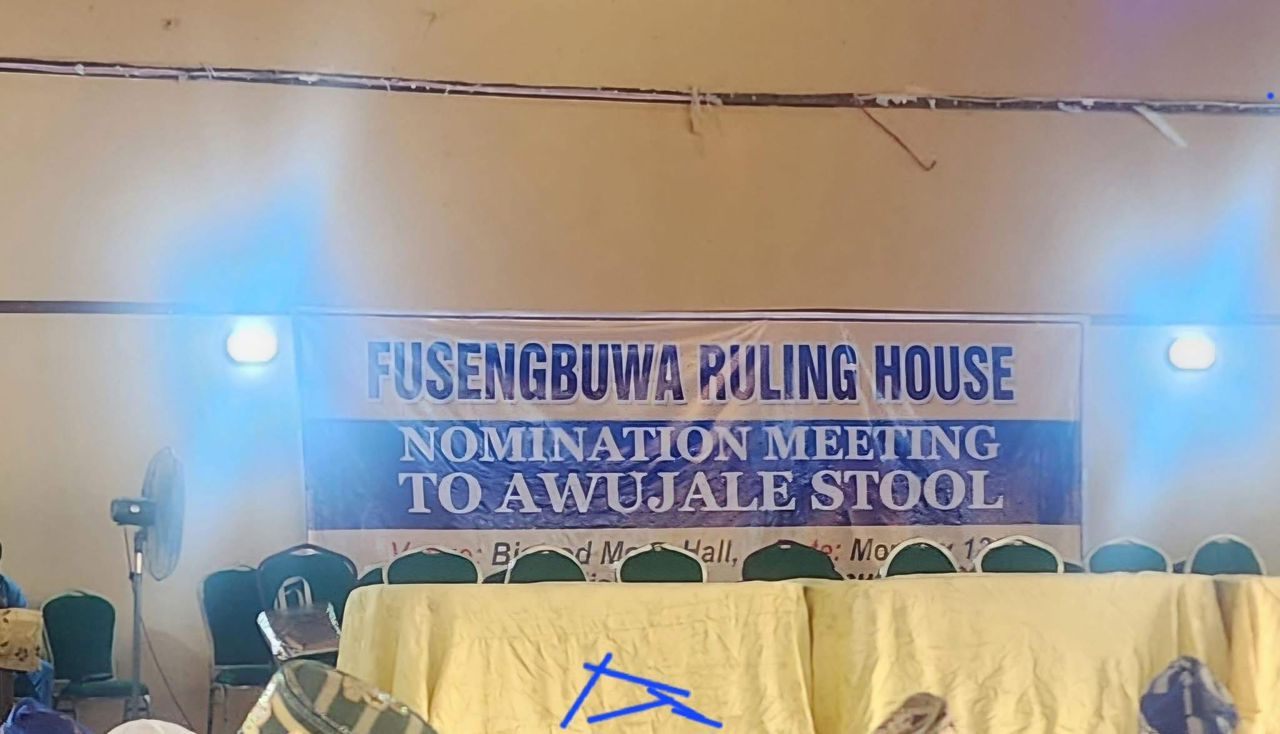
The Fusengbuwa Ruling House had shortlisted 95 contestants—including 94 princes and one princess—during a nomination meeting held at Bisrod Hall, GRA, Ijebu Ode.

The selection process has attracted widespread interest, including from Fuji musician Ayinde, popularly called KWAM1, who had sought an interim injunction at the state high court to stop the selection proces.

On Wednesday, the Regent and head of the Awujale Interregnum Administration Committee, Dr Sonny Kuku,  confirmed that the government had temporarily paused the process.

“Today, we received a message from the government indicating that the process has been temporarily halted. At the moment, we do not know the reason, but we are consulting with them to ensure the process resumes because the general members of the public are waiting for the emergence of the new Awujale,” he said.

See also  PHOTOS: FCT police rescue 23 abducted foreigners, arrest 14 transnational kidnappers in Nasarawa

“We will do our best to ensure that the process resumes because the general members of the public are waiting for the emergence of the new Awujale.

“The kingmakers cannot say much at this time because we have a very onerous task. We are confident that the government is also interested in ensuring a peaceful outcome. We are consulting with them, and we believe that something will happen soon.”

Speaking on reports suggesting government interference, the regent said that the kingmakers are unaware of any such move and that such reports should be treated as mere speculation.

He added that the kingmakers are fully aware of the weight of their responsibility and would therefore not betray the confidence reposed in them by tolerating any act of imposition.

Kuku further stated: “The government does not sit with the kingmakers during deliberations. We do not work with them directly, and as you know, in situations like this, there are always many rumours.

“We try to separate fact from speculation. If any form of imposition occurs, we will certainly let the public know, because we will not tolerate that. However, that has not happened.”

On the presence of heavy security personnel at the Awujale palace, Kuku said it should not be viewed as an attempt to influence the process, but rather as a measure to inform the public that the selection process has been temporarily halted.

He explained: “The palace is a symbol of the people, and by barricading it, the authorities are making it clear that the process is temporarily in abeyance.

“There is no physical or emotional conflict taking place. We hope the palace will be reopened very soon because we want to avoid any anxiety among the people. Our goal is peace, and that we shall achieve by God’s grace.”

Kuku also said that the kingmakers have not received any of the petitions reportedly written by stakeholders and security agencies regarding the Awujale selection process, which the government cited as the reason for halting it again on Wednesday.

See also  NCAA petitions Attorney-General and IGP to prosecute KWAM1

The regent said: “If such petitions exist, they should be forwarded to us, but we have not received any. That is why we are consulting with the government. Once discussions are concluded, we will make a statement as quickly as possible. There is nothing to worry about.

“As kingmakers, we are handling a very delicate responsibility. Our decisions can affect the lives of the people for centuries to come, so we are being extremely careful about what we do and say. We assure you that we will ensure peace and that the best person emerges as the next Awujale.”

Kuku also dismissed claims that the kingmakers have been compromised or are favoring a particular candidate, saying they are instead working tirelessly to ensure that only the best candidate is selected.

The renowned medical doctor said: “Let me be clear: we have not slept for five days. We are dealing with about 95 applications and over 1,200 documents, scrutinizing them meticulously.

“We are working diligently to ensure we select the best possible candidate. If we were biased, we would not be spending sleepless nights reviewing documents so thoroughly.

“We had planned to continue this process for several more days, and we are prepared for more sleepless nights. The criteria we have developed are meant to produce a leader who truly represents the people and will bring progress to the community.

“We still expect a few more sleepless nights, but for now, we may be able to rest briefly before the process resumes.”

DSS to profile aspirants

On Wednesday, the DSS confirmed that the 95 nominees were scheduled for profiling at their office in Ijebu-Ode. The exercise was planned to follow palace screening and run over several days to cover all nominees. The profiling is part of a comprehensive vetting process for aspirants to the Awujale stool.

See also  11th NASS: Senate blocks ex-govs, Uzodimma from principal offices

However, the exercise was suspended in line with the state government’s directive halting the Awujale selection process. The DSS stressed that the suspension is a government decision and not an action initiated by the agency.

Aspirant writes Abiodun

A contender to the Awujale stool, Mr. Wasiu Adewale Olasunkanmi Adesanya, formally wrote to the Ogun State Government, urging that the halted process be resumed inclusively, transparently, and fairly.

In a letter dated January 21, 2026, addressed to the Commissioner for Local Government and Chieftaincy Affairs and signed by his counsel, Dr. Wahab Shittu, SAN, Adesanya expressed appreciation to the government for suspending the process “in the interest of peace, order and good governance.”

He maintained that he is a qualified contender by virtue of his descent from the Fusengbuwa Ruling House, tracing his lineage to Princess Anifowoshe, an acknowledged princess of the ruling house. The letter noted that his family has long-standing recognition in Ijebuland’s traditional hierarchy and that Adesanya holds the traditional title of Olori-Omoba of Ijebuland.

He urged the government to ensure that no eligible contender is excluded when the process resumes, adding:

“We respectfully urge the Ogun State Government that, upon the resumption of the Awujale selection process, such process should be all-inclusive, transparent and fair, and should consciously eschew any act or omission capable of excluding or disenfranchising our client. An inclusive process will promote unity within Ijebuland, enhance public confidence, and further entrench the prestige and legitimacy of the Awujale stool.”

The Ogun State Government had earlier halted the process under powers contained in the Obas and Chiefs’ Law of 2021, citing procedural concerns and the need to preserve peace in Ijebuland.

punch.ng

FOLLOW US ON:

FACEBOOK

TWITTER

PINTEREST

TIKTOK

YOUTUBE

LINKEDIN

TUMBLR

INSTAGRAM

Continue Reading
Click to comment

Leave a Reply

Your email address will not be published. Required fields are marked *

News

Pentagon restores name of US Pacific Command

Published

on

The Pentagon is set to restore the name of the US Indo-Pacific Command to the US Pacific Command, it said on Tuesday, reversing a 2018 decision.

The renaming will not change the command’s area of responsibility, which stretches from the western part of India to America’s Pacific coastline, the Department of War said in a statement.

Its “fundamental mission and its unwavering commitment to maintaining a free and open theatre alongside regional allies and partners” also remain unchanged, it added.

The name change “honours the command’s deep historical roots, fostering a sense of pride and collective spirit among all who serve in the Pacific,” the department said, without giving additional details.

The US Pacific Command was established by former President Harry Truman after World War II.

It operated under that name for over 70 years before being renamed as the US Indo-Pacific Command in 2018, in a nod to the growing importance of the Indian Ocean in US strategic thinking.

The 2018 name change also came as part of broader efforts by Washington to counter China’s growing influence across the Asia-Pacific domain.

AFP

See also  School abductions: Protest in Oyo, Ogun as NUT begins nationwide rally today
Continue Reading

News

Labour to engage FG on minimum wage review

Published

on

The Nigeria Labour Congress and the Trade Union Congress said they will restart negotiations with the Federal Government over a new national minimum wage, warning that workers can no longer cope with rising living costs as inflation continues to erode real incomes.

The unions are pushing for what they described as a “genuine living wage” to replace the current framework, which they said no longer reflects Nigeria’s economic realities, particularly sharp increases in food, transport, housing, and healthcare costs.

The position was contained in a joint address delivered at the 114th International Labour Conference in Geneva on Monday, where the unions also rejected any proposal to tax the minimum wage or impose additional fiscal burdens on low-income earners.

Nigeria’s current minimum wage of N70,000 was signed into law on 18 July 2024, in an agreement between organised labour and the federal government. President Bola Tinubu formally announced the wage on 19 July 2024, and it took effect on 29 July 2024.

The agreement originally set a three-year review cycle, shifting from the previous five-year arrangement. However, in January 2025, the Federal Government adjusted the framework, announcing that the minimum wage would now be reviewed every two years, effectively setting 2026 as the next review point.

In light of this, labour leaders said they intend to formally open discussions with the federal government ahead of the July 2026 wage renegotiation deadline, in a bid to prevent the delays that have often hindered previous minimum wage reviews.

“The current Act expires early next year, and we have announced that renegotiation will commence by July 2026 to avoid the painful delays of the past. As soon as we leave here, we shall write again to the government demanding the commencement of the process for renegotiating the national minimum wage,” the unions said.

See also  PHOTOS: FCT police rescue 23 abducted foreigners, arrest 14 transnational kidnappers in Nasarawa

The labour leaders said workers are already under severe pressure from inflation, currency depreciation, and rising costs across essential services, arguing that official economic indicators do not reflect the daily realities of most households.

They warned that taxing the minimum wage would worsen poverty and deepen economic hardship at a time when many citizens are struggling to meet basic needs.

“We demand nothing less than a genuine living wage that reflects today’s harsh economic realities. We also demand immediate relief measures by governments at all levels until a new minimum wage is signed into law. We reject outright any attempt to tax the minimum wage or impose further burdens on the poor,” the unions said in their communiqué.

The unions stressed that the upcoming negotiations must go beyond nominal wage adjustments and instead focus on protecting real incomes, which they said have been steadily eroded by inflation.

They also urged federal and state governments to introduce short-term relief measures pending the conclusion of negotiations, warning that delays could heighten industrial tensions across the country.

Beyond wage concerns, the labour movement used the Geneva platform to highlight broader economic and social challenges, including insecurity, unemployment, and rising poverty levels.

They said insecurity in several parts of the country has made commuting increasingly dangerous for workers, with killings, abductions, and displacement affecting productivity and livelihoods.

According to the unions, nearly 2,000 people were killed in the first quarter of the year, while millions have been displaced, with entire communities and economic activities disrupted by violence.

See also  Explosions hit major cities as US launches new strikes on Iran

They warned that worsening insecurity could force workers to remain at home as a survival response, escalating tensions beyond traditional labour action if not urgently addressed.

The labour leaders also said about 65 per cent of Nigerians, estimated at roughly 150 million people, are currently living in multidimensional poverty, driven by inflation, job losses, and declining purchasing power.

They argued that while macroeconomic reforms are aimed at stabilisation, they have yet to translate into improved living standards for ordinary citizens.

As the 2027 general elections approach, the unions said they are developing a charter of demands to shape their engagement with political actors and inform their support for candidates, noting that  only political actors who commit to improved security, functional public services, wage reforms, and protection of labour rights would receive their backing.

The labour movement also raised concerns over alleged interference in union affairs in some states, accusing certain governments of undermining democratically elected labour leadership structures.

They emphasised that organised labour would resist any attempt to weaken union independence or impose external control on labour organisations.

As the current wage regime approaches its 2026 review window, the unions said their priority remains securing a wage structure that reflects economic realities and protects workers from further erosion of income.

They maintained that the outcome of the upcoming negotiations would determine whether Nigerian workers receive what they termed a “living wage” or continue to endure worsening economic hardship.

punch.ng

FOLLOW US ON:

FACEBOOK

TWITTER

PINTEREST

TIKTOK

YOUTUBE

LINKEDIN

INSTAGRAM

Continue Reading

News

Ribadu, Akpabio advocate tech-driven border control over Insecurity

Published

on

The National Security Adviser, Nuhu Ribadu, and President of the Senate, Godswill Akpabio, on Tuesday called for the deployment of modern technology and stronger regional cooperation to strengthen Nigeria’s border security architecture and address growing security threats across the country.

FILE: Akpabio

They made the call at the opening of the 15th National Security Seminar organised by the Alumni Association of the National Defence College in Abuja.

Represented by the Director of Policy and Strategy at the Office of the National Security Adviser, Yazid Gbemudu, the NSA said Nigeria’s territorial integrity and national stability were closely tied to the effectiveness of its border security framework.

He noted that while Nigeria’s extensive land and maritime borders facilitated trade, regional integration and socio-economic development, they also exposed the country to threats including terrorism, arms trafficking, smuggling, human trafficking, irregular migration and other forms of transnational organised crime.

According to him, weak border governance creates vulnerabilities that can be exploited by criminal and terrorist networks, thereby undermining national security and development efforts.

“A major pillar of Nigeria’s contemporary border security framework is the National Border Management Strategy, which promotes an integrated border management approach.

“The strategy seeks to enhance intelligence collaboration, strengthen border infrastructure, improve surveillance capabilities and modernise border management processes,” he said.

Ribadu said the deployment of Border Management Information Systems and other technological solutions at key entry and exit points had improved data collection, traveller screening and migration monitoring.

“These initiatives demonstrate Nigeria’s commitment to aligning its border management practices with international standards,” he added.

See also  PHOTOS: FCT police rescue 23 abducted foreigners, arrest 14 transnational kidnappers in Nasarawa

The NSA stressed the need for the full implementation of an integrated border management system to improve coordination among security, intelligence and law enforcement agencies.

“Effective intelligence sharing, joint operations and harmonised border procedures are essential for addressing contemporary security threats,” he said.

He also advocated increased investment in technology-driven border security solutions.

“Expanding surveillance systems across land, maritime and coastal borders will significantly improve monitoring capabilities and reduce illegal cross-border activities.

“Modern challenges require modern solutions, including biometric identification systems, advanced border monitoring technologies and data-driven security frameworks,” Ribadu stated.

The NSA further emphasised the importance of regional and bilateral cooperation, noting that many of the security challenges confronting Nigeria’s borders were transnational in nature and required coordinated responses among neighbouring countries.

He also called for greater investment in border communities through sustainable development, improved infrastructure and economic opportunities to reduce their vulnerability to criminal exploitation.

“Strengthening Nigeria’s border security architecture is fundamental to ensuring national stability, protecting territorial integrity and promoting socio-economic development,” he said.

Ribadu, however, acknowledged challenges such as porous borders, inadequate infrastructure, limited technological capabilities and gaps in inter-agency coordination, saying they required urgent attention.

“Border security is a shared responsibility that requires the collective efforts of security agencies, government institutions, border communities and international partners,” he added.

Speaking at the event, Akpabio, who was represented by the Chairman of the Senate Committee on Defence, Ahmad Lawan, said Nigeria’s extensive land and maritime boundaries posed significant security challenges.

“As a country with extensive land and maritime boundaries, Nigeria faces significant challenges relating to border control, illegal migration, arms trafficking, smuggling and the infiltration of criminal and extremist elements.

See also  PHOTOS: Top Iranian leaders ‘killed’ in US and Israel’s blitz as Ayatollah’s fate unknown

“It is, therefore, imperative that Nigeria prioritises the strengthening of its border security architecture through improved surveillance, enhanced infrastructure, better inter-agency coordination, technological innovation and stronger regional cooperation,” he said.

Akpabio noted that many of the security threats confronting Nigeria had transnational dimensions, making coordinated responses essential.

He stressed that peace and security remained prerequisites for meaningful national development.

“There can be no meaningful development without peace and security. Porous and poorly managed borders can become vulnerabilities that undermine national security efforts and national stability,” he said.

The Senate President also advocated a whole-of-government and whole-of-society approach to addressing insecurity.

According to him, government institutions, security agencies, civil society organisations, the private sector, traditional institutions, the media and academia all have critical roles to play in safeguarding the country.

Earlier, the Acting President of AANDEC, Commodore Amatare Kpou (retd.), described the seminar as a key platform for promoting informed discourse on national security challenges and opportunities.

Kpou said the theme of the seminar, “Strengthening Nigeria’s Border Security Architecture for National Stability,” was timely, given the growing threats of irregular migration, smuggling, trafficking and other cross-border crimes.

He expressed confidence that the deliberations would generate useful recommendations for policymakers and contribute to efforts aimed at building a safer and more secure Nigeria.

Nigeria shares over 4,000 kilometres of land borders with neighbouring countries and an extensive coastline, making border security a critical component of national security.

Authorities have repeatedly identified porous borders as channels for terrorism, arms smuggling, human trafficking and other transnational crimes.

The Federal Government has in recent years intensified efforts to strengthen border management through technology, intelligence sharing and regional cooperation.

See also  School abductions: Protest in Oyo, Ogun as NUT begins nationwide rally today

punch.ng

FOLLOW US ON:

FACEBOOK

TWITTER

PINTEREST

TIKTOK

YOUTUBE

LINKEDIN

INSTAGRAM

Continue Reading

Trending