Connect with us

News

El-Rufai sparks controversy after airport ‘arrest’ drama

Published

on

Former Kaduna State Governor, Malam Nasir El-Rufai, has described the attempt by security operatives to arrest him at Nnamdi Azikiwe International Airport, Abuja, as executive overreach and a deliberate disregard for the rule of law.

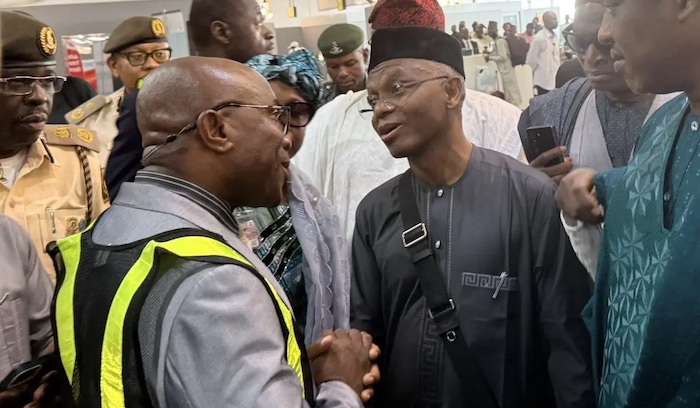
The former governor arrived at the airport to a waiting crowd of supporters who had gathered to welcome him.

In an interview with BBC Hausa on Wednesday, he stated that security agencies might arrest him soon, noting that four of his former aides had already been detained.

On Wednesday evening, he hinted in a post on X (formerly Twitter) that he would be returning to Nigeria soon.

However, a tense atmosphere prevailed at the Abuja airport on Thursday following a reported attempt by security operatives to detain El-Rufai upon his arrival from Cairo.

An aide of the former governor, Muyiwa Adekeye, reported on his X page that armed personnel approached El-Rufai shortly after he landed, attempting to escort him away.

He added that some individuals present intervened, insisting that the former governor would not comply without proper documentation. “The officers walked straight up to him and told him to follow them. But some people around insisted that he would not accompany them like that,” Adekeye said.

El-Rufai was said to have requested to see an official invitation, which could not be provided. “Mallam Nasir had asked them to show him any form of invitation before he joined them at their office, but they couldn’t provide any,” Adekeye added.

Supporters had thronged the airport to welcome the former governor and chieftain of the African Democratic Congress and were seen in a video pushing him and his wife into a Sport Utility Vehicle to exit the airport.

Condemning the development in a post on his X account, El-Rufai accused the authorities of exceeding their powers and flouting the rule of law.

See also  I’m the only monarch with authority to install titles covering Yorubaland — Alaafin

He stated, “My lawyers have issued a statement that condemns the illegal attempt to arrest me today at the Abuja airport upon my arrival from Cairo.

“Our country must outgrow executive overreach.”

El-Rufai defected from the All Progressives Congress to the African Democratic Congress after serving eight years as governor.

His counsel also accused security operatives of attempting to unlawfully arrest his client on Thursday.

In a statement by Ubong Akpan of the Chambers of Ubong Akpan, the lawyer said operatives moved against El-Rufai shortly after he landed aboard Egypt Air flight MS 877 from Cairo.

Akpan said, “We unequivocally condemn the attempted illegal arrest of our client by security operatives this afternoon upon his arrival in Abuja. This is a flagrant violation of constitutional rights, executive overreach, and a deliberate disregard for the rule of law.”

The lawyer stated that the Economic and Financial Crimes Commission had previously issued an invitation to El-Rufai while he was abroad, calling the action unreasonable and impractical.

“The invitation from the EFCC was delivered to Malam El-Rufai’s residence while he was already abroad, rendering it inherently illogical to demand immediate attendance.

“We formally communicated with the EFCC since December 2025, assuring compliance upon his return,” he said.

He added that the commission had been notified that El-Rufai would appear voluntarily.

“Yesterday, we explicitly informed them that he would appear at their office by 10:00 am on Monday, February 16, 2026. Resorting to arrest despite this clear commitment exemplifies arbitrary conduct and undermines procedural integrity,” he stated.

Akpan claimed that Department of State Services operatives tried to detain El-Rufai without showing a warrant or an official invitation.

“Upon his arrival, security operatives moved to arrest Malam El-Rufai without presenting any warrant or letter. When he demanded to see the invitation, none could be produced — no document, no signed directive, no lawful process,” the lawyer said.

See also  Tinubu approved lifetime salary for retiring senior officers – Interior minister

He also alleged that the security operatives confiscated El-Rufai’s passport, noting that passengers and other airport users stepped in during the incident.

“In the same unlawful manner, operatives physically snatched his international passport. This act is nothing short of stealing, the unlawful taking of private property by agents of the state acting without colour of authority.

“Ordinary Nigerians present at the airport, incensed by this display, surrounded the scene and insisted loudly that he could only be arrested upon a legitimate process.

“That citizens had to remind security operatives of the constitution is both shameful and instructive,” he added.

Akpan contended that the attempted arrest breached multiple constitutional rights, including the rights to personal freedom, a fair trial, human dignity, freedom of movement, and ownership of property.

“There exists no justifiable basis for this attempted arrest or the accompanying mistreatment,” he said, adding that El-Rufai returned to Nigeria despite alleged intelligence of plans to intercept him.

“This premeditated interception at the airport exemplifies lawlessness and an abuse of state power,” the statement read.

The lawyer called for a prompt cessation of any attempts to arrest El-Rufai and for his passport to be returned without delay.

“We demand the immediate and unconditional cessation of all unlawful efforts to detain Malam El-Rufai, the immediate return of his stolen passport, and a formal apology for this egregious infringement on his dignity and rights,” Akpan said.

The lawyer also stressed that El-Rufai will honour, without preconditions, all legitimate law-enforcement summons.

“Let it be publicly clear: Malam Nasir Ahmad El-Rufai will never take the cowardly route of running away from law enforcement. He will honour, without preconditions, all legitimate law-enforcement summons,” he stated.

See also  ‘I’ve Video, Audio Recording Showing Where Priest Sexually Harassed Me’ – Dismissed Catholic Nun

Security sources disclosed that operatives of the DSS were responsible for the drama at the airport, not officials of the EFCC.

A security source, who spoke to our correspondent on condition of anonymity, said that although El-Rufai had earlier been invited by the EFCC, the anti-graft agency was not involved in the airport encounter.

“Yes, he was invited by the EFCC, but it was not the anti-graft agency that approached him at the airport. There was an agreement that he would report to the EFCC on Monday, so they had no reason to look for him at the airport,” the source said.

According to the source, the operatives involved were from the DSS, adding that their action did not amount to an arrest.

“Those men are from the DSS. I don’t think they were out to arrest him. If that was the case, nothing would have prevented them from taking him away,” it added.

The source further noted that the DSS had already obtained what it required from him during the encounter.

“What they wanted from him, they already have,” the source added.

Neither the DSS nor the EFCC had officially commented on the incident as of the time of filing this report.

Efforts to also get their reactions failed as of the time of filing this report.

punch.ng

FOLLOW US ON:

FACEBOOK

TWITTER

PINTEREST

TIKTOK

YOUTUBE

LINKEDIN

TUMBLR

INSTAGRAM

Continue Reading
Click to comment

Leave a Reply

Your email address will not be published. Required fields are marked *

News

Averting pandemic amid global funding crisis

Published

on

Far away from another pandemic, it seems. Earlier this month, the World Health Organisation issued its latest alarm about the deteriorating state of global health financing – a stark new reality as the world stands on the brink of a renewed pandemic threat.

At the opening of the WHO Executive Board in Geneva on February 2, the Director-General Tedros Ghebreyesus, told health ministers and diplomats that sudden and severe cuts to bilateral aid “have also caused huge disruptions to health systems and services in many countries,” describing 2025 as “one of the most difficult years” in the agency’s history.

Indeed, the recent tragic death of renowned soprano singer, Ifunanya Nwangene, following a snake bite in her Abuja apartment—reportedly worsened by the unavailability of snake antivenom—has reignited concerns about the far-reaching consequences of inadequate healthcare funding in Nigeria.

According to WHO data, an estimated 4.6 billion people worldwide still lack access to essential health services, and 2.1 billion face financial hardship because of health costs.

Pandemics have repeatedly reshaped human history, exposing the strengths and weaknesses of societies while testing public health systems, economies, and governance structures.

They are not only medical emergencies but also social and economic crises that disrupt daily life, strain institutions, and deepen existing inequalities.

The rapid spread of infectious diseases across borders highlights how interconnected the modern world has become, making preparedness, surveillance, and timely response essential.

The COVID-19 pandemic is a recent and striking example of how devastating a global health crisis can be. It exposed gaps in healthcare funding, particularly in low- and middle-income countries where access to testing, vaccines, and treatment was limited.

See also  Shettima in Switzerland for World Economic Forum

Outbreaks such as Ebola in West Africa between 2014 and 2016 demonstrated how fragile health systems, misinformation, and delayed responses can worsen the toll of a pandemic.

Together, these examples underscore the importance of sustained investment in healthcare, public trust, and international cooperation to reduce the impact of future pandemics.

Meanwhile, a projected shortage of 11 million health workers by 2030 — more than half of them nurses — threatens the very backbone of pandemic prevention, detection and response.

These unsettling projections come amid a backdrop of dramatic shifts in international health financing. In January, the United States formally withdrew from the WHO, ending a role it has played for decades.

The US had previously been one of the largest contributors to the WHO’s budget, covering nearly a fifth of its funding. Its exit forced the agency to revise its finances, including planning for a 21 per cent budget reduction in the 2026–27 cycle, and to make staff and programme cuts across regions.

The ripple effects are already visible. WHO surveys conducted in 2025 across 108 low- and middle-income countries showed that funding cuts reduced key services, including maternal care, vaccination, emergency preparedness and disease surveillance, by up to 70 per cent in some settings. This is alarming.

Even more troubling, 70 per cent of countries reported disruptions to health emergency preparedness and response, and 66 per cent to public health surveillance, during the same period, according to WHO rapid assessments.

These disruptions translate directly into lives at risk. On the malaria front, recent WHO reports show that investments which once helped prevent more than 2 billion cases and nearly 13 million deaths are now jeopardised as planned preventive campaigns and distributions of insecticide-treated nets are delayed or derailed.

See also  US Airstrikes First Step To Ending Killings In Nigeria, Says Congressman Moore

These dips in global health aid, especially from major donors, could lead to millions of additional cases and deaths from tuberculosis and other infectious diseases over the next decade.

The lessons COVID-19 vividly echoed to the world are that pathogens do not respect borders. The Nigerian government needs to turn this funding crisis into an opportunity for investment in research and development to develop local production and standardisation of life-saving medicine.

In Nigeria, the federal and state governments need to invest in resilient health systems, from community clinics to national laboratories. There should be cuts in wasteful government spending, tackling the entrenched culture of corruption and developing the country’s healthcare system.

punch.ng

FOLLOW US ON:

FACEBOOK

TWITTER

PINTEREST

TIKTOK

YOUTUBE

LINKEDIN

TUMBLR

INSTAGRAM

Continue Reading

News

Fubara fires commissioners, Assembly awaits new list

Published

on

Rivers State Governor, Siminalayi Fubara, has dissolved the State Executive Council and relieved all Special Advisers of their appointments.

In addition, the governor has appointed a new Chief Press Secretary, Mr Onwuka Nzeshi, while his former Chief Press Coordinator, Nelson Chukwudi, was relieved of his duties.

No reason was provided for Chukwudi’s dismissal.

The cabinet dissolution was contained in a Government Special Announcement issued in Port Harcourt on Thursday and sent to newsmen by the new Chief Press Secretary.

Governor Fubara directed all commissioners and special advisers to hand over to the permanent secretaries or the most senior officers in their ministries with immediate effect.

The statement read: “His Excellency, Sir Siminalayi Fubara, GSSRS, Governor of Rivers State, has dissolved the State Executive Council.

“His Excellency has therefore directed all commissioners and special advisers to hand over to the permanent secretaries or the most senior officers in their ministries with immediate effect.

“His Excellency further expresses his deepest appreciation to the outgoing members of the executive council, wishing them the best in their future endeavours.”

Our correspondent reports that the development is connected to a recent peace deal brokered by President Bola Tinubu between Fubara and the Minister of the Federal Capital Territory, Nyesom Wike, in Abuja.

This marks the third time Tinubu has intervened in political tensions involving the governor, his estranged political godfather and Minister of the Federal Capital Territory, Nyesom Wike and members of the state House of Assembly.

Following the dissolution, Fubara is expected to submit a fresh list of commissioner-nominees to the Martin Amaewhule-led House of Assembly for screening and confirmation.

See also  ‘I’ve Video, Audio Recording Showing Where Priest Sexually Harassed Me’ – Dismissed Catholic Nun

It is understood that, as part of the agreement with Wike, Fubara will include some loyalists of the former administration in his new cabinet, while certain former commissioners may be reinstated.

Continue Reading

News

Umahi reveals the cause for flooding on Lagos-Calabar Coastal Highway

Published

on

The Federal Government on Thursday raised concerns over a disturbing surge in vandalism of critical public infrastructure, particularly along the Lagos–Calabar Coastal Highway corridor and major bridges in Lagos.

It warned that the trend threatened the durability of newly constructed roads and bridges nationwide.

The government also attributed recent flooding along the coastal highway to blocked drainage channels caused by improper waste disposal.

The Minister of Works, David Umahi, who spoke at a press briefing in Abuja, described the situation as “alarming and unsustainable,” saying the ministry was engaged in a “daily fight” to protect federal assets from deliberate sabotage.

According to him, the Lagos coastal highway had become a major hotspot for vandalism despite intensified security measures.

“This press briefing is to bring to the attention of the public the massive vandalism of our critical infrastructure all over the country. Within the coastal route that is being circulated, you can see massive break-ins. It is a daily fight,” he said.

Umahi said he personally visited Lagos two weeks ago to assess the destruction and commended the Lagos State Government and the police for deploying operatives along the highway.

“I thank the governor and the people of Lagos State, as well as the Commissioner of Police.

“There has been a massive deployment within the coastal route to check vandalism. But as we speak now, the things we have done to protect the coastal route are being destroyed by people,” he said.

The minister disclosed that protective installations, including green barbed wires and other security fittings along sections of the highway, had been repeatedly cut and stolen.

See also  ‘I’ve Video, Audio Recording Showing Where Priest Sexually Harassed Me’ – Dismissed Catholic Nun

“They have cut wires that were put there to protect the beauty of the coastal roads. In several sections, these have been cut and taken away,” he said, adding that ongoing construction works were being disrupted by illegal access to restricted areas.

“The width of our road is 12 metres, and nine metres have been completed. There are connecting wire bars and protective coverings. Yet people go there, cross into the restricted areas and damage the work,” he explained.

The Lagos–Calabar Coastal Highway, one of the Federal Government’s flagship road projects, is designed to run approximately 700 kilometres from Lagos through several coastal states to Calabar, Cross River State, boosting trade, tourism, and regional connectivity.

The first phase in Lagos has faced controversies ranging from right-of-way disputes to environmental concerns.

Umahi linked the recent flooding along the coastal highway to blocked drainage channels caused by indiscriminate waste disposal.

“The flooding of the coastal highway was because our underground drainage channels were blocked. People dump refuse inside the manholes and underground channels. When those channels are blocked, water has nowhere to go. That is the basic reason for flooding seen on the coastal road, and I think for most places in Lagos.

“The public has a duty to protect public assets. We are doing everything possible to ensure the coastal highway is free and functional, but citizens must also play their part,” he said.

Beyond the coastal road, Umahi expressed concern over the condition of major bridges in Lagos, including the Third Mainland Bridge and Carter Bridge.

See also  I’m the only monarch with authority to install titles covering Yorubaland — Alaafin

He disclosed that serious structural issues had been identified, with experts recommending eventual demolition of Carter Bridge.

Temporary measures are being implemented to keep it functional for about three years pending reconstruction.

Umahi attributed much of the damage to illegal sand mining around bridge foundations, explaining that many bridge piles depend on sand for stability.

“To the extent that by investigations and stakeholders’ meetings, experts have said Carter Bridge has to be demolished.

“But we are doing everything possible to strengthen it so that we can use it for the next three years pending reconstruction,” he said.

He cited an incident in which an illegal miner struck and removed a bridge pile, adding: “We have directed that the company involved be prosecuted. These illegalities have serious consequences on our infrastructure.”

The minister also listed other acts of vandalism nationwide, including the theft of expansion joints on bridges, reinforced concrete barriers on the Abuja–Kaduna–Zaria–Kano highway, and electrical installations on flyovers and bridges.

“Just about two weeks back, we caught people removing expansion joints on Carter Bridge in Lagos.

“This is the second time we are catching people there,” he said, noting that expansion joints were often sold as scrap, weakening structural integrity.

Umahi highlighted the role of security technology, noting that the installation of Closed-Circuit Television cameras on the Third Mainland Bridge, as directed by President Bola Tinubu, had helped track and arrest vandals.

“It was very easy for the police to catch the vandals because of the CCTV installed there,” he said.

See also  IGP orders investigation into KWAM1’s airport incident

The minister warned against the practice of parking heavy trucks on bridges, stressing that bridges are not designed to withstand prolonged static loads.

“Roads and bridges are never designed for static loads. When you allow heavy trucks and vehicles to be parked on bridges, you are asking for trouble,” he cautioned.

He reiterated that the Federal Government had adopted reinforced concrete technology in road construction to enhance durability.

“The President inherited a very terrible state of roads and bridges. That is why he introduced reinforced concrete technology.

“The roads we are building now will last between 50 and 100 years, unlike many older roads that failed within 10 years,” he said.

While acknowledging that no project execution was perfect, Umahi insisted that the ministry remained committed to transparency and value for money.

“No one is God. No human being does anything in perfect order. But we are doing everything within the limit of our ability and conscience to ensure there is value for money and that we address the needs of our people,” he said.

He urged Nigerians to take collective responsibility for safeguarding public infrastructure, warning that repeated vandalism would drain public resources and slow national development.

“If we do not protect this infrastructure, repairs will have to be repeated. That is not good for our society.

“The President is working tirelessly to deliver these projects, and we must all help to protect them,” he concluded.

punch.ng

FOLLOW US ON:

FACEBOOK

TWITTER

PINTEREST

TIKTOK

YOUTUBE

LINKEDIN

TUMBLR

INSTAGRAM

Continue Reading

Trending