Connect with us

Lifestyle

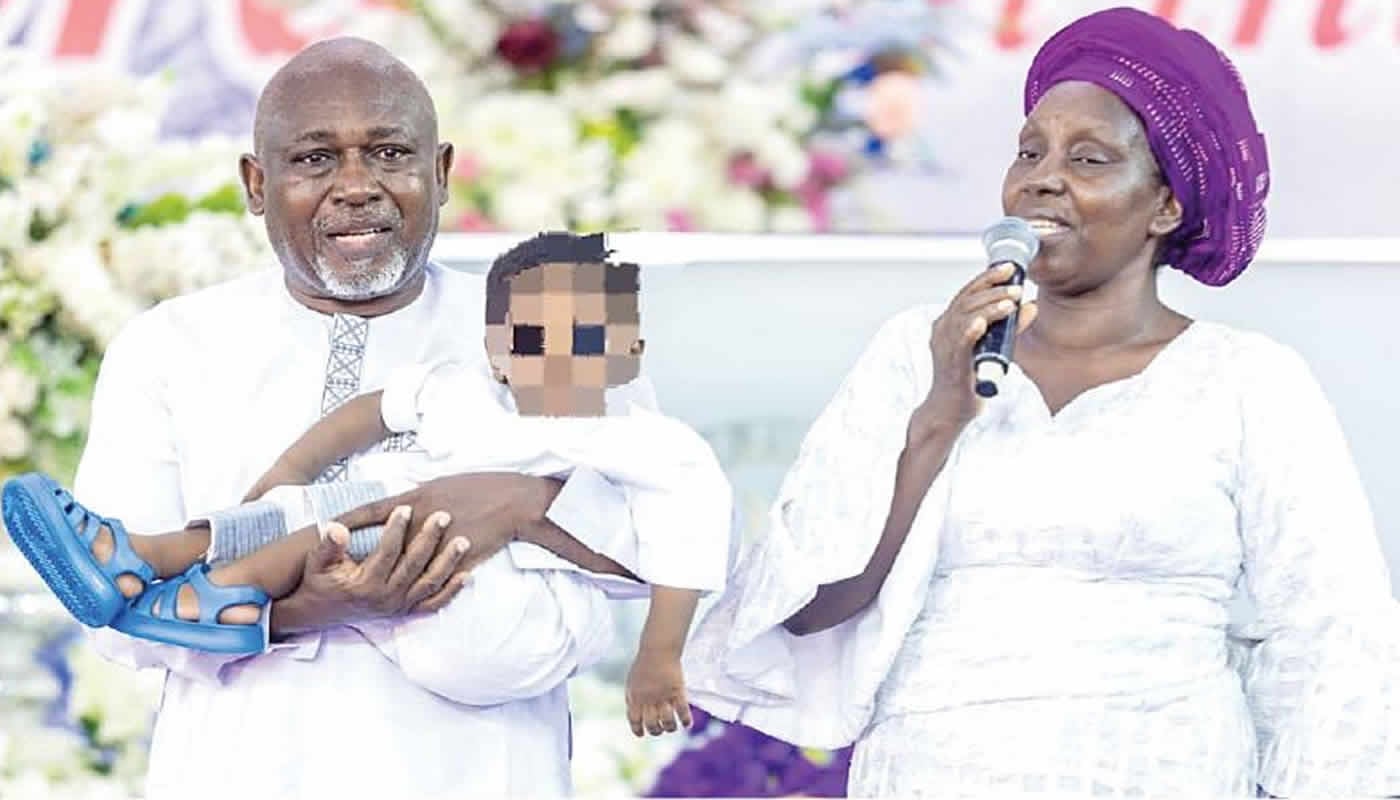
How we waited for 31 years before having our first child – Couple

Published

on

Laundry Manager at Mountain of Fire and Miracles Ministries, Prayer City, Mrs Kemi Omotinugbon, who welcomed her first child at the age of 56 after 31 years of marriage, shares with GRACE EDEMA how she overcame the trying periods

What do you do and how old are you?

I work at MFM Prayer City as a laundry manager. I am 57 years old. I was born on July 13, 1968.

When did you get married?

I got married in 1994.

When you got married in 1994, like most couples, you probably expected to have a child within a year or two. At what point did you realise there was a challenge with getting pregnant?

We realised it was a challenge about five years into the marriage.

What did you do after discovering that?

We started by praying. After that, we sought medical treatment and saw a doctor for possible solutions.

Was there any specific medical issue that was diagnosed?

No.

Did you try IVF at any point?

Yes, we did.

How many times?

We tried twice, as I mentioned in my testimony.

Did any of the attempts result in pregnancy?

No, they both failed, but we persisted in prayer and kept believing God. Whatever treatment or medication was required, we took it, and we continued trusting God. In His infinite mercy, God answered us.

That is why we are here today, thanking Him for what only He can do. This can only be God. It surpasses human imagination. It is purely God’s intervention.

How did you discover you were pregnant?

I was seeing a doctor at the time. When I began noticing some changes in my body, they ran some tests. It was through those tests that I discovered I was pregnant.

What year was that?

That was in May 2024.

Was it a natural delivery?

No, it was a Caesarean section because of my age.

Was the conception natural, or was there any medical procedure involved?

It was a natural conception. There were no injections or assisted procedures involved.

See also  Genevieve Nnaji slams viral tweet urging Igbo men to marry non-Igbo women

I want you to share your experience during the waiting period. How was the waiting period of over 30 years?

The waiting period was very challenging. It was a mixture of pain and occasional joy. Sometimes, when people know you do not have a child, they react to you differently. Some may not fully accept you, even within family or friendship circles.

Not everyone understands what it means to wait. There were painful experiences, and I had to deliberately cast them behind me so they would not affect my focus. At a point, I was dwelling on the situation too much, but later I received the wisdom to ignore the distractions. I had to put them behind me.

When some people later heard that I had put to bed, they said, ‘Ah, so she had been passing through that challenge? We didn’t even know.’ Many people did not know because, after some time, I stopped talking about it.

When people would ask, ‘How are your children?’ I would respond politely, but when I returned to my place of prayer, I would say, ‘God, they are asking You, where are these children? Let these children manifest. Let them not be far away from us again.’ That became my regular confession.

The journey was not easy, but I enjoyed the grace of God throughout. Eventually, His power was made manifest. I cannot point to any particular experience now that still makes me feel bitter.

However, I remember moments when I thought, ‘If I had my own child, this wouldn’t have happened.’ For example, there were times I sent another person’s daughter on an errand, and the mother refused to allow her to go. That was painful.

At one point, some children were visiting us, and their mother later suggested they were not well taken care of. That hurt deeply because I had done my best for them.

However, each painful experience drove me back to God. I would say, ‘Lord, only You can do this.’

There were moments I did not even know how it would happen anymore. I simply held on to God’s promise that I would not fail. That assurance sustained me.

See also  The day Chief Obafemi Awolowo left the world (May 9, 1987)

Some of my friends later reminded me that during our conversations, I always told them that no matter how long it took, I would have my own child. I may not remember saying it, but two of them confirmed it.

In the end, the entire experience has been God-centred. God knew about it all along. His name alone deserves to be praised and glorified.

How did you go through all these and still remain psychologically strong?

Before I talk about how it feels now, let me add this: in such a situation, there are times you honestly do not know what to do. Sometimes, you lose interest in many things — even in going out or associating with people.

I remember one day, I saw a friend at a shopping mall. She didn’t see me, but I saw her — and I carefully dodged her. I avoided her because I didn’t want her to ask, ‘Where are your children?’ and start the conversation all over again. I didn’t want to explain anything. So I made sure she didn’t see me. That was one of the experiences I had.

At times, you become disinterested in outings because people will ask about your children. In our community, especially in the Black community, not having a child can come with stigma. You feel stigmatised. That was part of the experience.

On the other hand, I also had people who supported me throughout the journey — people who believed that since God had promised, it would surely happen.

Now that the baby has come, my interest in doing many things has been awakened. I feel more motivated. There is something pushing you, something more meaningful to live for.

What other painful experience did you endure?

There was another painful experience. Someone once asked me to give him money. I said I didn’t have any. He told me to go and bring my ATM card and then said, ‘What are you even using your money for?’ That day, I really felt hurt. I wondered, ‘Why would this person say that? Is it because I don’t have a child?’

See also  The Creation of the Council of Obas in South West Nigeria

When I told my husband, he asked how I responded. I said I didn’t reply; I just looked at the person. My husband himself also had experiences — comments that could easily demoralise someone. But we thank God. Only God’s name can be glorified. This can only be God.

Do you think it was just divine intervention or medications that helped you?

Even if you go through treatments, unless God permits them to work, they will not work. That is the truth. So, I give Him all the glory.

How did you handle your in-laws who couldn’t wait any longer for you to have a child?

I tried not to overreact. I understood that they, too, might be anxious.

Sometimes, the pain comes from general comments people make without realising how hurtful they are — not necessarily from in-laws alone. We did not have fights.

They didn’t fight me, and I didn’t fight them.

What would you like to say to other women who have been married for five, 10, or even 15 years without a child?

What I would like to say to anyone trusting God for the fruit of the womb is this: please look unto God. Be steadfast and remain focused.

At the same time, do the needful. If you need medical treatment, seek treatment. If you need to interact with people and maintain healthy relationships, do so. Do not dwell too much on the pain — even though the pain can be overwhelming. Instead, dwell on the Word of God. Focus on His promises.

I also want to say that God greatly used Mountain of Fire and Miracles Ministries to bless me. I have been deeply involved in the prayer life, counselling sessions, and the teaching of the Word at MFM. I joined MFM in 1998, four years after I got married.

punch.ng

FOLLOW US ON:

FACEBOOK

TWITTER

PINTEREST

TIKTOK

YOUTUBE

LINKEDIN

TUMBLR

INSTAGRAM

Continue Reading
Click to comment

Leave a Reply

Your email address will not be published. Required fields are marked *

Lifestyle

Portable didn’t beat me; it was paid advert — Celebrity bodyguard, Kelvin Power

Published

on

Kelvin Atobiloye, popularly known as Kelvin Power, speaks with NAOMI CHIMA about his journey as a bodyguard, bodybuilder, and actor

How did the nickname, “Kelvin Power” come about?

They call me Kelvin Power because, lifting heavy things has always been my hobby. It’s not that I’m the strongest person, but I chose a very unique career. Lifting weights is something special, and I thank God for His grace. A friend of mine actually coined that name when he wanted to create another Instagram page for me. He suggested Kelvin Power, and that was how the name came about.

When you were growing up, did you always want to be a heavyweight lifter or bodyguard?

When I was in Ondo State, there was someone we called “the boss.” He used to bully us. There were three of us who played together, and the boss would challenge us, saying whoever lifted the heaviest weight would take the glory. Naturally, all of us wanted to win, so we kept lifting. At that time, I didn’t realise God was guiding me toward something bigger.

Later, when I moved to Lagos, I visited a friend and saw him lifting weights at the back of his house. I was physically bigger than him, so I thought I could lift the same. But when I tried, I couldn’t. Everyone laughed at me. I was angry and told him that the next time I came back, he wouldn’t come close to what I would lift. That anger pushed me to the gym. I could train eight times a day. Every opportunity I had, I was in the gym. That friend doesn’t lift anymore, but by the grace of God, I’m still keeping the glory.

Tell us about your childhood and family background.

I am from both Ondo and Ekiti states, and I claim both because I can’t tell a good story without mentioning them. I come from a well-known family in my hometown. I’m the sixth of eight children. Unfortunately, my parents have passed, but if they were alive, they would be proud of who I am today. My mum, however, lived to see me lifting weights before she passed.

Take us through your educational trajectory.

I didn’t originally plan to become a bodyguard. My educational background is in law, which is a highly respected profession. I am a law graduate from the Ekiti State University. But, as God would have it, here I am today. I am planning to complete my law school abroad soon, and that plan is almost within reach.

See also  Plateau Governor Gifts Pilgrim N1m For Returning Missing $5,000 to Owner in Saudi Arabia

After finishing law school, would you continue in entertainment or focus fully on being a lawyer?

Law and weightlifting are two separate things. Acting is another path entirely. For me, I believe it’s possible to combine different talents. I will continue to grow in the areas where God gives me opportunities, whether in law, security work, or entertainment.

What first drew you into professional security and bodyguard work?

My journey into professional security came naturally from my physique and my passion for lifting. Over time, I connected with people in the industry, including Kizz Daniel, and that shaped my career in bodyguard work. I have also worked with several notable personalities, including (billionaire businessman) Mike Adenuga.

How did you meet Kizz Daniel?

It was through a referral after I lost my job with Adenuga. A security company was asked to provide a bodyguard, but they rejected all the candidates they sent. Someone then recommended me, and that was how it started.

There were rumours that he relieved you of your job?

Can a body leave his heart? No! I still work with my boss (Daniel). I love him and we are good. People just like to talk.

Being a bodyguard means your life can be at risk. Does that worry you about your family?

My protection comes from God, and I always do my best. I love my family and children very much. It can be challenging because sometimes hanging out with them is difficult. Even when we go out together, I am still alert and protective. Balancing family life with my job isn’t easy, but I do my best.

How did you get into acting, and what roles are dear to your heart?

I had been creating skits but one day I got a call from Bolanle Austin-Peters’ personal assistant inviting me for a movie project. That was my first experience. When I arrived, I didn’t even know it was an audition. I saw many actors and bodybuilders. They gave me a script to read, and I did, unaware it was an audition.

Later, I was told I would be part of the movie. It was a big experience because I met established actors like Odunlade Adekola, Femi Adebayo, and Funke Akindele. I was unsure of what I was doing, so I spoke to a colleague on set. He told me to do my best, and that advice stuck.

See also  Why Atiku Abubakar Cannot Succeed Obasanjo

When it was my turn, I performed in my own way. Since I was to fight in the movie, I shouted, and by God’s grace, it was accepted. That marked the beginning of my acting journey. I return all the glory to God. The movie was House of Gaa.

What are some misconceptions about you as a professional security guard?

Many people think I’m a gym monster, that I eat flesh, or that I’m a vampire. No, I’m not. I have a life outside my job. If you know me outside work, you’ll see I’m a simple, lovely guy. I believe in family, friendship, and supporting others. People may look at me as a demon, but I know myself. I’m a sweet guy.

What skills are required to succeed as a celebrity bodyguard?

First, you must ignore material temptations. Your boss may leave money or expensive items around, but as a bodyguard, your job is to protect life and property. Don’t be greedy. Discipline is key.

Second, humility is essential. It doesn’t cost anything to be humble. Humility makes it easier to protect and work with people. And you must be professional. That’s how it works.

Have you ever handled dangerous situations on duty?

Many times. Every challenge reminds me of how loving God is. He has protected me through countless situations. I have faced guns, knives, and broken glass. This job is hard and dangerous, but I have no regrets.

How do you balance being protective while remaining approachable to fans?

I am a simple guy. I love meeting people. When fans approach me, it’s a blessing. I always return the respect, and give glory to God.

How do you maintain close relationships with your children and loved ones?

Kelvin is a sweet guy. Don’t worry, my people love me.

What comes naturally to you—performing on screen or working as security?

Wherever I’m paid to work, I give my best. It doesn’t matter the job.

Has your experience as a bodyguard helped your acting, especially in action roles?

Yes, it has. My security experience helps me perform action roles more convincingly.

See also  Alleged genocide: Why I prepared my will before coming to Nigeria — Ex-US mayor, Arnold

How do you prepare your body and mind to stay in top shape?

I stay ready at all times. Whether for acting or protection, preparation is key.

What values from your heritage do you carry into your professional life?

We are strong people who hate to be cheated. We are stubborn but not lazy or wicked. I embody these values daily.

Do you see yourself transitioning fully into acting, or will security remain part of your identity?

Yes, I see myself acting more, but being a bodyguard will always be part of who I am.

Do you have any desire to settle down, since you’re a lover boy with kids?

I don’t want to talk about that, but I’m already settled (laughs).

There was a rumour about you and Portable in the ring. What happened?

It was an advert for a real estate company. People said Portable beat me (laughs). When he saw he was supposed to wrestle me, he refused and said I should fight Anthony Joshua instead. I fell and pretended he beat me. We were both paid.

You’ve spoken a lot about spirituality. When did you embrace God fully?

Around 10 years ago. After leaving Adenuga’s compound, I was going to bury my mum. I had spent all my money and felt empty. I went to a (prayer) mountain to clear my head. That was the best decision I ever made. God has always been at the centre of my life, and He saved me.

How did you lose your job with the Adenugas?

I was working with Adenuga’s daughter, Bella, but it seemed nothing I did pleased her. One day, she sent me back to her father’s compound. I then started working with (Mike) Adenuga directly. But, she still had issues with me, so I eventually had to leave.

Mention three things you love that people may not know about you.

I read, watch movies, and listen to music by my boss, Kizz Daniel.

What is your favorite food?

Pounded yam and egusi soup.

How do you relieve stress and relax?

I sleep.

punch.ng

FOLLOW US ON:

FACEBOOK

TWITTER

PINTEREST

TIKTOK

YOUTUBE

LINKEDIN

TUMBLR

INSTAGRAM

Continue Reading

Lifestyle

I expected twins, shocked four babies came out — Mother detained over N3m bill

Published

on

Twenty-eight-year-old native of Cross River State, Mrs Charity Anani, tells AYOOLA OLASUPO about how her expectation of twins suddenly became quadruplets in the labour room, the family’s shock and their struggle to pay N3m hospital bill

Can you tell us about yourself and your family background?

I am 28 years old, and we are from Cross River State. I teach in a private school.

What does your husband do for a living?

My husband rides an okada (commercial motorcycle).

When did you first learn that you were expecting four babies?

We weren’t expecting four babies initially because when I went for a scan, it showed that there were two. So, we were very surprised that they all came out as four. After I gave birth to the first two by myself, the doctor said he realised that two more babies were still in my belly, so I was very surprised that I did not even know what to say.

What was your husband’s reaction when he heard the news?

He was very surprised, especially now that things are very hard for the family. He was happy and also displeased at the same time because he was not expecting four babies. We already have a daughter, and he was expecting twins, but it was so sudden how it changed to four. I think he is thinking about how to cope now.

When exactly did you deliver the babies?

It was on Friday, February 27, 2026.

How did your distant relatives react the moment they learnt that you had four babies?

Everybody was shocked because they all knew we were expecting just two babies. They were also worried about the financial burden the situation would cost. They were just like, ‘How are we going to cope with this now?’ But they were also happy I was part of the family, delivered the babies without complications, and the four of them are alive.

See also  HEALTH BENEFITS OF MOIN MOIN LEAVES

What is the gender of the babies?

There are three boys and a girl.

Why haven’t you been discharged until now?

I’ve been discharged, but it’s the hospital bills that are keeping us here. We were told that our bill is N3m.

How much have you been able to pay?

We have no money, and that is what is still keeping us here. We are very happy that we can help the children because the two babies that came out last were sick, and they are receiving oxygen, which costs N55,000 per one. The last baby was put in an incubator, and we pay N50,000 for that every day.

What happened to the last two babies?

They were very weak because I gave birth to the first two by myself, but the remaining two were through a caesarean section. It was after their birth that we found out that the babies were very weak, especially the last one, which is very small. So, we have to put him inside an incubator. All the babies are alive now, and they are fine.

What was the pregnancy journey like for you, carrying four babies at once?

It was very hard because I experienced a lot of pain, especially in my legs, which were swollen. It was as if the babies rested on my left leg, so I could not move properly, even though I was still going to school to teach when I was pregnant. I was still working and still doing some house chores.

My tummy was very big and heavy, but I was still trying to do some exercise; I used to move around. I used to feel both back and waist pain, so I could not walk very well.

See also  Maryam Abacha From Royal Roots to National Influence

Were there moments during the pregnancy when you were worried or scared for your health or the babies’?

No. After I gave birth to the first two babies, I was grateful to God because everything was okay before we later found out that there were two more. I was very weak, but there were no complications except for the caesarean section that was carried out. Even during the pregnancy, I was not worried because there were no complications whatsoever throughout the period.

Did you feel any sense of fulfilment when the four babies arrived?

I was very shocked and excited at the same time. But I didn’t know what was happening at the hospital.

It was when I woke up and realised that they were four, I said, ‘Ah! These four children came out of whose tummy?’

I was surprised because the scan revealed to us that there were two, and we were expecting just two babies. How come they turned to four all of a sudden? I also felt that they were going to cost us a lot of money to take care of them. That was how I felt at that moment.

What were the doctors’ reactions when the babies arrived safely?

My case was the first time they would be experiencing someone giving birth to four babies at once in the hospital. It was a private hospital, so they were happy too that it happened for the very first time.

Have you given the babies names?

We haven’t been able to name the kids yet since we are still in the hospital.

Since they are a week old now, when do you plan to do their naming ceremony?

We need to get out of here before we can plan a naming ceremony. Although I’ve been discharged, we need to pay up the money before they can allow us to go, and the babies are still receiving treatment.

See also  Why Atiku Abubakar Cannot Succeed Obasanjo

Caring for one newborn can be challenging. What has it been like taking care of four babies at the same time?

We have been able to do some things. We bought baby food for the babies. We have been able to take care of them just as they are. People are also helping us with whatever they have. Some bought baby food for us.

When you are eventually discharged from the hospital, how do you plan to raise the children?

We are hoping for God’s grace. The important thing is for us to do our best to raise the children, and we believe that with God, everything is possible, and with the help of the people, we will be able to raise the children.

What has been the most joyful or memorable moment since you welcomed the babies?

I give glory to God, and I’m happy that they are alive and healthy. I’m also happy that I was able to give birth to them without any complications or stress, and with the way I’m seeing them, it is a thing of joy.

Do you plan to have more children in the future after this?

No! We are okay now. We have been blessed with five children already. We are okay with what He has given to us because it is only God who understands why He gave them to us, so we are fine with it.

Are you saying that you will do family planning?

Yes, after these ones, we will go for family planning.

punch.ng

FOLLOW US ON:

FACEBOOK

TWITTER

PINTEREST

TIKTOK

YOUTUBE

LINKEDIN

TUMBLR

INSTAGRAM

Continue Reading

Lifestyle

I won’t die anytime soon, Obasanjo declares at 89

Published

on

Former President, Chief Olusegun Obasanjo, has said that at 89 years, he won’t die anytime soon.

He condemned those circulating a fake letter in which he was purportedly speaking about his death, saying they were only wasting their time because “I dey Kampe.”

The former president disclosed this on Wednesday while delivering a colloquium titled “Burden and Blessing of Leadership: Reflections from Global Africa to the World” held as part of the ceremonies lined up to mark his 89th birthday in Abeokuta.

Obasanjo was born on March 6, 1937.

The former president said at 89 years he had no doubt that God did not make a mistake to keep him alive and reasonably healthy at his age.

He slammed those wishing him dead, saying he would remain on the earth surface agile and healthy for as long as his Creator wanted.

“For my final note in this address, I want to point your attention to the work of some never-do-well.

“They publish and circulate a fake paper credited to me that I am writing, giving notice of my death, pafuka.

“That is their wish and surely not God’s wish for me. God has assured me that He has more for me to do on earth, and He has given me the wherewithal to do it.

“And those who wish otherwise are going to be dealt with by God Himself. I dey kampe as usual,” the former President said.

Earlier, the former President had lamented the leadership crisis that he said had, for decades, stifled Africa’s development, growth, and economic prosperity.

“Africa is not a problem to be managed but a promise to be fulfilled through honest, courageous, selfless, incorruptible and transformational leadership,” he said.

See also  Why Atiku Abubakar Cannot Succeed Obasanjo

He explained that genuine leadership carried immense burdens, citing his own incarceration and near execution under the military junta of the late Gen Sani Abacha as part of that burden.

Highlighting Africa’s unrealised potential, he said, “By every measure of natural endowment, Africa should be a continent of prosperity, stability, peace, security and global influence.

“Instead, a major part of the continent remains a theatre of preventable disease and suffering, starvation, conflict, insecurity and poverty.”

Obasanjo identified leadership failure, not geography or history, as the primary cause.

“The primary cause is the failure of those entrusted with power to lead for the people and serve them rather than against them; to build institutions rather than subvert them; to welcome accountability rather than flee from it, to ensure equity and justice rather than enthrone injustice, inequality and inequity.”

He warned that many leaders arrive with promises but soon govern for personal or familial gain, undermine democracy, and erode institutions.

“The same young reformer who promised accountability begins to silence the press, harass the judiciary, and intimidate civil society.

“All institutions become perverted only to serve the interest of the leader, his family, political accomplices and business interests,” he said.

To close the leadership gap, Obasanjo stressed the need for leadership formation, not just training.

“We must invest not only in teaching leaders what to do, but in forming leaders who are constituted and imbued with attributes and values to do the job the right way,” he said.

The former President urged young Africans to take democracy seriously and commit to governance that is accountable, transformational, transparent, and oriented toward the common good.

See also  Genevieve Nnaji slams viral tweet urging Igbo men to marry non-Igbo women

“A continent that fails its youth does not merely waste a generation; it plants the seeds of instability that will haunt the next several generations,” he said.

Reflecting on personal leadership experiences, Obasanjo described the loneliness and moral weight of decision-making, from commanding troops in the Nigerian Civil War to serving as Nigeria’s President from 1999 to 2007.

“The loneliness I speak of is the loneliness of final decision… your decision will affect millions of lives. That weight settles on one pair of shoulders – the leader’s shoulders,” he explained.

“I remember a few days before the Nigerian Civil War ended in January 1970. I was commanding the Third Marine Commando Division.

“My troops were positioned for the final push. Hundreds of thousands of Igbo civilians were trapped, starving, dying. On one side was the imperative of ending the war quickly to stop further suffering.

“On the other was the risk that a military advance would deepen the humanitarian catastrophe. No textbook told me what to do. No senior officer was going to make that call. It was mine alone. I made it. We saved lives by not shelling Owerri.  History has rendered its verdict,” he said.

He stated that a leader also carried the burden of being the repository of other people’s hopes — hopes that are often larger than any human being can satisfy.

Obasanjo said that “When I was elected President in 1999, the Nigerian people had endured years of military dictatorship, economic stagnation, and institutional decay.

“They did not elect a president, some of them thought; they elected a miracle performer. And when the miracle did not arrive in full measure overnight — as it never can — I could hear the murmurs of some of them. This is the burden: to be elevated by hope and measured by time, often simultaneously.

See also  HEALTH BENEFITS OF MOIN MOIN LEAVES

The former President said that with leadership also comes the burden of principle, adding that “True leadership requires the willingness to hold a position when it is unpopular, to say no when yes would be more convenient, to name a truth that powerful interests wish suppressed.

“This costs friendships. It costs alliances. It sometimes costs your freedom — as I learned in the prison under Sani Abacha, where I was held for three and a half years, tried before a kangaroo tribunal, and very nearly executed.”

He also highlighted the blessings of leadership, citing achievements such as Paris Club debt relief and the establishment of the Economic and Financial Crimes Commission to recover stolen public funds.

“The blessing of having done the right thing when doing the wrong thing would have been easier. That is the first blessing of leadership: the opportunity for moral self-definition. Not who others say you are,” he said.

On his personal well-being, Obasanjo affirmed that he remained strong at 89 and condemned those spreading false news of his death.

“God has assured me He has more for me to do on earth, and He has given me the wherewithal to do it. I dey kampe as usual,” he added.

punch.ng

FOLLOW US ON:

FACEBOOK

TWITTER

PINTEREST

TIKTOK

YOUTUBE

LINKEDIN

TUMBLR

INSTAGRAM

Continue Reading

Trending