The National Assembly on Tuesday approved the electronic transmission of election results but retained manual collation as a backup, triggering protests, a walkout by opposition lawmakers and heated debates in both chambers ahead of the 2027 general elections.
What should have been a routine legislative correction to the Electoral Act Amendment Bill instead degenerated into one of the most dramatic sittings of the 10th Assembly, exposing deep partisan fault lines ahead of the 2027 general elections.
In the Senate, 15 lawmakers, led by Senator Enyinnaya Abaribe (ADC, Abia South), stood defiantly against a controversial proviso in Clause 60(3) that recognises the manually completed Form EC8A as the primary source of collation where electronic transmission fails.
In the House of Representatives, the minority caucus staged a walkout, accusing the Speaker Tajudeen Abbas leadership of railroading amendments and frustrating attempts to insist on mandatory real-time electronic transmission without caveats.
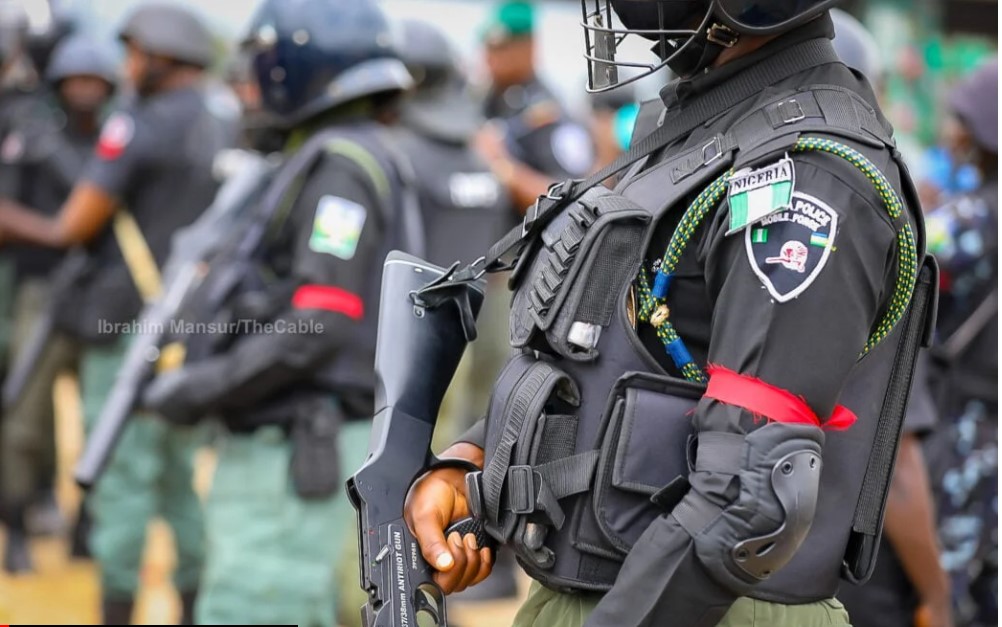
Outside the complex, protesters — joined by former Minister of Education, Oby Ezekwesili — accused lawmakers of attempting to dilute electoral safeguards.
By sunset, both chambers had passed versions of the bill that preserve electronic upload of polling unit results to the Independent National Electoral Commission’s Result Viewing Portal, while stopping short of making real-time transmission mandatory without exception.
At the heart of the storm lies a familiar Nigerian dilemma – whether technology alone can be trusted to safeguard democracy.
Senate torn apart
Tuesday’s Senate plenary was tense from the outset.
The Upper Chamber had earlier passed the Electoral Act (Repeal and Re-Enactment) Bill, 2026, but was compelled to rescind its decision and recommit it to the Committee of the Whole after discrepancies were identified in several clauses, including those affecting timelines for the 2027 elections already announced by the Independent National Electoral Commission.
But it was Clause 60 — dealing with the transmission and collation of election results — that ignited tempers.
The final reenacted version of the controversial clause, particularly subsection (3), reads: “The Presiding Officer shall electronically transmit the results from each polling unit to the IREV portal, and such transmission shall be done after the prescribed Form EC8A has been signed and stamped by the Presiding Officer and/or countersigned by the candidates or polling agents where available, provided that if electronic transmission fails due to communication failure, Form EC8A shall remain the primary source of collation and declaration of the result.”
Proceedings later resumed with Abaribe demanding a division on the clause, insisting that senators must publicly record their positions.
The Abia South lawmaker had attempted a similar move during last week’s emergency plenary but withdrew under pressure, which sparked criticisms within the chamber.
His renewed insistence triggered a rowdy session but Senate Leader Opeyemi Bamidele intervened, stressing that “whether he has done it or not is now in the past. But it is within his (Abaribe) rights to call for it. Let us allow him.”
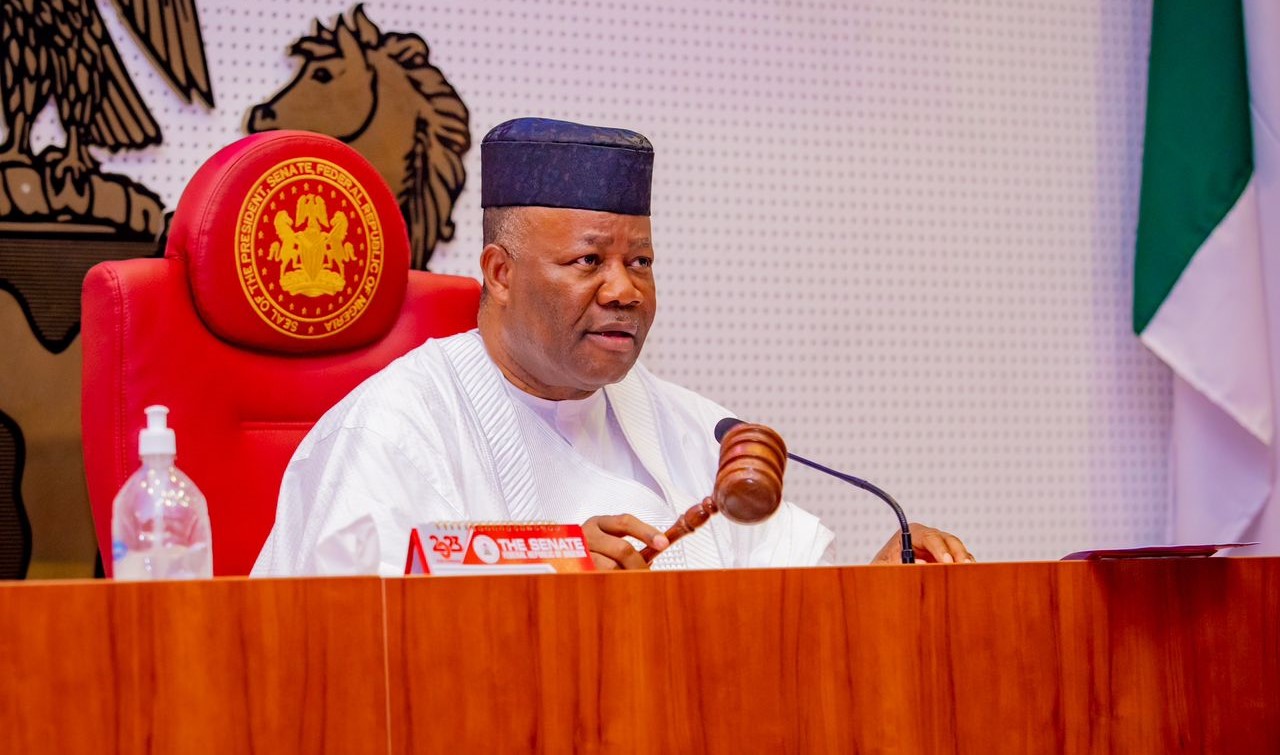
But Senate President Godswill Akpabio reminded the chamber of Abaribe’s earlier aborted attempt.
“People were mocking you on social media,” Akpabio said, noting that the previous demand had been withdrawn.
Opposition senators protested immediately, arguing that the matter was properly before the chamber.
Deputy Senate President Barau Jibrin cited Order 52(6) of the Senate Standing Orders, contending that it would be out of order to revisit provisions already ruled upon by the presiding officer.
That submission sparked uproar.
Senator Sunday Karimi briefly confronted Abaribe across the aisle as voices rose.
Bamidele insisted that since he had moved a motion for rescission, previous decisions were void, and Abaribe’s demand for a division was procedurally sound.
Each time Akpabio referenced Abaribe’s earlier withdrawal in a tone some senators described as mocking, opposition lawmakers shouted him down.
Eventually, the Senate President put the matter to a vote.
Fifty-five senators that cut across the ruling All Progressives Congress and a few opposition members — including Deputy Minority Leader Lere Oyewunmi, Wadada Aliyu (SDP, Nasarawa) and Amos Yohanna (PDP, Adamawa) — stood in support of retaining the manual backup proviso.
When those opposed to it were asked to rise, only Abaribe and 14 others stood, a development that led to the ‘ayes’ carrying the day.
For the second time in two weeks, the Senate approved electronic transmission with manual collation as a fallback.
Under the amended proviso, the manually completed and signed Form EC8A will constitute the primary basis for collation and declaration of results where electronic transmission is disrupted by network or communication challenges.
In practical terms, results will be uploaded electronically to IReV, but where technology fails, the signed paper result prevails.
2027 poll
Before the explosive division, the Senate had reversed its earlier passage of the bill.
Rising under Order 52(6), Bamidele moved that the Electoral Act (Repeal and Re-Enactment) Bill, 2026 be rescinded and recommitted.
He explained that INEC’s announcement fixing the 2027 general elections for February 2027 had triggered fresh concerns.
Stakeholders argued that the proposed date conflicted with Clause 28 of the bill, which required elections to be scheduled at least 360 days before the expiration of tenure.
There were also concerns that February 2027 would fall within Ramadan, potentially affecting voter turnout and logistics.
Following the debate, the Senate amended Clause 28, reducing the mandatory notice period from 360 days to 300 days.
The revised clause now requires INEC to publish notice of election not later than 300 days before polling.
The 60-day reduction grants INEC flexibility to schedule presidential and National Assembly elections between late December 2026 and January 2027.
Lawmakers said the adjustment was necessary to accommodate religious sensitivities and logistical realities.
The motion also corrected discrepancies in the bill’s Long Title and multiple clauses — including Clauses 6, 9, 10, 22, 23, 28, 29, 32, 42, 47, 51, 60, 62, 64, 65, 73, 77, 86, 87, 89, 93 and 143.
‘Act of patriotism’
After the division, Akpabio struck a conciliatory tone that saw him praising both the minority and majority blocs.
According to him, the dissenting lawmakers demonstrated courage despite being outnumbered, proving that democracy was at work.
He said, “Let me thank distinguished senators for their act of patriotism and display of democracy, particularly by those who had the courage even in the face of an overwhelming majority to stand up and to answer your father’s name by showing so much courage to vote against a proviso in 60 (3).
“Your minority status notwithstanding, you showed overwhelming courage. You were able to prove that democracy works. I also want to thank those who voted for the proviso to remain, as you have saved democracy by making sure that we don’t go on continuous reruns and repeats of elections by ensuring that the primary mode of election results is the form EC8A.
“I want to also thank the Senate for introducing electronic transmission of polling unit results through the portal to the IReV, which will now make it possible for election monitors, including foreigners, who monitor our results, who are not able to visit the 176,000 plus polling units in Nigeria, to see the polling unit results dropping into the IReV.”
Akpabio further described the introduction of electronic transmission of polling unit results to the IReV portal as a landmark innovation since 1960, noting that it would allow election observers, including foreign monitors, to track results in real time without physically visiting polling units.
The Senate President reiterated that elections are won and lost at polling units, not collation centres, hence the emphasis on properly completed and signed polling unit results as the foundation of the process.
“This is a major innovation since 1960, which is still a stance to be applauded. I also want to thank you for noting that elections are done in the polling units.
“Elections are not done at the collation centres. That is why you insisted that the polling unit results filled by presiding officers and co-signed by the polling clerk as well as agents of candidates and political parties, where available, remain the primary mode of collation of all results in Nigeria.
“I thank you for your innovation that we should undertake in the future, so that there is only direct consensus in our primary system because this will enable all the party people to partake in the choice of their candidates,” he stated.
However, Akpabio was silent on whether the earlier February 20, 2027 presidential poll date would be officially shifted.
Reps minority walkout
If the Senate session was explosive, the House sitting was equally dramatic.
The chamber descended into chaos when Francis Waive moved a motion for rescission of the Electoral Act (Amendment) Bill, 2025.
Speaking on the motion, Waive said, “The House is aware that a Technical Committee comprising the leadership of both chambers, members of the Conference Committee, the Clerks of the Senate and the House of Representatives and legal drafting experts from the Directorate of Legal Services of the National Assembly, met to harmonise and address the identified anomalies.
“We recognise the imperative of ensuring electoral timelines and statutory provisions, promote maximum participation, fairness, inclusivity, administrative efficiency and public confidence in the electoral system.
“Desirous of correcting the identified inconsistencies and unintended consequences through appropriate legislative action in order to safeguard the integrity of the Electoral framework; the House resolved to rescind the decision on the Electoral Act (Amendment) Bill, 2025, and recommit the same to the Committee of the Whole for consideration.”
When Speaker Abbas called for a voice vote, majority voices shouted “nay.”
But the Speaker ruled in favour of the “ayes,” triggering outrage from opposition lawmakers.
As tempers flared, the House went into executive session.
When plenary resumed, Deputy Speaker Benjamin Kalu attempted to proceed clause by clause.
Opposition members rose in protest, shouting “APC-ole,” “clause by clause,” and “the Speaker should take over.”
Moments later, Minority Leader Kingsley Chinda led opposition lawmakers out of the chamber.
Addressing journalists, Chinda said, “As a caucus, we want to clearly register our position and protect it, with particular reference to Section 60 (3), which has to do with electronic transmission.
“Our position is that elections shall and should be transmitted electronically. We are against any clause that will give room for any legislation, rigging or leeway for any untoward act.
“We have asked that the clause should remain solely for electronic transmission without any condition.
“We have also proposed where there is a conflict between the form EC8A, which is capable of being manipulated, and the electronically transmitted result, the electronically transmitted result should prevail.”
He alleged APC lawmakers frustrated the amendments.
“These positions (proposed amendments) were turned down, and we are aware that they were turned down by members of the APC, not on grounds of patriotism, but on grounds of political party affiliation,” he said.
On the walkout, he added, “After the plenary or whatever that happened on the floor, we felt it was better to register our position with Nigeria. We had to leave the plenary to address these issues.”
Indirect primaries row
Another flashpoint was Section 84, an amended version that recognises only direct primaries and consensus, striking out indirect primaries.
But Chinda objected, saying, “There is also Section 84, which has to do with primary elections. Our position remains that methods of selection of candidates should be the internal affairs of political parties.
“Political party should be allowed to determine what method they want to adopt on the selection of candidates that will represent them, not to be cocooned to either direct primaries or whatever.
“We support that parties should be allowed to adopt the method that best serve them whether it is direct, indirect primaries or consensus,” he added.
Ezekwesili joins protesters
Outside the complex, ex-minister Oby Ezekwesili joined the demonstrators.
“I have been particularly loud in stating that if the Senate gets away with a provision that is ambiguous, that gives power of discretion to determine the ifs and the buts, instead of making the clause mandatory; that every vote must count in this country,” she said.
“The way that our votes will count is to have this mandatory provision that makes it the core principle of our electoral transparency. No longer shall our votes be subject to the kinds of cancellations of results that we saw in previous elections.
“The only reason they don’t want transparency through the mandatory provision for there to be instant, real-time, electronic transmission of the results is because they want to continue to capture our democracy.
“The society is labouring under the weight of poor governance that we have seen so far in our democracy. And so we as citizens are saying, stop any coup against this democracy. Stop it.”
Abbas vs lawmakers
Behind the scenes, fresh details emerged of how Speaker Abbas convinced reluctant members to consider the bill.
A House member told The PUNCH that many lawmakers were angry over poor funding of capital components of the 2024 and 2025 budgets.
He said, “The speaker begged relentlessly for members to allow for Electoral Act consideration. Members later agreed with the agreement to shut down any subsequent consideration on resumption of plenary on February 24, unless the budgets are funded.
“Initially, members didn’t want to consider anything today (Tuesday).”
The compromise averted a boycott — but not the rebellion that followed.
With the conference committee already set up to reconcile differences between both chambers, the bill now moves toward harmonisation before transmission to the President.
Following the outrage that greeted the passage of the bill by both chambers, the House of Reps spokesman Akin Rotimi defended the process.
He said, “The House leadership consulted extensively, which formed the basis of a lot of the provisions that you saw earlier today (Tuesday). When you have a conference committee, it only considers the provisions in either the Senate or the House.
“INEC acted within the provisions of the extant law. But you need to be able to walk around those provisions to allow for more flexibility for INEC to be able to fix the timetable while keeping with the provisions of the law.”
He added that the rowdy session was democracy in action and that “the majority carries the day.”
Yet the images of senators standing in defiance, opposition lawmakers chanting before walking out, and protesters massed outside the gates tell a more complex story.
With barely a year before the 2027 general elections enter full campaign mode, the battle over Clause 60 has become more than a technical debate about transmission modes.