Connect with us

Lifestyle

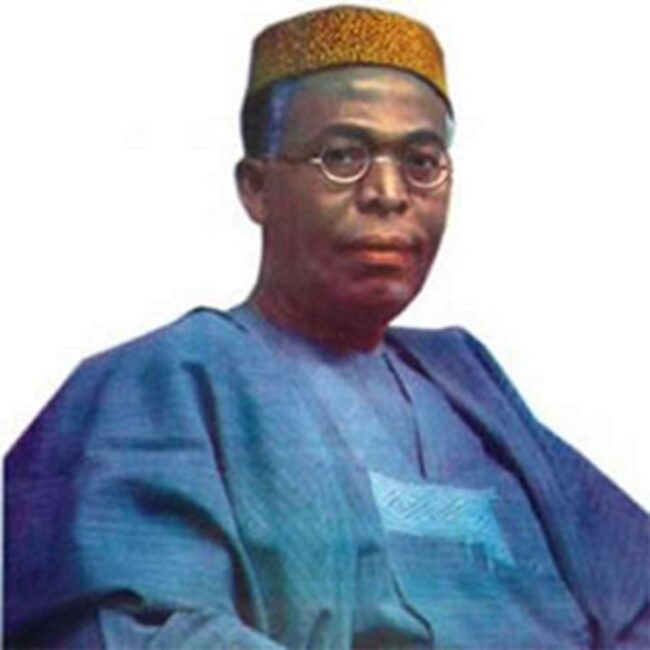
CHIEF OBAFEMI AWOLOWO (1909 – 1987)

Published

on

The last two years of Chief Obafemi Awolowo as Premier of Western Region was concentrated on efforts to develop YORUBALAND and write his own name in the book of Legends.

He incorporated: *Western Hotels* which invested in:

1) _Premier Hotel,
2) _Lafia hotels in Ibadan
3) _Lagos Airport Hotel respectively.

He set up:

*Western Nigeria Development Corporation* to finance mega corporations. This was established in 1958.

It encouraged plantation development with six agricultural plantations covering 20,517 acres in collabo-ration with Cooperative societies, eleven additional plantations covering 8,468 acres with crops ranging from Cocoa , Rubber, Oil Palm, Citrus, Cashew and Coffee had been put in place all over the region.

WNDC, a clearing house for multitude of companies, established for the rapid industrial development and revolution of the region.

Among them were:

1. _WAPCO at Ewekoro for cement, with enough capacity to serve the whole country.
2. _Nigerite Ltd, producing asbestos and roofing sheets,
3. _National Bank,
4. _Wema Bank,
5. _Nigerian General Insurance,
6. _Great Nigeria Insurance,
7. _Gravil Enthoven and coy,
8. _Vegetables Oil Ltd,
9. _Cocoa Processing Industry Ogba Ikeja,
10. _Odua Textile Mills Ltd,
11. _Wrought Iron Ltd,
12. _Union beverages Ltd, 13. Sungass company,
14. _Wemabod estates, owner of Western House tallest building, then on Broad Street, and other es-tates,
15. _Western livestocks,
16. _Fisheries services Ltd,
17. _Caxton Press,
18. _Epe Plywood,
19. _Asakar Paints,
20. _Nigeria Crafts and Bags Ltd,
21. _Nipol Plastics in Ibadan,
22. _Phoenix Motors.
Also, he opened up biggest industrial layouts in:
i. Ibadan, Oluyole and
ii. Lagos Oba Akran axis and
iii. *Ilupeju in Mushin axis with over 120 factories* for mass production of different needs & gave birth to:
23. _Nigeria Textile Mills,
24. _West Africa Breweries,
25. _Dunlop Tyres,
26. _Crittal Hope Aluminum,
27. _Tower Aluminium,
28. _Solel Boneh,
29. _Nidogas,
30. _Nigeria Wire and Cables in Ilupeju.

See also  This is "The Door Of No Return", Cape Coast, Ghana

Odua Investments was the largest conglomerates in Nigeria as at 2004 with assets worth over N10 tril-lion.

Chief Jeremiah Obafemi Awolowo paid the Western Nigeria Civil servants, the highest salaries far above Federal government.

So much jobs were created by vast industrialisation drives.

All these were achieved without Oil revenue between1951-1959. He also touched the road construction with bitumen & laid road network covering over 2,000 kilometers throughout the region.

Other achievements of his regime are:

1. _Cocoa House, the tallest building in West Africa for decades,

2. _Liberty Stadium, the most modern in the entire African,

3. _Western Nigeria Television & Broadcasting Service (WNTV/WNBS), the first Radio & Television Sta-tions in Africa,

4. _Many General Hospitals and Dispensaries in rural area.

5. _Free Education at primary school level.

6. _His effort in Cooperative society development gave birth to establishment of Cooperative Bank in 1953 and Cooperative College.

The eight years most of this present Governors spend, was the same with Pa Awolowo, covering what comprises 8 states nowadays, yet he achieved so much. Most of our present day Governors could not mention one world class company, corporate institution or industry set up to create jobs for teaming youths being turned out year in, year out, by our ivory towers.

Today leaders should at least emulate our late sage foot steps instead of all the temporary empower-ment programs (Motor cycle, Keke Napep, Pepper grinding machine, Cassava grinding machine, Deep freezer, Fridge, Clipper etc) being used to cajole the electorates at the turn of election every four years.

See also  Yemi Solade - No actress will say her G-Wagon was bought from acting alone

A time will come in this nation that people aspiring for position must show a well laid out plan before the electorate.

The cash and carry politics will fail as it’s the practise in developed nation.

Let us always look forward to lasting legacies.

*OBAFEMI AWOLOWO* was obviously ahead of his peers and till today no living or deceased Nigerian has surpassed his achievements.

You wonder why the southwest Nigeria did well.

In the 1990s, Nigeria Textile Mills, Oba Akran Ikeja alone employed over 4,000 workers before the mili-tary mismanagement of economy killed the company with unfriendly company policies.

*Can we ever find a leader like this man in Nigeria again?*

*Indisputable fact*

FACEBOOK

TWITTER

PINTEREST

TIKTOK

YOUTUBE

LINKEDIN

TUMBLR

INSTAGRAM

Continue Reading
Click to comment

Leave a Reply

Your email address will not be published. Required fields are marked *

Lifestyle

I’m A Christian But I Use Charms – Sunday Igboho

Published

on

Yoruba nation agitator, Sunday Adeyemo, also known as Sunday Igboho, has sparked reactions after revealing that he practices Christianity while also using traditional charms.

It was reports that the activist made this known in a video going viral on social media.

In the clip, he was speaking before a group of traditional rulers, where he talked about his religious background, family history, and spiritual life.

He explained that being a Christian does not stop him from making use of charms.

Igboho said he was born into a Christian home and grew up in the church.

However, he also stated that he was trained in traditional practices from a young age.

According to him, his father is a known babalawo based in Modakeke, and this influenced his knowledge of traditional spirituality.

He added that he relates to people of different religions and does not see a problem in combining beliefs.

While speaking, he mentioned Islamic cleric Muideen Ajayi Bello as an example of someone from a different faith, saying that religion does not prevent interaction among people with different backgrounds.

Sunday Igboho was born in Igboho, a historic town in the Oke-Ogun area of Oyo State.

His family later moved to Modakeke in Osun State, where he spent his early years.

He said, “I am a Christian, but I use charms. I do all religions. Even Islamic father, Muideen Ajayi Bello is a Muslim, I am a Christian. I was born in church, but I do charms. I was trained in the act. Everyone knows my father is a babalawo in Modakeke.”

FOLLOW US ON:

FACEBOOK

TWITTER

PINTEREST

TIKTOK

YOUTUBE

LINKEDIN

TUMBLR

INSTAGRAM

See also  Folorunso “Foley” Okenla: The Honest Footballer Who Defied Fate
Continue Reading

Lifestyle

Felicia Adetoun Ogunseye: Nigeria’s First Female Professor

Published

on

Professor Felicia Adetowun Ogunseye (née Banjo) holds the historic distinction of being Nigeria’s first female professor. A pioneer in Library and Information Science, she built a career that permanently transformed opportunities for women in higher education across the country.

Early Life and Education

Born on December 5, 1926, in Benin City, Ogunseye began breaking barriers early in life.

In 1946, she became the first female student admitted to Yaba Higher College, an institution then overwhelmingly male.

By 1948, she graduated with a teaching diploma, becoming its first female graduate.

Her academic journey continued abroad at the University of Cambridge, where she earned a Bachelor of Arts in Geography (1952) and later a Master of Arts (1956). She became the first Nigerian woman to receive a degree from Cambridge.

In 1962, she obtained a Master’s in Library Science from Simmons College (now Simmons University), equipping her for a distinguished career in librarianship, scholarship, and institutional development.

Academic Milestones

In 1973, Ogunseye was appointed Professor at the University of Ibadan, making her:

Nigeria’s first female professor

The first Professor of Library and Information Science in Nigeria

Between 1977 and 1979, she served as Dean of the Faculty of Education, becoming the first woman to hold a dean’s position in any Nigerian university. She retired in 1987 after decades of mentoring students and shaping Nigeria’s academic landscape.

Advocacy and National Impact

Beyond the university, Professor Ogunseye championed:

Women’s access to higher education

School library development nationwide

Children’s literacy initiatives

She founded the Abadina Media Resources Centre in Ibadan and worked as a consultant for international organisations including UNESCO and the World Bank. Her work consistently emphasized the connection between information access, education, and national development.

See also  Video - Sunday Igboho Visits Yoruba Traditional Rulers | Powerful Meeting for Unity & Progress

Family Background

Professor Ogunseye came from a family marked by remarkable achievement and historical tragedy.
Her younger brother, Victor Adebukunola Banjo, was a senior officer in the Biafran Army during the Nigerian Civil War. He was executed on September 25, 1967, on allegations of plotting a coup against Chukwuemeka Odumegwu Ojukwu.

Another brother, Ademola Banjo, excelled academically—graduating with a first-class degree in Mechanical Engineering from the University of Manchester in 1952 and later becoming the first Nigerian to earn a doctorate in Metallurgical Engineering in 1954.

Legacy

Now in her late nineties, Professor Felicia Adetowun Ogunseye remains a living symbol of courage, intellect, and perseverance. Her life story reflects the journey of a woman who entered institutions not originally designed for her, reshaped them through excellence, and left doors permanently open for generations of Nigerian women scholars.

Honors

Ogunsheye has received numerous accolades, including the Ford International Fellowship (1961), the Honorary D.L.S. from Simmons College (1969), the Fulbright Fellowship for Senior African Scholars (1980), and the Decade of Women Certificate of Merit for Outstanding Achievement (1985). She was named a Fellow of the Nigerian Library Association (1982) and the Nigerian Academy of Education (1985). In 1990, she was awarded an Honorary Doctor of Letters (D.Litt.) from the University of Maiduguri. She was also given the chieftaincy title of Iyalaje of Ile-Oluji in 1982. The University of Ibadan honored her by naming a female postgraduate hall after her.

Works

Ogunsheye’s academic publications include:

“The Role and Status of Women in Nigeria” (1960)
“A Preliminary Bibliography of the Yoruba Language” (1963)
“Library Education in Nigeria” (1968)
“Problem of Bibliographic Services in Nigeria” (1969)
“The Future of Library Education in Africa” (1976)
“Abadina Media Resource Centre: A Case Study in Library Service to Primary Schools” (1979)
She also edited Nigerian Women and Development (1988) and authored A Break in the Silence: A Historical Note on Lt. Colonel Victor Adebukunola Banjo (2001).
Children’s Books
My Alphabet Reading Book (1993)
My First Alphabet Book: A B C (1996)
My First Number Book: 1 2 3 (1996)
Lara and Kariba (2003)

See also  Major General Henry Edmund Olufemi Adefope (1926–2012)

Archives

Her archives are now accessible to researchers, and the finding aids are available online.

Source

University of Ibadan archival records

Punch newspapers

FOLLOW US ON:

FACEBOOK

TWITTER

PINTEREST

TIKTOK

YOUTUBE

LINKEDIN

TUMBLR

INSTAGRAM
Continue Reading

Lifestyle

Ojukwu’s Historic Return: 18 June 1982

Published

on

On 18 June 1982, Chukwuemeka Odumegwu Ojukwu returned to Nigeria after 12 years in exile in Cote d’Ivoire, where he had been granted asylum by President Felix Houphouet-Boigny following the end of the Nigerian Civil War.

His arrival at Murtala Muhammed International Airport, Lagos, drew an enormous crowd—widely described in contemporary reports as one of the largest gatherings ever witnessed at the airport.

Thousands of supporters thronged the terminal and surrounding roads to welcome the former Biafran leader home.

The Presidential Pardon

Ojukwu’s return followed a presidential pardon granted by Shehu Shagari, Nigeria’s civilian president at the time.

While there was no single publicly published “contract” listing detailed terms, widely reported and confirmed conditions of the amnesty included:

Renunciation of Military Rank

Ojukwu agreed to drop his military title and be addressed simply as “Mr.” He would not wear military insignia or assert command authority.

Property Matters

Properties confiscated during and after the Civil War were not automatically restored. Government-held properties remained under state control.

Security Guarantees

His safety was guaranteed under Nigerian law. He was not permitted to maintain any private armed formation.

Political Participation

He was free to participate in politics but was not compelled to join any specific political party.

Political Re-entry

Following his return, Ojukwu re-entered Nigerian politics. In the period leading up to the 1983 elections, he joined the National Party of Nigeria (NPN), aligning himself with the ruling party of the Second Republic.

A Symbol of National Reconciliation

Ojukwu’s homecoming was widely interpreted as a powerful gesture of reconciliation more than a decade after the Civil War ended in 1970.

See also  Folorunso “Foley” Okenla: The Honest Footballer Who Defied Fate

For many Nigerians—particularly in the Southeast—his return symbolized closure and reintegration into the national political framework. For the federal government, the pardon represented an effort to strengthen unity during Nigeria’s Second Republic.

The 18 June 1982 event remains one of the most memorable political homecomings in Nigerian history.

Photo Credit: Nairaland

FOLLOW US ON:

FACEBOOK

TWITTER

PINTEREST

TIKTOK

YOUTUBE

LINKEDIN

TUMBLR

INSTAGRAM

Continue Reading

Trending