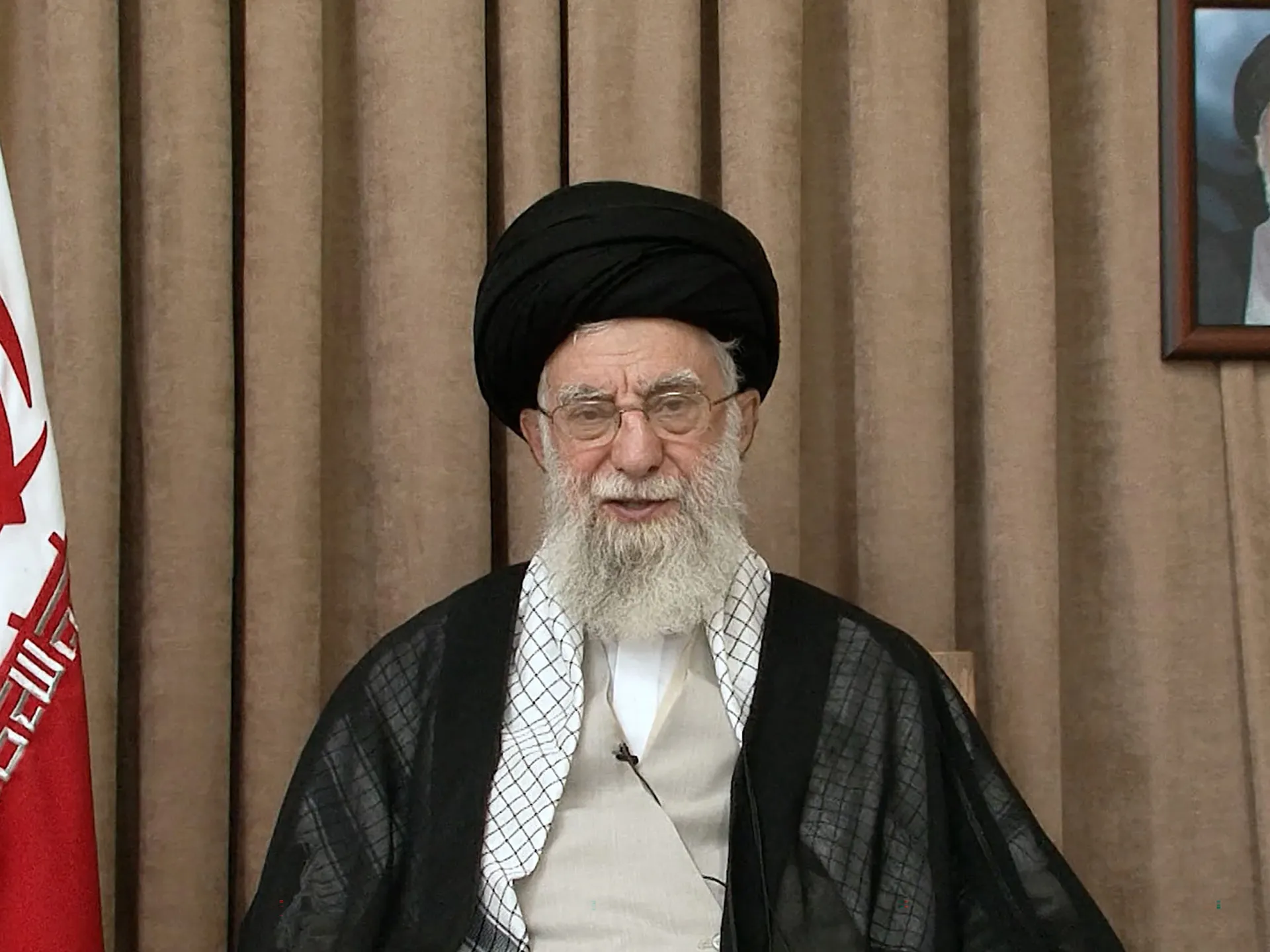
Iranian Supreme Leader Ali Khamenei was k!lled in an Israeli strike Saturday, February 28, as part of a massive joint military operation between the U.S. and Israel, Israel’s ambassador to Washington told U.S. officials.
US and Israeli forces attacked Iran in what the two countries described as a ‘pre-emptive’ strike against a Tehran government intent on developing nuclear weapons. The attack also prompted retaliation from Iran, with missiles reported to have targeted Israel and countries across the Middle East.
According to CNN, an Israeli official confirmed to Axios that Khamenei is de@d and his body was recovered from his destroyed compound, according to Israeli intelligence.
Some of the first strikes on Iran appeared to hit areas around the offices of Supreme Leader Ayatollah Ali Khamenei.
It wasn’t immediately clear whether the 86-year-old leader was in his offices when the attack occurred, and his de@th was not confirmed until several hours after the attack.
Khamenei has ruled since 1989 and held ultimate power as he continued to shape Iran’s Islamic Republic after the revolution in 1979.
One person has died and at least seven others have been injured after strikes hit major airports in the United Arab Emirates, as Iran launched a wave of retaliatory missile attacks across the region.
At Zayed International Airport in Abu Dhabi, officials confirmed a fatality involving an Asian national and multiple injuries following what they described as an “incident” on Saturday night.
In a statement, authorities said: “Abu Dhabi Airports has confirmed that an incident took place at Zayed International Airport and resulted in one fatality involving an Asian national and seven injuries. The public is urged to avoid circulating rumours and to rely only on official sources. Updates will be provided.”
Meanwhile, a separate blast rocked Dubai International Airport, the world’s busiest international travel hub, sending smoke through a terminal and prompting evacuations. The Dubai Media Office confirmed that a concourse at the airport sustained “minor damage in an incident that was quickly contained”.
In a statement, officials said: “Emergency response teams were immediately deployed and are managing the situation in coordination with the relevant authorities. Four staff sustained injuries and received prompt medical attention. Due to contingency plans already in place, most of the terminals were previously cleared of passengers. Further updates will be provided as they become available.”
Footage circulating online showed smoke and debris inside Terminal 3, with passengers and airport staff seen running for cover. Flights had already been halted earlier in the day as regional airspace closures disrupted travel across the Middle East. Approximately 250,000 passengers typically pass through Dubai International Airport each day.
Bahrain’s Ministry of the Interior also confirmed that Bahrain International Airport had been targeted. In a post on X, it said: “Targeting of Bahrain International Airport with a drone, resulting in material damage without loss of life, at a time when the relevant authorities are initiating procedures to secure the site.”
The strikes come after Iran warned it “has no red lines” following large-scale US and Israeli military operations earlier in the day. Tehran launched missiles and drones at multiple countries across the Gulf, targeting US military installations and key infrastructure.
Thousands of tourists have been left stranded as Iranian and Iraqi airspace closures forced aircraft to divert mid-flight. Travellers in Abu Dhabi reported hearing loud explosions, while hotels distributed refreshments to calm guests instructed to remain indoors due to falling missile debris.
British Airways passenger Mike Boreham said he was already seated on flight BA108 from Dubai to Heathrow when the captain made an announcement. “We were all boarded,” he told The Independent. “The flight is completely full. About 10 minutes after the ‘boarding complete’ announcement we were told airspace is closed.”
Authorities earlier released images showing fragments of intercepted rockets scattered across city streets in the UAE. The airport incidents follow a strike on the luxury Fairmont The Palm hotel in Dubai, where four people were injured after debris from Iran’s missile barrage hit the tourist hotspot.
Explosions were also reported in several Iranian cities, including Tehran, after diplomatic talks aimed at curbing Iran’s nuclear programme collapsed without agreement earlier this week. With missile exchanges intensifying and key transport hubs under threat, regional leaders have urged the public to follow official guidance as the volatile situation continues to unfold.
Biodun Abayomi Oyebanji is recording significant progress in the ongoing offensive against banditry in Ekiti State, as coordinated military forest clearance operations continue across identified flashpoints.
His Excellency is actively engaging the Office of the National Security Adviser to secure air power support that will further intensify and consolidate the current operations. This strategic step underscores the administration’s firm commitment to eliminating criminal elements and restoring lasting peace across the state.
The Governor has also appealed to community heads and traditional rulers to remain vigilant against the infiltration of suspicious elements into their domains. He urged them to promptly report any unusual movements to security agencies and sternly warned against any form of collaboration or connivance with bandits under whatever guise.
He emphasized that security is a collective responsibility that requires sincerity and cooperation at all levels.
While the current offensive is yielding positive results, His Excellency stressed that sustained victory will depend on strong synergy between community leadership, local stakeholders, and security agencies.
Only through coordinated intelligence sharing and unified action can the gains be consolidated and peace sustained.
The Governor expressed deep appreciation to the Special Adviser on Security Matters, the Commanding Officer of the 148 Battalion, the Commissioner of Police, the State Director of the Department of State Services, and other security agencies, including the local vigilante groups, for their dedication and professionalism.
In furtherance of this collaborative approach, His Excellency is holding strategic meetings with Local Government Chairmen in border communities adjoining neighbouring states to strengthen inter-state security coordination and prevent cross-border criminal activities.
Iran’s Supreme Leader Ali Khamenei has been killed in a wave of joint US-Israeli airstrikes on Tehran, according to Iranian state media, marking a dramatic escalation in the Middle East crisis.
A tearful presenter on Iranian state television confirmed the 85-year-old cleric’s death, announcing that 40 days of national mourning would be observed across the country. Khamenei, who had ruled the Islamic Republic since 1989, was reportedly found in the rubble of his heavily fortified compound after missiles struck what sources described as a top-security bunker in the capital.
US President Donald Trump confirmed the development on Truth Social, writing: “One of the most evil people in history is dead.” In a further statement, he declared: “This is not only justice for the people of Iran, but for all Great Americans.”
Mr Trump added: “He was unable to avoid our intelligence and highly sophisticated tracking systems and, working closely with Israel, there was not a thing he, or the other leaders that have been killed along with him, could do. This is the single greatest chance for the Iranian people to take back their country.” He warned: “The heavy and pinpoint bombing will continue, uninterrupted throughout the week or as long as necessary.”
Iranian state media confirms Ayatollah was k!lled alongside daughter in airstrikes carried out by America and Israel (video)
Israeli officials said the strikes were part of a coordinated operation targeting senior figures within Iran’s military and political leadership. The Israel Defense Forces declared the “elimination” of virtually every senior Iranian defence chief, with reports suggesting up to 40 officials may have been killed.
An Israeli military official said: “The attack was based on an operational plan developed over several months, centered on an intelligence effort to identify an opportunity when senior regime officials would convene. Three sites where gatherings of the Iranian terror regime were taking place were struck simultaneously, and several senior figures essential to the regime’s governance were eliminated.”
Among those reportedly killed were Iran’s defence minister and senior Revolutionary Guard commanders, though Tehran had earlier dismissed claims of Khamenei’s death as “mental warfare”. Iran’s foreign minister had insisted the supreme leader was alive, but he did not appear for a scheduled televised address.
Iranian state media confirms Ayatollah was k!lled alongside daughter in airstrikes carried out by America and Israel (video)
Israeli Prime Minister Benjamin Netanyahu called on Iranians to “take to the streets en masse” and “get the job done” in a direct appeal to topple the regime.
The US confirmed that more than 200 warplanes, supported by Tomahawk cruise missiles, struck 500 targets in what Israeli sources dubbed Operation Roaring Lion. American F-22 Raptors were believed to have led the assault, with aircraft carriers deployed across the region.
Iran retaliated with missile and drone strikes targeting US bases in Bahrain, Kuwait, Qatar and the United Arab Emirates. Explosions were reported near key installations, including the Fifth Fleet headquarters in Bahrain and Al-Udeid airbase in Qatar. One person was reported killed in Abu Dhabi, while Israeli emergency services said 89 people suffered minor injuries following interceptions over Jerusalem and Tel Aviv.
Footage circulating online showed flames rising near the Palm Jumeirah Fairmont hotel in Dubai after an apparent drone strike, sending thousands of British tourists and expatriates scrambling for shelter.
The Islamic Republic, established in 1979, now faces an uncertain future as questions mount over succession and the risk of further regional escalation. Iranian authorities have yet to outline a formal transition plan, while military operations across the region remain ongoing.