Connect with us

News

Medical trip: Okowa seeks passport release amid EFCC probe

Published

on

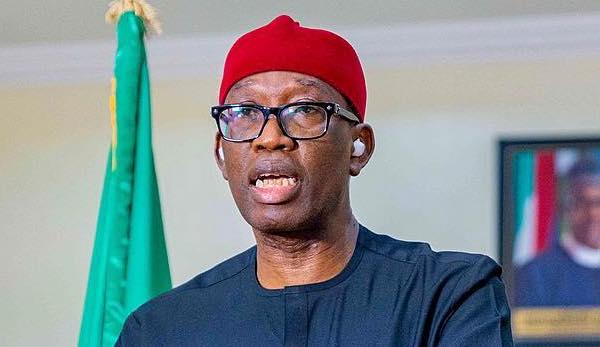
A former governor of Delta State, Ifeanyi Okowa, has reportedly sought his international passport held by the Economic and Financial Crimes Commission, The PUNCH has learnt.

Sources within the anti-graft agency said the former governor visited the commission’s office on Awolowo Road, Lagos, as part of efforts to retrieve his travel document to enable him to attend to medical issues abroad.

The former governor was arrested on November 4, 2024, and subsequently questioned at the Port Harcourt Zonal Directorate of the commission.

A source familiar with the development said the former governor’s visit to the Lagos office was connected to ongoing discussions regarding the release of his passport.

“No, he was not arrested; he was at the commission’s Lagos office as part of the ongoing investigation into his case.

“Also, he made moves to secure the release of his international passport to attend to some medical issues abroad,” one of the sources said.

However, it was not immediately clear whether the former governor succeeded in obtaining the document.

Efforts to get the reaction of the EFCC were unsuccessful as the commission’s spokesperson, Dele Oyewale, did not respond to calls placed to his telephone line as of the time of filing this report.

The EFCC has retained the international passport of Okowa since his arrest on November 4, 2024, over allegations of diverting N1.3tn in 13 per cent derivation funds received by the state from the Federation Account between 2015 and 2023.

The anti-graft agency is also investigating allegations that Okowa failed to account for the funds and another N40 billion allegedly used to acquire shares in UTM Floating Liquefied Natural Gas and a major commercial bank.

See also  No Genocide Against Christians Or Muslims In Nigeria — Tinubu

He was arrested in Port Harcourt and later granted bail after meeting the conditions set by the commission.

The allegations remained under investigation by the EFCC, while the former governor denied the allegations after he was released.

“To successfully take N1.3tn, it means you have to be taking between N16bn and N20bn every month into your pocket.

“I don’t even know if the President of this country will be able to do that, not to talk of the governor of Delta State.

“They have forgotten that the first three years we came into office – 2015, 2016 and 2017 – the money that was coming into the state was not even enough to pay salaries at all,” he said then.

Efforts to get his reactions through one of his associates, Charles Aniagwu, failed.

punch.ng

FOLLOW US ON:

FACEBOOK

TWITTER

PINTEREST

TIKTOK

YOUTUBE

LINKEDIN

Continue Reading
Click to comment

Leave a Reply

Your email address will not be published. Required fields are marked *

News

Burnham emerges front-runner for UK PM as Starmer resigns

Published

on

Keir Starmer, on Monday, resigned from office as Prime Minister of the United Kingdom, following weeks of internal revolt within the Labour Party.

The development set the stage for a rapid leadership transition that is increasingly expected to elevate former Manchester mayor Andy Burnham to Downing Street.

Announcing his departure outside 10 Downing Street, Starmer said he would remain in office only long enough to oversee an orderly handover.

“Every decision I’ve taken has been about putting the country I love first,” he said, according to a New York Times report, adding that, “That is why I will resign as leader of the Labour Party.”

In an emotional address, he added: “I will give my successor my full and unequivocal support,” while thanking his wife Victoria, who he described as “a rock by my side.”

His resignation marks a dramatic turning point for a government that only recently swept to power in 2024, ending 14 years of Conservative rule.

Despite that landslide victory, Labour’s mandate was widely described as fragile after it secured just 34 per cent of the popular vote, leaving Starmer politically exposed from the outset.

Attention within Westminster has now decisively shifted to Andy Burnham, whose rapid emergence has transformed what was initially expected to be a drawn-out leadership contest into a near-certain succession scenario.

Burnham, who only recently re-entered the national political frontline after winning a parliamentary seat in Makerfield, has quickly consolidated support across influential sections of the Labour Party.

He described the unfolding transition as a moment of renewal.

See also  LG power tussle: Osun APC kicks as Adeleke slams Oyetola

“People want to see progress on economic growth, cost of living, public services, housing and opportunities for the next generation,” Burnham said.

Party insiders increasingly view him not just as a contender, but as the inevitable successor, with senior figures already aligning behind him to avoid a prolonged and divisive leadership battle.

A senior Labour figure, Wes Streeting, publicly signalled support for a smooth transition, warning against internal fragmentation.

“We could spend the summer exaggerating small differences, or we can roll up our sleeves and help him deliver the change our party and our country needs,” Streeting said, effectively strengthening Burnham’s path to leadership.

Burnham’s rise has been accelerated by a combination of political timing and internal fatigue within Labour ranks following months of declining authority under Starmer.

The former Manchester mayor, long seen as a potential future prime minister, has benefited from both grassroots appeal and institutional backing, positioning him as the dominant figure in the post-Starmer landscape.

His recent political re-entry through a by-election victory in Makerfield is widely regarded as the pivotal moment that reopened his path to national leadership.

From that point, his campaign gained momentum, culminating in what party sources describe as a “clear alignment” of senior MPs around his candidacy.

Starmer’s resignation now triggers what is expected to be one of the fastest leadership transitions in recent British political history.

Labour is set to open nominations on July 9, with a new leader expected by September, though that timeline could collapse if Burnham stands unopposed.

If that scenario materialises, Burnham could assume leadership within weeks, effectively bypassing a full leadership contest and entering Downing Street as prime minister.

See also  See what caused Abuja-Kaduna train derailment

Political observers say such an outcome would represent a rare consolidation of power within Labour, reflecting both Burnham’s growing dominance and the party’s desire to avoid further instability.

In his farewell remarks, Starmer defended his record, insisting his government had left the country stronger than he inherited.

“I will do everhthing I can to ensure an orderly handover of power,” he said, adding, “I am leaving Britain far stronger and fairer than the one I inherited.”

His tenure included increased defence spending, expanded NHS investment and immigration reforms, but was increasingly overshadowed by policy reversals, internal dissent and declining public confidence.

Controversies surrounding senior diplomatic appointments and Labour’s poor local election performance further weakened his authority in the months leading up to his resignation.

Burnham’s potential premiership is already being defined in broad political terms, with allies framing his leadership as a shift toward economic reform, cost-of-living intervention and stronger public service investment.

He has emphasised priorities including economic growth, housing, transport reform and regional development, particularly in northern England, where his political base remains strongest.

In contrast to Starmer’s more technocratic approach, Burnham is widely expected to pursue a more interventionist domestic policy agenda, signalling a possible ideological reorientation within Labour if he formally assumes office.

The resignation marks Britain’s seventh change of prime minister in just over a decade, underscoring a prolonged period of political volatility since the Brexit referendum.

With Starmer departing and Burnham poised to rise, Labour now enters a decisive phase that could redefine its identity in government.

As one senior figure put it, the party is no longer simply managing a transition of leadership; it is preparing for a “full reset of power at the top of British politics,” with Burnham now firmly at its centre.

See also  Tinubu Asks Senate to Confirm New Service Chiefs

punch.ng

FOLLOW US ON:

FACEBOOK

TWITTER

PINTEREST

TIKTOK

YOUTUBE

LINKEDIN

Continue Reading

News

PHOTOS: Gridlock as protesters barricade popular Oyo roundabout

Published

on

There is gridlock at the popular Iwo Road area of Ibadan, the Oyo State capital, as protesters have barricaded the major route on Monday.

The protesters converged in the area around 10 am, led by a human rights group, Take It Back Movement.

The protesters are demanding an end to insecurity in the country and calling for the release of the abducted 39 school children and teachers in Oyo State.


Protesters protesting the Oyo pupils’ abduction in Ibadan on Monday. Credit: Gbenga Oloniniran

While speaking, the National Coordinator of the Movement, Juwon Sanyaolu, in a chat, said the protest “is a continuation of actions the organisation has embarked upon since the abduction of children and teachers” in the Orire Local Government Area of Oyo State in May.

A protester displaying a #End Kidnapping banner during the protest for the release of abducted Oyo pupils on Monday. Credit: Gbenga Oloniniran

“We will continue to protest for the release of all abducted victims until they are free. We believe that government officials are in the comfort of their rooms and offices while innocent 46 students and their teachers are languishing in the kidnappers’ den.


Protesters protesting the Oyo pupils’ abduction in Ibadan on Monday. Credit: Gbenga Oloniniran
“We are demanding freedom for all captives in the North, South, West and East of Nigeria.”

He said politicians are busy strategizing for the 2027 elections when the country is not secure.

Sanyaolu added, “We will not be sitting until 2027. By that time, we won’t even know how many will be alive. So that is why we are at the heart of Ibadan in Oyo State, where the abduction took place. The state and federal governments must act or they will continue to witness mass action.”

See also  Tinubu Asks Senate to Confirm New Service Chiefs

Source: Punchng.com

FOLLOW US ON:

FACEBOOK

TWITTER

PINTEREST

TIKTOK

YOUTUBE

LINKEDIN

INSTAGRAM

Continue Reading

News

Sunday Igboho defends action on Insecurity as ACF, NEF warn of anarchy

Published

on

The Arewa Consultative Forum and the Northern Elders Forum have warned that Nigeria risks sliding into anarchy if the Federal Government fails to rein in Yoruba Nation agitator, Sunday Adeyemo, popularly known as Sunday Igboho, over his reported ultimatum to Fulani leaders in Oyo State following the abduction of a pregnant woman and her relatives.

The groups, alongside several Fulani associations, accused Igboho of ethnic profiling and cautioned that attempts to hold an entire ethnic group responsible for the actions of suspected criminals could inflame tensions, provoke reprisals and undermine national unity.

Igboho, on Monday, defended his move, adding that his advocacy for effective security of the South-West was not targeted at any ethnic nationality but rather against criminal elements, who are perpetrating abduction, killings, banditry, and other vices.

The warnings and Igboho reaction came as the Oyo State police command and the Oorelope Local Government chairman dismissed reports that the abducted woman, Mrs Kuburat Omowumi, her son and other relatives had regained their freedom, insisting that they remained in captivity and that rescue efforts were ongoing.

The controversy followed a viral video in which Igboho reportedly issued a two-hour ultimatum to Fulani leaders in the Igboho community, Oke-Ogun area of Oyo State, demanding the release of the abducted victims.

In the video, Igboho accused unnamed Fulani men of engaging in kidnappings in the area, alleging that the victims were being held in a forest location within the community.

The National Publicity Secretary of the Arewa Consultative Forum, Prof Tukur Muhammad-Baba, on Sunday, described the ultimatum given to the ethnic group as unconstitutional, dangerous and capable of worsening the country’s security challenges.

According to him, the Federal Government, security agencies, traditional rulers and religious leaders must act quickly to prevent the situation from escalating.

“It is, therefore, the duty of the state, security agencies and community leaders, religious clergy, etc., to call him to order and to make it clear that ethnic profiling is a many-sided sword, a recipe for anarchy and an aberration in the modern world,” Muhammad-Baba told The PUNCH.

The ACF spokesman argued that the ultimatum unfairly portrayed all Fulani people as accomplices in crimes allegedly committed by a few individuals.

“The ultimatum is condemnable as it presumes the specific kidnappers represent the whole Fulani group without exception,” he said.

Muhammad-Baba noted that there was no evidence establishing the ethnic identity of the abductors, stressing that kidnapping had evolved into a criminal enterprise involving people from diverse ethnic and religious backgrounds.

“It is not clear how he has concluded that the kidnappers are of the Fulani ethnic group, when we know that the criminal enterprise that kidnapping has evolved into involves all manner of people irrespective of social identities—ethnicity, religion, gender, etc.

“Wholesale association of kidnapping with all Fulani ethnic people is clearly counterintuitive. Plainly, it is counterproductive to assume Fulani people in this location and everywhere else should be held responsible for the activities of criminal elements from among them.”

He further argued that attributing criminality to an ethnic group amounted to self-deception.

“It is a trite fact that criminality has no tribe and to assume otherwise is to engage in collective illusory self-deception,” he added.

Questioning the legality of Igboho’s actions, Muhammad-Baba maintained that neither the activist nor his associates had constitutional powers to issue such directives.

“Obviously, the directive is unconstitutional. Mr Igboho and his group are not state law enforcement agents and cannot operate outside the law of the land,” he stated.

See also  Cuba releases more than 2,000 prisoners amid US pressure

He warned that allowing non-state actors to assume security responsibilities could encourage retaliatory actions in other parts of the country.

“Their activities pose a threat to national security, and if they remain unrestrained, there is a risk of copycat backlash from others and our slide into catastrophic anarchy and atavism.”

The professor, however, blamed the rise of ethnic champions and self-help security measures on the inability of the government to adequately secure lives and property.

“It is a sign of failure and abdication of the responsibility of government to protect the lives and property of citizens, that enable kidnappers and other criminals to operate. The same failure also encourages local non-state actors and champions of provincialism to seek to fill the gap left by the state,” he said.

“Characters like Sunday Igboho can be seen as products of bad governance, corruption, impunity and criminal neglect by government.”

The Northern Elders Forum echoed similar concerns. Its spokesperson, Prof Abubakar Jiddere, condemned the abduction, but insisted that no ethnic group should be profiled because of the actions of criminals.

“The question is, who told them it is the Fulani people who carried out the kidnapping? That is the ethnic profiling we are against. That is the problem. We are overheating the political atmosphere,” he said.

“Already, Nigeria is facing serious challenges. When we make statements, we are supposed to do so with maturity and put the safety, peace and unity of the country first rather than ethnic sentiments.”

Jiddere argued that Fulani communities were among the worst victims of banditry and kidnapping.

“Many people do not know that Fulani people suffer more than any ethnic group as a result of banditry, kidnapping and cattle rustling. If you go to Zamfara, Sokoto, Katsina and Kebbi, you will discover that thousands of Fulani families have been displaced and forced to relocate,” he said.

He also warned against stereotyping. “Many people you see in the bush put on Fulani dressing. No Fulani man will wear his traditional ceremonial dress and go into the bush to kidnap people. We should be careful about stereotyping entire ethnic groups.”

Jiddere stressed that every Nigerian enjoyed equal rights under the Constitution.

“A Christian has the same rights as a Muslim in Nigeria. A Yoruba person has the same rights as a Hausa or Fulani person. Nobody has a birthright that is superior to another person’s in this country,” he stated.

“If a child is kidnapped in Oyo State, should a Fulani man in Sokoto be held responsible? A child is a child, and every Nigerian should feel concerned when any Nigerian suffers.”

The Coalition of Northern Groups also faulted the alleged threats against Fulani residents.

Its National Coordinator, Jamilu Charanchi, said while the kidnapping deserved condemnation, fighting crime should not involve threats or collective blame.

“While we condemn the kidnapping and support all lawful efforts to secure the victim’s release and bring the perpetrators to justice, addressing crime must not involve issuing threats, ultimatums, or assigning collective blame to an entire ethnic community,” he said.

“Criminal responsibility is individual, and law-abiding Fulani residents should not be held accountable for the actions of criminal elements. Sustainable security can only be achieved through intelligence-driven policing, due process and respect for the constitutional rights of all Nigerians.”

The coalition, in another statement on Monday, also expressed concern over reports and viral videos allegedly showing operatives of the Ondo State Security Network Agency, popularly known as Amotekun, profiling, publicly parading and threatening women identified as Hausa and Fulani residents who were engaged in lawful business activities in Ondo State.

See also  El-Rufai’s lawyer protests home raid amid ICPC detention

The group argued that while insecurity remains a major challenge across the country, criminality should not be linked to ethnic identity.

According to the coalition, different regions of Nigeria had experienced varying forms of crime, including terrorism, banditry and kidnapping in the North; separatist violence and organised criminal activities in the South-East; cybercrime, armed robbery and cultism in the South-West; and oil theft and piracy in the Niger Delta.

The CNG maintained that these security challenges are products of criminal networks rather than ethnic identities and warned against stigmatising entire communities because of the actions of a few individuals.

“We categorically reject the dangerous practice of collective punishment and ethnic stereotyping. No Nigerian should become a suspect merely because of his or her ethnicity, appearance or place of origin,” Charanchi said.

He described as unacceptable reports that women conducting legitimate businesses in Ondo State were allegedly paraded or humiliated because of their ethnic background.

The group urged security agencies to focus on intelligence gathering, investigation and prosecution of criminal suspects rather than resorting to ethnic profiling.

It further called on the Ondo State Government to investigate the conduct of Amotekun personnel featured in the circulated videos and sanction any officers found culpable of misconduct.

In Oyo State, the CNG called on security agencies to ensure the protection of all residents, including Fulani communities, while intensifying efforts to apprehend those responsible for the reported kidnapping incident that sparked tensions in Igboho.

Similarly, the National President of Kautal Fulaku Fulbe, Dr Muhammad Hussaini, condemned the remarks attributed to Igboho, describing them as divisive and detrimental to national unity.

“He is not advocating for peace. Rather, he is one of those whose actions and comments continually threaten the peaceful coexistence and unity of the country,” Hussaini said.

“There is no situation in any of the 19 northern states where an entire tribe would be asked to leave a community because of the actions of a few individuals. Such an approach is unfair and unfortunate.”

The Kulen Allah Cattle Rearers Association of Nigeria also joined the criticism.

Its President, Khalil Muhammad Bello, said no individual had the authority to issue eviction orders to fellow citizens.

“We strongly condemn the statement attributed to Sunday Igboho, especially the part where an ultimatum was issued to a group of citizens, as it is capable of creating tension and misunderstanding in society.

“The Nigerian Constitution guarantees every citizen the right to reside and carry out lawful activities in any part of the country without intimidation, harassment or being forced to leave by any individual or group.”

Bello urged influential figures to avoid inflammatory statements capable of undermining peaceful coexistence.

“Farmers and pastoralists have lived together for many years and depend on one another for survival and economic activities, and anything that threatens that relationship is not in the interest of national peace and development,” he added.

Meanwhile, the pan-Yoruba socio-political organisation, Afenifere, expressed concern over the worsening security situation in Oke-Ogun and renewed calls for state police.

Its National Publicity Secretary, Jare Ajayi, described the abductions and killings in the area as disturbing and unacceptable.

See also  Tinubu Asks Senate to Confirm New Service Chiefs

“As we in Afenifere and others have repeatedly demanded, kidnapping for whatever reason and terrorisation of our people must stop. It is a very sad thing indeed that these heinous crimes are occurring right on our own soil,” he said.

“The government and security agencies should buckle up to put an end to the evil act and ensure that those in bondage presently are freed without further delay.”

Ajayi urged authorities to fast-track the creation of state police.

“This must be fast-tracked and made to go down to the community level. Enough avoidable bloodshed has been shed. The banditry we are experiencing must come to an end forthwith,” he said.

Reacting on Monday, Igboho, in a statement issued by his spokesperson, Olayomi Koiki, contended that Nigerians, irrespective of religious, political and ethnic divides, should collaborate with the government and relevant security agencies to rid the nation of criminality.

Reacting to the statement of a Fulani socio-cultural group, the Concerned Fulani People of Nigeria, Igboho described the development as “baseless, misplaced priority and distortion of facts over insecurity ravaging some communities in Yorubaland.”

The PUNCH reports that the group, in a statement by its Convener, Ibrahim Barkindo Chubado, called on President Bola Tinubu and the Oyo State Governor, Seyi Makinde, to caution Igboho over what it described as inflammatory remarks directed at Fulani communities in Oyo over the alleged abduction of a woman and her children.

Reacting, Igboho said, “It is obvious that since my agitation for improved security in South-West and other parts of the country, I have never declared war against any ethnic group but have consistently voiced my position against criminal elements responsible for kidnapping, vicious killings, rape and violent attacks across Yoruba communities.

“The call by this faceless CFPN is myopic, uninformed and ridiculous. Our concern and primary focus have always been the protection of innocent lives and the preservation of peace, security and justice.

“We will never advocate hatred against any ethnic group. Our position has always been very clear: criminals should be identified, arrested and prosecuted by the law enforcement agencies regardless of their ethnic, religious and political inclinations because crime has no colour or race.

“It is absolutely wrong and misleading to portray our reaction to security breaches in South-West as ethnic profiling when the rights to life, freedom, and economic livelihoods of our people are being threatened by mindless hoodlums who are obsessed with gruesome killings and kidnapping of innocent people in rural communities.”

Igboho commended the Inspector General of Police, Tunji Disu, the Director-General of the Department of State Service and heads of other security agencies for their sustained onslaught against criminals in the South-West and other parts of the nation.

“While we would not hesitate to collaborate with security agencies to strengthen peace and safety of our communities in the South-West, the collective task of ensuring a secure environment in our society should not be left to the government and stakeholders in the security sector,” the statement explained.

It, however, added that those calling on the government to caution Igboho should instead support stronger security measures aimed at dismantling criminal networks and ensuring justice for victims of kidnapping and other violent crimes.

punch.ng

FOLLOW US ON:

FACEBOOK

TWITTER

PINTEREST

TIKTOK

YOUTUBE

LINKEDIN

Continue Reading

Trending