
Connect with us

Politics

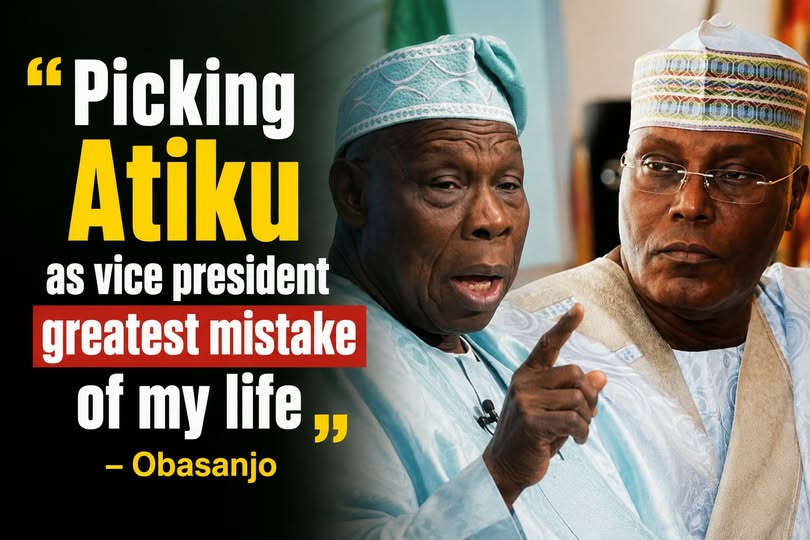
Picking Atiku as vice president greatest mistake of my life – Obasanjo

Published

on

Former President Olusegun Obasanjo has described his decision to choose Alhaji Atiku Abubakar as his running mate in the 1999 presidential election as the biggest mistake of his life. Politics

Obasanjo made the remark on Friday, July 31, during a fireside chat with veteran musician and activist Charly Boy in Lagos. The event marked the unveiling of Charly Boy’s foundation and his memoir, 999: A Memoir in Tribute to Late Justice Chukwudifu Oputa.

Reflecting on his time in office, Obasanjo said that, with the benefit of hindsight, he would not have selected Atiku as vice president. “I would say the greatest mistake I made was picking Atiku Abubakar as my vice president in 1999,” he said.

The former president added that he remained grateful that Atiku’s actions did not derail his administration or prevent him from achieving his objectives while in office. “There is no bitterness in me over what happened,” Obasanjo said. “Despite everything, I was able to achieve what I set out to achieve while in power.”

Obasanjo also addressed the long-standing debate surrounding his ancestry, stating that his parents were from Abeokuta, the Ogun State capital. “I still know our family house there,” he said.

The event attracted several prominent personalities, including former Commonwealth Secretary-General Chief Emeka Anyaoku; National Democratic Congress (NDC) presidential candidate Peter Obi; business mogul Leo Stan Ekeh, who donated ₦20 million each on behalf of Obasanjo and Anyaoku; book reviewer Dr Austin Tam-George; veteran broadcaster Bisi Olatilo; and other dignitaries.

Obasanjo and Atiku were elected on the platform of the Peoples Democratic Party (PDP) and served as president and vice president from 1999 to 2007. Their relationship later deteriorated during their second term in office following political disagreements.


Continue Reading
Click to comment

Leave a Reply

Your email address will not be published. Required fields are marked *

Politics

Obasanjo bombs Atiku: You’re my biggest mistake

Published

on

Former President Olusegun Obasanjo on Friday described his decision to pick former Vice President Atiku Abubakar as his running mate in the 1999 presidential election as the biggest mistake of his presidency.

Obasanjo made the remark in Lagos during a fireside conversation with veteran entertainer and activist Charles Oputa, popularly known as Charly Boy, at the public presentation of Charly Boy’s foundation and memoir, 999: A Memoir in Tribute to Late Justice Chukwudifu Oputa.

The former President, who served alongside Atiku between 1999 and 2007, said although every leader makes mistakes in office, his choice of vice president remained the one decision he regretted most, saying he would never have chosen him had he known then what he later discovered about his former deputy.

A video of the event, later published by iWitnessLive TV on YouTube, captured Obasanjo reflecting on his years in office after Charly Boy asked him to identify the greatest mistake he made as president.

“What I have found in my own life is that mistakes that could have been fatal, God had taken care of them for me,” he stated.

Pressed to identify one specific mistake, the former President responded, “The man I picked as my running mate, my number two. If I had known him as I came to know him later, I would not have picked him.”

When Charly Boy sought clarification on whether he was referring to Atiku, Obasanjo replied, “My vice president. I don’t know what name you want to give him, but my vice president, I mean that.”

See also  Why I Didn’t Join Atiku, Peter Obi, Amaechi For #OccupyINEC Protest – Sowore

He maintained that with the benefit of hindsight, he would have made a different choice.

“Of course, what I know about him later… I would not have picked him. Thank God that God did not allow his actions and reactions to overwhelm me, divert my focus from Nigeria or harm Nigeria,” he said.

The former President, however, insisted he harboured no personal resentment against Atiku despite their turbulent political relationship.

“There’s no bitterness because he did what he believed he should do, and God did what God had to do, which enabled me to achieve what I was able to achieve,” he added.

Friday’s remarks represent one of the strongest personal assessments the former President has made publicly about his decision to select Atiku as vice president, reviving a political rivalry that has shaped the country’s democratic landscape for more than two decades.

Obasanjo and Atiku emerged as the first democratically elected President and Vice President after the end of military rule in 1999, winning the election on the platform of the Peoples Democratic Party.

For much of their first term, the administration was widely regarded as a formidable political partnership, with Atiku playing a prominent role in the National Economic Council, the National Council on Privatisation and several economic reform initiatives.

However, relations between the two leaders deteriorated sharply during Obasanjo’s second term in office.

The crisis intensified after Atiku opposed attempts by allies of the former President to amend the Constitution to allow a third presidential term for Obasanjo.

The failure of the controversial constitutional amendment in 2006 widened the gulf between both men and triggered one of the most bitter power struggles in Nigeria’s Fourth Republic.

See also  Peter Obi charges new INEC chairman, Amupitan on credible guber poll in Anambra

The feud escalated into legal battles over the powers of the vice president after Obasanjo declared Atiku’s office vacant following his defection from the PDP to the then Action Congress ahead of the 2007 general election.

The Supreme Court eventually ruled that the President lacked constitutional powers to remove an elected vice president, allowing Atiku to complete his tenure.

Since leaving office, both men have repeatedly traded accusations over corruption, abuse of office and political betrayal.

In his memoir, My Watch, published in 2014, Obasanjo accused Atiku of corruption, disloyalty and placing personal ambition above national interest.

Atiku dismissed the allegations, accusing his former principal of attempting to rewrite history and portraying himself as the victim of political persecution during the closing years of the Obasanjo administration.

Although the two politicians briefly reconciled ahead of the 2019 presidential election when Obasanjo endorsed Atiku’s bid against President Muhammadu Buhari, the rapprochement proved short-lived, with both men subsequently returning to separate political paths.

Obasanjo has since remained one of Atiku’s most vocal critics, repeatedly urging Nigerians to prioritise competence, integrity and national interest in the choice of future leaders.

punch.ng

FOLLOW US ON:

FACEBOOK

TWITTER

PINTEREST

TIKTOK

YOUTUBE

LINKEDIN

Continue Reading

Politics

Fubara’s emergence as Rivers governor contentious, says Tonye Cole

Published

on

Former All Progressives Congress governorship candidate in Rivers State, Tonye Cole, has said Governor Siminalayi Fubara’s emergence was controversial from the outset.

Cole urged political actors to use the current situation to chart a new course for governance in the state.

He stated this on Friday during an appearance on Channels Television’s Sunrise Daily.

He commented on Fubara’s reconciliation with the Minister of the Federal Capital Territory, Nyesom Wike, and the political developments in Rivers State.

The APC chieftain said he believed Fubara must have consulted with his associates before deciding to reconcile with Wike in order to complete his tenure without further political distractions.

He stated, “My assumption is that the governor would have gone with his own close allies, discussed with them, and said that this is the best way, that he has to move forward for the next six months or thereabouts of his administration. I would assume that’s what he did.

“But I am not in his chamber, so I wouldn’t know. But that’s what I would assume he would do.”

Cole said that having chosen to remain in office after the political crisis, the governor now has a responsibility to focus on governance rather than prolonging the conflict.

“But the battle that was fought? Now, what do you do? Do you walk away? If he was going to walk away then, he should not have come back as governor.

“But having taken the responsibility to come and finish his term, then he has to finish it in the way that allows him to govern. He can’t go back into fighting.”

See also  Why I Didn’t Join Atiku, Peter Obi, Amaechi For #OccupyINEC Protest – Sowore

He argued that Fubara’s path to office had been disputed from the beginning, adding that the prolonged face-off between the governor and his predecessor had negatively affected the state.

He said, “First of all, the method with which he came into power in the first instance was contentious. Throughout the period when he was there, the contention between himself and his predecessor had a lot of problems for River State.

“So that could not have been the wishes of the people. People looked for something different; they didn’t get it.”

Cole, however, expressed hope that the current political climate presents an opportunity for Rivers State to embrace a new style of leadership and a more transparent electoral process.

“Now we have an opportunity, and I come back to this – we have an opportunity in Rivers State, and I’m praying this time around that it will work.

“We have an opportunity in Rivers State to set a different type of governance, a different type of process in electing those who represent us in power. My prayer is that we do it right,” he said.

Fubara and Wike have been locked in a prolonged political feud since shortly after the governor assumed office in May 2023.

The crisis split the Rivers State House of Assembly, disrupted governance and led to a series of legal and political battles over control of the state’s political structure.

In March 2025, President Bola Tinubu declared a state of emergency in Rivers State, suspending Governor Fubara, his deputy and members of the House of Assembly for six months, while appointing a sole administrator to oversee the state.

See also  Panic in ADC as EFCC goes after key members

The emergency rule was lifted after the suspension elapsed, with Fubara returning to office following a reconciliation brokered by the President between him and Wike.

Since his return, the governor has resumed official duties and pledged to work with all stakeholders to restore stability and focus on governance, although political observers say tensions within the state’s political class remain.

punch.ng

FOLLOW US ON:
FACEBOOK

TWITTER

PINTEREST

TIKTOK

YOUTUBE

LINKEDIN

Continue Reading

Politics

Nigerians must say enough to hunger, poverty — Peter Obi

Published

on

The presidential candidate of the Nigeria Democratic Congress for the 2027 general elections, Mr Peter Obi, has said the power to ensure credible elections lies with the Nigerian people, insisting that the Independent National Electoral Commission will only act according to the resolve of the electorate.

Obi spoke with journalists on Friday after attending the burial service of the late Pa Simon Okorie Abaa, father of the NDC senatorial candidate for Ebonyi South, Chief Linus Okorie, at Isiama Primary School, Onicha Igboeze, in Onicha Local Government Area of Ebonyi State.

He described his relationship with Okorie as longstanding, recalling that they had worked together in the Labour Party before joining the NDC.

“We have worked together before in the Labour Party and now we are in the NDC. That shows we have a close relationship. We are here today to pay our last respects to his late father.

“I pray that God Almighty, who gave Papa a long life and has now called him home, will grant him eternal rest and give the family and all of us the fortitude to bear this irreplaceable loss. May God continue to bless the family,” Obi said.

Speaking on preparations for the 2027 general election, Obi said his confidence was not in INEC alone but in Nigerians’ determination to defend their votes.

“It is not about confidence in INEC. Do I still have confidence in the people? Because it is the people that will determine what INEC will do. If the people insist that their votes will count, their votes will count.

See also  2027 battle: Opposition rages as court scraps ADC, four parties

“It is for Nigerians to look at what is happening in the country today and ask themselves what the future holds for our children in this enterprise called Nigeria. Are we going to continue in this direction? Anybody talking about changing Nigeria today is making the ultimate sacrifice because we cannot continue like this,” he said.

The former Anambra State governor lamented the worsening economic situation, saying poverty and hunger had reached alarming levels.

“Every day poverty is increasing. Every day hunger is increasing. You don’t even need World Bank reports to know this because you can see it in the villages.

“They are saying that about 70 million Nigerians are facing acute hunger. What are we going to do about it? Are we going to continue like this? No. That is not possible,” he added.

On concerns that opposition supporters may face intimidation and harassment during the elections, Obi said Nigerians were already suffering from economic hardship.

“For me, every Nigerian is already being harassed by hunger. People are being harassed by the worsening situation in the country. Everybody is affected.

“It is time for Nigerians to tell those who are harassing us that enough is enough,” he said.

punch.ng

FOLLOW US ON:

FACEBOOK

TWITTER

PINTEREST

TIKTOK

YOUTUBE

LINKEDIN

Continue Reading

Trending