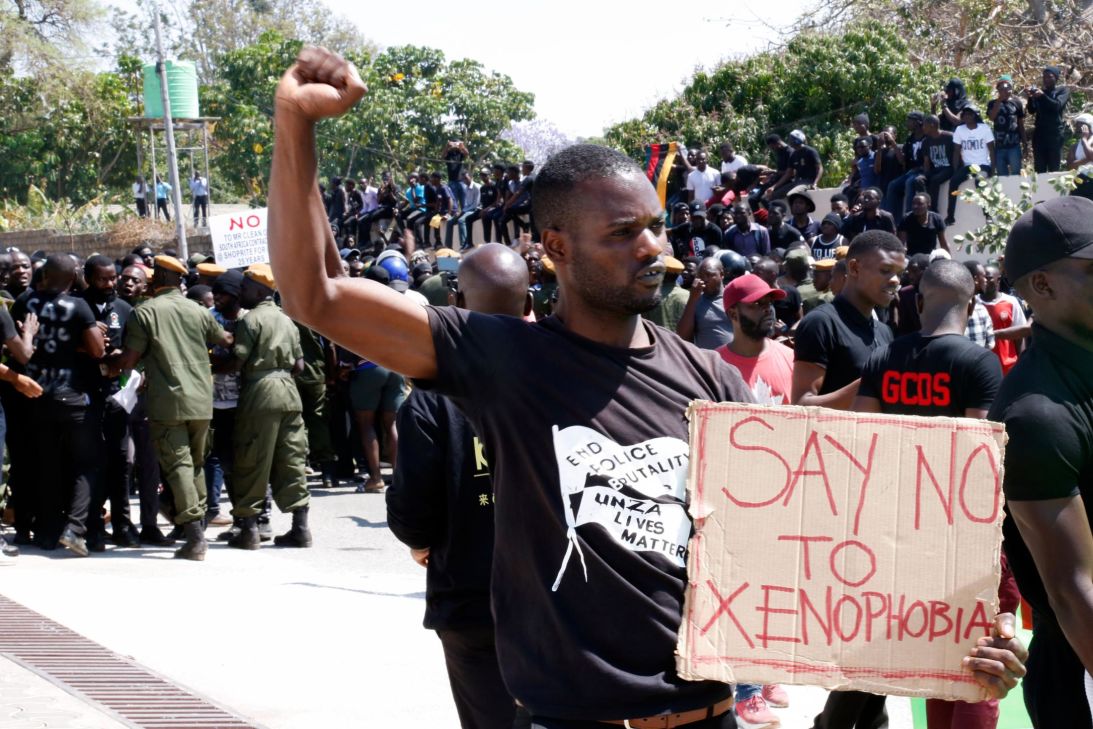
The Federal Government has assured Nigerians still residing in South Africa of their safety, even as fresh concerns over xenophobic tensions and renewed anti-immigrant protests continue to trigger calls for stronger diplomatic action.
This comes after Nigerians reportedly stormed the country’s embassy in Pretoria as xenophobic tensions escalated while another batch of 269 Nigerians evacuated from South Africa arrived at the Murtala Muhammed International Airport, Lagos, on Tuesday aboard an Air Peace flight from Johannesburg at 10.48 am, marking the second government-coordinated evacuation exercise in recent weeks.
Nigerian businessman popularly known as ‘Big Joe’ was reportedly shot and killed by unidentified gunmen on Sunday, outside his shop in Witbank, Mpumalanga Province, though local police have not announced cause of his death.
Thousands of locals marched in major cities across South Africa on Tuesday, calling for the removal of undocumented migrants from the country.
Police officers, supported by private security personnel, were deployed amid concerns that the demonstrations could turn violent. Anti-migrant groups had set Tuesday as a deadline for undocumented foreigners to leave.
In the wake of the protests, many foreign nationals have reportedly fled their communities due to fear of violence and intimidation. South African police said about 25,000 migrants have been repatriated so far, most of them from other African countries.
South African police said the protests were largely peaceful, although isolated incidents of looting, vandalism and assaults were recorded.
In Johannesburg, police maintained a strong presence across the city centre, while businesses remained closed in parts of the commercial district. The military was also deployed to Hillbrow, a suburb with a large migrant population, following reports that a teenager had been shot and a vehicle set ablaze.
Local media reported that protesters in Yeoville threw bricks at some homes occupied by migrants, while demonstrators in Germiston allegedly evicted suspected undocumented foreign nationals from their homes and handed them over to police for immigration checks.
Police said five people were arrested for allegedly looting a foreign-owned shop in Soweto. In KwaZulu-Natal Province, about 10 people were arrested over looting, while another woman was arrested for assaulting a police officer and a man was detained over alleged intimidation following the reported assault of a foreign national.
The leader of the anti-migrant group March and March, Jacinta Ngobese-Zuma, said the group would continue staging weekly protests over the next six months to pressure the government to deport undocumented migrants.
A member of another anti-migrant movement, Operation Dudula, told the BBC the group would continue pushing police to arrest foreigners found to be living in the country illegally.
On the eve of the protests, President Cyril Ramaphosa met with some protest leaders in an effort to ease tensions.
While acknowledging concerns over immigration, Ramaphosa urged demonstrators to remain peaceful and warned against intimidation and violence.
The Nigerian returnees’ arrival marked the second government-coordinated evacuation flight from South Africa.
“Some foreign nationals who live in South Africa are here lawfully,” the president said in his weekly newsletter.
“They work, study, raise families, invest in our economy and contribute positively to our society. They too are entitled to the protection of our laws and our Constitution.”
He added that the right to protest “does not allow people to threaten or intimidate others, or to engage in acts of vandalism or violence.”
South African authorities said about 50,000 undocumented migrants have been arrested since January, while approximately 25,000 have already been repatriated. Most are from other African countries.
On April 20, Amaramiro Emmanuel allegedly died after he was assaulted by members of the South African National Defence Force in Port Elizabeth. Days later, on April 26, Ekpenyong Andrew was reportedly arrested in Pretoria and was later found dead in a mortuary under circumstances that remain under investigation.
The Nigerian government demanded thorough investigations into both deaths, while Nigerian community organisations have continued to raise concerns over attacks on their members amid rising anti-foreigner sentiment.
Foreign Affairs ministry
The Ministry of Foreign Affairs, in a statement issued in Abuja and signed by its spokesperson, Mr. Kimiebi Ebienfa, said the Federal Government had intensified efforts to bring home Nigerians willing to return, particularly ahead of the June 30 (Tuesday) deadline set by South African groups for undocumented foreigners to leave the country.
Despite the deadline, the FG reassured Nigerians still in South Africa of their continued safety, pledging sustained high-level diplomatic engagement with the South African government to protect their interests.
Before Tuesday’s evacuation, 66 Nigerians returned to Lagos on June 24 aboard a Value Jet airline facilitated by its CEO, Kunle Soname.
The ministry said the latest batch of evacuees, who were accompanied by officials of the Nigerian Mission in South Africa, was received at the airport by senior officials of the Ministry of Foreign Affairs led by the Director of the African Affairs Department, Ambassador Haruna Ali-Gombe.
Speaking during the reception, Ali-Gombe conveyed President Bola Ahmed Tinubu’s message of reassurance to the returnees.
He said, “The batch of 269 evacuees, escorted by officials of the Nigerian Mission in South Africa, were officially received at the airport by senior officials of the Ministry of Foreign Affairs led by the Director, African Affairs Department, Ambassador Haruna Ali-Gombe, mni, who conveyed the heartfelt greetings and assurances of President Bola Ahmed Tinubu, GCFR, to the returning nationals, reaffirming the Federal Government’s steadfast commitment to ensure the safety of Nigerian nationals living outside the country.”
The ministry stressed that the evacuation exercise remained ongoing despite the June 30 deadline imposed by South African authorities.
According to the ministry, additional evacuation flights are expected in the coming days to bring back all Nigerians who have completed the screening process and opted for voluntary return.
The ministry stated, “With the June 30 deadline on undocumented foreigners to leave South Africa, the Federal Government wishes to reiterate the fact that the evacuation process is still on course and more flights are expected in the country in the next few days to evacuate all Nigerians that have been screened and cleared to voluntarily return to the country. Government will continue to engage South African authorities at the highest levels to ensure the protection of Nigerian nationals living in the country.”
Announcing the arrival of the latest batch, the ministry said, “The Ministry of Foreign Affairs wishes to inform that the second evacuation flight from Johannesburg, South Africa, operated by Air Peace, arrived the Murtala Mohammed International Airport, Lagos, on Tuesday, 30th June 2026, at 10.48 am with 269 returnees. This is in addition to 66 returnees that arrived via South African Airways, facilitated by a good-spirited Nigerian, on the 24th of June, 2026.”
Nigerians stranded
Nigeria’s Acting High Commissioner to South Africa, Temitope Ajayi, on Tuesday said many Nigerians stranded outside the country’s mission in Pretoria during the anti-migrant protests ignored the embassy’s directives and instead responded to announcements made by community members.
Ajayi stated this while explaining reports of Nigerians sleeping outside the embassy and taking refuge in churches as the Federal Government continued the evacuation of citizens who volunteered to return home.
According to him, the mission has put in place a structured evacuation process and only invited screened individuals to report when their respective flights were ready.
He said, “The (Nigerian) community here puts people in a difficult situation. Our agreement was that it is only when the flight is coming that we call the people who are captured on the list because we have a list for different batches.
“The last time we called them, the community went overboard to announce that everybody should report, whereas that was not the case. It is not what we asked them to do.”
He added that some of those staying in churches and outside the embassy were not even part of the approved evacuation list.
He said, “Some of these people you said are staying at the church were those who defied the mission’s notification and followed the community’s notification. They found themselves in such a situation, which is uncalled for. Some of them were not even captured during the screening exercise. They just showed up, while some were told to exercise patience so that we could call them when it was their turn. We are following due process to ensure that everything is orderly.”
Meanwhile, hundreds of Nigerians have been screened for repatriation, while the Nigerian High Commission in Pretoria and the Nigerian Union South Africa continued to provide temporary shelter, food and other humanitarian assistance to affected citizens pending their evacuation.
The renewed tensions have also heightened concerns over the safety of Nigerians living in South Africa following a series of violent incidents in recent months.
Most recently, the alleged killing of two people has added to the growing list of cases involving Nigerians who have been killed in the country.
On the reported killing of a Nigerian in South Africa on Sunday, Ajayi said the Nigerian mission had begun engaging the South African police to establish the facts surrounding the incident.
The acting envoy also disclosed that the mission had continued to pursue justice in previous cases involving Nigerians allegedly killed in South Africa.
He said, “We are getting an initial report. We are getting detailed information to be clear on the circumstances surrounding that. We have been liaising with the police, and we are getting a preliminary report concerning that incident. Yes, he is a Nigerian living there, but we are getting the details.
“As you are aware, there is a case that happened in April, and there was the case of the Uber driver in February. We have submitted the case files to the government. We have written a protest note to the South African Ministry of Foreign Affairs. They said they have commenced investigations into the officers and those involved, and they will furnish us with the outcome of the investigation, which is what we are waiting for.”
Ajayi said the evacuation exercise ordered by the Federal Government was progressing, with hundreds of Nigerians already returned home.
He added that the Nigerian mission had continued to cater for distressed citizens awaiting evacuation.
The envoy said, “A total of 269 people arrived in Lagos this morning. The evacuation is ongoing. We have done about three batches now. The number remaining should be around 700, whom we are going to evacuate based on people who voluntarily showed interest in coming back to Nigeria.
“The mission has been taking care of those who come to the embassy claiming their rent has expired and other issues. At the mission now, we have close to 150 people. We are doing the evacuation in batches. When it gets to their batch, we will evacuate them.”
Also speaking, the President General of the Nigerian Union South Africa, Barrister Smart Nwobi, said the union had advised Nigerians to remain indoors while monitoring the anti-migrant protests across the country.
Nwobi said South African President Cyril Ramaphosa had assured that adequate security personnel had been deployed to prevent attacks during the protests.
He said, “We are still monitoring things. We instructed our people to close their shops and stay indoors.
“The South African President has assured that they have deployed enough resources for security agencies to ensure that no life or property is lost during the anti-migrant protest. As a union, we are monitoring things with our agents at every corner, and the police have reacted to cases where people wanted to take the law into their own hands. There is the use of rubber bullets, and police tanks are all over.”
According to him, the Nigerian Union, the Nigerian High Commission and other organisations had continued to provide humanitarian support for displaced Nigerians.
He said, “The returnees have gone to the Nigerian embassy where they are being fed by the Nigerian Union and other organisations. There are provisions of humanitarian relief, blankets and other necessities.
“About 79 men were taken to a nearby church after a pastor volunteered the facility as a refuge centre, while over 80 women and children remained at the Nigerian High Commission.”
Nwobi disclosed that more than 600 Nigerians had already been screened and cleared for repatriation, with additional evacuation flights expected.
He, however, noted that about 400 other screened Nigerians were still hoping to benefit from the FG’s evacuation exercise.
He said, “We still have more than 600 Nigerians who have already been screened and cleared to be repatriated on the Federal Government flights. Two of those flights have come, and we are expecting the third, fourth and fifth batches. The Nigerian High Commission has promised that the third batch might be here on Thursday.
“We are glad that the Federal Government, through President Bola Tinubu, has kept its promise to protect the lives of Nigerians. We thank everyone who has played a role in ensuring that our people are evacuated.”
Nwobi also called on state governments to emulate the Imo State Governor, Hope Uzodimma, who, according to him, provided N1m to returnees from the state to help them resettle.
He urged the FG to review Nigeria’s bilateral relationship with South Africa in view of recurring xenophobic attacks.
“Our government should review the agreement and relationship it has with South Africa in view of the ongoing xenophobia. Nigeria has received illegal immigrants without complaining,” he said.
Reacting to the protest, the President of the Association of Yorubas in Diaspora, South Africa, Dr Olusola Agbeniyi, said the planned anti-migrant demonstration ended peacefully without any reported attacks on Nigerians or other foreign nationals.
According to him, the protest was directed against illegal immigration and did not degenerate into violence.
“Today’s march ended peacefully. Nothing happened. They only protested against illegal immigrants,” Agbeniyi said.
NICASA appeal
Also, the Deputy Chairman of the Nigerian Citizens Association South Africa, Western Cape Province, Mr. Leo Azebeokhai, urged the FG to strengthen diplomatic engagement with South Africa to address the challenges facing Nigerians in the country amid renewed anti-immigrant protests.
He called on the FG to urgently intensify efforts to evacuate stranded Nigerians in South Africa.
Azebeokhai said Abuja should use diplomatic channels to facilitate the renewal of immigration documents and improve the welfare of Nigerians living in South Africa.
According to him, many Nigerians become undocumented not because they deliberately violate immigration laws but because they encounter difficulties renewing their Nigerian passports and South African permits.
He explained that the Nigerian Consulate in Johannesburg remains the only centre where Nigerians can renew their passports, forcing many to travel long distances from other provinces at considerable expense.
“People travel from different provinces to Johannesburg just to renew their passports. A return flight from Cape Town can cost more than R3,000, and many simply cannot afford it,” he said.
Azebeokhai noted that although NICASA leaders had repeatedly appealed to the consulate to deploy mobile passport enrolment facilities to other provinces, they had been informed that the mission was still awaiting approval and equipment from Nigeria.
He said the delays had resulted in many Nigerians carrying expired passports, thereby exposing them to immigration-related challenges.
“There are many people whose passports have expired, not because they don’t want to renew them but because they cannot access the renewal process,” he said.
“Our body, over time, has engaged the consulate and pleaded with them to find a way to come to different provinces so that they can have these people captured. But what the consulate keeps telling us is that they have applied for a machine, a mobile capture machine, from Nigeria, and they are still waiting.
“There are a lot of people who want their passports renewed but cannot renew them. So, a lot of passports expire because people can’t renew them, not because they don’t want to. So, when your passport expires, you become someone with expired documents.
“So, that is one way that the Nigerian government can at least do something. Nigerians in South Africa didn’t disappear from Nigeria and appear in South Africa. They came through the borders, they came through points of entry, like the airport.
“So, papers are expiring. We apply for document renewals, and it’s either delayed at Home Affairs and your document expires and nothing happens. I believe that the Nigerian government, through Foreign Affairs and all that, can engage its South African counterparts more, you know, it’s diplomacy.”
He also urged the Federal Government to engage South African authorities on the delays in processing residence permits, work permits and business permits, which he said had left many law-abiding Nigerians without valid documentation.
According to him, prolonged delays in renewing permits prevent Nigerians from working legally or operating their businesses despite submitting the necessary applications.
“We need our documents renewed. We want to work, we want to do business. If you don’t get your business permit, you can’t do business. If you don’t get your work permit, you can’t work.
And this is majorly because of the Nigerian government, which I believe has not really engaged the South African government. They have to push more. So, whatever they know they have to do with their counterparts here, they should just do it. Nigerians pay as much as R40,000 trying to renew documents, but don’t get them.
“The Nigerian government, through the Ministry of Foreign Affairs, should engage more with its South African counterpart. This is about diplomacy. Nigerians need their documents renewed so they can work, do business and remain compliant with the law,” he said.
Azebeokhai added that stronger bilateral engagement would help address the administrative bottlenecks affecting Nigerians in South Africa and reduce the vulnerability of those whose immigration documents had expired while awaiting renewal.
Speaking further, Azebeokhai said delays in evacuation arrangements had left hundreds of Nigerians stranded after many abandoned their homes and livelihoods following earlier government assurances of repatriation.
He said the FG had promised five evacuation flights but only two had been deployed, leaving many Nigerians uncertain about their return, adding that nearly 600 people were affected, with some already assisted by unidentified private individuals. Azebeokhai noted that many evacuees were stranded in Pretoria and other areas after leaving their homes in expectation of the flights.
“The government promised that they were going to make available five airlines. So far, only two have moved,” he said.
“It’s about 596 nationals now, close to 600. About 66 were lifted by a citizen. We don’t even know who that person is, a Nigerian citizen who volunteered. Most people are kind of stranded. I am not sure what the situation is back home or why this is being delayed, but I believe the government should be able to do more.”
He added that as at Tuesday morning, community leaders were struggling to provide immediate humanitarian support, noting that the NICASA leadership had convened an emergency meeting to coordinate assistance for affected Nigerians.
“This (Tuesday) morning, the President of NICASA had an emergency meeting with us where he asked for help. We’ve been trying to contribute some money so that we can get relief materials, maybe food and all that, for those who are stranded.
“These people were asked to leave where they were staying because they would be evacuated. Most of them gave up their homes, maybe sold their properties and all that, so they are kind of stranded. It’s winter in South Africa. People are hungry and stranded,” he said.
Ambassadors advise FG
Retired Nigerian ambassadors also called on the FG to strengthen diplomatic engagement with South African authorities, accelerate the evacuation of Nigerians willing to return home, and pursue long-term measures to prevent recurring attacks and the mistreatment of Nigerians in the country.
Retired Ambassador Ogbole Amedu-Ode commended the FG for initiating the evacuation of Nigerians but urged authorities to intensify efforts following reports of challenges in the airlift process.
He said, “The Federal Government is already engaging the South African authorities, and the airlifting of Nigerians concerned has commenced. However, going by some social media sources, there appear to be some hiccups in the airlift process. In that case, our authorities should double down on the airlift.”
The former envoy also stressed the need for sustained diplomatic engagement with South African authorities, noting that Nigeria could not physically intervene within another sovereign state.
“Secondly, there must be continuous monitoring of the situation and engagement with the South African authorities because Nigeria cannot physically go and secure its citizens, whether legally or illegally resident in the country. They have to be told the consequences of their inability to bring the unfortunate situation under their control.”
Also speaking, retired Ambassador to Algeria, Mohammed Mabdul, called for stronger diplomatic action, including summoning the South African Ambassador on a regular basis to account for efforts being made by the South African government to resolve the crisis.
He said, “Diplomatic engagement: The Ministry of Foreign Affairs should strongly protest the implementation of this policy by summoning the South African Ambassador on a regular basis to explain the efforts of the South African government towards resolving the impasse, as it negates the spirit of African unity.”
Mabdul further recommended the immediate establishment of an inter-ministerial committee to coordinate the evacuation and reintegration of Nigerians returning from South Africa.
According to him, “An inter-ministerial committee should be urgently set up to coordinate the immediate evacuation of Nigerians who are willing to return to Nigeria. Members of this committee should include the Ministry of Foreign Affairs, Nigerians in Diaspora Commission, Ministry of Humanitarian Affairs, National Commission for Refugees, Migrants and Internally Displaced Persons, Nigeria Immigration Service, and the National Emergency Management Agency. The committee should work harmoniously to address the problems of returnees to Nigeria.”
The retired diplomat also urged the Federal Government to escalate the matter to the African Union for collective action.
He said, “The matter should be tabled at a meeting of African Union Heads of State to address long-term solutions to these recurring issues. Joint decisions should be taken to apply sanctions and other measures against South Africa to serve as a deterrent to other member states.”
Mabdul further advised the government to discourage unnecessary travel to South Africa through a nationwide public awareness campaign.
He stated, “The Ministry of Information and National Orientation should embark on sensitisation programmes through news outlets, flyers and other channels to discourage Nigerians from travelling to South Africa, except those who have permanent residence or are gainfully employed with the relevant documents to stay in the country.”
He also proposed economic measures against South African business interests in Nigeria.
According to him, “The Federal Government should consider imposing economic sanctions on South African interests in Nigeria, including taking over companies such as MTN and DStv operating in the country.”
In addition, Mabdul urged Nigerian diplomatic missions in South Africa to work with international migration authorities to facilitate the orderly return of undocumented Nigerians.
He said, “The Nigerian Embassy in Pretoria and the Consulate General in Johannesburg should liaise with the International Organisation for Migration (IOM) in South Africa to coordinate the swift repatriation of Nigerians living illegally by issuing the relevant documents that will facilitate their evacuation to Nigeria on a regular basis.”
NAUS vows protest
The National Association of University Students has condemned the reported xenophobic attacks against Nigerians in South Africa, warning of nationwide protests if the South African government fails to address the situation within one week.
Speaking at a press conference, NAUS President, Meshach Nwankwo, decried what he described as rising attacks, intimidation and hate speech targeting Nigerians and other African nationals, saying the incidents had heightened fears among Nigerian students and citizens.
“The National Association of University Students unequivocally condemns every act of xenophobia, hate speech and violence directed against Nigerians and indeed any African living lawfully in another African nation,” he said.
NAUS urged South African authorities to investigate all reported attacks, prosecute those responsible and provide adequate protection for foreign nationals. It also called on the South African High Commission in Nigeria to publicly reassure Nigerians of their safety.
“Nobody has the monopoly of wisdom. Nobody has the monopoly of violence,” Nwankwo said.
The association warned that if no concrete action is taken within one week, it would mobilise peaceful nationwide protests, pursue lawful measures against South African-owned businesses in Nigeria and relocate its national headquarters to the South African High Commission in Abuja as a sustained protest.
The warning comes amid renewed anti-migrant demonstrations in parts of South Africa, which have raised fresh concerns over the safety of foreign nationals and prompted the evacuation of hundreds of Nigerians.
punch.ng
FOLLOW US ON: