Connect with us

News

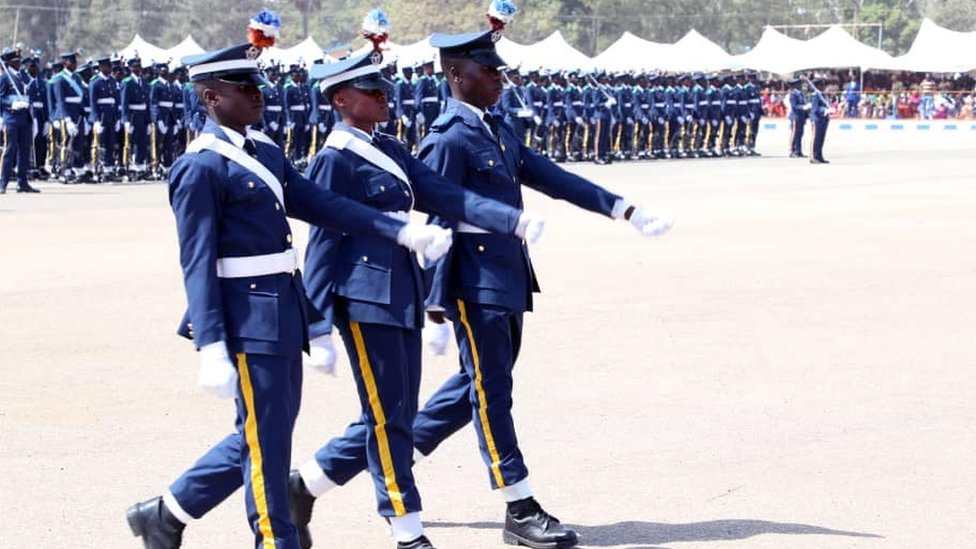
Nigerian Air Force names successful candidates for 2025 recruitment, training begins July 19

Published

on

The Nigerian Air Force has released the list of successful candidates for its Basic Military Training Course 46/2025 recruitment exercise.

NAF said the names of successful candidates had been published on its official recruitment portal.

It disclosed this in a public announcement posted on its official Facebook page on Wednesday signed by the Director of Public Relations and Information, Headquarters, Nigerian Air Force, Air Commodore Ehimen Ejodame.

The Air Force said candidates who passed the selection interview are expected to report to the NAF Military Training Centre, NAF Base, Kaduna, on Sunday, July 19, 2026, to commence training.

“The Nigerian Air Force hereby informs the general public that the list of successful candidates for the Basic Military Training Course (BMTC) 46/2025 Recruitment Exercise has been published on the official Nigerian Air Force Recruitment Portal,” the statement said.

It added, “The candidates whose names appear on the published list were successful at the selection interview and are to report to the NAF Military Training Centre (MTC), NAF Base, Kaduna, on Sunday, 19 July 2026, to commence training.”

The NAF directed successful candidates to report with the originals and photocopies of their credentials, alongside other items listed in the joining instructions.

It advised candidates to carefully review all instructions on the recruitment portal before reporting for training.
The Air Force also warned applicants against falling victim to recruitment fraud, stressing that the enlistment exercise is free.

“The Nigerian Air Force reiterates that the recruitment exercise is entirely free of charge. Successful candidates and members of the public are therefore advised to beware of fraudsters and refrain from making any payment to individuals or groups claiming to facilitate recruitment or enlistment into the Nigerian Air Force,” the statement added.

See also  Lagos Assembly backs state police, advances anti-begging bill

The statement advised candidates to visit the official recruitment portal https://nafrecruitment.airforce.mil.ng for the full list of successful applicants and detailed joining instructions.

punch.ng

FOLLOW US ON:

FACEBOOK

TWITTER

PINTEREST

TIKTOK

YOUTUBE

LINKEDIN

Continue Reading
Click to comment

Leave a Reply

Your email address will not be published. Required fields are marked *

News

Macron to visit Nigeria — French ambassador

Published

on

French President Emmanuel Macron will undertake a State visit to Nigeria this Fall, the French Ambassador to Nigeria and ECOWAS, Marc Fonbaustier, has announced, describing the trip as an opportunity for both countries to review their growing strategic partnership and chart a new course for future cooperation.

Fonbaustier made the announcement while delivering his address at the celebration of France’s National Day on Tuesday night in Abuja.

Revealing what he described as a scoop, the ambassador said Macron’s visit would come two years after President Bola Tinubu’s State visit to Paris.

He said, “Secondly, a scoop. I am pleased and honored to announce that, two years after President Bola Ahmed Tinubu’s State visit to Paris, the President of the French Republic, Emmanuel Macron, will travel to Nigeria for another State visit this fall.

“Together, our two Presidents will assess the progress of our roadmap and outline the key elements of our relationship for the years to come. These will undoubtedly be ambitious and mutually beneficial for our two peoples.”

The envoy said the relationship between Nigeria and France was founded on equality, stressing that both countries regarded each other as partners of equals.

“In a chaotic world searching for meaning, I would like to talk to you about values. I would like to focus on the three values that accompanied the birth of the French Republic: Liberty, Equality, and Fraternity.

“First and foremost, Equality. I say this, and I say it with pride, that the partnership between Nigeria and France is, in reality, not just in words, a partnership between equals.

See also  Lagos Assembly backs state police, advances anti-begging bill

“This equality among members of the international community is the cornerstone of the United Nations Charter, which Nigeria and France continue to defend, against all odds.

“In our bilateral relationship, this principle has concrete implications. It means avoiding prejudice, not imposing anything, and not interfering. On the contrary, it means listening to each other, communicating openly, and making decisions together.

“I stand before you tonight to say that, together, Nigerians and French people, we fully respect the spirit and profound meaning of this word: Equality. Our common interests are clearly stated and understood,” the envoy stated.

Fonbaustier noted that both countries shared the common goals of economic and social development, job creation, and environmental protection.

“We want the economic and social development of both our countries, for our citizens, for job creation, and for improving the standards of living, with due respect for the environment, biodiversity, water and air,” he said.

Fonbaustier highlighted recent commercial partnerships between Carrefour and HyperCity, Accor and Shoreline, as well as Canal+’s acquisition of MultiChoice, saying the collaborations reflected growing economic ties and would enrich television programming in Nigeria.

The ambassador also commended the initiative led by Abdul Samad Rabiu to establish a House of African Worlds in Paris.

On democracy and governance, he said Nigeria and France remained committed to democracy, the rule of law, freedom of expression, and equal opportunities for women and men.

He added that the French Embassy continued to support women, young people, and persons with disabilities to promote their economic and social empowerment.

See also  3,715 PHCs inactive in 19 states and FCT

Fonbaustier also underscored ongoing cooperation in agriculture through the French Development Agency, particularly projects aimed at strengthening food security and agricultural value chains in northern Nigeria and across the ECOWAS region.

He said, “We are working together on agricultural issues, particularly to strengthen food security, in Nigeria of course, but also throughout the region together with ECOWAS.

“I would like to underscore the commitment of the AFD (French Development Agency) in the North, particularly its project on agricultural value chains, which complements another innovative project focused on market access, often in very remote areas.

“There are many other collaborative projects. All of them are shaped jointly.”

Speaking on security, he said Nigeria and France shared a commitment to strategic autonomy and the global fight against terrorism.

“Our two countries have repeatedly demonstrated this, through their unfailing and resolute commitment to the global fight against terrorism,” he said.

He added that both countries were working together to support nations seeking to strengthen their capacity to combat terrorism.

“In the face of terrorism, which is affecting the entire region, Nigeria and France are working together to assist countries eager to strengthen their capabilities, in order to better combat this scourge that destroys lives, communities and ultimately, our core values,” he said.

The ambassador stressed that the region needed a strong Nigeria, while Nigeria also required a united and mobilised region to confront insecurity.

On broader international relations, Fonbaustier described the France-Nigeria partnership as part of a wider strategic relationship between Europe and Africa, saying both continents were working together to promote stability, the rule of law, and global cooperation.

See also  Veteran Nollywood actor, Elegbeje Ado dies at 66

He also disclosed that Macron’s vision for Africa was shaped in part by his six-month stay in Nigeria as a student 24 years ago.

“The new relationship between Africa and France was, in some way, born in Nigeria or ‘Made in Nigeria’. Because a young man, Emmanuel Macron, spent six significant and formative months in this country while he was a student, 24 years ago.

“He himself admits that this foundational experience inspired the broad outlines of his vision for the continent and his African diplomacy,” he said.

Continue Reading

News

Kebbi gov approves N2.11bn for gratuities of 772 retirees, families

Published

on

Kebbi State Governor, Dr Nasir Idris, has approved the release of N2.11 billion for the payment of gratuities and death benefits to 772 beneficiaries, reaffirming his administration’s commitment to the welfare of retired public servants and the families of deceased workers.

The approval covers state and contract staff, as well as retirees from the Local Government Service and Local Government Education Authorities.

The Head of Service, Malami Shakari, mni, disclosed this in a statement signed by the Director of Administration, Rashidu Muhammad Bala, FCIA, FCIHRSM, and made available to journalists on Tuesday.

According to the statement, Governor Idris approved the release of N2,110,403,965.83 for the settlement of gratuities and death benefits accrued between September 16, 2025, and January 15, 2026.

“The approval is in line with the administration’s commitment to the prompt payment of gratuities and other retirement benefits,” the statement said.

It added that the 772 beneficiaries would receive the payments, including retired state and contract employees, former local government workers, retirees from the Local Government Education Authorities, and the next of kin of deceased public servants entitled to death benefits.

The Head of Service said the governor’s decision reflected his administration’s resolve to prioritise the welfare of workers and retirees across the state.

“The approval underscores Governor Idris’ commitment to improving the welfare of workers, retirees, and the families of deceased public servants by ensuring the timely settlement of their entitlements,” the statement added.

The latest approval is part of the Kebbi State Government’s ongoing efforts to clear outstanding retirement benefits and provide financial relief to retirees and bereaved families.

See also  Lagos Assembly backs state police, advances anti-begging bill

punch.ng

FOLLOW US ON:

FACEBOOK

TWITTER

PINTEREST

TIKTOK

YOUTUBE

LINKEDIN

Continue Reading

News

Read how House of Reps dump own state police bill, adopt Tinubu’s version

Published

on

The House of Representatives has resolved to withdraw its earlier State Police Bill and adopt the Executive Bill transmitted by President Bola Tinubu, signalling a major shift in the National Assembly’s ongoing constitutional amendment process on one of Nigeria’s most consequential security reforms.

The Speaker of the House, Tajudeen Abbas, announced the decision on Tuesday at the opening of the 2026 National Assembly Open Week in Abuja, saying the Executive Bill was “more robust and more comprehensive” than the version previously passed by the Green Chamber.

The decision effectively halted plans to harmonise the House and Senate versions of the earlier proposal, with lawmakers now set to begin fresh legislative work on the President’s proposal.

Explaining the decision, Abbas said the executive proposal incorporated additional safeguards developed by a presidential committee chaired by the Chief of Staff to the President and former Speaker of the House, Mr Femi Gbajabiamila.

“The deeper lesson of Oyo is that a nation of this magnitude cannot be policed in perpetuity from a single command in Abuja. On this question, this House has already acted.

“In the course of the constitutional reform ably led by our Deputy Speaker, this House passed a State Police Bill and placed the matter squarely before the nation. Tomorrow’s roundtable carries that work forward, in the open and before you.

“I am, indeed, able to share a development that speaks to the seriousness with which this administration regards the safety of Nigerians.

“His Excellency the President has now transmitted to the National Assembly an executive version of the state police bill, one that is more robust and more comprehensive than the version this House earlier passed.

“That bill is the product of a dedicated committee inaugurated by the President and chaired by a distinguished former Speaker of this House, Rt Hon Femi Gbajabiamila,” he said.

Abbas pledged the readiness of lawmakers to consider the president ‘s proposals.

“The House will therefore recall the version it earlier passed, and accord the executive bill the expedited consideration that a matter of this urgency deserves,” he said.

See also  Veteran Nollywood actor, Elegbeje Ado dies at 66

The Speaker also dismissed concerns that the legislation was being hurried through the National Assembly without public input, assuring Nigerians that the bill would undergo full legislative scrutiny.

“To the thoughtful citizens and to the members who have observed that they are yet to see the draft bills and who fear that this matter is being settled beyond public view, I offer this reassurance: nothing here is concealed. The bill will pass through a public hearing and open scrutiny.

“And I give this assurance to every Nigerian: the framework will carry robust safeguards. A state must satisfy clear and demanding standards and safeguards before it may be entrusted with a police service.

“There will be accountability, the protection of fundamental human rights, and firm boundaries between federal and state authority, so that no state police force may ever be reduced to the private instrument of a governor,” he assured.

According to him, the parliament was aware of how power conducted itself in the absence of restraint, stressing that lawmakers “have no intention of repeating that error.”

He said, “This roundtable is our invitation to examine the draft and to submit your memoranda before it becomes law. Your security is far too grave a matter to be designed behind closed doors.”

President Tinubu had formally transmitted the Constitution of the Federal Republic of Nigeria (Alteration) (State Police) Bill, 2026, to the House in a letter dated June 15, urging lawmakers to accord it expedited consideration as part of his administration’s efforts to restructure the country’s security architecture.

According to the President, the legislation seeks to create “a constitutional pathway for the establishment of State Police Services” capable of complementing the Nigeria Police Force in addressing the country’s growing security challenges.

“This bill builds on the significant work already done in this regard by the House of Representatives and incorporates additional safeguards to ensure that the creation of a dual policing structure to address our nation’s evolving national security challenges can be achieved quickly and effectively to the benefit of all Nigerians,” Tinubu wrote.

See also  Alteration claims: National Assembly to re-gazzette tax laws, says Reps spokesperson

He added, “The proposed legislation is a critical component of our administration’s strategy to reorganise Nigeria’s security architecture to better protect our citizens, and I am confident that the House of Representatives will act quickly to consider and pass this bill.”

Before the President’s intervention, both chambers of the National Assembly had independently advanced constitutional amendment bills seeking to establish a state police.

The House version, sponsored through the Constitution Review Committee chaired by Deputy Speaker Benjamin Kalu, proposed constitutional recognition of state police while retaining the Nigeria Police Force as the federal policing institution.

Among its key provisions were the establishment of State Police Services by state governments, creation of State Police Service Commissions responsible for recruitment, discipline and promotions, and constitutional delineation of the responsibilities of federal and state police authorities.

The proposal also sought to provide mechanisms for cooperation between federal and state police formations, while preserving the overriding constitutional responsibility of the Federal Government for national security, defence, border protection, terrorism and other offences with national implications.

Similarly, the Senate’s version of the amendment endorsed the creation of state police but proposed elaborate safeguards to prevent abuse.

The Red Chamber recommended constitutional limits on the deployment of state police officers outside their territorial jurisdiction, strengthened oversight by State Police Service Commissions, federal supervisory mechanisms where constitutional order is threatened, and clear procedures governing funding, recruitment, discipline and operational accountability.

Both chambers also recognised the need for coordination between federal and state policing institutions to avoid jurisdictional conflicts and ensure seamless intelligence sharing.

The executive bill is expected to consolidate these proposals while introducing additional constitutional safeguards recommended by the presidential committee established to review the framework for decentralised policing.

Although details of the executive draft have yet to be made public, Abbas disclosed that it contains stronger accountability measures and stricter conditions that states must satisfy before establishing their own police services.

See also  Lagos Assembly backs state police, advances anti-begging bill

The proposed legislation represents the most significant attempt to decentralise Nigeria’s policing system since the country’s return to democratic rule in 1999.

Nigeria currently operates a single, centrally controlled police structure under the Nigeria Police Force, with operational authority vested in the Federal Government.

For more than two decades, state governors, security experts, constitutional scholars and civil society organisations have argued that the existing centralised model has become increasingly overstretched in responding to terrorism, banditry, kidnapping, communal conflicts and other violent crimes.

Those calls intensified with the establishment of regional security outfits such as the Western Nigeria Security Network (Amotekun), Ebube Agu in parts of the South-East and numerous state-backed vigilante organisations created to complement federal security agencies.

Supporters of state police argue that decentralised policing would strengthen intelligence gathering, improve response time, deepen community policing and enhance local ownership of security.

Critics, however, have consistently warned that state police could be manipulated by governors to intimidate political opponents, interfere in elections and undermine civil liberties if adequate constitutional safeguards are not entrenched.

Under Section 9 of the 1999 Constitution, the proposed amendment must secure the approval of two-thirds of members of both the Senate and the House of Representatives before being transmitted to the 36 State Houses of Assembly, where it must be ratified by at least 24 legislatures before it can become part of the Constitution.

With the House now aligning with the Executive proposal, attention is expected to shift to public hearings and stakeholder consultations as lawmakers begin consideration of what could become the most far-reaching reform of Nigeria’s internal security architecture in more than two decades.

punch.ng

FOLLOW US ON:

FACEBOOK

TWITTER

PINTEREST

TIKTOK

YOUTUBE

LINKEDIN

Continue Reading

Trending