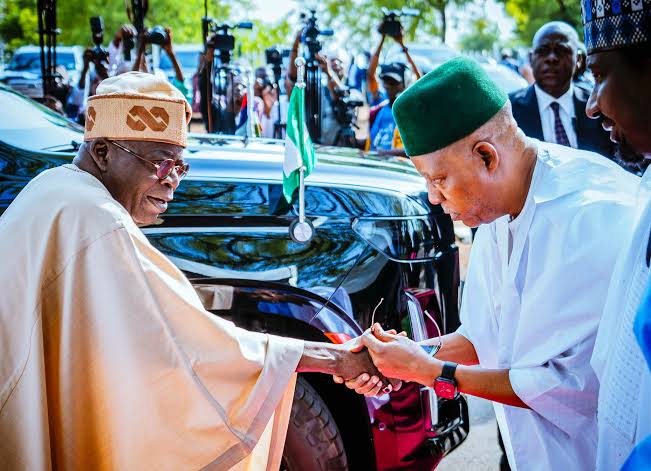
The decision by President Bola Tinubu to retain Vice President Kashim Shettima as his running mate for the 2027 presidential election has reignited debate over the All Progressives Congress’ Muslim-Muslim ticket.
Shettima’s confirmation for the 2027 presidential election has reopened debate over the APC’s Muslim-Muslim ticket, with political parties and stakeholders divided over whether religion or competence should shape leadership choices.
The APC’s decision ended months of speculation that Tinubu could replace Shettima with a Northern Christian, while reviving arguments that dominated the build-up to the 2023 election.
Although critics had argued that the same-faith ticket undermined Nigeria’s religious balance, Tinubu and Shettima won the presidency, and the ruling party has now opted to retain the combination for a second term.
While some opposition parties, including the All Progressives Grand Alliance and the Young Progressives Party, have downplayed concerns over the same-faith ticket, others have warned that religious balance remains an important factor in Nigeria’s politics.
The renewed debate followed the APC’s confirmation on Friday that Tinubu would contest the 2027 election with Shettima, a move that effectively ended months of speculation that the President could pick a Northern Christian as his running mate.
Ahead of the announcement, several names had been linked to the position, including the Minister of Defence, Gen Christopher Musa (retd.); the Catholic Bishop of Sokoto Diocese, Most Rev Hassan Kukah; and former Speaker of the House of Representatives, Yakubu Dogara.
The APC’s decision has revived arguments that dominated the 2023 election after Tinubu, a Muslim from the South-West, selected Shettima, also a Muslim from the North-East, as his running mate.
Critics had argued that the ticket broke with Nigeria’s tradition of balancing presidential tickets along religious lines to reflect the country’s diversity. However, Tinubu and Shettima went on to win the election, defeating candidates of the Peoples Democratic Party, Atiku Abubakar; the Labour Party, Peter Obi; and the New Nigeria Peoples Party, Rabiu Kwankwaso.
Reacting to the development, APGA said the focus of elections should be on leadership capacity rather than religion.
The party’s National Publicity Secretary, Ejimofor Opara, said Nigeria must move beyond identity politics and judge leaders by their performance.
“Competence should remain the defining issue in 2027, not whether candidates are Muslims or Christians,” he said.
The Young Progressives Party also argued that character, competence and integrity should outweigh religious or ethnic considerations in leadership selection.
Its spokesman, Wale Egbeola-Martins, said Nigeria’s major challenge had been poor leadership rather than the religious identities of those in power.
“The real challenge confronting our nation since the return to democratic rule has not been the ethnic or religious identity of those in power, but the persistent deficit of purposeful and accountable leadership,” he said.
The party said it would continue to support politics based on merit, service and national interest rather than religious or ethnic considerations.
APC defends retention
Meanwhile, the APC has defended its decision to retain Shettima, insisting that the choice was based on national interest and a careful assessment of political realities.
The party’s Director of Publicity, Bala Ibrahim, said the Muslim-Muslim ticket had not produced the religious tensions predicted by critics ahead of the 2023 election.
“The decision was reached after a careful assessment of the situation. The party is conscious of religious sensitivities but is also mindful of the broader interests of Nigerians,” he said.
Ibrahim dismissed fears that the ticket could fuel religious division, arguing that the administration had promoted interfaith harmony since assuming office.
The National Chairman of the Action Democratic Party, Yabagi Yusuf, and a leader of the Coalition of United Political Parties, Mark Adebayo, also argued that issues such as security, the economy and governance performance would dominate the 2027 campaign rather than religious identity.
Yusuf said the APC’s decision was largely influenced by electoral considerations, particularly the need to secure support across key voting blocs.
He argued that while religious considerations remain part of political discussions, parties ultimately consider the electoral strength and acceptability of their candidates when making strategic decisions.
Yusuf said the APC’s decision was driven by electoral calculations rather than religious considerations.
According to him, political parties are primarily concerned with assembling tickets capable of attracting the broadest electoral support.
“It’s politics. They must have done their calculations and concluded that this is their best chance of winning. In the end, elections are about where the votes are,” he said.
The immediate past National Publicity Secretary of the Coalition of United Political Parties, Mark Adebayo, also argued that the Muslim-Muslim ticket is unlikely to generate the level of controversy it did in 2023.
He said issues such as security, the economy and governance would dominate the 2027 campaign.
“I do not think the Muslim-Muslim ticket will generate the same level of traction in 2027 as it did in 2023. The next election will be driven more by security, the economy and the government’s performance,” Adebayo said.
The Ijaw Youths Council also dismissed religious identity as the basis for evaluating political leaders.
The President of IYC Worldwide, Jonathan Lokpobiri, said Nigerians should focus on competence and good governance rather than the faith of candidates.
“What we need is a competent, focused and compassionate leader who can take difficult decisions and improve the lives of Nigerians. Religion should not be the yardstick for leadership,” he said.
Groups oppose ticket
However, the Coalition of South East Youth Leaders criticised the APC’s decision, describing the retention of the Muslim-Muslim ticket as insensitive to Nigeria’s religious diversity.
Its President-General, Goodluck Ibem, said overlooking the opportunity to nominate a Northern Christian could deepen feelings of exclusion among many Nigerians.
“In a nation as religiously and culturally diverse as ours, leadership must not only be fair but must also be seen to be fair,” he said, urging the APC to embrace greater inclusiveness.
Similarly, the South-South Youths Initiative rejected Shettima’s renomination.
Its National President, Imeabe Oscar, argued that the APC’s decision was politically motivated and alleged that the party retained the Vice President largely for electoral advantage in Northern Nigeria.
‘Christians feel excluded’
The National President of the Middle Belt Forum, Dr Pogu Bitrus, criticised the APC’s decision, describing the retention of the Muslim-Muslim ticket as a slight on Christian Nigerians.
“To retain a Muslim-Muslim ticket after 2023 sends the wrong signal in a country as religiously diverse as Nigeria,” he said, urging the APC to reconsider its decision in the interest of national unity.
The Chairman of the Centre for Accountability and Open Leadership, Debo Adeniran, however, said fears expressed over the Muslim-Muslim ticket before the 2023 election had not materialised.
“The fears widely expressed in 2022 did not happen. The President and the Vice President have worked together, and that relationship appears to have remained stable,” he said.
Adeniran added that Shettima’s loyalty and working relationship with Tinubu may have influenced the President’s decision to retain him.
APC backs Shettima
Stakeholders of the APC in Abia State also defended the President’s decision.
The state chairman of the party, Chijioke Chukwu, said there was no justification for replacing Shettima, describing the President and Vice President as a team that had worked harmoniously since assuming office.
“It’s unreasonable to drop him (Shettima). Tinubu is a Muslim from the south and has been supporting Christians. Going for his second tenure, it is proper for the President to pick from the North. They have collaborated well without any problems between the Vice President and the President. There is no reason for a new VP. To us, this is a wonderful decision,” he said.
Similarly, Ohanaeze chieftain Justice Rowland Ajuzieogu said Tinubu was constitutionally entitled to choose his running mate, adding that Shettima had remained loyal throughout the administration.
“Tinubu looks at loyalty. Shetima is loyal.”
Industrialist and politician Sam Ohuabunwa also backed the decision, saying the Tinubu-Shettima ticket had already secured victory in 2023 and there was no compelling reason to alter it.
“Since Tinubu made the choice, heaven did not fall. He can do it again, and I believe that is the right thing to do.”
Afenifere faults decision
A faction of Afenifere led by Oba Olaitan Oladapo, however, faulted the renomination of Shettima.
Its National Publicity Secretary, Justice Faloye, said retaining another Muslim-Muslim ticket failed to reflect fairness, religious balance and inclusiveness in a multi-faith country.
Speaking on Tinubu’s choice of Shettima, Faloye said “President Tinubu has continued to show disregard for federal character and religious balance and fairness.
“Most important is that we can expect more of the same if he chooses to coronate himself in 2027. May God save Nigeria sociopolitically and economically from this regime.”
punch.ng
FOLLOW US ON: