Connect with us

Lifestyle

Couples May Fight, But Do Not Transfer Your Anger to Your Children

Published

on

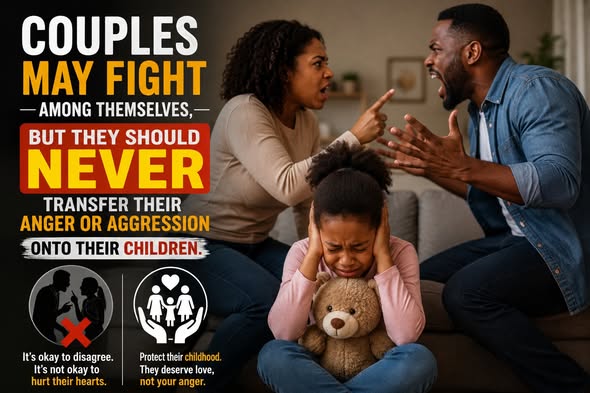
Every marriage will face disagreements. Couples may argue, misunderstand each other, or become angry, but children should never become the target of that anger or aggression. A disagreement between husband and wife should not become emotional punishment for the children.

The Bible teaches us to control our anger and to be careful about the way we treat others:

“Let not the sun go down upon your wrath.”
— Ephesians 4:26 (KJV)

When parents allow anger to control their words and actions, children can carry the emotional wounds long after the argument is over. Instead of using children as messengers, taking out frustration on them, or making them choose sides, parents should strive to resolve their disagreements with wisdom, patience, and love.

The Bible says:

“A soft answer turneth away wrath: but grievous words stir up anger.”
— Proverbs 15:1 (KJV)

Parents should remember that children are not responsible for marital problems. They need reassurance, stability, discipline, and love from both parents. Even when husband and wife disagree, they should work to create a peaceful environment for their children.

Scripture also teaches:

“And be ye kind one to another, tenderhearted, forgiving one another, even as God for Christ’s sake hath forgiven you.”
— Ephesians 4:32 (KJV)

And to parents, the Bible gives this important warning:

“And, ye fathers, provoke not your children to wrath: but bring them up in the nurture and admonition of the Lord.”
— Ephesians 6:4 (KJV)

A marriage may have disagreements, but children should not have to suffer for them. Learn to separate marital conflict from parenting. Correct your children when necessary, but do not punish them because you are angry with your spouse.

See also  Bukunmi Oluwashina: A Rising Star in Nigerian Film and Music

Fight the problem, not the child. Control your anger, protect their hearts, and let your home be a place where love, forgiveness, and peace can grow.

FOLLOW US ON:

FACEBOOK

TWITTER

PINTEREST

TIKTOK

YOUTUBE

LINKEDIN

INSTAGRAM

Continue Reading
Click to comment

Leave a Reply

Your email address will not be published. Required fields are marked *

Lifestyle

STOP BLEACHING AFRICA OUT OF YOUR SKIN.

Published

on

Let’s say the uncomfortable truth:

When an African looks at their natural Black skin and thinks, “I need to become lighter to be beautiful,” something deeper than beauty may be happening.

Who convinced us that the closer we look to Europeans, the more beautiful we become?

Who convinced the African that dark skin is something to escape?

For centuries, Africans have been exposed to systems that associated whiteness with power, privilege, sophistication and beauty. Even after colonialism ended politically, some of those beauty standards remained deeply embedded in society.

And today, some people are spending money putting chemicals on their skin because they desperately want to become lighter.

Imagine being born with millions of years of African ancestry written into your skin—and being taught to hate it.

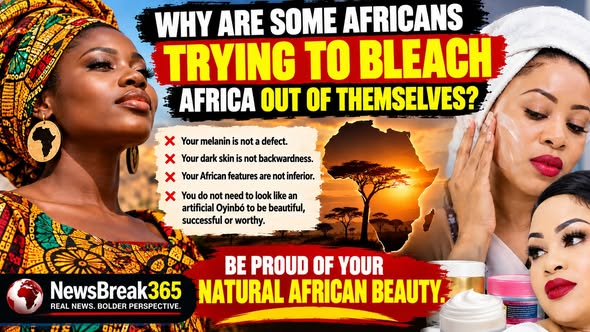
Your melanin is not a defect.

Your dark complexion is not backwardness.

Your African nose is not a mistake.

Your African lips are not something to hide.

Your natural appearance does not need to resemble an Oyìnbó before it becomes beautiful.

There is nothing wrong with wanting to look attractive. But beauty becomes dangerous when improving your appearance turns into rejecting your identity.

Africa does not need a population trying to look less African.

Africa needs people confident enough to look in the mirror and say:

“This is my skin. This is my ancestry. This is Africa. And I am not ashamed of it.”

The real bleaching Africa needs is not skin bleaching.

It is the bleaching of the inferiority complex from our minds.

See also  Ikoli Harcourt Whyte: The Father of Igbo Church Music (PHOTOS)

🔥 QUESTION:

If a society repeatedly tells Black people that lighter skin is more beautiful, how much of skin bleaching is really a “personal choice”?

Let the debate begin. 👇🏿

FOLLOW US ON:

FACEBOOK

TWITTER

PINTEREST

TIKTOK

YOUTUBE

LINKEDIN

INSTAGRAM

Continue Reading

Lifestyle

AFRICA, WHY ARE WE SO DESPERATE TO LOOK LIKE SOMEONE ELSE?

Published

on

For generations, African people have been told—directly and indirectly—that certain features are more beautiful because they look closer to European standards.

Now look around:

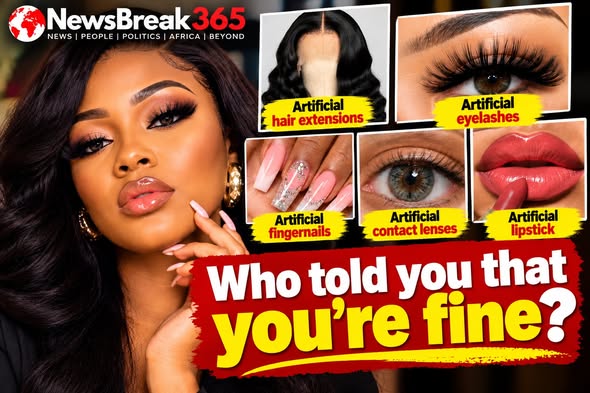
Wigs and hair extensions.
False eyelashes.
Acrylic nails.
Colored contact lenses.
Heavy makeup.
Skin bleaching.
Filters that completely change our faces.

When did African skin become something to escape from?

Our dark skin is not a defect.
Our natural hair is not a problem to be fixed.
Our African facial features are not inferior.
Our dark eyes do not need to become blue or green to be beautiful.

There is nothing wrong with dressing up, wearing makeup or experimenting with fashion. The problem begins when we start believing that our natural African appearance is somehow less valuable.

Africa has millions of unique cultures, languages, hairstyles, skin tones and facial features. We should not need European approval before we learn to appreciate ourselves.

You don’t have to become an artificial version of somebody else to be beautiful.

Our children are watching us. What are we teaching them about their skin, their hair and their identity?

🔥 Maybe the greatest beauty revolution in Africa is not creating another artificial look—it is learning to love the face, skin and hair we were born with.

Africa, embrace yourself. Stop apologising for your natural beauty.

💬 Is modern beauty culture empowering Africans—or making Africans insecure about their natural appearance?

#NewsBreak365 #Africa #AfricanBeauty #NaturalBeauty #BlackBeauty #SelfConfidence #BeautyStandards #AfricanIdentity

FOLLOW US ON:

FACEBOOK

TWITTER

PINTEREST

TIKTOK

YOUTUBE

LINKEDIN

INSTAGRAM

See also  Video of ark built by Ghanaian Pastor who is claiming God wants to destroy the earth with flood just like the days of Noah
Continue Reading

Lifestyle

STOP JUDGING PEOPLE YOU DON’T KNOW!

Published

on

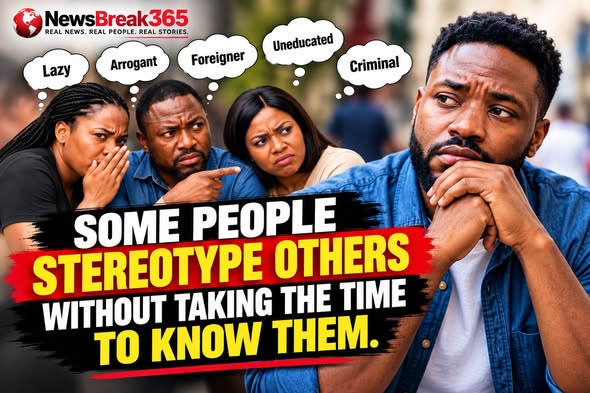
Some people see a person’s appearance, accent, nationality, religion, job, social class or background and immediately create a story about who that person must be.

They call someone lazy without knowing their struggles.

They call someone arrogant without understanding their personality.

They call someone uneducated without knowing their achievements.

They call someone a criminal simply because of where they come from.

That’s stereotyping—and it can be deeply unfair.

Behind every face is a story you may never have heard.

Before you judge someone, talk to them. Know their story. Understand their journey.

Because sometimes, the person you judged wrongly may be carrying battles, achievements and experiences you know absolutely nothing about.

👉 Don’t judge a book by its cover. Get to know the person first.

💬 Have you ever been stereotyped by someone who didn’t even know you? Tell us your experience in the comments.

#NewsBreak365 #StopStereotyping #DontJudge #KnowTheirStory #LifeLessons #SocialAwareness #RespectOthers #Humanity #ThinkBeforeYouJudge

FOLLOW US ON:

FACEBOOK

TWITTER

PINTEREST

TIKTOK

YOUTUBE

LINKEDIN

INSTAGRAM

See also  Pictures - Hilda Baci turns 30, reflects on milestones, gratitude
Continue Reading

Trending