Connect with us

Lifestyle

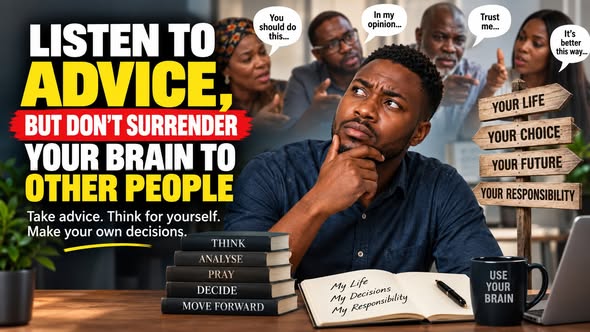
Listen to Advice, But Don’t Surrender Your Brain to Other People

Published

on

Advice can be valuable, but there is a dangerous point where listening to advice becomes surrendering your ability to think for yourself.

Life is full of people who will tell you what they believe you should do. Your friends may have an opinion. Your family may have an opinion. Your colleagues may have an opinion. Even strangers on social media may confidently tell you how to live your life.

But remember this: an opinion is not automatically wisdom.

You can listen to someone without agreeing with them. You can respect someone’s experience without allowing them to control your decisions. You can consider advice carefully while still making your own judgment.

The person giving you advice may not know the full story. They may not understand your circumstances, your struggles, your goals, or the consequences you will have to face.

That is why you should never switch off your brain simply because someone sounds confident.

Listen. Think. Question. Consider the consequences. Then decide.

Some people become so dependent on other people’s opinions that they are afraid to make a decision without getting permission from someone else. Eventually, they stop trusting their own judgment.

That is not wisdom. That is dependence.

At the same time, refusing every piece of advice is not intelligence either. Nobody knows everything. Sometimes another person’s experience can help you avoid a mistake you would otherwise make.

The goal is not to reject advice. The goal is to develop enough wisdom to know which advice deserves your attention and which advice should be ignored.

See also  PHOTOS: Nigerian Foundation Offers Free IVF, Celebrity Endorsement to Tackle Infertility.

Your life is ultimately your responsibility.

People can advise you, but they may not be there when the consequences arrive. They can influence your decision, but you may be the one who has to live with the outcome.

So listen to advice—but don’t surrender your brain.

Think for yourself. Make informed decisions. Take responsibility for your choices.

Because having people around you who give advice is a blessing, but having the ability to think critically for yourself is priceless.

FOLLOW US ON:

FACEBOOK

TWITTER

PINTEREST

TIKTOK

YOUTUBE

LINKEDIN

INSTAGRAM

Continue Reading
Click to comment

Leave a Reply

Your email address will not be published. Required fields are marked *

Lifestyle

Africa Is Sitting on Trillions in Wealth—So Why Are Millions of Africans Still Poor?

Published

on

Africa is not a continent without wealth. Africa is a continent struggling to turn its wealth into prosperity.

Gold. Diamonds. Oil. Gas. Copper. Cobalt. Lithium. Uranium. Vast agricultural land. Forests. Fisheries. And, perhaps most importantly, a huge population of young and talented people.

Yet millions of Africans continue to struggle with poverty, unemployment, poor infrastructure, inadequate healthcare, unreliable electricity and limited opportunities.

So what exactly is going wrong?

This is the question many Africans would rather debate than ignore.

How Can a Rich Continent Remain Poor?

For decades, Africa’s poverty has been blamed on colonialism, foreign exploitation and unfair international economic systems.

There is certainly a historical argument to be made.

But here is the uncomfortable part:

Colonialism cannot be the explanation for every problem Africa faces today.

African governments have had decades of independence to build stronger institutions, develop industries, improve education and create economies that benefit ordinary citizens.

So why hasn’t this happened on a larger scale?

Who Is Taking Africa’s Wealth?

Imagine a country exporting enormous quantities of valuable minerals while importing finished products made from those same resources.

The raw materials leave the country.

The processing happens elsewhere.

The high-value products come back.

And ordinary citizens are left asking:

Where is the wealth?

This is one of Africa’s biggest economic challenges.

Instead of simply exporting raw materials, African countries need to build industries capable of processing their own resources and creating millions of skilled jobs.

Africa should not only be a place where the world’s resources are extracted.

See also  Efunsetan Aniwura: Yoruba's Most Powerful Woman That Ever Lived (PHOTOS)

Africa should also be a place where those resources are transformed into wealth.

But Let’s Talk About African Leadership

It is easy to blame foreign countries.

It is also easy to blame multinational corporations.

But African leaders must answer difficult questions too.

Why do some resource-rich countries still struggle with basic infrastructure?

Why do some governments remain heavily dependent on borrowing?

Why do young people leave their countries in search of better opportunities abroad?

Why are billions of dollars spent without ordinary citizens seeing enough improvement in their daily lives?

And why is accountability often so weak?

Natural resources do not automatically create prosperity. Good governance matters.

But Are Africans Completely Blameless?

This is where the conversation becomes even more uncomfortable.

Citizens elect leaders.

Citizens defend political parties.

Citizens sometimes tolerate corruption when it benefits their own families or communities.

Citizens sometimes demand accountability only when their preferred politician is not in power.

If we want better leadership, shouldn’t citizens also demand better governance consistently?

Perhaps Africa’s transformation requires more than replacing one politician with another.

Perhaps it requires changing the systems that allow poor governance to survive.

Africa’s Biggest Opportunity

Africa’s greatest opportunity may not be another oil discovery or another gold mine.

It may be African people themselves.

A young population with access to quality education, technology, capital and functioning institutions could transform the continent.

Imagine African minerals being processed locally.

Imagine African agricultural products becoming globally competitive brands.

Imagine African universities becoming major research centres.

Imagine reliable electricity powering factories and technology companies.

See also  VIDEO: Seyi Tinubu arrives Alaafin’s palace for installation as ‘Okanlomo of Yorubaland’

Imagine millions of young Africans building businesses instead of desperately searching for opportunities abroad.

That is the Africa many people want to see.

Africa Doesn’t Need Pity—It Needs Transformation

The world often talks about helping Africa.

But Africa should also be asking a more uncomfortable question:

How can Africa build the capacity to help itself?

Foreign investment can help.

International partnerships can help.

Trade can help.

But sustainable development ultimately requires strong African institutions, responsible leadership, productive industries, quality education, innovation and accountable governance.

Africa cannot remain permanently trapped between enormous natural wealth and widespread poverty.

At some point, the wealth underground must become prosperity above ground.

The Question Everyone Should Be Debating

Africa has the resources.

Africa has the people.

Africa has the land.

Africa has enormous potential.

So what is holding Africa back?

Is it:

1. Poor leadership?
2. Corruption?
3. Foreign exploitation?
4. Colonial history?
5. Weak institutions?
6. Lack of industrialisation?
7. Or a combination of all of them?

Perhaps the answer is uncomfortable because there may be enough blame to go around.

But one thing should be beyond debate:

Africa is blessed with abundant resources, yet it continues to suffer in the midst of plenty.

The question is no longer whether Africa is rich in resources.

The real question is: WHO IS BENEFITING FROM AFRICA’S WEALTH?

And perhaps the even bigger question is:

WHEN WILL AFRICANS BEGIN TO SEE MORE OF THAT WEALTH IN THEIR EVERYDAY LIVES?

What is your honest opinion? Who is most responsible for Africa’s continued poverty despite its enormous wealth?

See also  Akinwumi Isola: Professor who stood for the Yoruba people, his last words

Leave your answer in the comments—and don’t just name someone. Explain why.

FOLLOW US ON:

FACEBOOK

TWITTER

PINTEREST

TIKTOK

YOUTUBE

LINKEDIN

INSTAGRAM

Continue Reading

Lifestyle

Your Life Is Not a Committee Meeting: Learn to Think for Yourself

Published

on

There comes a point in life when you must stop allowing everyone around you to participate in every decision you make.

Your life is not a committee meeting.

You can listen to advice. You can seek opinions. You can learn from people who have more experience than you. But ultimately, you are responsible for the decisions you make and the consequences that follow.

Advice Is Valuable, But It Is Not a Command

Seeking advice is not a sign of weakness. In fact, wise people often seek counsel before making important decisions.

The problem begins when you become so dependent on other people’s opinions that you can no longer make decisions for yourself.

You ask your friends what career to choose.
You ask your family who you should marry.
You ask people what business you should start.
You ask everyone whether you should move, change jobs, leave a relationship, or pursue a new opportunity.

Before long, you have heard so many different opinions that you no longer know what you actually want.

Advice should help you think better, not prevent you from thinking.

Not Everyone Understands Your Situation

One of the biggest mistakes people make is assuming that everyone giving them advice understands their circumstances.

They don’t.

People see your life from the outside. They may know parts of your story, but they don’t necessarily know your struggles, ambitions, responsibilities, fears, or long-term plans.

Someone may tell you to give up because they would have given up.

Someone may tell you that something is impossible because they never succeeded at it.

See also  I was once homeless in US — Nigerian-American politician

Someone may discourage you because they are afraid of taking the same risk.

That doesn’t automatically mean their advice is wrong. It simply means you should evaluate advice instead of blindly accepting it.

You Must Live With the Consequences

This is where personal responsibility becomes important.

When you make a major decision because everybody told you to do it, those people may not be there when you face the consequences.

If the business fails, you deal with the loss.

If the relationship fails, you experience the pain.

If you choose the wrong career, you live with the frustration.

If you abandon your dream because people discouraged you, you may spend years wondering what could have happened if you had tried.

People can give you opinions, but you are the one who has to live with the outcome.

Learn to Think Independently

Thinking independently does not mean ignoring everybody.

It means listening carefully, asking questions, examining the facts, considering the consequences, and then making your own informed decision.

There is a difference between wisdom and dependence.

A wise person can listen to advice without becoming controlled by it.

A dependent person needs everybody’s approval before taking action.

You don’t need 20 people to agree before you can move forward with your life.

Sometimes, you simply need enough wisdom and courage to make the decision yourself.

Your Life Belongs to You

Your family may have expectations for you.

Your friends may have opinions about you.

Society may have a picture of what your life should look like.

See also  ALI MUST GO! Nigeria Students Protest, 1978 (PHOTOS)

But at the end of the day, you are the person who has to live your life.

Don’t spend your entire life trying to satisfy everybody while becoming unhappy with yourself.

Listen to people. Learn from people. Respect good advice.

But don’t surrender your ability to think.

Your life is not a committee meeting.

You don’t need everybody’s permission to become the person you were meant to become.

The goal is not to make everyone agree with your decisions.

The goal is to make responsible, informed decisions that you can stand behind.

Final Thought

Before accepting someone’s advice, ask yourself:

Do they understand my situation?

Do they have experience in what they are advising me about?

Are they genuinely trying to help me?

Have I considered the consequences for myself?

And most importantly:

What do I actually believe is the right decision?

Listen to advice—but keep your brain.

Because when everybody gets a vote in your life, you may eventually discover that you are living a life designed by everyone except yourself.

FOLLOW US ON:

FACEBOOK

TWITTER

PINTEREST

TIKTOK

YOUTUBE

LINKEDIN

INSTAGRAM

Continue Reading

Lifestyle

Are You Living Your Own Life—or Someone Else’s?

Published

on

One of the clearest signs of maturity is the ability to think for yourself.

Too many people make major life decisions based on what their parents want, what friends recommend, what society expects, or what people might say. They choose a career because someone told them it was best. They marry because family pressured them. They stay in situations they hate because they are afraid of criticism.

But here is the uncomfortable question:

If other people are making most of your important decisions, whose life are you actually living?

Listening to advice is not weakness. In fact, wise people listen. But there is a difference between considering someone’s opinion and surrendering your judgment to them.

People can advise you, but they will not necessarily live with the consequences of your decision.

When things go wrong, those who pressured you may not be there to carry the burden. You will.

That is why maturity requires more than simply following instructions. It requires the courage to gather information, consider different opinions, think critically, make your own decision, and accept responsibility for the outcome.

Your life is not a committee meeting.

You don’t need everyone’s approval before you make every decision.

Sometimes you have to respectfully say, “I appreciate your advice, but I have decided what is best for my life.”

Of course, this does not mean ignoring everyone or believing you are always right. Nobody knows everything. Good advice can save you from painful mistakes.

The real question is:

Are you listening to advice—or are you allowing other people’s opinions to control your life?

See also  I was once homeless in US — Nigerian-American politician

Let’s Debate

Do you believe a mature person should make their own decisions, even when family and friends strongly disagree?

Or should we always follow the advice of those who have more experience?

Tell us what you think in the comments.

FOLLOW US ON:

FACEBOOK

TWITTER

PINTEREST

TIKTOK

YOUTUBE

LINKEDIN

INSTAGRAM
Continue Reading

Trending