Connect with us

Lifestyle

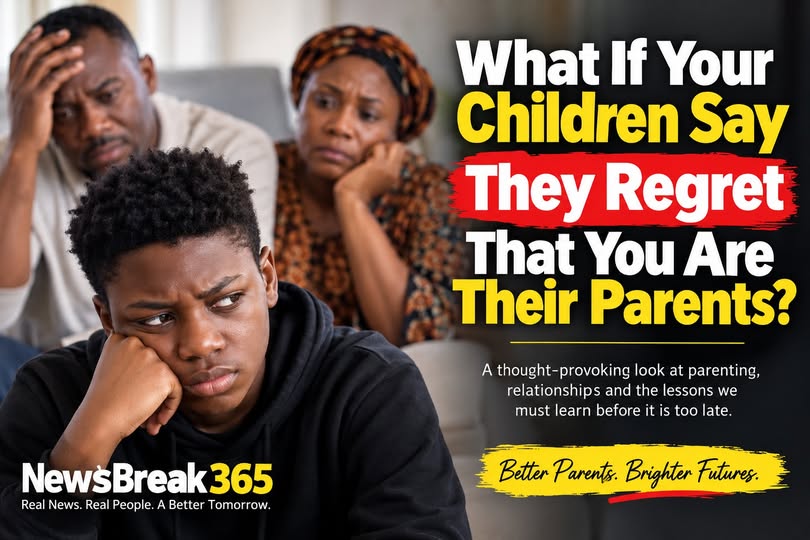
What If Your Children Say They Regret That You Are Their Parents?

Published

on

Imagine hearing your own child say, “I wish you were not my parent.”

That sentence can break a parent in ways that money cannot repair.

But before you become angry with the child, ask yourself a painful question: What did the child experience while growing up that made them feel this way?

Parenthood is not simply about giving birth to a child, paying school fees, providing food, or putting a roof over their head. Those things matter, but children also remember how they were treated.

They remember the words you used when they made mistakes.

They remember whether you listened to them or dismissed everything they said.

They remember whether home felt like a place of safety or a place where they were constantly afraid.

They remember whether you encouraged them to become themselves or forced them to become the person you wanted.

Providing for a child is not the same as raising a child

Some parents believe that because they sacrificed financially for their children, the children have no right to complain.

But raising a child involves more than financial responsibility.

A child may have everything materially and still feel emotionally abandoned.

A child may attend the best school and still feel unloved.

A child may have food on the table but never feel heard.

And sometimes, parents who believe they are being “strict” may not realise that their children experience that strictness as rejection, humiliation or fear.

But children also have responsibilities

This conversation should not become an excuse for children to disrespect their parents.

See also  K1 De Ultimate apologises over airport row, denies alcohol claim

Parents are human beings. They make mistakes. They can be tired, frustrated, financially pressured or emotionally wounded themselves.

Not every disagreement means a parent failed.

Not every punishment means abuse.

And not every child who says, “I regret having you as my parents,” is necessarily telling the whole story.

Children can misunderstand their parents. They can also make unfair judgments, especially when they are young.

That is why communication matters.

What kind of parent will your children remember?

One day, your children will become adults.

They may move away.

They may build their own families.

They may become successful.

And eventually, they will look back at their childhood.

The question is not only:

“Did I provide for my children?”

The deeper question is:

“How did my children feel when they were around me?”

Did they feel respected?

Did they feel safe?

Did they know they could talk to you?

Did you apologise when you were wrong?

Did you celebrate their achievements?

Did you allow them to have dreams different from yours?

Did you teach them discipline without destroying their confidence?

These questions can be uncomfortable, but good parenting requires uncomfortable self-examination.

Your children are not your property

Giving birth to a child does not give a parent unlimited ownership over that child’s life.

Children are individuals with their own personalities, talents, fears and ambitions.

Your responsibility is to guide them—not to control every aspect of who they become.

You may want your child to become a doctor, while the child dreams of becoming an artist.

See also  LASG reacts over Tiktoker Peller’s N36m tax demand claim

You may want them to live exactly as you did, while they want to create a different future.

Parenting requires wisdom to know when to guide, when to correct and when to let go.

Before it is too late

If your relationship with your children is already damaged, don’t wait for them to become adults before trying to repair it.

Talk to them.

Listen without immediately becoming defensive.

Ask them what hurts them.

And when you discover that you were wrong, apologise.

An apology does not make a parent weak.

Sometimes, the words “I was wrong” can heal years of emotional distance.

The goal of parenting should not be to make children afraid of you.

It should be to raise adults who can look back and say:

“My parents were not perfect, but they loved me, listened to me, corrected me and gave me the foundation to become who I am.”

Because one day, when your children are old enough to tell their own story, what will they say about you?

Will they remember you as the parent who gave them everything except peace—or the parent who gave them both provision and love?

FOLLOW US ON:

FACEBOOK

TWITTER

PINTEREST

TIKTOK

YOUTUBE

LINKEDIN

INSTAGRAM

Continue Reading
Click to comment

Leave a Reply

Your email address will not be published. Required fields are marked *

Lifestyle

When Love Becomes Emotional Blackmail: How to Recognise the Difference

Published

on

“If you really loved me, you would do it.”

It sounds like an emotional statement, but sometimes a sentence like this can be more than an expression of hurt—it can be a way of putting pressure on someone to do something against their wishes.

Emotional blackmail occurs when a person uses guilt, fear, threats, punishment, or emotional pressure to influence another person’s decisions.

It can happen in romantic relationships, friendships, families, workplaces, and even between parents and children.

When Does Emotional Pressure Become Manipulation?

Everyone expresses disappointment. Everyone can feel hurt when someone says no.

The difference is in how those emotions are used.

Statements such as:

“After everything I have done for you, this is how you repay me?”
“If you really loved me, you would do this.”
“Fine, do whatever you want. Now I know where I stand.”
“You will regret it if you refuse.”
“Do it, or I will never forgive you.”

can place someone under significant emotional pressure.

A person may eventually agree—not because they genuinely want to, but because they feel guilty, frightened, or responsible for the other person’s emotions.

Love Does Not Mean Giving Up Your Right to Say No

Healthy relationships involve compromise, but compromise should not require manipulation.

You can love someone and still disagree with them.

You can appreciate everything someone has done for you and still refuse a request.

You can care deeply about a partner, friend, parent, or family member while maintaining personal boundaries.

Saying “no” does not automatically mean that you do not love someone.

See also  LASG reacts over Tiktoker Peller’s N36m tax demand claim

Likewise, someone being disappointed by your decision does not automatically mean they are emotionally blackmailing you.

Context matters.

Why Emotional Blackmail Can Be Difficult to Recognise

Emotional blackmail does not always look aggressive.

Sometimes it appears as crying, withdrawal, silence, repeated reminders of past sacrifices, threats to end a relationship, or making someone feel responsible for another person’s happiness.

That is why it can be difficult to recognise.

A useful question to ask yourself is:

“Am I changing my decision because I genuinely changed my mind, or because I am afraid of what will happen if I say no?”

The answer may reveal whether you are making a free choice or responding to emotional pressure.

Boundaries Are Not Disrespect

Setting a boundary does not necessarily mean rejecting someone.

A person can say:

“I understand that you are hurt, but I am still not comfortable doing this.”

That response acknowledges the other person’s feelings without surrendering personal choice.

Healthy communication allows people to express disappointment without using guilt, threats, fear, or punishment to force an outcome.

Love, Sacrifice and Control

Relationships often require sacrifice. Parents sacrifice for their children. Partners make compromises. Friends support each other.

But sacrifice should not automatically become a tool for control.

“I did this for you, so you must do this for me” can turn kindness into a transaction.

The important question is not simply whether someone has sacrificed for you. It is whether that sacrifice is now being used to control your decisions.

The Bigger Question

Emotional blackmail is not always obvious, and not every emotional statement is manipulation.

See also  The Majekodunmi Family of Abeokuta: A Legacy of Heritage and Leadership

Sometimes people simply express their pain badly. Other times, repeated guilt, threats, fear, or punishment may be deliberately used to control another person’s choices.

The difference deserves honest conversation.

So, what do you think?

When someone says:

“If you really loved me, you would do it.”

Is it simply an expression of hurt—or can it become emotional blackmail?

Share your opinion in the comments.

FOLLOW US ON:

FACEBOOK

TWITTER

PINTEREST

TIKTOK

YOUTUBE

LINKEDIN

INSTAGRAM

Continue Reading

Lifestyle

Nollywood Actress, Jumoke Odetola Turns Minister Of God

Published

on

Nollywood actress, Jumoke Odetola, has announced that she has dumped acting for ministerial work.

It was reports that Jumoke made the announcement while addressing fans’ concerns about her disappearance from the screen.

In a post via her Instagram page on Saturday, the movie star said she is now a minister of God.

While asking the public for prayers, Jumoke Odetola said God had compelled her to work for Him.

She said, “I’m now a minister of God. I am entering a new season with God. I need all the prayers in this season.

“When God compels you, you may delay, but you cannot escape the call.”

FOLLOW US ON:

FACEBOOK

TWITTER

PINTEREST

TIKTOK

YOUTUBE

LINKEDIN

INSTAGRAM


See also  SHOULD A HUSBAND PAY FOR EVERYTHING IN THE FAMILY?
Continue Reading

Lifestyle

ARE SOME PARENTS CHOOSING MONEY OVER THEIR OWN CHILDREN?

Published

on

Some parents spend years chasing money, building businesses and accumulating wealth—all in the name of “giving their children a better life.”

But here is the uncomfortable question:

What if your child has everything money can buy, but doesn’t have YOU?

A child needs more than school fees, expensive clothes, gadgets and a comfortable home.

They need your time.
They need your attention.
They need your affection.
They need to know that they are loved, heard and valued.

💰 Money can be earned again.

❤️ But once a child’s trust is broken, rebuilding it may not be easy.

🕰️ And once childhood is gone, you can never buy it back.

Don’t become so busy providing for your children that you forget to actually be present in their lives.

Because one day, your child may remember the money you provided—but they may remember even more clearly the moments you were never there.

🔥 QUESTION:

Do you believe some parents are sacrificing too much family time in the pursuit of money?

Tell us what you think in the comments.

#Newsbreak365 #Parenting #Children #Family #Parenthood #LifeLessons #FamilyValues #Money #Childhood #Relationships

FOLLOW US ON:

FACEBOOK

TWITTER

PINTEREST

TIKTOK

YOUTUBE

LINKEDIN

INSTAGRAM

See also  The History of Pounded Yam in Ekiti State: A Cultural Heritage Beyond Food
Continue Reading

Trending