Connect with us

Lifestyle

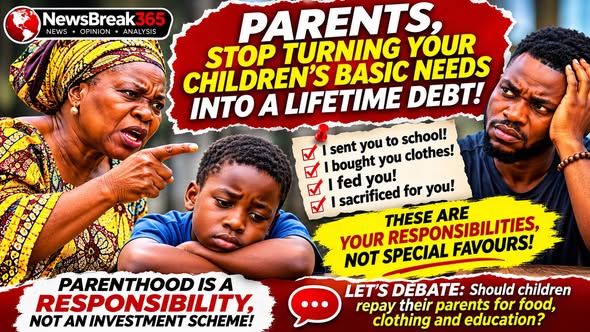
PARENTS, STOP USING YOUR CHILDREN’S BASIC NEEDS AS A LIFETIME DEBT: PARENTHOOD IS A RESPONSIBILITY, NOT AN INVESTMENT SCHEME

Published

on

Providing food, clothing, education and shelter for your children is part of being a parent. So why do some parents behave as though their children must spend the rest of their lives repaying them?**

There is a conversation many families avoid, particularly in African households, because challenging certain parenting traditions is often interpreted as disrespect.

But it is a conversation that needs to happen.

How many times have you heard a parent say:

“I sent you to school!”

“I bought you clothes!”

“I fed you when you had nothing!”

“I sacrificed everything to give you a better life!”

“I suffered because of you!”

While these sacrifices may be genuine, there is one important question parents must answer: **Are you reminding your children of your sacrifices because you want them to appreciate you, or because you want to control them with guilt?**

## CHILDREN DID NOT ASK TO BE BORN!

Let’s be honest. Children do not choose to enter this world. Their parents make that decision.

When parents decide to have children, they accept the responsibility of providing for them, protecting them, educating them and preparing them for adulthood.

Sending a child to school is not a special favour. Providing food is not an extraordinary achievement. Buying clothes and providing shelter are not services that should automatically become lifelong debts.

These are fundamental responsibilities of parenthood.

Unfortunately, some parents turn these responsibilities into emotional weapons, reminding their children of everything they have ever spent on them whenever disagreements arise.

A child makes an independent decision, and suddenly the old accounts are reopened.

See also  When the Love of Money Tears Families Apart

A child disagrees with a parent’s opinion, and the familiar statements begin:

“After everything I have done for you, this is how you repay me?”

But when did raising children become a financial transaction?

## PARENTAL SACRIFICES SHOULD NOT BECOME EMOTIONAL BLACKMAIL

There is absolutely nothing wrong with parents expecting appreciation, respect, love and support from their children.

Parents make enormous sacrifices. Some work multiple jobs, go without food, abandon personal ambitions and endure difficult circumstances to give their children opportunities they never had.

Those sacrifices deserve recognition.

However, there is a difference between teaching children gratitude and making them feel permanently indebted.

Gratitude should come from genuine appreciation, not fear, manipulation or constant reminders of childhood expenses.

A child should not have to surrender personal happiness, independence, dreams or opinions simply because a parent once paid school fees.

Respect should never mean that children must agree with everything their parents say.

And parental love should not be measured by how much financial control a parent can maintain over an adult child.

## SOME PARENTS WANT GRATITUDE, OTHERS WANT CONTROL

This is where the discussion becomes uncomfortable.

Some parents genuinely want their children to succeed, become responsible adults and build better lives.

Others struggle when their children become independent.

They want to remain the final authority over their children’s decisions, relationships, careers, marriages and personal lives.

Whenever those children attempt to establish boundaries, the sacrifices of the past become ammunition.

But parenting is supposed to prepare children for independence, not create lifelong dependence.

If your children cannot make decisions without feeling guilty about everything you spent raising them, perhaps it is time to reconsider what you have taught them about love, responsibility and family.

See also  First female Archbishop of Canterbury to meet Pope Leo in Rome

## CHILDREN ALSO HAVE RESPONSIBILITIES!

To be fair, this conversation must not become an excuse for ungrateful children.

Children should appreciate their parents. They should respect their sacrifices, acknowledge their struggles and support them when they genuinely need help and when they are able to do so.

Growing older does not give anyone permission to become arrogant, disrespectful or abandon parents who stood by them.

But appreciation must not be confused with lifelong financial obligation.

Parents have responsibilities towards their children, and adult children have moral responsibilities towards their parents.

Both can be true without turning family relationships into debt-collection exercises.

## THE BIG QUESTION: ARE YOU RAISING CHILDREN OR CREATING DEBTORS?

Perhaps the greatest achievement of parenting is not how much money you spend on your children, but how well you prepare them to become independent, responsible and compassionate adults.

Do not raise children to believe that every meal, school fee, birthday gift or piece of clothing must eventually be repaid with unquestioning obedience.

Raise them to understand gratitude without sacrificing their freedom.

Raise them to respect you because of the love, wisdom and values you demonstrated, not because you repeatedly remind them of what you spent.

**Parenthood is a responsibility, not an investment scheme. Children are not financial projects, and love should never come with an invoice.**

—

### NEWSBREAK365 DEBATE: LET’S HEAR YOUR SIDE!

We want to hear from both parents and adult children.

1. Should parents expect their children to repay them financially for the money spent raising them?
2. Is constantly reminding children about school fees, food and clothing a form of emotional blackmail?
3. Do children owe their parents lifelong obedience because their parents sacrificed everything for them?
4. Should parents expect financial support from their adult children, even when those children have their own families and responsibilities?

See also  Major General Henry Edmund Olufemi Adefope: The Soldier, Diplomat, Physician and Sports Statesman Who Shaped Modern Nigeria

**PARENTS AND CHILDREN, THIS CONVERSATION IS FOR YOU!**

Who is right, and who is wrong?

Share your honest opinion in the comment section. Respectful disagreement is welcome.

*Newsbreak365 — Bringing uncomfortable conversations to the forefront.*

FOLLOW US ON:

FACEBOOK

WHATSAPP CHANNEL

TWITTER

PINTEREST

TIKTOK

YOUTUBE

LINKEDIN

INSTAGRAM

Continue Reading
Click to comment

Leave a Reply

Your email address will not be published. Required fields are marked *

Lifestyle

YOUR CHILDREN ARE NOT YOUR RETIREMENT PLANS, PERSONAL SERVANTS OR EMOTIONAL SLAVES: THE TOXIC SIDE OF PARENTING WE MUST TALK ABOUT

Published

on

Some parents are not raising children to become independent adults. They are raising future financial sponsors, unpaid domestic workers and lifelong emotional prisoners. And perhaps it is time someone said it out loud.**

There is an uncomfortable conversation many families, particularly in African societies, would rather avoid: the growing expectation that having children automatically gives parents lifelong ownership over their children’s money, time, decisions and personal happiness.

For some parents, bringing a child into this world comes with an invisible contract. The child must grow up, become successful, provide financial support, build a house for the parents, pay their bills, obey their instructions and sacrifice personal ambitions whenever the family demands it.

But who signed this contract?

Did the child agree to become a retirement investment before being born?

Did they choose to enter this world with an obligation to spend their entire adult lives repaying someone for giving them life?

These questions may sound disrespectful to some people, but they deserve serious consideration.

## PARENTING IS NOT A RETIREMENT INVESTMENT SCHEME

One of the most deeply rooted expectations in many African families is that children must become their parents’ retirement plans.

There is nothing wrong with supporting ageing parents. In fact, caring for parents who sacrificed to raise their children is a beautiful expression of gratitude, compassion and family responsibility.

However, there is a significant difference between supporting your parents out of love and being financially manipulated through guilt.

Some parents believe that once their children start earning money, their salaries automatically become family property.

The child cannot save independently, invest in a business, buy a house, travel or pursue personal dreams without being accused of selfishness.

Every financial boundary becomes disrespect. Every refusal becomes ingratitude.

See also  Tolani Quadri Oyebamiji “Sisi Quadri”: Life and Legacy of a Yoruba Comic Actor

**Is raising children supposed to be an investment that guarantees financial returns, or a responsibility to prepare another human being for life?**

## YOUR CHILDREN ARE NOT YOUR PERSONAL SERVANTS

Another disturbing expectation is the belief that children must remain permanent domestic servants in their parents’ homes, regardless of their age, responsibilities or circumstances.

Some parents expect adult children to perform every household responsibility simply because they are living under their roof.

Respecting parents and contributing to household responsibilities are important values. But respect should never become an excuse for exploitation.

Children deserve to learn responsibility, but they also deserve dignity.

Being a parent does not give anyone the right to treat another adult as a personal servant.

## STOP USING YOUR SACRIFICES AS EMOTIONAL WEAPONS

Perhaps one of the most damaging forms of parenting is emotional blackmail.

Some parents never allow their children to forget the sacrifices they made.

Every argument becomes an opportunity to remind the child about school fees, food, clothing, medical bills and everything else they provided.

Statements such as:

– “After everything I suffered to raise you?”
– “You will understand when I am dead.”
– “I sacrificed my entire life for you.”
– “If you truly love me, you will do what I ask.”
– “You have forgotten who paid your school fees.”

These statements can turn parental love into a lifelong burden of guilt.

Of course, parents make enormous sacrifices. Raising children requires money, patience, sleepless nights and personal compromises.

But children should not spend the rest of their lives feeling guilty for receiving the care and protection that responsible parenting requires.

**Your sacrifices deserve appreciation, but they do not give you unlimited ownership over your children’s lives.**

See also  Toyin Abraham denies payment claims amid rift with protégé, Abike Shugaa

## WHY DO SOME PARENTS FEAR THEIR CHILDREN’S INDEPENDENCE?

Here is another uncomfortable question.

Why do some parents become angry when their children establish boundaries?

Why does a child pursuing a different career, choosing a different lifestyle or making independent decisions suddenly become labelled disrespectful?

Why must success mean becoming financially available to everyone except yourself?

Some parents want their children to become wealthy, but they struggle to accept that wealth gives those children the freedom to make independent decisions.

They want successful children, but not independent ones.

They want financially comfortable children, but only if those children remain available to satisfy every family demand.

That is not healthy parenting. It is control disguised as family responsibility.

## CHILDREN ALSO HAVE LIVES TO LIVE

Children grow up. They become adults. They establish relationships, build careers, raise their own families and pursue ambitions.

They have responsibilities beyond their parents.

A married son has a responsibility to his wife and children. A daughter also deserves the freedom to build her own future without being constantly pressured to surrender her happiness.

Supporting parents should not mean destroying one’s marriage, financial stability, mental peace or future.

Family responsibility must be balanced with personal responsibility.

Parents should also understand that their children are not responsible for fulfilling every dream they were unable to achieve.

You cannot demand that your children abandon their own future simply because you sacrificed yours.

## THE KIND OF PARENTING THE NEXT GENERATION NEEDS

Good parenting should produce responsible, independent, compassionate and emotionally healthy adults.

Teach your children to respect their elders. Teach them to appreciate sacrifice. Teach them the importance of family support.

But also teach them how to establish boundaries, manage money, make decisions and build independent lives.

See also  TikToker Jarvis confirms breakup with Peller, urges public support

Raise children who will willingly stand beside you in difficult times, not children who feel trapped by the fear of being called ungrateful.

The ultimate success of parenting should not be measured by how much money children eventually give their parents.

It should also be measured by the kind of human beings they become.

**Children are a responsibility, not a retirement policy. They are human beings, not lifelong investments. And parental love should never become a lifetime debt collection exercise.**

—

## THE BIG QUESTION: ARE WE RAISING CHILDREN OR RECRUITING RETIREMENT SPONSORS?

This conversation may offend some parents, but avoiding it will not make the problem disappear.

Parents deserve respect, appreciation and support. Children deserve independence, dignity and the opportunity to live their own lives.

Both truths can exist together.

**Newsbreak365 wants to hear your opinion:**

1. Should children be expected to finance their parents’ retirement simply because their parents raised them?
2. Is it emotional blackmail when parents constantly remind children of the sacrifices they made?
3. Should adult children be allowed to refuse financial demands from their parents without being labelled ungrateful?
4. Is it wrong for parents to expect their children to sacrifice their marriages, ambitions and personal happiness for family obligations?
5. Should parents make their own retirement plans instead of depending entirely on their children?

**WHERE SHOULD PARENTAL RESPONSIBILITY END AND CHILDREN’S INDEPENDENCE BEGIN?**

Let’s have an honest conversation. Respectfully, but without pretending this issue does not exist.

*Newsbreak365 — Challenging perspectives. Inspiring conversations.*

FOLLOW US ON:

FACEBOOK

WHATSAPP CHANNEL

TWITTER

PINTEREST

TIKTOK

YOUTUBE

LINKEDIN

INSTAGRAM

Continue Reading

Lifestyle

ARE YOU RAISING CHILDREN OR CREATING DEBTORS? WHEN PARENTAL SACRIFICE BECOMES A LIFETIME BILL

Published

on

Some parents raise their children with love, while others raise them with an invisible invoice. Every school fee, every meal, every piece of clothing and every sacrifice becomes a debt their children are expected to repay for the rest of their lives. But is that really what parenting should be?**

There is an uncomfortable conversation many families, particularly in African households, need to have: Are some parents genuinely raising children, or are they creating lifelong debtors who must spend their adulthood paying for the privilege of being born?

Across many homes, children grow up hearing statements such as:

“After everything I have done for you!”

“I suffered to send you to school.”

“I denied myself everything because of you.”

“When you become successful, remember who sacrificed for you.”

At first glance, these statements may sound like expressions of parental sacrifice. And certainly, raising children requires enormous financial, emotional and personal sacrifices.

But something becomes deeply troubling when these sacrifices are repeatedly used as weapons of guilt, control and emotional blackmail.

## WHEN PARENTING BECOMES A DEBT COLLECTION BUSINESS

Some parents never allow their children to forget the cost of raising them.

They remember every school fee, every hospital bill, every meal and every sacrifice. Unfortunately, they sometimes forget that providing these things was part of the responsibility they accepted when they decided to become parents.

The problem becomes worse when children grow older.

A child gets a job, starts earning money and begins building an independent life. Instead of celebrating that achievement, some parents immediately present an emotional invoice.

Suddenly, the child is expected to finance every family problem, solve every financial difficulty and fulfil every parental expectation.

See also  Desist From Doing Evil — Karma Is Real

Refusing a demand becomes disrespect.

Setting boundaries becomes arrogance.

Making independent decisions becomes betrayal.

And choosing a different future becomes evidence of ingratitude.

Is this love, or is it financial and emotional control disguised as parenting?

## YOUR CHILDREN DID NOT SIGN A CONTRACT BEFORE THEY WERE BORN

Here is a truth that some parents may find difficult to accept: Children never negotiated the terms and conditions of their birth.

They did not request school fees, food, clothing or accommodation. Their parents made the decision to bring them into the world and accepted the responsibility of raising them.

This does not mean children should disrespect their parents or ignore their sacrifices.

Far from it.

Children should appreciate their parents, support them when possible and recognise the difficulties their parents endured.

However, appreciation is different from permanent indebtedness.

A child should not have to surrender personal happiness, financial security, marriage, career opportunities or mental peace simply because a parent believes that raising a child creates an unlimited lifetime obligation.

**Parenting should produce responsible adults, not lifelong prisoners of parental expectations.**

## THE AFRICAN PARENTING CULTURE WE NEED TO QUESTION

In many African families, respect for parents is deeply rooted in culture and tradition.

Children are taught to honour their parents, care for them in old age and support their families when they become financially stable.

These values can be beautiful.

But what happens when respect becomes unquestionable obedience? What happens when parental authority is used to control the adult lives of children?

Some parents want their children to become successful, but only on their own terms.

See also  Nigerians must not stay silent on insecurity, Davido tells Rarara

They want financially successful children who must seek permission before making important decisions.

They want married children whose spouses and families must always come second.

They want children who earn their own money but cannot decide how to spend it.

They want independence without freedom.

Is that the ultimate purpose of raising children?

## CHILDREN ARE NOT RETIREMENT PLANS

One of the biggest problems in some families is the assumption that children must eventually become their parents’ financial security.

There is nothing wrong with children supporting parents who genuinely need assistance. It is a beautiful expression of gratitude and family responsibility.

But having children primarily because you expect them to rescue you financially in old age is a dangerous expectation.

Children have their own responsibilities, dreams, marriages, businesses and families.

They may want to help their parents, but they should not be forced to destroy their own financial future to satisfy unlimited demands.

Parents should raise children to become financially responsible and independent, not create a generation that feels guilty every time it chooses to invest in its own future.

## GOOD PARENTING IS NOT ABOUT WHAT YOU CAN COLLECT LATER

The real achievement of parenting is not how much money your children eventually give you.

It is the kind of human beings they become.

Can they make responsible decisions?

Can they respect others?

Can they build healthy relationships?

Can they stand independently without constantly seeking approval?

Can they remember their parents with genuine love rather than fear and resentment?

A child who voluntarily supports a parent out of love is demonstrating appreciation.

See also  Tolani Quadri Oyebamiji “Sisi Quadri”: Life and Legacy of a Yoruba Comic Actor

A child who supports a parent because of constant threats, shame and emotional manipulation may simply be trying to escape guilt.

There is a difference, and parents must understand it.

## THE QUESTION EVERY PARENT SHOULD ANSWER

Before reminding your children about everything you sacrificed, ask yourself one uncomfortable question:

Did you raise your children to give them a better future, or did you raise them expecting them to spend their entire lives repaying you?

Because the ultimate purpose of parenting should be to prepare children for life, not to make them feel guilty for living it.

**Your children owe you respect, love and appreciation. But they should not have to spend their entire lives paying an imaginary debt for being born.**

—

## NEWSBREAK365 PUBLIC DEBATE

Let’s open this conversation.

1. Should children be financially responsible for repaying their parents for everything spent raising them?
2. Is it acceptable for parents to constantly remind their children of their sacrifices?
3. Should adult children be free to prioritise their spouses, children and personal financial future without being labelled ungrateful?
4. Are some African parents raising independent children or creating lifelong financial obligations?

**PARENTS AND CHILDREN, WE WANT TO HEAR FROM BOTH SIDES.**

Is parental sacrifice a gift, a responsibility or an investment that must eventually be repaid?

*Share your honest opinion. This conversation may be uncomfortable, but it needs to happen.*

**Newsbreak365 – Breaking Stories, Challenging Perspectives.**

FOLLOW US ON:

FACEBOOK

WHATSAPP CHANNEL

TWITTER

PINTEREST

TIKTOK

YOUTUBE

LINKEDIN

INSTAGRAM

Continue Reading

Lifestyle

CORPORATE BEGGARS: WHEN BEGGING WEARS A UNIFORM, SITS IN AN OFFICE AND HIDES BEHIND A SOCIAL MEDIA ACCOUNT!

Published

on

Not every beggar stands on the street with an empty bowl. Some wear uniforms, carry official identification, occupy respectable offices or operate behind glamorous social media profiles.

Welcome to the world of **CORPORATE BEGGARS!**

These are individuals who appear to have turned soliciting money, favours and financial assistance into a regular habit, sometimes using their professional positions, authority or personal relationships to do so.

Look around:

**1. AIRPORT BEGGARS:** Reports and personal experiences sometimes raise concerns about security personnel or other airport workers allegedly soliciting unofficial payments from travellers under the guise of assistance, tips or special treatment.

**2. SEAPORT BEGGARS:** Concerns arise when people dealing with port procedures encounter demands for money that appear unrelated to legitimate official fees.

**3. LAND BORDER BEGGARS:** Some travellers complain about alleged unofficial payment requests at checkpoints, where individuals may feel pressured to pay simply to continue their journeys.

**4. OFFICE BEGGARS:** People who constantly use their professional positions, connections or workplace relationships to solicit money, gifts and personal financial favours.

**5. ONLINE BEGGARS:** Social media has created another avenue for constant financial appeals. Some accounts repeatedly circulate emotional stories, emergency requests and fundraising appeals. While genuine people need help, transparency and accountability are essential to distinguish legitimate requests from potentially misleading ones.

**6. RELATIONSHIP BEGGARS:** Individuals who maintain friendships and relationships largely because of the financial benefits they receive. Their loyalty often disappears when the money stops flowing.

Let’s make something clear: there is absolutely nothing shameful about asking for genuine help when life becomes difficult.

See also  First female Archbishop of Canterbury to meet Pope Leo in Rome

However, there is a serious difference between requesting assistance voluntarily and using a position, uniform, authority, emotional manipulation or professional influence to pressure others into giving money.

A uniform should represent responsibility, not an opportunity for personal financial gain. A public position should represent service, not personal entitlement.

**THE BIGGER PROBLEM IS NOT POVERTY. IT IS THE NORMALISATION OF ENTITLEMENT, UNOFFICIAL PAYMENTS AND FINANCIAL EXPLOITATION.**

You can have a respectable job, an impressive title and an expensive appearance, yet still demonstrate a begging mentality.

**REMEMBER: NOT EVERYONE WHO ASKS FOR MONEY IS A BEGGAR, BUT NOT EVERYONE WHO WEARS A UNIFORM HAS ESCAPED THE BEGGING MENTALITY.**

Let’s discuss this honestly.

Have you ever encountered an experience involving an alleged unofficial payment demand at an airport, seaport, land border or government office?

Share your experience responsibly. Don’t publish unverified accusations or identify individuals without evidence.

#CorporateBeggars #PublicAccountability #BorderTransparency #AirportExperience #OnlineBegging #SocialCommentary #Newsbreak365

FOLLOW US ON:

FACEBOOK

WHATSAPP CHANNEL

TWITTER

PINTEREST

TIKTOK

YOUTUBE

LINKEDIN

INSTAGRAM
Continue Reading

Trending