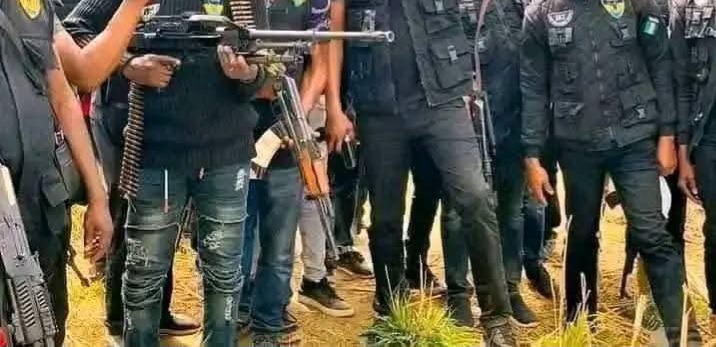
Nigeria is witnessing a resurgence of mass abductions as at least 145 people have been kidnapped in Kebbi, Niger and Zamfara states in the past four days.
The resurgence of mass kidnappings raises familiar political and security alarms as the country gears up for the 2027 polls.
In the run-up to the 2023 general elections, abductions were rampant.
A report by The PUNCH showed that between January and March 2023 alone, 792 people were abducted across Nigeria.
Many of these incidents were tied to banditry and criminal gangs, especially in the north.
However, as the political parties are warming up for the 2027 elections, there appears to be a resurgence of the situation.
In the early hours of Monday, armed men stormed the Government Girls Comprehensive Secondary School, Maga, in Danko/Wasagu Local Government Area of Kebbi State, abducting 25 female students and killing a staff member.
A school guard was also injured during the attack, which occurred early in the morning.
The Nigeria Police Force, in a statement shared via its WhatsApp channel, confirmed the incident, noting that police tactical units deployed within the school engaged the attackers but the gunmen escaped with the abducted students.
The police said additional tactical teams, in collaboration with the military and vigilantes, have been deployed to comb suspected bandit routes and nearby forests in a bid to rescue the victims and arrest the perpetrators.
“On November 17, 2025, at about 0400hrs, a gang of armed bandits with sophisticated weapons stormed the school, shooting sporadically.
“The police tactical units engaged them in a gun duel, but the bandits had already scaled the fence and abducted 25 students. One Hassan Makuku was shot dead, while Ali Shehu sustained an injury to his right hand, “ the statement partly read.
The force spokesperson, Benjamin Hundeyin, could not be reached for more information on the incident.
But the Commissioner of Police, Kebbi State Command, Bello Sani, reiterated the command’s resolve to protect residents and urged the public to remain calm and support ongoing operations.
The Kebbi incident came just two days after at least 16 vigilante members were killed and 42 residents kidnapped in seperate attacks by bandits in the Mashegu Local Government Area of Niger State.
Also, on Saturday, bandits attacked Fegin Baza village in the Tsafe Local Government Area of Zamfara State, killing three persons and abducting at least, 64 others.
In another attack on Sunday, bandits launched a fresh assault on Tsohuwar Tasha village in the Ruwan Doruwa Ward of Maru Local Government, abducting 14 people, including 11 women and three children.
Recent reports by Daily Trust indicates that communities in Zurmi, Shinkafi, Maradun, Tsafe and Bungudu LGAs of Zamfara State have faced repeated assaults in recent months, leading to displacement and the imposition of levies and ransoms by armed groups.
Swift rescue pledged
The Federal Government expressed deep concern over the abduction of the female students from Government Girls Secondary School, vowing to ensure their safe return.
This was contained in a statement signed by the Minister of Information and National Orientation, Mohammed Idris, on Monday.
Idris noted that President Bola Tinubu, has reiterated that protecting every Nigerian, especially schoolchildren, remains a solemn responsibility of the state.
The government condemned the attack on the school, describing it as “reprehensible” and decried the killing of school officials who were carrying out their duties.
He added, “Our security and intelligence agencies have been issued clear directives to locate, rescue, and safely return the students, and to ensure that the perpetrators face justice.
“The Federal Government will not relent until this objective is achieved.
“We assure Nigerians that strengthening internal security remains a top priority. The Federal Government is recalibrating the nation’s military, policing, and intelligence capabilities to more effectively prevent these attacks and respond with greater speed and precision whenever threats arise.”
The minister further stated that government is intensifying collaboration with regional partners through the Economic Community of West African States, the African Union, and the Multinational Joint Task Force to secure the borders and dismantle terrorist and criminal networks.
Meanwhile, the Nigeria Police Force and the military have launched an intensive search-and-rescue operation to recover the abducted students.
Minister condemns attack
The Minister of Defence, the Minister of State for Defence, Bello Matawalle condemned the attack on the Kebbi school, describing it as “totally unacceptable.”
In a statement issued in Abuja on Tuesday by Enderline Chukwu, Assistant Director (Information & Public Relations), on behalf of the Director of Information & Public Relations of the ministry, the minister said the president had directed all security agencies to urgently coordinate efforts to locate and secure the release of the abducted students.
“The government, led by President Bola Tinubu, has directed that the state’s security apparatus swing into immediate action to ensure the abducted students are released unharmed, “ he added.
The statement added that the minister urged security forces to work collectively to rescue the victims and bring the perpetrators to justice.
Matawalle also appealed for calm in the affected communities, advising residents to go about their normal activities while government and security agencies work to resolve the situation.
Atiku, PDP react
Meanwhile, former Vice President Atiku Abubakar and the People’s Democratic Party have condemned the Kebbi school attack as well as other abduction cases.
In a statement posted on his Facebook, the former VP said he was devastated by the news of the tragic attack on Government Girls Comprehensive Senior Secondary School, Maga, in Kebbi State.
He said, “This is yet another reminder of the worsening insecurity in our nation.
I equally condemn the killing of an APC chieftain, Umar Moriki, and the mass abductions in Tsafe LGA of Zamfara, where entire families, including women and children, were taken by bandits. These acts of barbarity have no place in a civilized society.
Similar tragedies continue to unfold in Plateau, Benue, and other states, where communities are being torn apart by violence. In Shanono LGA of Kano, residents are fleeing their homes in fear, highlighting a national security challenge that has reached intolerable levels.”
He added, “Nigeria cannot continue on this path. I call on the Federal Government to urgently review and strengthen its security architecture, deploy adequate personnel across vulnerable communities, and intensify intelligence-led operations. Our citizens deserve protection, dignity, and peace—nothing less.”
Also, the PDP, in a statement issued on Monday by its National Publicity Secretary, Ini Emomobong, faulted the Federal Government for what it described as its inability to curb the escalating wave of insecurity across the country.
“This tragic incident further highlights the alarming rise in insecurity that has become the lived reality of the majority of Nigerians under the Tinubu-led APC administration, which has consistently preferred the politicisation of governance over the protection of citizens,” the party said.
It added that any government that fails in its primary duty of protecting lives and property must accept responsibility and confront the crisis head-on, “rather than act aloof or attempt to deflect from the core issues, as this administration has repeatedly done.”
The PDP condoled with the parents of the abducted students, the family of the slain Vice Principal, as well as the staff and management of the school and the Kebbi State Government.
The party noted that beyond the “deeply troubling” Maga school attack, similar abductions had recently taken place in Nasarawa, Plateau, Kano, and Katsina states — a trend it said was at odds with the promises made to Nigerians.
It urged President Bola Tinubu to devote urgent and adequate attention to security, saying the repeated tragedies must be halted.
“Do we need a foreign country to threaten the government before it acts? Let the killings stop,” the statement added
Security experts speak
Speaking on the rising wave of kidnappings ahead of the 2027 polls, security analyst and a retired Commissioner of Police, Emmanuel Ojukwu said the run-up to elections in Nigeria often witnesses a spike in politically motivated abductions.
He said, “In the build-up to elections in Nigeria, it is not uncommon to record a spike in the incidences of abductions. Some political actors may want to disroganise the camp of their opponents, distract their strategies or to plainly discomfit and embarrass them.
“A number of such abductions end up on a sad fatal note, either as payback or to finally nail the coffin on the aspiration of opponents. “
He added that elections are sometimes treated as a do-or-die contest where “almost everything is weaponised, including human lives.
Ojukwu stated, “Elections are often viewed as a kind of do-or-die battle, and almost everything is weaponised, including human lives. In the stiff competition and rivalry, human lives become pawns and dispensable, so long as victory is assured. And so, an abduction is proof of superiority of one group over the other, as the abductee is rendered impotent and comatose.
“Again, the law enforcement apparatus is usually overstretched in election periods such that many details in their operation order are missed or neglected.”
But retired Commissioner of Police Ladodo Rabiu rejected the idea that elections alone explain the rise in kidnappings, stressing that insecurity has become deeply rooted and continuous.
“It’s not always during elections. If you are current with what has been happening, insecurity across Nigeria is growing — especially in our area here in the Northwest. And these kidnappings have never stopped elections from holding.
“Check the electoral laws. They have their own provisions for conducting elections even when there are kidnappings and other security issues. I’ve witnessed many elections; despite insecurity, elections were still carried out.
“The problem is that during campaigns, insecurity becomes a talking point. But in my opinion, it’s not only elections — politics in general is taking advantage of the insecurity.
“I have a fear, and I always express it. The government is trying its best to fight crime, particularly kidnappings. Security agencies are trying too. But my question is: why are we still experiencing insecurity here and there? Some parts of the country are negotiating with bandits; others are fighting them and dealing with capital offences.
“I don’t have a problem with negotiation, but many areas are not covered in these negotiations. For example, negotiating with bandits while leaving them with their arms — government should not allow that.
“Government must restrategise. It should come up with proper policies and measures. When I served in Angola under the United Nations, we adopted what is called integration — reintegrating criminals or bandits and making them members of society.
“There was the use of both kinetic and non-kinetic measures. You journalists, in your investigative work, should also try to find out why the government is doing certain things at a particular time and yet insecurity persists.
“I know there are problems here and there. Government is not fully taking care of security agencies. There is corruption and politics within the security system. But these issues can be addressed; they can be dealt with.”
On the way forward, Rabiu admonished the government to be more serious.
“Security agencies must be empowered. Members of the public must also play their part. Security is not the responsibility of government alone — it is everybody’s business.There are layers of security we can adopt. That is it.”
On his part, Retired Assistant Inspector-General of Police Wilson Inalegwu called for a comprehensive strengthening of Nigeria’s security architecture, emphasizing local-level policing, community partnerships, and empowerment of security personnel as key strategies to combat rising insecurity across the country ahead of the elections.
While acknowledging the successes of federal security operations, Inalegwu stressed the importance of addressing local-level challenges.
He noted that local government security committees and community policing initiatives are critical for detecting and responding to threats.
“Even, if we have five million security personnel, they cannot do it alone. Winning the confidence of the public is key. If people give information and nothing comes of it, they lose trust.”
He also advocated greater coordination across all layers of the security apparatus, from the National Security Council to state and local government committees.
According to Inalegwu, effective communication and trust between communities and security forces are essential in tackling insecurity.
On manpower, Inalegwu warned that the police force is severely understaffed.
“You see police stations whose personnel should be 200 or 300 officers, but there are only 50 or 60 officers. If you can’t secure your divisional headquarters, how do you put personnel on the streets?” he asked.
The former AIG further directed attention to the Special Constabulary provision under the Police Act 2020, suggesting that trained and agile community vigilantes could be converted into officially recognised special constables, paid stipends, and integrated into divisional police structures to strengthen operational capacity while preventing abuses.
He noted, however, that governors and subnational leaders often resist this approach due to fears over control.