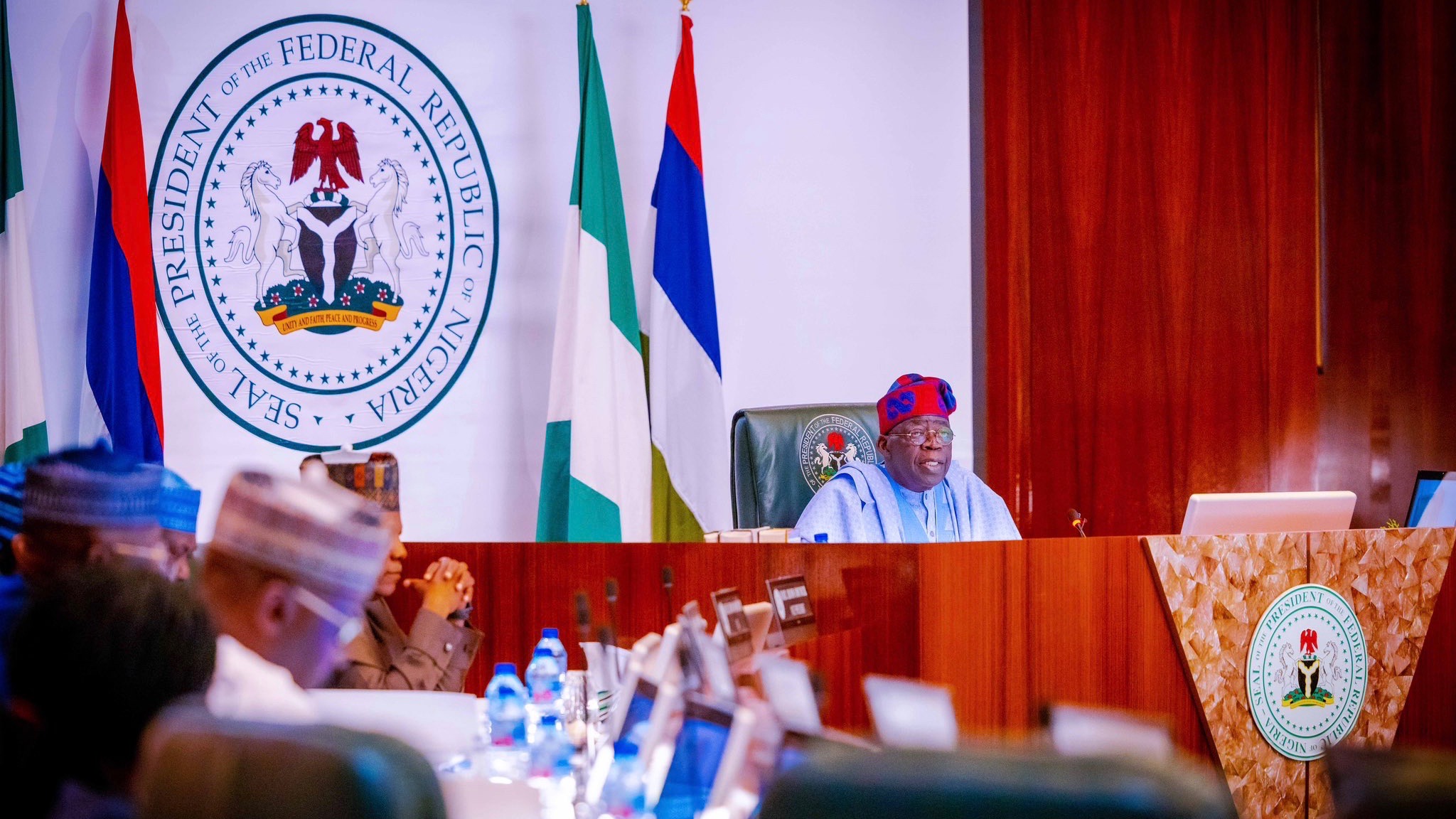
President Bola Ahmed Tinubu on Tuesday asked the National Assembly to approve a N9.09tn increase in the 2026 budget.
The government plans to finance the budget increase through crude oil gains linked to the Unites States-Iran conflict and by securing new loans
The Tinubu’s request, which signals a significant adjustment to the fiscal framework for the coming year, was conveyed in a letter read on the Senate floor by the President of the Senate, Godswill Akpabio, during plenary on Tuesday.
Tinubu explained that the proposed adjustment is intended to enhance fiscal transparency and support the effective execution of key national programmes.
The letter reads, “The proposed adjustment is aimed at strengthening fiscal transparency and ensuring the effective implementation of priority national programmes.”
According to him, the review would allow the government to properly capture existing public debt obligations within the fiscal framework.
The adjustment, Tinubu added, would also provide for a limited number of strategic priority projects while aligning the 2026 financing plan to safeguard macroeconomic stability and reduce pressure on the domestic financial market.
However, the National Assembly passed the 2026 Appropriation Bill, increasing the budget to N68.32tn from the N58.18tn initially proposed by President Bola Ahmed Tinubu.
An analysis by The PUNCH shows that adding the President’s N9.09tn request to the original proposal would bring the total to about N67.3tn. This indicates that the approved figure of N68.32tn includes an additional increase of roughly N1tn beyond the executive’s request.
The upward revision, according to lawmakers, is intended to clear legacy obligations, fund key infrastructure, strengthen the judiciary, boost healthcare interventions, and support preparations for the 2027 general elections.
Presenting the report, Chairman of the Senate Committee on Appropriations, Solomon Adeola, said the increase was necessary to address outstanding commitments and align the budget with prevailing economic conditions.
He said the adjustment would “regularise outstanding commitments from previous fiscal years, align the budget with current economic realities and maintain macroeconomic stability.”
Tinubu had originally presented the N58.18tn proposal to the National Assembly on December 19, 2025, under the theme, “Budget of Consolidation, Renewed Resilience and Shared Prosperity,” with a focus on economic growth, security and capital projects.
However, the version approved by both chambers reflects a significant expansion in spending.
A breakdown shows that N4.799tn is allocated to statutory transfers, N15.809tn to debt servicing, N15.427tn to recurrent (non-debt) expenditure, and N32.287tn to capital projects.
The committee explained that the N9.09tn increase followed a formal request from the President to include critical expenditures omitted in the initial proposal and to prevent unresolved obligations from undermining the 2026 fiscal plan.
A major component of the adjustment is the rollover of N7.71tn in outstanding capital obligations from the 2025 budget.
Lawmakers noted that about 70 per cent of capital projects in the 2025 Appropriation Act were affected by revenue shortfalls, necessitating a carryover into 2026 to avoid abandonment and rising costs.
Beyond legacy liabilities, new provisions were introduced for strategic interventions across key sectors.
These include N478.6bn as the Federal Government’s equity contribution under the Ministry of Finance Incorporated framework to support rail projects in Lagos, Kano, Kaduna and Ogun States, as well as feasibility studies for urban rail systems in Enugu and Maiduguri and upgrades to the narrow-gauge rail network.
The committee also approved N8.96bn for feasibility studies on the Calabar–Maiduguri corridor and the Maiduguri–Sokoto superhighway under the Tinubu National Beltway Initiative.
In the health sector, an additional $344.83m, equivalent to about N482.76bn, was allocated for priority interventions under bilateral agreements, aimed at improving healthcare infrastructure and service delivery.
The judiciary received increased funding, including N98.5bn for the Court of Appeal, N36.7bn for the Supreme Court and N268.54bn to restore its budget ceiling and accommodate the appointment of more judges ahead of the 2027 elections.
Lawmakers stressed that strengthening the judiciary was essential to handling election-related disputes and ensuring timely justice.
To finance the expanded budget, the committee proposed a combination of revenue measures and borrowing.
This includes a $10 per barrel increase in the oil benchmark, expected to generate about N2.592tn in additional revenue.
The committee also highlighted improved contributions from the telecommunications sector following tariff adjustments and policy reforms.
It is projected that MTN Nigeria would generate N724bn in company income tax in 2026, while Airtel Nigeria is expected to contribute N150bn, bringing total additional revenue from the sector to N874bn.
Despite these measures, lawmakers approved an increase in external borrowing by N6.163tn to bridge the financing gap, noting that the borrowing remains within manageable limits.
The report stated that the 2026 budget is designed to strengthen macroeconomic stability, improve the business environment, create jobs and reduce poverty.
It added that priority sectors include security, infrastructure, health, education and human capital development.
The committee recalled that the Senate had debated the general principles of the bill in December 2025 before subjecting it to detailed scrutiny, including engagements with the President’s economic team.
It said a public hearing held on February 9, 2026, themed ‘From Budget to Impact,’ drew inputs from government agencies, civil society groups, development partners and private sector stakeholders.
However, lawmakers raised concerns over delays in fund releases and other bureaucratic challenges that affected the implementation of the 2025 budget.
They called for urgent reforms, warning that such bottlenecks could weaken the impact of the 2026 fiscal plan.
The committee recommended stronger collaboration between the executive and legislature, as well as improved oversight to ensure the timely execution of projects.
It also proposed extending the 2025 Appropriation Act to June 30, 2026, to allow for the completion of ongoing projects.
Adeola commended members of the committee and stakeholders for their contributions, noting that collaboration with the House of Representatives ensured a balanced report.
He urged the Senate to approve the revised bill, describing it as critical to sustaining economic gains, addressing structural challenges and setting the country on a path of growth.
Like the Senate, the House of Representatives also passed the N68.30tn Appropriation Bill for the 2026 fiscal year.
At a plenary on Tuesday, presided over by the Speaker, Tajudeen Abbas, the House also approved extending the implementation of the capital component of the 2025 budget from March 31 to June 30, 2026.
Of the proposed total expenditure of N68.30tn, N34.33tn is the projected revenue for the year. Budget deficit is N23.85tn, representing 4.28 per cent of the Gross Domestic Product.
Macroeconomic assumptions of the budget consist of an oil benchmark of $64.85 per barrel, a production target of 1.84 million barrels per day, and an exchange rate of N1,400 to a dollar.
The Federal Government’s share of the main revenue pool is projected at N21.62tn, while the revenue targets for tax and non-tax sources are N124.25tn and N845.98 bn, respectively.
The government also hopes to generate N1.37tn from foreign aid and grants, with government-owned enterprises expected to contribute N10.27tn to the revenue pool.
The Federal Government allocated N618.13bn to the Niger Delta Development Commission, N244.07bn to the North-East Development Commission and N145bn to the North-West Development Commission. The South-West, South-South, South-East and North-West Development commissions had a statutory transfer of N140bn each.
Other statutory transfers include the National Assembly (N577.85bn), the Independent National Electoral Commission (N1tn), the National Human Rights Commission (N20bn) and the Public Complaints Commission (N29.46bn).
Also, domestic debt servicing, including ways and means, got N10.16tn, while foreign debt was allocated N5.36tn.
The presidency was allocated N142.42bn, the Ministry of Defence (N2.69tn), the Ministry of Foreign Affairs (N287.90bn), and the Office of the Head of the Service of the Federation (N17.17bn), among others.
Addressing lawmakers shortly before the passage of the budget, the Chairman, House Committee on Appropriation, Mr Abubakar Bichi, said all amounts appropriated in the proposal shall be released from the Consolidated Revenue Fund of the Federation only for the purpose specified in the executive bill.
On virement, the Kano lawmaker noted that “if the implementation of any of the projects intended to be undertaken under this bill cannot be completed without virement, such virement shall only be effected with the prior approval of the National Assembly.”
He called on the Accountant General of the Federation to “immediately, upon coming into force of this bill, maintain a separate record for the documentation of revenue accruing to the Consolidated Revenue Fund in excess of the oil price benchmark adopted in this budget.”
According to Bichi, “such revenues refer to monies accruing from sales of government crude oil in excess of the approved benchmark price per barrel, the Petroleum Profit Tax and Royalty on Oil and Gas.”
With the Senate similarly passing the budget proposal, it is expected to be transmitted to the President for assent in the coming days.
Tinubu’s $6bn loan
The Senate and House of Representatives have also approved President Bola Tinubu’s request to secure fresh external loans totalling $6bn, in a move aimed at plugging fiscal gaps and financing key infrastructure projects.
The approval followed the presentation and consideration of reports by the Chairmen of the Senate and House Committees on Local and Foreign Debts, Senator Aliyu Wamakko (APC, Sokoto North) and his House of Representatives counterpart, Abubakar Nalaraba, on Tuesday.
The red chamber’s decision came just hours after the President formally wrote to the Senate seeking legislative backing for the facilities, underscoring the Executive’s push to shore up funding for priority sectors.
In a letter addressed to the President of the Senate, Godswill Akpabio, and read during plenary, Tinubu sought approval to borrow $5bn from Abu Dhabi Bank to support budget deficit financing and meet existing debt obligations.
The president said the facility would be made available to Nigeria in tranches.
The letter partly read, “The purpose of this letter is to request for the approval and resolution of the national assembly pursuant to the provisions of section 21(1) and 27(1) of the debt management office establishment act 2003 to establish a structured total return swap derivative external financing programme from First Abu Dhabi Bank of the United Arab Emirates of up to $5bn which will be made available to the Federal Republic of Nigeria in tranches.”
Tinubu said the proceeds would be used for budget implementation, development of priority infrastructure projects and repayment of relatively expensive domestic and external debts.
He added that the facility would also help the federal government meet urgent financial obligations when necessary.
The president said Nigeria’s total public debt currently stands at $110.3bn, equivalent to about N159.2tn as of December 31, 2025.
In a separate letter, the president sought approval for a $1bn UK export finance loan facility arranged by Citibank, London branch.
Tinubu noted that the projects—covering the Lagos Port Complex and Tin Can Island Port—are designed to tackle longstanding operational challenges and reposition Nigeria’s maritime sector.
“The rehabilitation of the ports project is a strategic modernisation initiative of the Federal Government of Nigeria through the Nigerian Ports Authority to restore and upgrade two of Nigeria’s most vital ports, namely Tin Can Island Port complex and Lagos Port complex, Apapa, which have reached critical engineering failures,” the letter read.
Following the reading of the requests, Akpabio had referred both letters to the Senate Committee on Local and Foreign Debts, directing the panel to expedite consideration and report back promptly—a directive that culminated in Tuesday’s approval.
The latest borrowing request comes amid the Federal Government’s continued reliance on a mix of domestic and external loans to finance budget deficits and critical infrastructure.
Shortly after both letters were read by Mr Abbas, the requests were referred to the Committee on Aids, Loans and Debts Management.
The House thereafter dissolved into the Committee of Supply to consider the report.
Speaking on the substance of the request, Nalaraba who represents Awe/Doma/Keana Federal Constituency, Nasarawa State said, “The House should consider the report of the Committee on Aids, Loans and Debt Management on the request for approval to establish a structured total return swap an external financing programme of $5bn with First Abu Dhabi Bank, to support Federal Government funding and fiscal liquidity management and approve recommendations therein.”
According to him, “the implementation of a total return swap transaction involving the Federal Government of Nigeria and First Abu Dhabi Bank in aggregate principal amount of up to $5bn together with the collateralisation of the transaction by the issuance of naira-denominated FGN Securities to First Abu Dhabi Bank PJSC as collateral for the loan of up to 133.3 per cent of the amount drawn.”
The Committee recommended that the Federal Government of Nigeria make margining payments to First Abu Dhabi Bank PJSC in dollars upon demand if, at any time, either due to fluctuations in the market prices of the Federal Government securities or as a result of movements in exchange rate or both, the value of the collateral issued to First Abu Dhabi Bank falls below the initial value at the time of issuance.”
Another recommendation includes “that the $5bn should be drawn down in tranches, with each tranche comprising a corresponding confirmation and other ancillary agreements (as may be required) between the Federal Government of Nigeria and First Abu Dhabi Bank.
“Authorisation of the use of proceeds for budget implementation, development of key infrastructure projects, which are of priority to the administration, repayment of relatively more expensive domestic and external debts in the Federal Government of Nigeria’s public debt portfolio.”
Both loan requests were unanimously approved when the lawmakers returned to plenary from the Committee on Supply, where the consideration took place.
Expert react
Commenting, the Chief Executive Officer of CSA Advisory and a development economist, Aliyu Ilias, urged the Federal Government to prioritise security, economic productivity and targeted support measures in deploying the proposed N9tn budget expansion.
Speaking in a telephone interview with our correspondent, Ilias said strengthening security should be the government’s foremost priority, noting that economic growth would remain constrained without stability across the country.
“The first sector these funds should be channelled into is security. Once we are able to stabilise the security situation, then we can look at the economy, particularly trade and industry, to make things actually work,” he said.
He also called for targeted interventions to cushion the impact of rising crude oil prices on Nigerians, suggesting that some form of subsidy or support mechanism may still be necessary.
“I also expect a form of relative subsidy in terms of helping people to mitigate the effect of the rising price of crude oil and its impact on petrol prices. It can even be extended to critical players like Dangote as some form of leverage, if funds can be directed to that sector,” he added.
On the proposed budget review, Ilias said the move was not unexpected, citing Nigeria’s historical trend of revising budgets during the fiscal cycle.
He pointed to structural issues in past budgets, particularly the low implementation of capital projects, as justification for a larger fiscal framework.
The economist further explained that changes in global oil prices have altered Nigeria’s revenue outlook, creating room for upward budget adjustments.
While supporting a larger budget size, Ilias emphasised the need for improved revenue generation to sustain increased spending.
“For me, I am an advocate of a bigger budget, but only if we can strengthen our revenue side. A bigger budget allows us to implement more projects and drive development,” he stated.
He also stressed the importance of increasing capital expenditure, warning that rising global volatility could worsen Nigeria’s debt profile.
Ilias, however, cautioned that the effectiveness of the budget review would ultimately depend on how well the additional funds are utilised.
Also speaking, an economist, Professor Adeola Adenikinju, urged the Federal Government to prioritise the power sector, social investment programmes, infrastructure, and agriculture to address the country’s economic challenges and improve citizens’ welfare.
Speaking on key areas requiring urgent government attention, Adenikinju stressed the importance of electricity for economic growth and welfare.
“I think the power sector is very important. The power sector? Yes, given the role that the power sector, or electricity, plays in economic growth and welfare generally. The power sector is very important,” he said.
While noting that the sector has already been privatised, the economist pointed out that several unresolved challenges persist.
“I know it is privatised, but there are legacy issues that require further attention. The huge debt that is being owed is probably because of issues with tariffs,” he said.
According to him, the government must address major infrastructure gaps in the electricity value chain.
“We have to fix some of the infrastructural issues, particularly the transmission and distribution segments that are not working well. That is one sector that is very important,” he added.
Beyond power, Adenikinju also called for stronger social protection programmes to cushion the impact of ongoing economic reforms on vulnerable citizens.
“Then the government needs to pay more attention to social investment expenditure because a lot of people are feeling the impact of reform,” he said.
He noted that reforms introduced by the administration of President Bola Ahmed Tinubu had intensified inflationary pressures on households.
“The effect of the economic reforms that the president started about three years ago—removal of subsidy, the single-unit pricing, all of that—has led to severe inflation in the economy and has impacted negatively on the welfare of people,” he said.
Adenikinju emphasised that targeted relief measures are necessary for citizens most affected by the reforms.
“There needs to be an effective way of providing relief to very poor people who are badly affected by the reforms. Social investment is very important to take care of those who are extremely vulnerable and who are struggling,” he added.
The economist also identified poor infrastructure, particularly road networks, as a major contributor to rising food prices across the country.
“The other sector that I will mention is infrastructure. Our roads are bad. The roads leading to rural areas are very bad. Therefore, that has driven up the cost of food in many urban areas where a lot of consumers are,” he said.
He noted that improving transport links between rural production areas and urban markets would help reduce food costs.
“The road infrastructure has to be looked at. It has to be improved, especially the rural–urban areas and from the food-producing areas to urban centres,” he said.
Adenikinju further stressed the need for greater government support for farmers through improved access to agricultural inputs.
“Finally, I will say agriculture—by providing food seedlings for farmers and supporting fertilisers,” he said.
He warned that rising fertiliser prices, driven by global factors, were also affecting local food production.
“The prices of fertilisers have gone up because of the war. They also have to be supported. So these are the areas that I think should be prioritised, in my view,” he added.
punch.ng
FOLLOW US ON: