Connect with us

Education

Alleged extortion: FUOYE deputy dean claims suspension pre-planned

Published

on

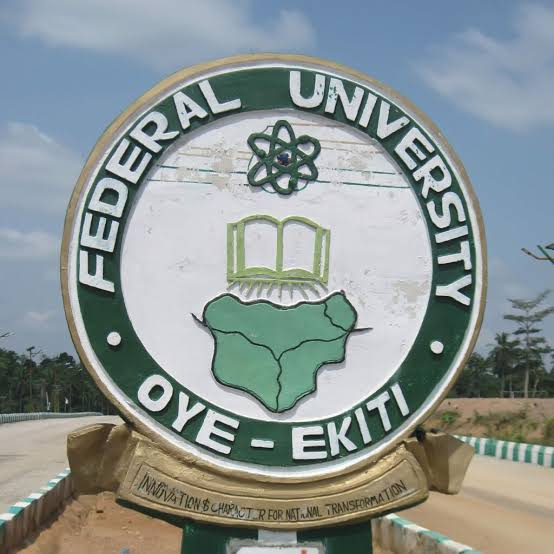
The suspended Deputy Dean of Student Affairs at the Federal University Oye-Ekiti (FUOYE), Dr Banji Olaleye, has claimed his suspension over alleged extortion was orchestrated long before the investigation, alleging that the university’s current administration had been seeking his removal since February.

The school’s spokesperson, Dr Sunday Saanu, said on Sunday that “those claims are false.”

The university management had announced the suspension of Olaleye alongside the Director of the Directorate of Educational Technology, Innovation and Entrepreneurship, Olanrewaju Ogunjobi, and the Students’ Union Government President, James Adio.

The university said a petitioner accused the trio and others of extorting students through the unauthorised collection of N1,000 from each 100-level student.

However, in an exclusive interview with our correspondent on Sunday, Olaleye maintained that his suspension, which came before the commencement of the investigation into the allegations, was part of a calculated attempt to tarnish his reputation.

According to him, the current administration had made it clear from the outset that it did not want to work with him because of the belief that he did not support the emergence of the incumbent Vice-Chancellor.

“We have had a new administration since February. Since then, the present administration has always told people that it doesn’t want to have anything to do with me because it feels I did not support its emergence.

“I am not a kingmaker. I don’t put somebody there as the VC,” he said.

Olaleye explained that he had expected to leave his position as Deputy Dean of Student Affairs at the end of July when the tenure of political appointees was due to expire.

He said the controversy over entrepreneurship fees arose from a disagreement between the Directorate of Entrepreneurship and the Dean of Student Affairs over practical sessions for students, stressing that he had no official role in the programme.

He said his involvement began only after the Dean of Student Affairs, Professor Temitope Babalola, requested that he intervene to resolve the dispute between the directorate and student leaders over the collection of N1,000 from students.

See also  WAEC mandates 250 computers, CCTV for schools participating in CBT

According to him, following meetings with the Students’ Union Government and faculty executives, he contacted the Director of Entrepreneurship, who explained that the fees were being collected directly from students because funds meant for practical sessions were not released by the university management on time.

Olaleye said he was thereafter asked to help ensure that class representatives remitted the money already collected to the directorate.

He said that after directing student leaders to recover outstanding funds from class governors, about N2.5m was recovered.

According to him, the Director of Entrepreneurship later instructed that N1m should be paid to student representatives as appreciation for their support, while the remaining N1.5m should be transferred to “a designated account provided by the Directorate of Entrepreneurship.”

Olaleye said he merely conveyed the resolution by the directorate and ensured money in the custody of class governors was retrieved.

“Meanwhile, my involvement was after the Director of the Entrepreneurship Centre mentioned that he had approval, and he even spoke with the VC on maintenance to undergo it at the directorate.”

He added that he was later invited before an investigative panel over allegations of extortion despite having only facilitated the recovery and remittance of the funds.

According to him, the panel initially questioned claims that students received only N35,000 instead of the approved N1m but later confirmed that the students had indeed received the N1m.

“I said, ‘How can I give the students N35,000 out of N1m? The N1m had been communicated to them. There is no way you can spend students’ money.’ Eventually, they confirmed that the students got the N1 million.”

Despite this, he said he was suspended on June 10 alongside the Director of the Entrepreneurship Centre and the SUG president.

He also alleged that other staff members who directly handled the funds were excluded from the investigation.

Olaleye further faulted the university for announcing his suspension while investigations were still ongoing, saying the development subjected him to public ridicule.

See also  OAU raises alarm over missing female student

“My name circulated over something they had not been able to investigate. They had not finished their investigation.”

He maintained that he had never collected or diverted students’ money and insisted that the allegations were being used to justify a decision already taken against him.

“I never had any issues with any student. I never collected any money. There is no way you can find any offence against me. Instead, I support students with my own personal money.”

Olaleye also questioned the disciplinary process, noting that he was issued a query five days after he had already been suspended.

He said he responded to the query, appealed the suspension and petitioned the Chairman of the Governing Council, asking the university to allow the investigation to be concluded before taking disciplinary action.

He added that the reinstatement of the suspended SUG president had further raised questions about the basis of the sanctions.

“The SUG president has been called back. They have reinstated him. People started asking, if this is the student who really spent the money, then what is the offence of the staff who tried to protect the interest of the management?”

Meanwhile, a senior member of the school management who spoke on condition of anonymity for fear of retribution told our correspondent that the management had been misled by the probe panel.

“The office where Olaleye belongs was only called to intervene in the crisis. His office even advised the Directorate of Entrepreneurship to seek other means to fund the said practical.

“The Deputy Director (Olaleye) has been intervening in similar cases. So based on that, it was against that background that he was directed to intervene.

“Let me just put it this way. The members of the panel that investigated have had issues with students in the past. It’s like telling somebody’s enemy to be the judge in the case. So definitely, they will mislead the system.

See also  Reps seek suspension of WAEC CBT exams until 2030

“They definitely misled the system. I see this more as… the members who conducted the investigation actually misled the university on this matter.”

Reacting to the allegation, the Director of Public Relations of FUOYE, Saanu, however, dismissed the allegations, insisting that the university’s actions were based solely on its anti-extortion policy and not on political considerations.

According to him, since the current Vice-Chancellor assumed office, the administration has made it clear to all stakeholders that misconduct, particularly the extortion of students, would no longer be tolerated.

He said the policy was endorsed by the university Senate and later strengthened by the Governing Council, which approved the dismissal of any lecturer found guilty of extortion.

He added that Heads of Department and Deans who fail in their oversight responsibilities would also face sanctions.

Saanu maintained that a prima facie case had been established against the lecturer before disciplinary measures were taken, adding that the matter was reviewed by the university’s management committee, where it was resolved that the Dean should also be sanctioned because leadership carries responsibility for misconduct under its supervision.

He rejected claims that the suspension was linked to the lecturer’s alleged opposition to the emergence of the Vice-Chancellor, describing the allegation as “blackmail.”

“The evidence against him was overwhelming. The university set up a committee, and the committee established that he was culpable. It found that he directed that money be collected from students,” Saanu said.

He also referenced a previous case involving the immediate past Students’ Union president, Alao, saying management decided to pardon him because the practice predated his tenure and opted to treat the incident as a deterrent.

“For this lecturer, however, the situation is different. It has nothing to do with politics or whether he supported the Vice-Chancellor. Many people did not support the Vice-Chancellor, so that allegation does not hold,” he added.

punch.ng

FOLLOW US ON:

FACEBOOK

TWITTER

PINTEREST

TIKTOK

YOUTUBE

LINKEDIN

Continue Reading
Click to comment

Leave a Reply

Your email address will not be published. Required fields are marked *

Education

Meet Nigerian professor appointed dean at Canadian university

Published

on

Nigerian-born law professor, Dr. Ibironke Odumosu-Ayanu, has been appointed dean of the College of Law at the University of Saskatchewan, Canada, for a five-year term beginning October 1, 2026.

Odumosu-Ayanu, who is currently the college’s associate dean of research and graduate studies, has been a member of the University of Saskatchewan College of Law since 2008.

The university announced her appointment on Tuesday, September 1, through a statement on its website by Patti McDougall, interim provost and vice-president, academic and chair of the search committee for the new dean.

“Dr. Odumosu-Ayanu’s appointment as dean reflects a distinguished record of academic excellence, collaborative leadership, and dedication to advancing research and graduate education,” McDougall stated.

“Her work as dean will continue to build on the College of Law’s strong reputation for excellence in legal education and research, while strengthening its leadership in Indigenous legal scholarship and engagement with local and global communities.”

Odumosu-Ayanu will succeed Martin Phillipson, who completed two five-year terms as dean and began administrative leave on July 1.

From Lagos to Canada

According to an article on the college website, Odumosu-Ayanu grew up in Lagos, Nigeria, where she developed an early interest in reading and writing.

Although she initially considered pursuing communications, encouragement from her teachers and support from her parents led her towards law.

By the end of secondary school, she had decided to study law and enrolled at the University of Lagos, where she earned her Bachelor of Laws degree.

She later moved to Canada to pursue a master’s degree at the University of Calgary, drawn by its research strengths in natural resources, energy and environmental law.

See also  Reps seek suspension of WAEC CBT exams until 2030

“Since I started law school, I always knew that I wanted to do a master’s and to do one abroad. But I always thought I would go to England.”

She had initially planned to return to Nigeria after completing her master’s degree and work as a lawyer. Instead, she continued her academic journey by pursuing a PhD at the University of British Columbia.

She said she had not initially intended to pursue a doctorate.


After completing her PhD, Odumosu-Ayanu began considering a career in academia and interviewed for academic positions.

She moved to Saskatchewan in 2008 to join the College of Law. A mentor at the University of British Columbia who grew up in Saskatoon had advised her to prepare for the Canadian winter.

Source: punchng.com

FOLLOW US ON:

FACEBOOK

TWITTER

PINTEREST

TIKTOK

YOUTUBE

LINKEDIN

INSTAGRAM

Continue Reading

Education

UN approves new learning institute, Nigeria backs merger of UNITAR, UNSSC

Published

on

The UN General Assembly has approved the merger of two United Nations learning and training bodies, creating a new institution designed to strengthen support for both member states and the UN system itself.

In a resolution adopted on Thursday, the 193-member Assembly, including Nigeria, endorsed the integration of the UN System Staff College (UNSSC) into the UN Institute for Training and Research (UNITAR).

They also approved the establishment of the UN Institute for Capability and Learning Innovation (UNICLI) from January 2027.

The decision is part of the wider UN80 Initiative, which aims to make the United Nations more coherent, effective and responsive to today’s challenges.

The new institute will combine UNITAR’s work helping governments, diplomats and public institutions build skills and capacity with UNSSC’s expertise in training, leadership development and knowledge-sharing for UN personnel.

“Member States and the United Nations system are facing increasingly complex and interconnected challenges.

“The UN must continue to evolve, building stronger capabilities, fostering innovation, and enhancing institutional effectiveness to turn global commitments into tangible results,” said Michelle Gyles-McDonough, UN Assistant Secretary-General and Executive Director of UNITAR.

The merger will create a single platform for learning and capability development, making it easier for member states, UN entities and partners to access expertise and support while reducing duplication and fragmentation.

Overall, the measure better equips the UN system to adapt to a rapidly changing world.

“By integrating UNSSC’s and UNITAR’s expertise in providing training for the UN system and Member States respectively, the new entity will be better positioned to provide a stronger, more coherent capability development function,” Miguel Panadero, Acting Director of UNSSC, said.

Addressing correspondents at UN Headquarters later in the day, spokesman Stéphane Dujarric said the Secretary-General welcomed the Assembly’s decision.

See also  Lagos law student dies after jumping from four-storey building

“The Secretary-General welcomes the decision, which recognises that capability development, continuous learning and innovation are not ancillary functions, but strategic drivers of the UN’s effectiveness, reform and impact for Member States,” Dujarric said.

“The UN chief invites Member States, UN entities, partners and all stakeholders to join in shaping the new entity’s future and strengthening its contribution to a more sustainable, inclusive and resilient world,” he added.

The transition will take place in phases through the end of 2026 to ensure continuity of programmes, partnerships and services. Until then, UNITAR and UNSSC will continue operating under their existing arrangements.

The new institute will be headquartered in Geneva, while Turin will continue serving as a UN learning campus and centre for leadership development. Existing offices and operations in Bonn, Hiroshima, Madrid and New York will also continue.

The merger represents one of the latest concrete actions taken by member states under the UN80 Initiative, reflecting efforts to build a more agile and future-focused United Nations equipped to meet evolving global needs.

NAN

Source: punchng.com

FOLLOW US ON:

FACEBOOK

TWITTER

PINTEREST

TIKTOK

YOUTUBE

LINKEDIN

INSTAGRAM

Continue Reading

Education

NECO question papers were sold for N3,000 before exams — Minister

Published

on

The Minister of Education, Dr Tunji Alausa, has revealed how examination questions were allegedly obtained for N3,000 before the conduct of the National Examinations Council examinations, describing the level of examination malpractice in the country as “mind-boggling.”

Alausa made the revelation on Thursday at a meeting with the National Association of Proprietors of Private Schools and other stakeholders in the education sector, where he warned parents, teachers, proprietors, principals, invigilators and students against practices capable of undermining the integrity of public examinations.

The minister said examination malpractice had, for years, been tolerated in Nigeria, creating an unfair system in which students who prepared genuinely for examinations were disadvantaged by those who gained access to leaked questions.

According to him, the situation was particularly dangerous because it could push honest students into malpractice as they sought to compete with candidates who had access to examination materials before the tests.

Alausa said, “It’s sad. Before she (Minister of State for Education) and I came, the acceptance of examination malpractice, cheating and examination leakages in this country was mind-boggling, and the country accepted it. It was a nightmare,” adding that the “danger was that the good students would also become bad.”

The minister, while recounting his experience in the fight against examination malpractice, alleged that examination questions had previously been made available for sale before candidates sat for the examinations.

He said, “The Registrar of NECO at the time had a name. His name was (Ibrahim) Wushishi. You would go to Wushishi… I didn’t know that Wushishi meant going to the dark website.

See also  Lagos law student dies after jumping from four-storey building

“They bought his question for N3,000. That was it. Before the examination. They called him Wushishi and bought the questions for N3,000 before the examination.”

Alausa also recalled his experience during the 2025 examination period, saying he was regularly sent examination questions allegedly obtained before candidates sat for the papers.

He said the development forced officials to verify the questions with examination authorities, sometimes confirming that the questions being circulated were actually the ones scheduled for the day.

He said, “During that examination period, during the hardest time of my life, I was always worried, waking up. I would wake up to her text. She would send questions to me… She would say, ‘I just got this question.’

“It could be English or Chemistry. I was always waking up with trepidation every morning, doing work. I would send it to the HNO and ask, ‘HNO, is this correct?’ And the answer I got was, ‘Unfortunately, that’s the question we’re doing today.’

“So, that was a more aggressive intervention because we were seeing the question and confirming from the other side.”

The minister said the revelations demonstrated that examination malpractice was not simply a student problem, insisting that the wider education ecosystem must take responsibility for curbing the practice.

He noted that parents, schools, teachers, invigilators and principals all had roles to play in preventing candidates from gaining unfair access to examination materials.

Alausa said, “You might be in that isolated school, but the school system is also involved. In fact, I don’t blame the students that much. Any child can be bad.

See also  St. Gregory’s College, Lagos: A Legacy of Catholic Education in Nigeria

“But when we have an ecosystem where parents, schools, teachers, invigilators and principals are in full connivance, the students are the smallest players. The people who should put the deterrents in place are the ones involved.”

He warned that the Federal Government would strengthen measures to protect the integrity of public examinations and ensure that academic qualifications reflected genuine learning and merit.

The minister said the reforms were part of President Bola Tinubu’s broader efforts to restore standards and reposition Nigeria’s education system.

He said, “This is a country with the rule of law. President Bola Ahmed Tinubu is transforming this country in a way that’s never been transformed before. This is Nigeria’s renaissance that we’re building to be sustainable into the future.”

He added that the country had for too long tolerated practices that undermined its education system, but said the Tinubu administration was determined to reverse the trend.

The Minister of State for Education, Prof Suwaiba Ahmad, also called on private school proprietors and other stakeholders to support the reforms, noting that stronger examination controls could initially expose weaknesses in students’ actual preparation.

Ahmad explained that some students who appeared to perform exceptionally well in internal examinations might have become accustomed to accessing leaked questions ahead of external examinations.

She said the introduction of serialised examination questions would make it more difficult for candidates to rely on leaked materials, while encouraging genuine preparation.

The minister urged schools to complete their curricula on schedule and promote consistent study among students, assuring private education stakeholders that the Federal Ministry of Education would continue to engage them during the implementation of the reforms.

See also  Out-of-school children rise to 273m globally – UNESCO

The latest warning comes amid longstanding concerns over examination malpractice in Nigeria, including question-paper leakages, impersonation, collusion and unauthorised assistance to candidates.

The Federal Government’s renewed emphasis on examination integrity is aimed at ensuring that results from public examinations provide a credible assessment of students’ knowledge and abilities, while protecting candidates who prepare and compete fairly.

Source: punchng.com

FOLLOW US ON:

FACEBOOK

TWITTER

PINTEREST

TIKTOK

YOUTUBE

LINKEDIN

INSTAGRAM

Continue Reading

Trending