Connect with us

Lifestyle

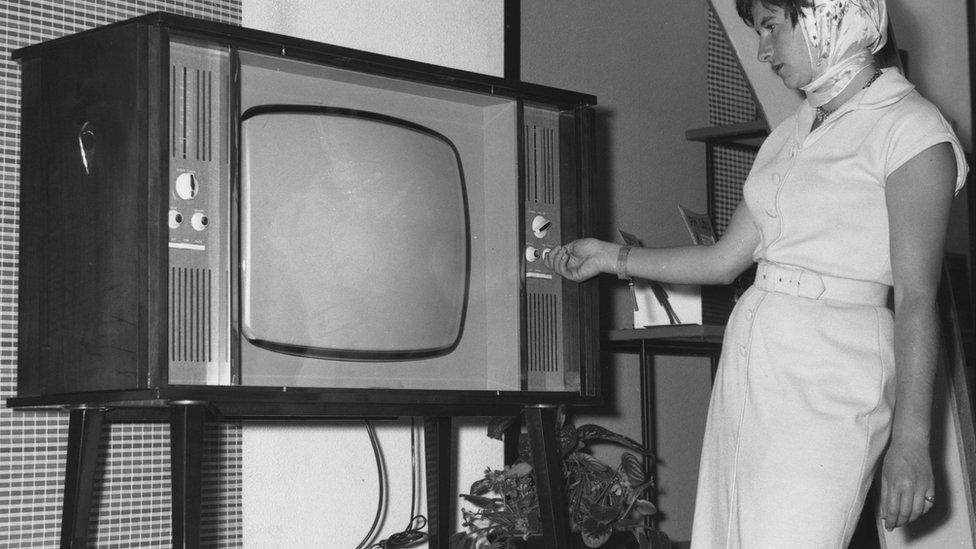
Vintage Mid-20th Century Black and White Television: A Glimpse into Early Home Entertainment (PHOTOS)


Published

on

Location & Era: Global, late 1940s–1970s

Photo Credit: Public domain / archival collections

The image captures a classic mid-20th-century black-and-white television set—an emblem of the first great wave of home entertainment. Before color broadcasting became mainstream, these sets shaped how families experienced news, drama, and sport, ushering in a new era of visual mass communication.

Design and Features

Typically housed in polished wooden cabinets, early televisions were designed to double as living-room furniture. Many models included sliding or hinged covers to shield the screen when not in use.

Screens were small and curved, usually 10–20 inches across, relying on cathode-ray tube (CRT) technology. Reception depended on external aerials—rooftop arrays or the familiar indoor “rabbit ears.”

Adjusting dials for picture clarity and sound was part of the viewing ritual, making television a hands-on technology compared with today’s remote-controlled flat panels.

Historical Context

Commercial black-and-white television emerged in the late 1920s and 1930s, but it was the post–World War II economic boom (late 1940s–1950s) that brought TV ownership into the mainstream across the United States and Western Europe.

In Africa, television arrived later. Western Nigeria Television (WNTV) in Ibadan, launched on 31 October 1959, became the first television station on the African continent, broadcasting entirely in black and white. For two decades, black-and-white sets dominated Nigerian homes and public viewing centres.

Color broadcasting did not begin in Nigeria until FESTAC ’77 preparations in the late 1970s, and widespread household access to color came only in the 1980s, far later than in the United States, where color transmissions were introduced in the early 1960s and became common by the 1970s.

Cultural Impact

The black-and-white television transformed family and social life. Evening programmes turned living rooms into communal spaces, where neighbours gathered for news, music, or major sporting events.

In Nigeria, early broadcasts carried educational programmes and government public-service messages, helping to knit together a newly independent nation and creating shared cultural memories—from local dramas to the first televised independence celebrations.

Legacy and Collectible Value

By the late 20th century, digital broadcasting and the rise of streaming platforms made CRT sets obsolete.

Yet vintage black-and-white televisions remain prized by collectors, museums, and retro interior designers.

Their warm wood finishes and curved screens now serve as film props and nostalgic décor, while reminding us of the pioneering age when broadcasting first brought the world into the home.

Sources
Burns, R. W. Television: An International History of the Formative Years. IET, 1998.

FOLLOW US ON:

FACEBOOK

TWITTER

PINTEREST

TIKTOK

YOUTUBE

LINKEDIN

TUMBLR

INSTAGRAM

Continue Reading
Click to comment

Leave a Reply

Your email address will not be published. Required fields are marked *

Lifestyle

Jadesola Olayinka Akande (CON, OFR) (15 November 1940 – 29 April 2008)

Published

on

Jadesola Olayinka Akande (CON, OFR) (15 November 1940 – 29 April 2008) was a Nigerian lawyer, academic and author, widely regarded as Nigeria’s first female professor of law.

She was born in Ibadan, Oyo State (then in the Western Region). Her early schooling was at Ibadan People’s Girls School and St. Anne’s School, Ibadan. She later went to Barnstaple Girls Grammar School in Devon, England, where she completed her G.C.E Advanced Level, before studying law at University College London, graduating in 1963.

She was called to the bar at the Inner Temple, London, and completed training at the Nigerian Law School. She returned to Nigeria (circa 1965), and worked in the West Regional Civil Service as an Administrative Officer for a time before transitioning fully into academia and legal practice.

She joined the University of Lagos as a lecturer, earning her LLM and PhD along the way. In 1989, she was appointed the second Vice-Chancellor of Lagos State University, serving until 1993, at which point she stepped down from her academic post. In 2000, she was named Pro-Chancellor of the Federal University of Technology, Akure, a role she held until 2004.

She was a member of the 1987 Constitutional Review Committee and also served on the Presidential Panel on National Security in 2000. In 1984, she established a Family Law Centre to provide legal aid for the underprivileged—a demonstration of her interest in women’s rights and social justice.

Today, she is remembered for her pioneering role in legal scholarship and advocacy in Nigeria.

FOLLOW US ON:

FACEBOOK

TWITTER

PINTEREST

TIKTOK

YOUTUBE

LINKEDIN

TUMBLR

INSTAGRAM

Continue Reading

Lifestyle

Alhaja Batile Alake: Pioneer of Waka Music in Nigeria

Published

on

Alhaja Batile Alake stands as a trailblazer in Nigerian music history, remembered for her pioneering role in transforming Waka into a celebrated and enduring genre. Through her groundbreaking career, she elevated a traditional Yoruba chant into a form of popular expression that influenced generations of musicians and reshaped Nigeria’s cultural soundscape.

A Pioneering Career

In the 1950s, Batile Alake made history as the first professional Waka singer to record an album. This achievement not only marked the formal recognition of Waka as a genre but also cemented her place as one of Nigeria’s foremost female musical innovators. Waka, which originated from the Yoruba rárà chant performed mainly by women at communal gatherings, was traditionally associated with praise singing and devotional expression. Alake’s decision to take the form into professional recording transformed it from a localised tradition into a commercially viable art form.

Her music was deeply rooted in Yoruba cultural heritage yet carried the influence of her Islamic faith. This combination gave Waka a unique identity distinct from other Nigerian musical genres of the time. Her pioneering step provided a platform for women’s voices in Nigeria’s male-dominated music industry, allowing Waka to gain both recognition and respect.

Musical Style and Performance

Batile Alake’s songs were distinguished by their strong percussive foundations and the use of call-and-response vocals, a hallmark of Yoruba music. She infused her performances with improvisation, which kept her work dynamic and engaging, whether on record or in live settings. Her lyrics often wove together religious themes with social commentary, creating a repertoire that resonated with audiences across social and cultural divides.

At weddings, naming ceremonies, and religious events, her music became a central feature of Yoruba social life. Women, in particular, embraced Waka as a form of collective identity, empowerment and celebration. Through her artistry, Batile Alake gave Waka a relevance that bridged both sacred and secular settings.

Cultural Legacy

Alhaja Batile Alake’s legacy is most powerfully seen in the generations of Waka performers who followed her path. Among the most prominent was Salawa Abeni, who would later be crowned the “Waka Queen.” Alake’s pioneering career opened doors for women to rise as professional musicians in Nigeria, at a time when cultural and industry barriers were formidable.

By elevating Waka from its traditional margins into mainstream Nigerian music, she ensured that Yoruba women’s artistic voices were preserved, celebrated and modernised. Her work also demonstrated how indigenous traditions could be adapted into modern forms without losing their cultural essence.

Passing and Remembrance

Alhaja Batile Alake passed away in 2013 at the age of 78 in her hometown of Ijebu-Igbo, Ogun State. Her death marked the end of a remarkable era but also solidified her reputation as one of Nigeria’s greatest female music pioneers. Tributes poured in from cultural leaders, musicians, and admirers who recognised her invaluable role in shaping indigenous Nigerian music.

Today, she is remembered not only as a musician but also as a cultural custodian who gave legitimacy and visibility to an art form that might otherwise have remained confined to community gatherings. Her name continues to inspire new generations of Nigerian artists exploring traditional genres in contemporary contexts.

Sources

Vanguard News, “Waka Music Legend, Batile Alake, Dies at 78,” 10 October 2013
The Guardian Nigeria, “Alhaja Batile Alake: The Woman Who Paved the Way for Waka,” 2013
AllAfrica, “Nigeria: Remembering Batile Alake, Pioneer of Waka Music,” 2013

FOLLOW US ON:

FACEBOOK

TWITTER

PINTEREST

TIKTOK

YOUTUBE

LINKEDIN

TUMBLR

INSTAGRAM

Continue Reading

Lifestyle

Remi Lagos: The Legacy of a Nigerian Fashion Icon

Published

on

Oluremi Dorcas Osholake, widely known by her brand name Remi Lagos, was one of Nigeria’s most celebrated fashion designers. She left an indelible mark on the Nigerian and African fashion landscape through her elegant, timeless creations, particularly her signature kaftans, which became synonymous with style among Nigeria’s social elite and high-profile women.

Early Life and Education

Born in 1961, Remi Lagos developed a passion for fashion early in life. She pursued textile design in London, equipping herself with the skills that would later distinguish her as a creative force in the fashion industry.

Career and Fashion Journey

Remi Lagos launched her career with a label first known as Freaky Designs, before rebranding to Remi Lagos, a name that would grow into one of the most recognizable in Nigerian fashion. Her designs, which often blended traditional African aesthetics with modern elegance, were celebrated for their sophistication and accessibility.

The designer became especially famous for her kaftans, which were embraced by Nigerian women for their stylish versatility. Her creations appealed to both everyday wearers and celebrities, establishing her as a household name in fashion circles.

International Recognition

Beyond Nigeria, Remi Lagos brought Nigerian fashion to the global stage. She showcased her collections at prestigious fashion events in Johannesburg, Accra, and London, earning international acclaim and positioning Nigerian design within the global fashion conversation.

Death and Legacy

In November 2012, Remi Lagos passed away at the age of 51 after a battle with cancer. Her death was mourned across Nigeria and the African fashion community, as tributes poured in recognizing her contributions to elevating Nigerian fashion.

Her work continues to influence new generations of Nigerian designers, while her kaftans remain a timeless symbol of elegance.

Sources

Vanguard Nigeria. (2012). Fashion Designer Remi Lagos is Dead. Retrieved from Vanguardngr.com

Premium Times Nigeria. (2012). Nigerian fashion designer Remi Lagos dies at 51. Retrieved from Premiumtimesng.com

BellaNaija. (2012). Remi Lagos – A Tribute to a Fashion Icon. Retrieved from Bellanaija.com

FOLLOW US ON:

FACEBOOK

TWITTER

PINTEREST

TIKTOK

YOUTUBE

LINKEDIN

TUMBLR

INSTAGRAM

Continue Reading

Trending