Connect with us

Lifestyle

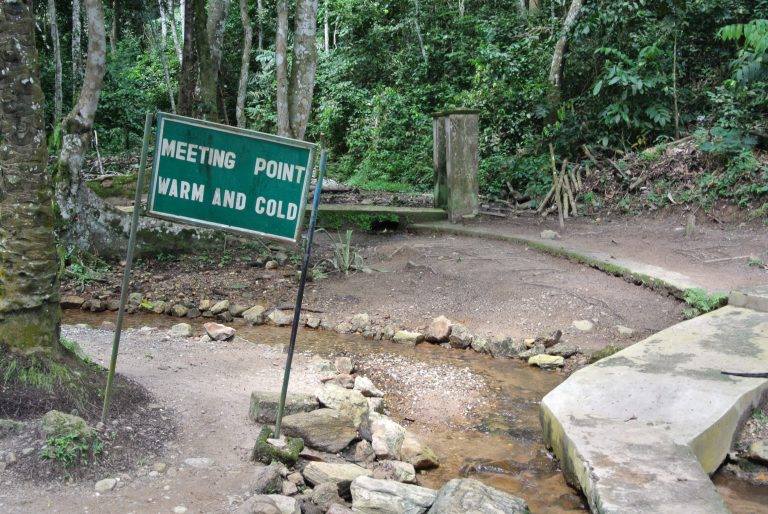
Ikogosi Warm/Cold spring in Ekiti State

Published

on

This is Ikogosi Warm/Cold spring in Ekiti State. Located in Ekiti West Local Government Area. The warm spring rolls down over a hilly landscape at 70 degrees. From another hill rises a cold spring which joins the warm spring at a confluence at the end maintaining a temperature of thirty seven degrees. Together they form a continuous stream.

The spring is said to have some therapeutic effects on some diseases like rheumatism and guinea worm. The undulating topography enhances the aesthetic beauty of the people of Ikogosi.

The people of Ikogosi worship the goddess of the water and have strong belief in the myth around it.

The myth

The traditional legend has it that the Ikogosi Warm Spring was discovered by a local hunter by the name Ogunkugan in the course of his hunting expedition.

Fagged out and with a craving for water, Ogunkugan was propelled to stop by at the water fountain, which he later discovered to have a higher temperature than other similar streams in such a pristine environment. It was with an admix of fear and ecstasy that the hunter hurriedly made his way to the Oba’s palace to reveal the amazing wonder that he had just discovered.

Pronto, the Oba dispatched a retinue of traditional title chiefs to the site to validate the awesome story. At last, it was confirmed to be true. Such a site must be idolised, the people thought in themselves, as one Ijoye Baaleshi was immediately made the spiritual head of the “Awo” (the traditional name given to the warm spring). Similarly, the adjourning cold spring, which has a confluence at a point in the same precinct was called “Awele”.

See also  Mohammed Babangida: Businessman and Son of Nigeria’s Former Military Leader

“The warm spring automatically became a place of traditional worship and point of intercession with the gods by the community dwellers for a long time during the olden days.

And it remained so until the coming of the Baptist Missionary Church into the town.

The coming of Reverend MacGee

The people of Ikogosi, while tendering this natural gift, had an encounter with a Baptist missionary, Reverend MacGee, a Briton, who was allocated some parcel of the land around the spring.

Knowing the import of the spring, Rev MacGee built a Baptist youth camp on the land, made up of chalets, a chapel, his residence, recreational corner and dormitory.

These are enclosed on the right while passing through Ikogosi to Ipole Iloro.

He managed the spring site as a tourism site and provided accommodation for visitors who streamed in to see and feel the wonders of the spring.

Rev MacGee, enjoyed the administration of the site until one night when he had an encounter with a pan Africanist fiery social critic.

Having been aware of the tourism potentialities of Ikogosi Warm spring, the late Tai Solarin packaged an excursion of some students of Mayflower School, all the way from Ikenne to Ikogosi, which was not a light adventure, considering the transportation system then.

The Mayflower group got to Ikogosi very late, wearied, tired and fagued out the excursionists desperately needed a place to sleep for the night till the next day, as there was nothing they could do by that time of their arrival.

There was no hotel or a guest house that could accommodate the excursionists other than the youth camp being run by Rev MacGee.

See also  We’ll keep preaching in buses, PFN president vows to defy proposed ban

Solarin was said to have contacted Rev MacGee requesting for accommodation, which the latter claimed to have refused on the point that the tariff which the former offered to pay for the night was low and that late Solarin did not pre–book his accommodation.

The argument that ensued and the breakdown in negotiation led to the late Tai and the students sleeping in the open.

The second day, Solarin wrote a strongly worded and potent petition to the Government of Western State alleging that Rev MacGee was practising apartheid in Ikogosi, at the site of a natural gift of God in Nigeria.

This petition generated controversy and raised dust about the propriety of a Briton running such a site in Nigeria and even going for broke by denying Nigerians from enjoying the facilities therein, not minding the fact that he planted those structures there.

And one thing led to the other, Rev MacGee was asked to vacate the land and he went back to his country, leaving behind all the structures he erected.

Chief Adekunle Ajasin collaborated with the then Nigerian Tourist Board, then under Alhaji Ahmed Gumel, which has metamorphosed to Nigerian Tourism Development Corporation, (NTDC) to develop the Area

Without gainsaying, you need to visit the Ikogosi warm spring now and see the laudable work being carried out to beautify and enhance this wonderfully and awesomely unique tourism asset in Ikogosi Ekiti by Governor Kayode Fayemi.

Source:
Wale Ojo-Lanre
Nigerian Tribune

FOLLOW US ON:

FACEBOOK

TWITTER

PINTEREST

TIKTOK

YOUTUBE

LINKEDIN

TUMBLR

INSTAGRAM

Continue Reading
Click to comment

Leave a Reply

Your email address will not be published. Required fields are marked *

Lifestyle

Women Who Love and Listen to Their Pastors More Than Their Husbands Should Be the Pastor’s Second Wife

Published

on

This statement may sound funny, provocative, or even offensive, but it raises an important question about priorities in marriage and religion.

A pastor is a spiritual leader, but he is not supposed to replace a woman’s husband. If a married woman consistently values her pastor’s opinions above her husband’s, obeys her pastor while dismissing her husband, or shows greater loyalty and admiration toward her pastor than toward her spouse, then something may be seriously wrong with the balance in that marriage.

Marriage requires communication, mutual respect, trust, and understanding. A pastor can provide spiritual guidance, but that guidance should not become a reason for a husband and wife to lose respect for each other.

At the same time, husbands should not expect their wives to obey them blindly. Both husband and wife should seek God’s wisdom, communicate openly, and make decisions with love and respect.

So perhaps the real question is not whether such a woman should become the pastor’s “second wife,” but why has the pastor become more important in her marriage than her own husband?

Put God first. Respect your spouse. And never allow a spiritual leader to become a substitute for your marriage partner.

FOLLOW US ON:

FACEBOOK

TWITTER

PINTEREST

TIKTOK

YOUTUBE

LINKEDIN

INSTAGRAM

See also  Oba Ovonramwen Nogbaisi and the Fall of the Benin Kingdom
Continue Reading

Lifestyle

Why is it only in Africa that we hear so much about “generational curses”?

Published

on

This is a question worth asking—not to insult African traditions or dismiss anyone’s beliefs, but to encourage honest reflection.

Across Africa, it is common to hear people explain repeated family problems as a “generational curse.” When poverty, broken relationships, addiction, failure, sickness, family conflict or misfortune appears to repeat from one generation to another, some people immediately conclude that an ancestor, spiritual force or past wrongdoing is responsible.

But is every repeated family problem truly a curse?

If a child grows up in poverty, has limited access to quality education, receives little financial support and then struggles as an adult, is that necessarily a spiritual curse—or could it be the result of circumstances that have been passed from one generation to another?

If children grow up watching violence, substance abuse, unhealthy relationships or constant conflict, they may unknowingly repeat those patterns. That does not necessarily mean they are cursed. Sometimes behaviour is inherited through environment, not through supernatural forces.

And Africa is certainly not the only place where people believe in supernatural explanations for suffering or misfortune. Different societies around the world have their own concepts of inherited wrongdoing, family misfortune, ancestral consequences, fate and spiritual punishment.

So perhaps the more important question is not:

“Who cursed my family?”

But:

“What pattern has been passed down to me, and what can I do to stop passing it to the next generation?”

We should be careful not to use the idea of a curse to discourage people from taking action. A family facing poverty may need education, opportunity and financial planning. A family experiencing repeated conflict may need healthier communication. A person struggling with addiction may need professional support and a strong recovery environment. Communities facing injustice may need better institutions, accountability and opportunity.

See also  Maiduguri cleaner explains why she returned N4.8m bank error

Faith and spirituality are deeply meaningful to many people, and everyone has the right to hold their beliefs. But faith should not prevent us from examining the practical causes of our problems.

We cannot change the past, but we can change what we pass forward.

Instead of teaching our children that they are victims of an unavoidable family curse, let us also teach them knowledge, discipline, emotional strength, financial responsibility, education, healthy relationships and the courage to break destructive patterns.

Maybe the greatest “curse” is not something mysterious placed upon a family.

Maybe sometimes it is simply a problem that nobody stopped long enough to understand and change.

And the greatest inheritance we can give the next generation is not fear of a curse—but the knowledge and courage to build a better future.

FOLLOW US ON:

FACEBOOK

TWITTER

PINTEREST

TIKTOK

YOUTUBE

LINKEDIN

INSTAGRAM

Continue Reading

Lifestyle

You are very proud to speak big English, but yet you cannot speak your own language?

Published

on

There is nothing wrong with speaking English fluently. In fact, being able to communicate confidently in different languages is a valuable skill. But we should ask ourselves a deeper question: while learning to speak the language of another culture, are we slowly losing the language that connects us to our own roots?

Your mother tongue is more than just words. It carries the stories of your ancestors, the wisdom of your grandparents, the jokes that only your people understand, the traditional greetings, the names, the songs, the history and the identity of your community.

Imagine being able to speak perfect English, but struggling to have a simple conversation with your own grandmother because you do not understand the language she grew up speaking. Imagine your children knowing foreign languages but being unable to understand the language of their own heritage.

That should make us pause.

Speaking English does not make you more intelligent, and speaking your indigenous language does not make you less educated. One is a communication skill; the other can be a connection to your heritage. We should not have to choose between being educated and preserving our identity.

Learn English. Speak it confidently. Learn French, Dutch, Spanish or any other language that opens doors for you.

But don’t let the pursuit of foreign languages close the door to your own.

Teach your children your language. Speak it at home. Ask your parents and grandparents to teach you the words you never learned. If you have forgotten it, it is never too late to start again.

See also  Soyinka decries Seyi Tinubu’s ‘excessive’ security escort

Because when a language disappears from a family, something precious disappears with it.

Be proud of your education. Be proud of your ability to speak English. But also be proud of where you come from.

Your language is not something to be ashamed of. It is a part of your story. Preserve it before the next generation only knows it as something their ancestors once spoke.

FOLLOW US ON:

FACEBOOK

TWITTER

PINTEREST

TIKTOK

YOUTUBE

LINKEDIN

INSTAGRAM

Continue Reading

Trending