Connect with us

Lifestyle

Ikogosi Warm/Cold spring in Ekiti State

Published

on

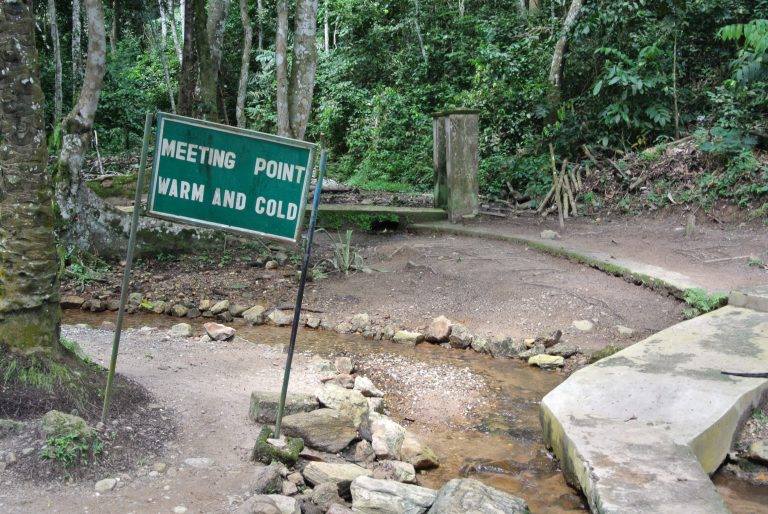
This is Ikogosi Warm/Cold spring in Ekiti State. Located in Ekiti West Local Government Area. The warm spring rolls down over a hilly landscape at 70 degrees. From another hill rises a cold spring which joins the warm spring at a confluence at the end maintaining a temperature of thirty seven degrees. Together they form a continuous stream.

The spring is said to have some therapeutic effects on some diseases like rheumatism and guinea worm. The undulating topography enhances the aesthetic beauty of the people of Ikogosi.

The people of Ikogosi worship the goddess of the water and have strong belief in the myth around it.

The myth

The traditional legend has it that the Ikogosi Warm Spring was discovered by a local hunter by the name Ogunkugan in the course of his hunting expedition.

Fagged out and with a craving for water, Ogunkugan was propelled to stop by at the water fountain, which he later discovered to have a higher temperature than other similar streams in such a pristine environment. It was with an admix of fear and ecstasy that the hunter hurriedly made his way to the Oba’s palace to reveal the amazing wonder that he had just discovered.

Pronto, the Oba dispatched a retinue of traditional title chiefs to the site to validate the awesome story. At last, it was confirmed to be true. Such a site must be idolised, the people thought in themselves, as one Ijoye Baaleshi was immediately made the spiritual head of the “Awo” (the traditional name given to the warm spring). Similarly, the adjourning cold spring, which has a confluence at a point in the same precinct was called “Awele”.

See also  Chief George Sodeinde Sowemimo, GCON (8 November 1920 – 29 November 1997)

“The warm spring automatically became a place of traditional worship and point of intercession with the gods by the community dwellers for a long time during the olden days.

And it remained so until the coming of the Baptist Missionary Church into the town.

The coming of Reverend MacGee

The people of Ikogosi, while tendering this natural gift, had an encounter with a Baptist missionary, Reverend MacGee, a Briton, who was allocated some parcel of the land around the spring.

Knowing the import of the spring, Rev MacGee built a Baptist youth camp on the land, made up of chalets, a chapel, his residence, recreational corner and dormitory.

These are enclosed on the right while passing through Ikogosi to Ipole Iloro.

He managed the spring site as a tourism site and provided accommodation for visitors who streamed in to see and feel the wonders of the spring.

Rev MacGee, enjoyed the administration of the site until one night when he had an encounter with a pan Africanist fiery social critic.

Having been aware of the tourism potentialities of Ikogosi Warm spring, the late Tai Solarin packaged an excursion of some students of Mayflower School, all the way from Ikenne to Ikogosi, which was not a light adventure, considering the transportation system then.

The Mayflower group got to Ikogosi very late, wearied, tired and fagued out the excursionists desperately needed a place to sleep for the night till the next day, as there was nothing they could do by that time of their arrival.

There was no hotel or a guest house that could accommodate the excursionists other than the youth camp being run by Rev MacGee.

See also  I Don’t Love Men – Laide Bakare Opens Up On Relationships

Solarin was said to have contacted Rev MacGee requesting for accommodation, which the latter claimed to have refused on the point that the tariff which the former offered to pay for the night was low and that late Solarin did not pre–book his accommodation.

The argument that ensued and the breakdown in negotiation led to the late Tai and the students sleeping in the open.

The second day, Solarin wrote a strongly worded and potent petition to the Government of Western State alleging that Rev MacGee was practising apartheid in Ikogosi, at the site of a natural gift of God in Nigeria.

This petition generated controversy and raised dust about the propriety of a Briton running such a site in Nigeria and even going for broke by denying Nigerians from enjoying the facilities therein, not minding the fact that he planted those structures there.

And one thing led to the other, Rev MacGee was asked to vacate the land and he went back to his country, leaving behind all the structures he erected.

Chief Adekunle Ajasin collaborated with the then Nigerian Tourist Board, then under Alhaji Ahmed Gumel, which has metamorphosed to Nigerian Tourism Development Corporation, (NTDC) to develop the Area

Without gainsaying, you need to visit the Ikogosi warm spring now and see the laudable work being carried out to beautify and enhance this wonderfully and awesomely unique tourism asset in Ikogosi Ekiti by Governor Kayode Fayemi.

Source:
Wale Ojo-Lanre
Nigerian Tribune

FOLLOW US ON:

FACEBOOK

TWITTER

PINTEREST

TIKTOK

YOUTUBE

LINKEDIN

TUMBLR

INSTAGRAM

Continue Reading
Click to comment

Leave a Reply

Your email address will not be published. Required fields are marked *

Lifestyle

Nigeria’s ambassador-designate to Algeria, Lele, dies at 50

Published

on

The Federal Government has announced the death of Nigeria’s ambassador-designate to Algeria, Mohammed Mahmud Lele, who died at the age of 50.

The Ministry of Foreign Affairs disclosed this in a statement issued in Abuja on Wednesday by its spokesperson, Kimiebi Ebienfa.

According to the ministry, Lele died in the early hours of April 19, 2026, in Ankara, Türkiye, after a protracted illness.

The ministry described the late diplomat as a dedicated officer who served the country with distinction.

“The late Ambassador Lele, until his death after a protracted illness, was the Director in charge of the Middle East and Gulf Division in the Ministry of Foreign Affairs.

“Ambassador Lele, a career diplomat, was recently appointed by President Bola Ahmed Tinubu as Ambassador-designate to the People’s Democratic Republic of Algeria, following the Nigerian Senate’s confirmation of his nomination,” the statement said.

Born in Gamawa, Bauchi State, in 1976, Lele studied Economics at Bayero University, Kano, and went on to serve in Nigerian missions in Berlin, Lomé and Riyadh.

“Ambassador Lele was known for his intellectual depth, strategic insight and commitment to the advancement of Nigeria’s foreign policy objectives,” the statement added.

The Permanent Secretary of the ministry, Dunoma Umar Ahmed, who received the remains of the late diplomat at the Nnamdi Azikiwe International Airport, Abuja, described him as “a hardworking, humble and fine officer, who will be sorely missed by the ministry.”

The ministry added that his death “is a monumental loss not only to his immediate family but also to the entire Foreign Service community and the Federal Republic of Nigeria.”

See also  I Don’t Love Men – Laide Bakare Opens Up On Relationships

Lele was buried on Wednesday in Kano in accordance with Islamic rites.

The ministry extended condolences to his family, associates, and the government and people of Bauchi State, praying for the peaceful repose of his soul and strength for those he left behind.

Continue Reading

Lifestyle

Governor Amuneke reveals party officials offered him dollars to alter anti-govt skits

Published

on

Comedian Kevin Chinedu, popularly known as Kevinblak, has revealed that officials of a political party offered him dollars to change his satirical skits criticising politicians and governance.

He made the disclosure on Monday in an interview on ARISEtv’s Arise 360 programme, where he spoke about the pressures facing content creators who hold public officials accountable through humour.

Chinedu, known for his character Governor Amuneke, said the approach came at a particularly vulnerable moment, shortly after his wife had a Caesarean section and he was under financial strain.

“They said they were going to change my life, that I’m earning crumbs, you know, give me dollars. They mentioned that my colleagues are in the game and all of that,” he said.

He declined to name the party, saying only that it was “Amuneke’s party”, a reference to the fictional political figure in his skits, and cautioned against any attempt to identify it publicly.

“Don’t mention names, trust me, don’t mention names,” he said.

Despite the financial pressure, the comedian said he turned down the offer, recalling how the officials had tried to lure him to Abuja with the promise of a life-changing sum.

“I had a lot of bills on my head and I just heard come, come to Abuja, let’s change your life. Dollars upon dollars,” he said.

He said he ultimately held firm, guided by a personal code he had maintained throughout his career.

“I looked at it, I said, no, I am who I am. I’ve been here for a long time, and I’ve never been in any illegal thing, and I’ve never been somewhere, you know, I’m doing something because I’m being influenced, because of money.

See also  Princess Omo-Oba Adenrele Ademola: The Nigerian Royal Who Served as a Wartime Nurse (PHOTOS)

“If I want to do it, it should be something I’m doing because I want to do it. So, you know, it is what it is,” he said.

When asked whether friends had urged him to accept the money, Chinedu said his inner circle was equally principled, and had themselves been approached and refused.

“I don’t have friends that are easily overwhelmed with money. I have people who have principles because they have, you know, approached them, they themselves. So, we always have that conversation,” he said.

punch.ng

FOLLOW US ON:

FACEBOOK

TWITTER

PINTEREST

TIKTOK

YOUTUBE

LINKEDIN

INSTAGRAM

Continue Reading

Lifestyle

Over 4,600 Nigerian doctors relocate to UK in three years – Report

Published

on

Nigeria’s already fragile healthcare system is facing renewed strain as no fewer than 4,691 doctors have relocated to the United Kingdom since President Bola Tinubu assumed office on May 29, 2023, fresh data from the General Medical Council shows.

The UK GMC is a public official register detailing the number of practising doctors in the UK alongside other details such as their areas of speciality, country of training, among others.

The mass migration represents not just a human resource crisis but a significant economic loss.

With the Federal Government estimating that it costs about $21,000 to train a single doctor, Nigeria has effectively lost at least $98.5m in training investments within less than two years.

The figure put the total number of Nigeria-trained doctors currently practising in the UK to about 15,692, making Nigeria one of the largest sources of foreign-trained doctors in Britain, second only to India.

As of May 28, 2025, official records showed that the number of Nigerian-trained doctors in the UK was a little over 11,000. The figure has grown significantly since then.

The exodus of doctors comes as Nigeria’s doctor-to-population ratio hovers around 3.9 per 10,000 people, far below the minimum threshold recommended by the World Health Organisation.

For many health experts, the numbers confirm what has long been visible: a system gradually losing its most critical workforce.

The Nigerian Medical Association has repeatedly warned that poor remuneration, unsafe working conditions, and inadequate infrastructure are pushing doctors out of the country.

“Our members are overworked, underpaid and exposed to unsafe environments daily. Many are simply burnt out,” the NMA said in one of its recent statements addressing workforce migration.

See also  Homosexuality scandal rocks Nigerian Catholic Church

Similarly, the National Association of Resident Doctors has consistently highlighted the toll on younger doctors, who form the backbone of Nigeria’s tertiary healthcare system.

“Doctors are leaving because the system is failing them—irregular salaries, excessive workload, and lack of training opportunities,” NARD noted during one of its nationwide engagements.

Ironically, the doctor exodus persists even as Nigeria continues to spend heavily on healthcare abroad.

While official foreign exchange data shows only modest spending on medical tourism in recent years, broader estimates suggest Nigerians still spend hundreds of millions of dollars annually seeking treatment overseas.

For instance, a recent report by The PUNCH revealed that foreign exchange outflow for health-related travel by Nigerians surged to $549.29m in the first nine months of 2025, a 17.96 per cent increase from $465.67m in the same period of 2024, according to official data by Nigeria’s apex bank.

A public health expert, Dr David Adewole, noted that the Federal Government’s national policy on health workforce migration, aimed at curbing the growing trend of health professionals leaving the country—commonly referred to as ‘Japa’—is a good initiative, but may not do much to address the fundamental problems of the shortage of skilled healthcare professionals in Nigeria, particularly in rural and underserved areas.

According to him, many of the push factors for health professionals emigrating to greener pastures, like insecurity, emolument and lack of basic amenities like potable water, health facilities, cost of living and constant electricity, persisted.

He stated: “To make healthcare workers stay here, let the salaries be enough so that what you earn will be much more than the multiples of what you need for basic needs, like food, power supply, housing, and so forth.

See also  I Don’t Love Men – Laide Bakare Opens Up On Relationships

“People still look at life after retirement. You might have a good policy, but its implementation is the issue. For example, you are retired, and for your retirement package, you don’t need to know anyone for it to be processed promptly.

“Then subsequently, your monthly pension, without pressing anybody, should be paid. Those things are not here.

“And when you go to the hospital abroad, if you tell them that you are in a hurry, you go to your home; they’ll bring the medicines to your doorstep.”

Continue Reading

Trending