Connect with us

Lifestyle

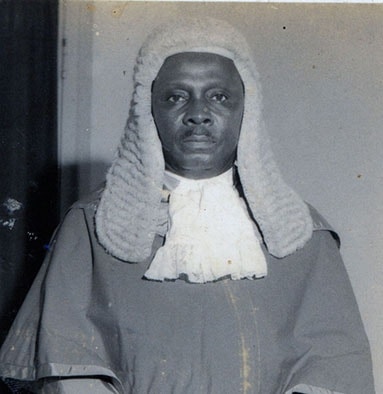
Justice Akinwunmi Rhodes-Vivour: A Legacy Carved in Law and Integrity

Published

on

Born on the 8th of July, 1910, in Lagos Island, Akinwunmi R.W. Rhodes-Vivour came from a distinguished lineage that would later shape some of Nigeria’s most illustrious legal minds. His father, Garnet Vivour, and mother, Sarah Rhodes de Vivour, belonged to the early class of educated Lagosians. From the start, his life was steeped in the values of hard work, discipline, and public service.

He began his early education at the Methodist Church Primary School and continued at the prestigious Wesleyan Boys’ High School in Lagos. Initially trained as a surveyor, he obtained a diploma in Surveying from the British Institute of Engineering Technology, London, and worked with Shell and D’Arcy Exploration between 1939 and 1942. However, destiny had other plans. Inspired by his uncle, Justice Steven Bankole Rhodes—one of the earliest Nigerian judges—young Akinwunmi turned his attention to law.

He went on to study law in London and was called to the Bar at the Middle Temple on the 18th of November, 1946. Upon his return to Nigeria, he joined the colonial judicial system as a Magistrate Grade I on August 1, 1950. Through sheer dedication and an unwavering commitment to justice, he rose through the ranks: promoted to Senior Magistrate in 1955, Chief Magistrate in 1961, and appointed a High Court Judge in 1964. He served in this capacity until his retirement in 1972.

Justice Rhodes-Vivour’s tenure was not without turbulence. During the military rule of Col. Samuel Ogbemudia in the Mid-Western region, he was falsely accused of bribery in a case widely believed to be politically motivated. He fought the charges in court, was acquitted, and emerged with his integrity intact—a testament to his character and resilience in the face of power.

See also  Fela wouldn’t have been great if he wasn’t from privileged background – Seun Kuti

Beyond the bench, he was deeply respected in society. In 1972, the Alake of Egbaland honored him with a traditional chieftaincy title. He was also a prominent member of the Lagos Metropolitan Club and the Island Club, institutions that symbolized the emerging Nigerian elite of his time.

Justice Akinwunmi Rhodes-Vivour’s influence did not end with his own life. His legacy lived on through his son, Justice Bode Rhodes-Vivour, who rose to become a Justice of the Supreme Court of Nigeria, and through his grand-nephew, Gbadebo Rhodes-Vivour, a prominent architect and political figure in Lagos.

He passed away in 1987, leaving behind a name etched into the annals of Nigerian legal history—respected, tested, and never found wanting.

FOLLOW US ON:

FACEBOOK

TWITTER

PINTEREST

TIKTOK

YOUTUBE

LINKEDIN

TUMBLR

INSTAGRAM

Continue Reading
Click to comment

Leave a Reply

Your email address will not be published. Required fields are marked *

Lifestyle

When Love Becomes Emotional Blackmail: How to Recognise the Difference

Published

on

“If you really loved me, you would do it.”

It sounds like an emotional statement, but sometimes a sentence like this can be more than an expression of hurt—it can be a way of putting pressure on someone to do something against their wishes.

Emotional blackmail occurs when a person uses guilt, fear, threats, punishment, or emotional pressure to influence another person’s decisions.

It can happen in romantic relationships, friendships, families, workplaces, and even between parents and children.

When Does Emotional Pressure Become Manipulation?

Everyone expresses disappointment. Everyone can feel hurt when someone says no.

The difference is in how those emotions are used.

Statements such as:

“After everything I have done for you, this is how you repay me?”
“If you really loved me, you would do this.”
“Fine, do whatever you want. Now I know where I stand.”
“You will regret it if you refuse.”
“Do it, or I will never forgive you.”

can place someone under significant emotional pressure.

A person may eventually agree—not because they genuinely want to, but because they feel guilty, frightened, or responsible for the other person’s emotions.

Love Does Not Mean Giving Up Your Right to Say No

Healthy relationships involve compromise, but compromise should not require manipulation.

You can love someone and still disagree with them.

You can appreciate everything someone has done for you and still refuse a request.

You can care deeply about a partner, friend, parent, or family member while maintaining personal boundaries.

Saying “no” does not automatically mean that you do not love someone.

See also  You Got a Foreign Passport, Not a Crown: Citizenship Is a Privilege, Not Proof of Superiority

Likewise, someone being disappointed by your decision does not automatically mean they are emotionally blackmailing you.

Context matters.

Why Emotional Blackmail Can Be Difficult to Recognise

Emotional blackmail does not always look aggressive.

Sometimes it appears as crying, withdrawal, silence, repeated reminders of past sacrifices, threats to end a relationship, or making someone feel responsible for another person’s happiness.

That is why it can be difficult to recognise.

A useful question to ask yourself is:

“Am I changing my decision because I genuinely changed my mind, or because I am afraid of what will happen if I say no?”

The answer may reveal whether you are making a free choice or responding to emotional pressure.

Boundaries Are Not Disrespect

Setting a boundary does not necessarily mean rejecting someone.

A person can say:

“I understand that you are hurt, but I am still not comfortable doing this.”

That response acknowledges the other person’s feelings without surrendering personal choice.

Healthy communication allows people to express disappointment without using guilt, threats, fear, or punishment to force an outcome.

Love, Sacrifice and Control

Relationships often require sacrifice. Parents sacrifice for their children. Partners make compromises. Friends support each other.

But sacrifice should not automatically become a tool for control.

“I did this for you, so you must do this for me” can turn kindness into a transaction.

The important question is not simply whether someone has sacrificed for you. It is whether that sacrifice is now being used to control your decisions.

The Bigger Question

Emotional blackmail is not always obvious, and not every emotional statement is manipulation.

See also  The Ultimate Nigerian Native Jollof Rice Recipe (Authentic Palm Oil Rice)

Sometimes people simply express their pain badly. Other times, repeated guilt, threats, fear, or punishment may be deliberately used to control another person’s choices.

The difference deserves honest conversation.

So, what do you think?

When someone says:

“If you really loved me, you would do it.”

Is it simply an expression of hurt—or can it become emotional blackmail?

Share your opinion in the comments.

FOLLOW US ON:

FACEBOOK

TWITTER

PINTEREST

TIKTOK

YOUTUBE

LINKEDIN

INSTAGRAM

Continue Reading

Lifestyle

Nollywood Actress, Jumoke Odetola Turns Minister Of God

Published

on

Nollywood actress, Jumoke Odetola, has announced that she has dumped acting for ministerial work.

It was reports that Jumoke made the announcement while addressing fans’ concerns about her disappearance from the screen.

In a post via her Instagram page on Saturday, the movie star said she is now a minister of God.

While asking the public for prayers, Jumoke Odetola said God had compelled her to work for Him.

She said, “I’m now a minister of God. I am entering a new season with God. I need all the prayers in this season.

“When God compels you, you may delay, but you cannot escape the call.”

FOLLOW US ON:

FACEBOOK

TWITTER

PINTEREST

TIKTOK

YOUTUBE

LINKEDIN

INSTAGRAM


See also  I Raised ₦8 Million To Japa. I Was Deported The Next Day
Continue Reading

Lifestyle

ARE SOME PARENTS CHOOSING MONEY OVER THEIR OWN CHILDREN?

Published

on

Some parents spend years chasing money, building businesses and accumulating wealth—all in the name of “giving their children a better life.”

But here is the uncomfortable question:

What if your child has everything money can buy, but doesn’t have YOU?

A child needs more than school fees, expensive clothes, gadgets and a comfortable home.

They need your time.
They need your attention.
They need your affection.
They need to know that they are loved, heard and valued.

💰 Money can be earned again.

❤️ But once a child’s trust is broken, rebuilding it may not be easy.

🕰️ And once childhood is gone, you can never buy it back.

Don’t become so busy providing for your children that you forget to actually be present in their lives.

Because one day, your child may remember the money you provided—but they may remember even more clearly the moments you were never there.

🔥 QUESTION:

Do you believe some parents are sacrificing too much family time in the pursuit of money?

Tell us what you think in the comments.

#Newsbreak365 #Parenting #Children #Family #Parenthood #LifeLessons #FamilyValues #Money #Childhood #Relationships

FOLLOW US ON:

FACEBOOK

TWITTER

PINTEREST

TIKTOK

YOUTUBE

LINKEDIN

INSTAGRAM

See also  THE EVILDOERS IN OUR SOCIETY
Continue Reading

Trending