
Connect with us

Business

CBN – Lending rates may fall as inflation eases

Published

on

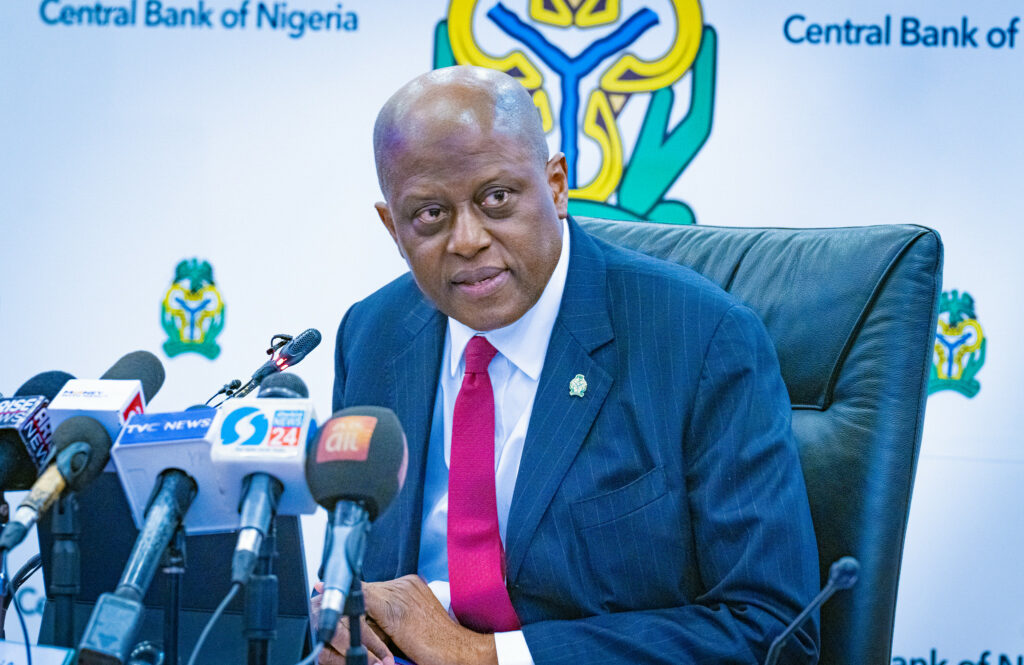
The Governor of the Central Bank of Nigeria, Mr Olayemi Cardoso, has hinted that lending rates may decline in the coming months as inflation continues to ease, raising hopes for improved access to credit and stronger investment flows.

Cardoso gave the assurance during a fireside chat at the European Business Chamber (Eurocham Nigeria) C-Level Forum in Lagos on Saturday.

A statement by the CBN on Sunday reaffirmed the bank’s commitment to macroeconomic stability, a stronger banking sector, and positioning Nigeria as a top investment destination.

According to the CBN governor, headline inflation, though still high, has begun to slow down, creating the possibility of lower lending rates once price stability is further consolidated.

“He stated that there is a substantial potential for interest rates to decrease in the future as inflation continues to decline and as markets become more efficient in allocating capital,” the statement read.

He was also quoted in the statement as saying, “That is the environment in which stronger corporate lending and higher levels of investment will naturally follow.”

Cardoso acknowledged that high lending rates have weighed on businesses but explained that the CBN’s priority has been to restore confidence and strengthen the system’s resilience.

“We will protect the stability that has been re-established in the financial system with the utmost zeal,” the statement quoted him as saying. “Our primary objective is to maintain that stability while simultaneously addressing inflation and ensuring that the financial system is sufficiently resilient to facilitate corporate lending and investment.”

The Governor highlighted the progress of the ongoing bank recapitalisation exercise, which he described as critical for safeguarding the financial system.

See also  BUA Foods declares N13 per share dividend for shareholders

He explained that the new minimum capital requirements would produce stronger institutions capable of withstanding shocks and financing broader economic growth.

He further stressed that technology-driven solutions and the deepening of financial inclusion were key priorities for the Bank.

According to him, expanding access to fintech platforms and supporting innovation will play a central role in tackling poverty and bridging financing gaps.

Cardoso also pointed to improved coordination with the fiscal authorities as a positive shift in Nigeria’s policy environment, noting that collaboration with the Ministry of Finance, the Ministry of Trade and Industry, and the Budget Office “will enable the country to sustain reforms and achieve long-term stability.”

Speaking on Nigeria’s position in the global economy, the CBN Governor remarked that the country’s size and strategic location gave it a unique role to play in West Africa and beyond.

“The urgency of addressing our own affairs is underscored by the ongoing geopolitical changes,” he observed.

The statement added, “Nigeria is a market that is both large and appealing in its own right, and it is also situated at the entrance to the broader continent and West Africa. This underscores the importance of maintaining stability at home.”

Earlier, Eurocham President Yann Gilbert praised the forum as an important platform for dialogue between European businesses and Nigerian policymakers.

He noted that members of the chamber were committed to long-term partnerships in Nigeria, with a focus on job creation and sustainable investment.

The CBN raised its benchmark lending rate six times in 2024, pushing the Monetary Policy Rate from 18.75 per cent at the start of the year to 27.50 per cent by December.

See also  FG eyes N796bn annually from 5% petrol surcharge

The aggressive tightening cycle was aimed at stemming runaway inflation and stabilising the naira, which had been under sustained pressure.

Records show that the series of hikes, delivered across all six MPC meetings in 2024, represented the steepest monetary tightening in recent history.

Each decision was followed by statements emphasising the Bank’s resolve to restore price stability and anchor investor confidence in the domestic economy.

The final increase, announced at the November meeting, brought the MPR to 27.50 per cent, its highest level on record.

However, 2025 has so far marked a pause in the tightening cycle. The CBN has held the rate unchanged at 27.50 per cent in each of its meetings this year, including those in February, May, and July.

It was earlier reported that businesses across Nigeria have ranked high interest rates as the most severe constraint affecting their operations in June 2025, overtaking long-standing challenges such as insecurity and poor electricity supply.

The CBN disclosed this in its June 2025 Business Expectations Survey, which polled 1,900 firms across the agriculture, services, and industrial sectors.

According to the report, high interest rates scored 75.6 on the constraint index, followed by insecurity at 75.2 and insufficient power supply at 74.3.

The Director-General of the Lagos Chamber of Commerce and Industry, Dr Chinyere Almona, earlier warned that retaining the MPR at 27.5 per cent translates to a significant burden on businesses.

“We must restate that the interest rate at 27.5 per cent remains a depressing burden on businesses. We therefore desire to see a reduction in the Monetary Policy Rate,” Almona said.

See also  Nigerian billionaire Tonlagha hires lobbyists to push Nigeria-US ties

The next Monetary Policy Committee meeting is scheduled to be held on September 22 and 23, 2025, according to the Bank’s published calendar.

Market watchers are looking to that meeting for signals on whether the regulator will maintain its pause or begin to ease policy as inflation continues to ease.

FOLLOW US ON:

FACEBOOK

TWITTER

PINTEREST

TIKTOK

YOUTUBE

LINKEDIN

TUMBLR

INSTAGRAM

Continue Reading
Click to comment

Leave a Reply

Your email address will not be published. Required fields are marked *

Business

X offers changes to blue checkmarks after $138m EU fine

Published

on

Elon Musk’s X has offered to make changes to its blue checkmark for “verified” accounts, a European Commission spokesman said Friday, after the platform received a 120-million-euro ($138 million) fine.

The European Union slapped the fine in December on X for breaking its digital rules, including through the “deceptive design” of its blue checkmark.

“X has submitted remedies in relation to its blue checkmark. The commission will now carefully assess the proposed remedies,” EU spokesman for digital affairs Thomas Regnier said.

He did not provide details about what X had submitted.

X risked periodic financial penalties had it not submitted any remedy.

“We have to value the fact that after a constructive exchange with the company, the company has taken its obligation seriously and has submitted us remedies,” Regnier told reporters in Brussels.

When contacted by AFP, X did not provide comment immediately.

Blue checkmarks, long free of charge at what was previously known as Twitter, were intended to signal the identity of certain users — such as celebrities, journalists and politicians — had been verified in an effort to build trust in the platform.

But after Musk bought the platform, he allowed users to pay to get one.

X in February announced it had filed an appeal with the EU’s top court against the fine, which was the first ever under the bloc’s Digital Services Act (DSA).

But Regnier said the commission still expected X to pay it by Monday, and to provide further remedies on other breaches by April 28.

The fine came under a probe started in December 2023.

See also  Nigeria exits global money-laundering watchlist

That investigation continues as EU regulators study how X tackles the spread of illegal content and information manipulation.

X has often been in the EU’s sights.

The 27-nation bloc in January began another DSA probe into the company’s AI chatbot Grok’s generation of sexualised deepfake images of women and minors after a global outcry.

AFP

Continue Reading

Business

Akwa Ibom to drive large-scale farming with equipment leasing firm

Published

on

Akwa Ibom State Government has said it will soon inaugurate its Agric Equipment Leasing Company as part of efforts to promote large-scale mechanised farming in the state.

Governor Umo Eno disclosed this while fielding questions from Government House correspondents shortly after inspecting the progress of work at the company’s facility located at Ekpri Nsukara in Uyo on Thursday.

In a statement obtained from the Government House Press Unit on Friday, the governor commended the contractor for the progress recorded at the project site.

“There is a lot of improvement in the work done here to get the company kick-started in earnest.

“The contractor has given her word that the project will soon be inaugurated, and I hold her to that,” he said.

Eno explained that the essence of the project is to encourage farmers to embrace large-scale farming in order to boost productivity, increase earnings and ensure food sufficiency in the state.

“The farming season is here again, and we are putting everything in place for this project to function optimally. There are over 25 tractors with tracking devices and two low-bed trucks in readiness for the agriculture programme.

“What we intend to do here is to lease these equipment to our farmers across the state at subsidised rates so that they can utilise it for improved farming productivity.

“These farming equipment range from ploughs to harvesters and other implements that will help improve farming output,” he said.

The governor noted that the initiative forms part of his administration’s strategy to mechanise farming methods in the state in order to achieve large-scale crop production and increase farmers’ profits.

See also  DisCos install 228,614 meters in Q3, 2025 — NERC

Speaking on the government’s tree-crop revolution programme, Eno assured that the initiative would commence once the rainy season sets in, noting that such crops thrive better during the rainy season.

“The nursery for palm seedlings has already been established, and the necessary enumeration of farmers has been conducted across the state.

“Within the next two weeks, the seedlings will be distributed to farmers for planting across the state,” he added.

The governor urged farmers to take advantage of the various agricultural programmes introduced by the government to enhance large-scale farming output and improve economic growth in the state.

punch.ng

FOLLOW US ON:
FACEBOOK

TWITTER

PINTEREST

TIKTOK

YOUTUBE

LINKEDIN

Continue Reading

Business

Forum dismisses claims of N210tn missing in NNPC accounts

Published

on

A coalition of professionals under the Ajiyya Solidarity Forum has dismissed allegations that about N210tn is missing from the accounts of the Nigerian National Petroleum Company Limited (NNPC).

Addressing journalists on Thursday, ASF National Coordinator, Usman Hamza, described the claim as “mathematically impossible” and politically motivated.

The group’s position is in response to a recent claim by the Chairman of the Senate Public Accounts Committee, Ahmed Wadada, that the NNPC Limited could not account for about N210tn.
Hamza said such a figure was misleading.

“Senator Wadada’s claim of N210tn ‘unaccounted for’ funds is a mathematical impossibility designed to shock the public,” Hamza said.

He argued that the claim did not align with Nigeria’s fiscal reality, noting that the country’s entire 2024 national budget stood at about N28.7tn.

“To suggest that a single entity ‘lost’ nearly eight times the national budget is an insult to the intelligence of Nigerians,” he added.

The forum also condemned threats of arrest warrants against former officials of NNPCL, including former Chief Financial Officer, Umar Ajiya, describing the move as part of a coordinated campaign of political blackmail.

According to the group, the Senate committee may have misinterpreted financial figures by combining accrued expenses and receivables in a way that falsely suggests missing funds.

“We consider that the committee has erroneously ‘netted’ N103tn in accrued expenses, largely joint venture liabilities, with N107tn in receivables owed to NNPCL. Labelling money owed to a company as ‘missing funds’ is a professional travesty,” Hamza stated.

During the ongoing review of the financial records of Nigerian National Petroleum Company Limited, the Senate Public Accounts Committee, chaired by Wadada, had raised concerns over alleged discrepancies running into trillions of naira.

The ASF maintained that the allegations ignored the broader financial and structural reforms undertaken by the national oil company in recent years.

See also  Naira could hit N1,100 to $1 in 2026, says Dangote

Furthermore, Hamza mentioned that the tenure of former CFO Ajiya coincided with the transition of the national oil firm into a commercial entity under the Petroleum Industry Act, a reform that ended decades of opaque financial reporting.

“Mr Ajiya’s tenure saw the transition of NNPC into a commercially driven entity and the publication of the first audited financial statements in 43 years,” the forum stated.

ASF defended the N5.9bn cost incurred during the transition process of NNPC to NNPC Limited, saying it covered complex legal and structural reforms required to transform the former state corporation into a limited liability company.

The forum warned that politicising the Senate’s oversight role could damage Nigeria’s credibility in the eyes of international investors.

“Using the Senate’s hallowed chambers to pursue personal vendettas damages Nigeria’s reputation with international investors,” Hamza said.

The forum further called on the leadership of the Senate to institute an independent ethics investigation into what it described as an alleged demand for bribes linked to the ongoing oversight process.

“We call on the Senate leadership and its Ethics Committee to investigate the alleged bribe demand connected to this oversight exercise,” he said.

He urged lawmakers to stop what he described as the harassment of officials who have already submitted several technical responses to the committee.

“Public accountability should be pursued through a sober forensic review of facts, not through sensational claims and phantom numbers,” he added.

punch.ng

FOLLOW US ON:

FACEBOOK

TWITTER

PINTEREST

TIKTOK

YOUTUBE

LINKEDIN

Continue Reading

Trending