

Connect with us

Business

Dangote Refinery: Consumer Forum says PENGASSAN plotting to sabotage energy independence

Published

on

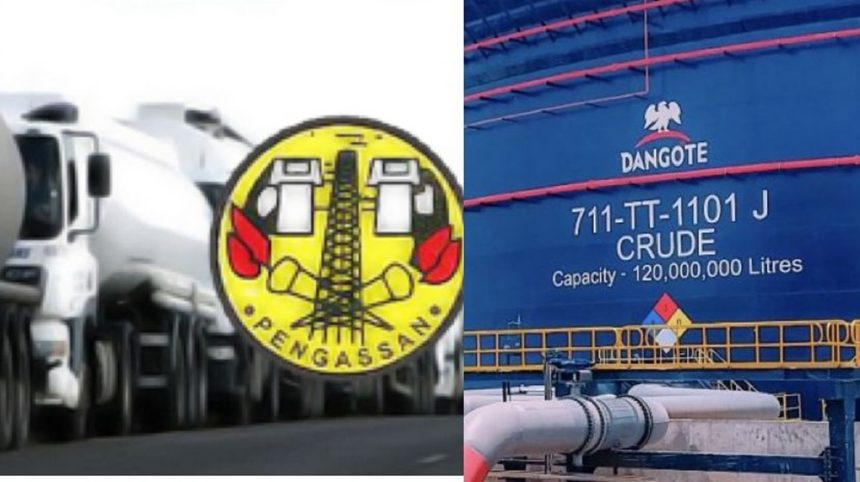
Following plans by the Petroleum and Natural Gas Senior Staff Association of Nigeria, PENGASSAN, to shut down Dangote Refinery, the Concerned Nigerian Consumers Forum has called on the Federal Government and the Department of State Services, DSS, to investigate what it described as a plot by the union to sabotage energy independence in the country.

The Forum, while expressing alarm over PENGASSAN’s threat to picket the $20 billion refinery over recent mass sacking of workers, described Dangote Petroleum Refinery as a critical national asset aimed at achieving Nigeria’s energy independence.

In a statement signed by Comrade Olabisi Taiwo, President, and Dr. Justice Akani Alikor, Secretary, the Forum accused PENGASSAN of plotting to return Nigerians to the agonies of fuel scarcity, with attendant economic instability and national embarrassment.

Urging Nigerians to question PENGASSAN’s motives, the Forum said, “PENGASSAN, alongside NUPENG, played a significant role in the collapse of Nigeria’s public refineries in Port Harcourt, Warri, and Kaduna.

“They resisted reforms, blocked privatization, and crippled fuel supply with strikes. Their actions contributed to the rot that turned these refineries into relics of corruption and mismanagement.”

According to the Forum, Dangote Refinery is a private initiative designed to end Nigeria’s reliance on imported fuel while stabilizing prices and creating jobs.

It further noted that the refinery, which employs over 3,000 Nigerians and continues to recruit, is not anti-labor but focused on operational efficiency and safety.

The Forum criticized PENGASSAN’s threat to picket the refinery despite a court order restraining industrial action, describing its actions as “union overreach” and a violation of the rule of law.

See also  Rising debt: Financial expert, Idakolo x-rays Nigeria’s situation

“Who benefits if the refinery fails? Certainly not the Nigerian people but fuel importers and rent seekers who profit from chaos,” the Forum noted.

Condemning what it termed “irresponsible unionism”, the Forum urged PENGASSAN to engage in dialogue, respect the courts and prioritize national interest.

In the same vein, the Forum called on the ministries of Labour, Petroleum Resources and Justice to intervene and stop the threat to shut down the refinery.

“The government must send a clear message: industrial blackmail will not be tolerated.

“Nigerians have suffered enough from fuel queues and economic hardship. The Dangote Refinery is our best chance at energy independence, and we must not allow vested interests to destroy it,” the Forum added.

FOLLOW US ON:

FACEBOOK

TWITTER

PINTEREST

TIKTOK

YOUTUBE

LINKEDIN

TUMBLR

INSTAGRAM

Continue Reading
Click to comment

Leave a Reply

Your email address will not be published. Required fields are marked *

Business

CNG: States race to cut transport fares, read details

Published

on

As the Federal Government moves to deliver measurable reductions in transportation costs from October 1, states are adopting different approaches to the Compressed Natural Gas initiative, with some already operating subsidised transport services while commercial operators in several others complain about inadequate refuelling infrastructure, high conversion costs and long queues at existing stations.

The uneven rollout has raised questions about the ability of transport operators and state governments to deliver cheaper fares across the country within the timeline set by President Bola Tinubu.

The President, after meeting the 36 state governors on August 27, announced an implementation committee for the National Affordable CNG Transit Programme under the Nigeria Governors’ Forum, chaired by Governor AbdulRahman AbdulRazaq.

In an update on Saturday, Tinubu urged states to work with transport unions and commercial operators, support vehicle conversion and fleet deployment, and ensure that savings from cheaper energy were passed on to commuters through lower fares. The Presidency said more than 120,000 vehicles had been converted, with over 400 certified conversion centres and more than 90 CNG refuelling stations across the country.

But while the Federal Government says the infrastructure is expanding, transport operators in some states say the available facilities remain inadequate to support widespread conversion.

The challenge is particularly evident in areas where motorists already using CNG spend several hours waiting to refuel.

CNG queues

In Lagos, CNG queues have continued to be reported at some filling stations, including the NIPCO facility at Ibafo along the Lagos-Ibadan Expressway. At about 9:30 pm during one such visit, buses, cars and trucks were seen waiting to buy CNG, with the queue extending towards the highway.

A commercial driver, Saheed, said the scarcity of stations was forcing operators to spend hours waiting for the product.

“We have been here since 7:30 pm. My bus is just getting close to the pump. The reason for this queue is because we have a few CNG stations along this axis. Some have left to go and buy petrol, but N1,400 is too much for a commercial driver. That’s why you see my buses here,” he said.

A commuter who expressed frustration with the queues said the delays were discouraging some passengers from using CNG-powered buses. “This is why I don’t like boarding CNG buses. Aside from asking to disembark from the bus, they will also delay your journey by staying in the queue,” the commuter said.

Similar queues have been reported around Mowe and Ibafo, as well as at NNPC Ilasamaja and NIPCO Mobil on Ajegunle Road. For some commercial operators, the problem is not only the availability of CNG but also the cost of converting their vehicles.

A commercial driver, Musa Kazeem, said he had considered converting his vehicle but was discouraged by the cost and the prospect of spending hours at refuelling stations.

“I planned to convert my vehicle last month, but they told me to look for N800,000 or N1m, depending on the size of the cylinders I want. Where will I get that? Another issue is, after doing the conversion, I will have to stay in a long queue for hours to buy the product. It now looks as if the CNG stations inherited the petrol queues we used to have before the Dangote refinery became operational,” he said.

Another concern among some motorists and passengers is safety. A middle-aged man, Oladeinde Lekan, said he remained worried about the possibility of CNG-related accidents despite government assurances about safety.

The shortage of stations has also attracted concern from transport industry leaders.

NARTO speaks

The National Association of Road Transport Owners National President, Yusuf Othman, said the queues were costing operators valuable time.

“The queues in CNG stations are really costing us time, because time is money. And this is because of the non-availability of refilling stations. The stations are not many; therefore, because of those long queues, we lose a lot of time and money,” he said.

Othman, however, said more stations were being developed and that increased infrastructure would gradually reduce the queues.

“There are a lot of CNG stations coming up. The government is intervening through the Midstream and Downstream Gas Infrastructure Fund. That will go a long way in having many stations, and with those many stations, of course, all those queues will reduce. You know, a lot of people are just keying into CNG. They are not used to it, but it’s gradual,” he said.

He added that despite the difficulties associated with the rollout, CNG remained cheaper than petrol.

“As it is now, CNG is the way to go. It’s clean energy, and it’s cheaper. The only problem is the queue, and when we have more stations, transporters will have no choice. Usually, people are susceptible to change. They don’t accept change easily. But then, this is a change that is coming with gains; because we are going to save a lot of money in the purchase of CNG as against petrol or diesel,” Othman said.

See also  Port Harcourt Customs Record N247bn Revenue In 10 Months

Situation across states

The situation in the various states shows the contrast between existing subsidised transport schemes and the slower adoption of CNG by private commercial operators.

In Plateau State, the government said it was already providing one of the cheapest city transport services in the country through its social intervention programme.

The Commissioner for Transport, Davou Jatau, said the government bus service charged N200 for journeys covering between 18km and 20km within Jos.

“Within a short time, we have a transportation system within the city centre that compares to no other state in Nigeria in terms of rating and affordability. You can quote me anywhere; there is no state in Nigeria that charges only N200 for between 18km and 20km distance coverage,” he said.

He said the programme was not designed to make a profit. “Since the removal of fuel subsidy, a journey from Zawan Junction in Jos to a place like Terminus cost between N1,000 and N1,400 in a taxi, but you have a government bus that picks you up for just N200. On a return trip, that is just N400,” Jatau said.

He added that the savings made by commuters could provide additional disposable income for households. However, the Chairman of NTA Park, Jos, Alhaji Ibrahim Maikudi, said the Federal Government’s CNG programme had not translated into tangible benefits for transport operators in Plateau.

“They once approached us, took our plate numbers and everything, but nothing has happened. In Plateau State, for instance, there is no station where you have a CNG vehicle that you go and buy CNG in the Plateau completely,” he said.

Maikudi said some CNG buses supplied to the state were parked because there was no station where they could refuel. He also argued that the government’s subsidised buses had limited coverage, with the service concentrated around Jos-Bukuru.

In Kaduna State, however, the CNG programme has already become part of the state’s mass transit system. The state government said its free CNG bus service had been operating since July 2025, after the inauguration of 100 CNG buses.

The Commissioner for Information and Culture, Malam Ahmad Mayaki, said the buses operated on eight routes with about 200 bus stops. “Kaduna is the only state offering free services in the whole of Nigeria. Other states offer different forms of subsidised costs; some offer 50 per cent, while others offer certain percentages.

“Even the FCT, where the Federal Government is partnering with the NURTW, is not offering it free. Kaduna is the only state providing free services to students, civil servants, traders, artisans and the entire citizens of the state,” he said.

Mayaki said the state government had directed that the service continue indefinitely. “The government has directed that these free services should continue indefinitely. There is no window, and there is no stopping; it is indefinite,” he said.

But in Gombe State, a transport operator said the infrastructure remained inadequate, particularly for long-distance journeys. “Gombe now has CNG, which is good for town services, but for long-distance transportation, we don’t have enough infrastructure,” the operator said.

He explained that gaps in refuelling facilities could make long-distance journeys difficult for CNG-powered vehicles. “If you want to travel to Abuja and return the following morning, you could spend six, seven or even eight hours in a queue waiting to refuel. So, up to now, we need more infrastructure before CNG becomes more feasible,” he said.

According to him, plans were being made to establish about 30 CNG substations across Gombe State, potentially providing one at each local government headquarters.

He also identified conversion costs as another major barrier. “You know the economic situation in Northern Nigeria. How many people can afford between N750,000 and N800,000 to convert their vehicles to CNG?” he asked.

The Managing Director of Gombe State Transport Service, Dr Sani Sabo, agreed that the initiative could reduce transportation costs but said infrastructure expansion would take time.

“The policy itself is very good. We have done the analysis, and it can reduce the cost of transportation and fuel. However, it will take time for the infrastructure to cover the necessary locations,” he said.

In Jigawa State, commercial drivers and transport owners said the Federal Government’s target would be difficult to achieve without stations and conversion centres.

An official of the National Association of Transport Owners, Muhd Mudi, said, “The government is just making promises in Abuja. Where are the CNG stations in Jigawa? Where do you want us to get gas? This policy cannot work without stations and conversion centres.”

See also  No new taxes for fuel, telecom – FG

He also questioned how transport fares could be reduced if operators continued to face high costs for fuel, spare parts and vehicle maintenance.

Zamfara State faces a similar infrastructure gap, with motorists saying the state is yet to get a CNG station. Commercial driver Aminu Suleiman said the programme could ease the hardship caused by rising petrol prices but expressed concern about the delay.

“This is a welcome development as it will ease the hardship experienced in the country because of fuel price increase,” he said. “I hope it is not a fake promise because we have been hearing about the CNG but we, the people of Zamfara State, have never seen it.”

The Zamfara State Government said plans were underway to establish CNG facilities in Gusau and other parts of the state.

In Kwara, the level of vehicle conversion also remains low. The Chairman of the Road Transport Employers Association of Nigeria in the state, Abdulrasheed Onikijipa, said only about 100 commercial vehicles belonging to union members had been converted.

“The CNG vehicles that have been converted so far among our members in Kwara State are around 100. The reason is that the vehicle owners are running from it because they don’t have belief in it,” he said. “Most of them complain that it damages their vehicles. That is why they don’t key into it as expected.”

Onikijipa also said transport unions had not been adequately consulted. “There has been no consultation from the government, especially at the state level, with our unions. We are just seeing it on the pages of the newspaper,” he said.

Kwara has two major CNG refuelling stations in Ilorin. A CNG-powered commercial tricycle operator, Abdulmalik Idris, said he had not experienced long queues because relatively few vehicles were using the fuel.

In Borno State, transport operators said safety concerns and the cost of gas were discouraging some vehicle owners from embracing CNG. A member of the National Union of Road Transport Workers identified as Sani said some drivers were still worried about possible vehicle explosions.

“We have been sensitised about it (CNG conversion), but to be sincere, a good number of us are still scared that it could lead to car explosions,” he said.

Another executive of the association said rising gas prices were also affecting the willingness of operators to convert their vehicles.

However, Maiduguri already has hundreds of government-owned electric vehicles conveying passengers at fares of between N50 and N100, with charging facilities available within the metropolis.

In Benue, the government said it was preparing the ground for CNG adoption through a three-day awareness campaign. The Commissioner for Transport and Energy, Dr Joseph Ter, said he had converted his official vehicle to CNG to demonstrate support for the programme.

“As soon as we finish the awareness, we are going to swing into action with the conversion. I have already converted my own vehicle to show leadership by example,” he said.

Nasarawa State said it was planning to establish CNG bi-fuel conversion centres in each of its three senatorial zones. The Senior Special Assistant to Governor Abdullahi Sule on Public Affairs, Peter Ahemba, said 50 auto-technicians had been trained on CNG conversion.

“The Nasarawa State government is committed to building conversion centres so that the trained auto-technicians will not only be able to make their own impacts but train other people there. Based on the current needs of our people, we are going to establish these centres, one each in the three senatorial zones,” he said.

Edo State is also preparing to deploy more CNG buses, with the Commissioner for Information and Strategy, Kassim Afegbua, saying more than 50 52-seater buses would be launched in October.

“We are also launching our own CNG next month with over 50 52-seater CNG buses. It will be distributed according to commuter strength across the three senatorial districts. Once the passengers have the option of cheaper rates from the CNG, other transporters will be forced to reduce their fares,” he said.

A transport union official in the state, however, said commercial operators continued to face high maintenance costs and queues at CNG stations.

“Those buses that also run on gas have to queue for hours or days to buy the product. Those are the factors leading to high fares, and hopefully the government can address them,” the official said.

Kano State said it was ready to collaborate with the Federal Government on CNG-powered mass transit. The Commissioner for Transport, Alhaji Haruna Isah Dederi, said the state would make CNG buses available for interstate and urban mass transit.

See also  GenCos deny NLC’s ‘extortion’ claims, warn of looming power crisis

“The Kano State government in collaboration with the Federal Government is vigorously pursuing the programme with a view to reducing transport fares,” he said.

The state has also procured 500 electric tricycles and introduced plans for a Rapid Bus Transit programme aimed at reducing fares within the metropolitan area.

In Bayelsa, transport operators said they were willing to adopt CNG but wanted the government to address the cost of conversion and availability of stations.

Ebi Patrick said, “We are interested in the CNG programme because fuel is one of the biggest challenges facing transport operators. But converting a vehicle is not something every driver can afford immediately.”

Another operator, Akpagra Michael, said CNG could lower fares if it remained affordable and readily available.

“If CNG is genuinely cheaper than petrol and it is readily available, there is no reason why transport fares should not come down. But the government must also consider other expenses such as spare parts, maintenance, vehicle financing and levies,” he said.

In Ogun State, the government said it was engaging stakeholders on the implementation of the CNG initiative while also working on electric vehicles.

The Special Adviser to Governor Dapo Abiodun on Information and Strategy, Kayode Akinmade, said the state was working with relevant stakeholders to establish a framework for cleaner and more affordable transportation.

In Rivers State, the government said it would return palliative buses to the roads from October, with additional buses expected to transport civil servants and other commuters free of charge.

The Permanent Secretary, Rivers State Ministry of Transport, Dr Vera Ndidi Sam-Dike, said the buses had previously operated on routes across the state but were suspended as a result of renovation at the state secretariat.

“However, from October we should have the buses back on the road. In fact, we will bring out more buses, those ones that take civil servants. Then, apart from civil servants, there were some of the buses that were carrying commuters free of charge.

“They will be on the road as well from next month. In fact, we will bring out all the buses. These buses will be playing several routes across the state. We are sure it will go a long way to help both civil servants and the rest of our people,” she said.

The state, however, had yet to fully implement the CNG initiative.

Infrastructural investment

Beyond the states, the Federal Government has continued to invest in CNG infrastructure. In May, President Tinubu commissioned four CNG projects supported by the Midstream and Downstream Gas Infrastructure Fund in Lagos, Abuja and Owerri.

The government has also introduced financing arrangements aimed at helping motorists and commercial operators spread the cost of vehicle conversion rather than paying the full amount upfront.

The President has pointed to examples from states where CNG and alternative-energy transport have already reduced fares. According to the State House, Borno has CNG and electric transport services charging between N50 and N100 on routes where commercial operators charge N300 to N600, while CNG buses in Oyo initially reduced the Lagos-Ibadan fare from about N8,000 to N3,200. Adamawa recorded fare reductions of up to 50 per cent, while Enugu reduced the Enugu-Nsukka fare from N2,500 to N1,500.

The figures demonstrate the potential of cheaper energy to reduce transport costs, but the reports from commercial operators across the country show that lower fuel prices alone may not immediately translate into lower fares.

For operators, the cost of vehicle conversion, access to refuelling stations, queues, spare parts, maintenance, financing and road conditions all influence the cost of running commercial vehicles.

The challenge, therefore, is moving beyond isolated examples of subsidised transport to a sufficiently broad CNG network that can support commercial operators on urban and inter-state routes.

For commuters, the difference is already visible in places where governments have deployed subsidised buses, but in states without sufficient CNG infrastructure, petrol remains the dominant fuel for commercial transportation.

With October 1 approaching, the rollout is consequently entering a critical phase. The Federal Government says the infrastructure is expanding and has urged states to accelerate implementation, while transport operators are demanding that stations and conversion facilities be made available before they can be expected to pass CNG savings on to passengers.

As Othman put it, “The only problem is the queue.” But across many states, the reports suggest that the challenge is broader: getting enough vehicles converted, ensuring reliable access to CNG, and making sure the savings eventually reach commuters through lower fares.

Source: punchng.com

FOLLOW US ON:

FACEBOOK

TWITTER

PINTEREST

TIKTOK

YOUTUBE

LINKEDIN

INSTAGRAM

Continue Reading

Business

Read how Nigerians tap savings, loans to buy Dangote refinery shares

Published

on

Some Nigerians seeking to invest in the Dangote Petroleum Refinery and Petrochemicals FZE Initial Public Offering have turned to personal savings, loans and proceeds from the sale of assets to raise funds to buy shares, Saturday PUNCH has learnt.

Findings by our correspondents revealed strong interest in the shares among prospective retail investors, some of whom said they expected the investment to yield substantial returns in the future.

While some respondents said they were dipping into savings or raising funds through other means, others said the prevailing economic hardship had made it difficult for them to participate in the offer.

The refinery opened its IPO on Monday, September 14, giving Nigerians an opportunity to own equity in the company.

The offer comprises 4.1 billion ordinary shares priced at N525 each, with the company targeting about N2.15tn to part-fund an expansion that would nearly double the refinery’s capacity to 1.4 million barrels per day.

The minimum subscription is 10 shares, costing N5,250.

Dangote Group Chief Executive Officer, Aliko Dangote, said the low entry threshold was deliberately set to allow ordinary workers, including drivers, cooks and domestic staff, to become shareholders, describing the offer as “the IPO for the people.”

The offer is expected to close on October 13.

Investors turn to savings, loans

A staff member of the Federal Ministry of Works, David Adelabu, described the shares as expensive for struggling civil servants but said he considered the offer an opportunity to become a shareholder in the refinery.

He said, “I have small shares in some companies, including Glo and MTN, but Dangote’s shares will be the highest I will be buying. It is on the high side, but I feel this is an opportunity to become a shareholder in Dangote.

“I understand that the dividends are not going to be immediate, but I don’t mind even if it will entail selling a plot of land I have in Metumbi here in Minna. I will gladly do so.”

A trader in Dutse, Jigawa State, Adamu Bala, said he planned to use savings from his business to buy the shares.

See also  GenCos deny NLC’s ‘extortion’ claims, warn of looming power crisis

“I will not sell my house. I will use a small profit from my shop to buy,” he said.

Similarly, a civil servant, Fatima Mannir, said women in her group had started raising money through contributions, known as adashe, to participate in the offer.

“We have started raising money through adashe,” she said.

A trader in Damaturu, Yobe State, Malam Musa Ibrahim, said he invested part of his business savings after learning about the offer.

“I am using part of the money I have saved from my business.

“I believe that if I can invest a small amount now, it may become useful to me in the future. But I am also being careful because business is not easy at the moment,” he said.

Another resident, Aisha Mohammed, said she raised money by cutting down on some household expenses.

“I did not borrow money to buy the shares. I have been saving little by little, and when I heard about the offer, I decided to use part of what I had saved,” she said.

A businessman, Abdullahi Yusuf, however, said he obtained financial assistance from a friend to increase his subscription.

“I wanted to buy more shares than what my savings could afford, so I discussed it with a friend who agreed to lend me some money.

“I know that borrowing money to invest carries risks, but I am hoping that the investment will perform well. I will repay the money from my business income,” he said.

A petty trader, Hauwa Lawan, said she sold some personal belongings she no longer used and added the proceeds to her savings to finance her purchase.

“I sold some things that I was no longer using and added the money to my savings,” she said.

A farmer, Mallam Abdullahi Adamu, said he sold farm produce to raise about N500,000 to invest in the shares.

In Kano State, an investor, Abdulmalik Ibrahim, said he bought 10 shares for N5,250 using personal funds.

Hardship keeps some investors away

While some Nigerians are finding ways to participate in the IPO, others said economic pressures had put the investment beyond their reach.

See also  NNPC, NUPRC remit N322bn, $116.9m after Tinubu order

A civil servant in Kogi State, Saliu Joseph, said he would have loved to invest but had just paid his children’s school fees.

“Right now, I don’t think I can afford to participate unless a miracle happens,” he said.

A retired permanent secretary in the state, Bola Boro, also said he would not participate because he could not afford the investment at the moment.

“As a retired civil servant, I cannot afford such an amount to invest in the offer. Even though I am a fan of investment through the stock market, which I have been doing for years, I don’t think it will be convenient for me to participate considering the time frame of just one month,” he said.

A civil servant, Kuta Abdulahi, said the financial demands of his children’s education had left him unable to participate in the share offer.

“I must tell you the truth, I know about the Dangote Refinery shares, but I cannot even think of it at this time. My children are just resuming a new term in school. Where will I get the money for their school fees before thinking of buying shares? Please, I have a lot on my head,” he said.

Similarly, a vulcaniser, Ahmed Alkali, said his income was barely enough to meet his family’s basic needs, making investment in shares difficult.

“With the kind of job I do, I am working from hand to mouth. So, how can I buy shares when I have not eaten?” he asked.

Experts warn against borrowing

Investment experts, however, cautioned Nigerians against taking loans, selling properties or committing all their savings to the IPO, warning that equity investments carry risks.

Speaking with Saturday PUNCH, the Group Managing Director of Lancelot Group, Adebayo Adeleke, urged prospective investors to understand the risks associated with the capital market before committing their funds to the IPO.

Adeleke, who is also a former Secretary of the Independent Shareholders Association of Nigeria, said capital market investments should be made with funds that investors could afford to leave untouched for the long term, noting that equities were unsuitable for people struggling to meet immediate financial needs.

He said, “When you buy shares, you are buying a portion of the ownership of the business. Investment takes a lot of time to pass through gestation, to stability, to profitability. And you cannot, with any degree of certainty, predict when the company is going to turn the corner and begin to produce profits.

See also  The Bank of British West Africa: Pioneering Modern Banking in Nigeria

“So, investment money is not the money you are likely to need in the next two months, three months, six months, even one year. If you cannot part with your money for a minimum of three to five years, the capital market is not the place to invest.”

Adeleke, however, described the IPO as a strategic investment, citing the refinery’s scale and demand for its products.

Also speaking, the Head of Financial Institutions Ratings at Agusto & Co., Ayokunle Olubunmi, urged Nigerians to consider the risks associated with the investment and avoid committing all their savings to the offer.

He said, “There are plenty of risks to this business. It’s not risk-free. Things can get worse for the business. Valuation is based on expectations of what will happen in the future. Things might not go as planned. And, like we all know, equity is a risky business.”

Olubunmi particularly cautioned prospective investors against selling property or using up all their savings to invest in the offer.

He advised them to invest only a portion of their funds and diversify their portfolios.

The expert also advised those considering taking loans to buy the shares to have a separate and reliable repayment plan rather than depending on returns from the investment.

The Emir of Kano, Muhammadu Sanusi II, had earlier warned prospective investors against using their children’s school fees or selling their homes to invest in the shares.

Sanusi, who gave the warning on Thursday while speaking at the company’s roadshow in Kano, urged prospective investors to invest only money they could afford to set aside for some time, suggesting amounts such as N10,000, N20,000 or N30,000.

Source: punchng.com

FOLLOW US ON:

FACEBOOK

TWITTER

PINTEREST

TIKTOK

YOUTUBE

LINKEDIN

INSTAGRAM

Continue Reading

Business

ARE NIGERIANS BUILDING CHINA’S ECONOMY WHILE NEGLECTING THEIR OWN?

Published

on

While other nations are busy producing, manufacturing and exporting, Nigeria must ask itself a difficult question: Are we building our own economy, or simply creating a bigger market for other countries?

Nigeria has a huge population, abundant natural resources and a massive consumer market. Yet the country continues to depend heavily on imported finished products—from electronics and clothing to machinery, household goods and other consumer items.

The issue is not simply about Chinese businesses or businesses from any other foreign country operating in Nigeria. Foreign investment can bring capital, technology, jobs and expertise.

The bigger issue is whether **Nigerian businesses are being given the opportunity and support to manufacture competitively at home.

Instead of remaining primarily a consumer of finished products, Nigeria needs to strengthen its manufacturing sector and move further up the value chain.

Nigeria needs to produce, not just consume.

A stronger manufacturing economy could help Nigeria:

* Create more jobs for Nigerians
* Add value to locally available raw materials
* Develop industrial skills and technology
* Reduce excessive dependence on imported finished goods
* Build competitive Nigerian companies
* Increase the country’s ability to export

The goal should not be to drive legitimate foreign businesses out of Nigeria. The goal should be to build an economy where **Nigerian manufacturers can compete, grow and eventually take Nigerian-made products to markets around the world.

The question Nigerians should be asking is simple:

**Why should Nigeria remain one of the world’s biggest markets for finished products when we have the potential to manufacture many of them ourselves?

See also  GenCos deny NLC’s ‘extortion’ claims, warn of looming power crisis

🇳🇬 **Nigeria must move from being predominantly a consumer nation to becoming a stronger producer, manufacturer and exporter.

What do you think?

Which products should Nigeria prioritize for local manufacturing instead of relying heavily on imports?

Share your thoughts in the comments.

FOLLOW US ON:

FACEBOOK

TWITTER

PINTEREST

TIKTOK

YOUTUBE

LINKEDIN

INSTAGRAM

Continue Reading

Trending