Connect with us

Education

Joel Mokyr, Philippe Aghion, Peter Howitt win 2025 Nobel Economics Prize

Published

on

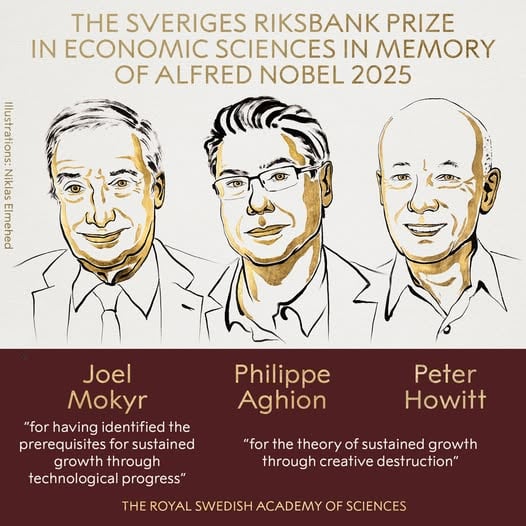
The Royal Swedish Academy of Sciences has decided to award the Sveriges Riksbank Prize in Economic Sciences in Memory of Alfred Nobel 2025 to Joel Mokyr, Philippe Aghion, and Peter Howitt “for having explained innovation-driven economic growth.”

According to the announcement on Monday, one half of the prize goes to Joel Mokyr, Northwestern University, Evanston, IL, USA, “for having identified the prerequisites for sustained growth through technological progress.”

The other half is shared jointly by Philippe Aghion, Collège de France and INSEAD, Paris, France, The London School of Economics and Political Science, UK, and Peter Howitt, Brown University, Providence, RI, USA, “for the theory of sustained growth through creative destruction.”

Innovation as the Engine of Progress

The Royal Swedish Academy stated that the laureates “show how new technology can drive sustained growth.

Over the last two centuries, for the first time in history, the world has seen sustained economic growth. This has lifted vast numbers of people out of poverty and laid the foundation of our prosperity.”

“This year’s laureates in economic sciences, Joel Mokyr, Philippe Aghion and Peter Howitt, explain how innovation provides the impetus for further progress.”

The Academy noted that “technology advances rapidly and affects us all, with new products and production methods replacing old ones in a never-ending cycle.

“This is the basis for sustained economic growth, which results in a better standard of living, health and quality of life for people around the globe.”

But as the release observed, “this was not always the case. Quite the opposite – stagnation was the norm throughout most of human history.

See also  Wigwe varsity seeks NDDC’s partnership, as Ogbuku assures support for schools

“Despite important discoveries now and again, which sometimes led to improved living conditions and higher incomes, growth always eventually levelled off.”

From Stagnation to Sustained Growth

Joel Mokyr used historical sources to uncover how sustained economic growth became the new normal.

He showed that for innovations to succeed one another continuously, “we not only need to know that something works, but we also need to have scientific explanations for why.”

The Academy explained that “the latter was often lacking prior to the industrial revolution, which made it difficult to build upon new discoveries and inventions.”

Mokyr also emphasized “the importance of society being open to new ideas and allowing change.”


His work helps explain how the Industrial Revolution marked a fundamental shift — when the combination of science, technology, and cultural openness created the conditions for self-sustaining progress.

Creative Destruction: The Double-Edged Force of Growth

Meanwhile, Philippe Aghion and Peter Howitt have, since their landmark 1992 paper, explored the mechanics of modern growth.

Their mathematical model captured the concept of creative destruction — the dynamic by which innovation simultaneously builds and disrupts.

As the Academy described, “when a new and better product enters the market, the companies selling the older products lose out.

“The innovation represents something new and is thus creative. However, it is also destructive, as the company whose technology becomes passé is outcompeted.”

Their research, it added, shows that “creative destruction creates conflicts that must be managed in a constructive manner.

“Otherwise, innovation will be blocked by established companies and interest groups that risk being put at a disadvantage.”

See also  FG makes fresh clarification on English, Mathematics requirement

Chair of the Committee for the Prize in Economic Sciences, John Hassler, remarked, “The laureates’ work shows that economic growth cannot be taken for granted. We must uphold the mechanisms that underly creative destruction, so that we do not fall back into stagnation.”

Meet the Trio: Architects of the Modern Growth Story

Joel Mokyr, born in 1946 in Leiden, the Netherlands, earned his PhD in 1974 from Yale University, New Haven, CT, USA.

He is Professor at Northwestern University, Evanston, IL, USA.

Mokyr is a leading historian of technological change and author of The Lever of Riches and A Culture of Growth, which trace how ideas and institutions shaped the Industrial Revolution.

Philippe Aghion, born in 1956 in Paris, France, received his PhD in 1987 from Harvard University, Cambridge, MA, USA.

He is Professor at the Collège de France and INSEAD in Paris, and at The London School of Economics and Political Science, UK.

Aghion is one of the foremost theorists of innovation-led growth and co-author of The Power of Creative Destruction.

Peter Howitt, born in 1946 in Canada, obtained his PhD in 1973 from Northwestern University, Evanston, IL, USA, and is Professor at Brown University, Providence, RI, USA.

His collaboration with Aghion produced one of the most influential frameworks in modern economics, illuminating how progress and disruption go hand in hand.

As the Academy concluded, “The laureates showed how new technology can drive sustained growth.”

punch.ng

FOLLOW US ON:

FACEBOOK

TWITTER

PINTEREST

TIKTOK

YOUTUBE

LINKEDIN

TUMBLR

INSTAGRAM

Continue Reading
Click to comment

Leave a Reply

Your email address will not be published. Required fields are marked *

Education

16-year-old girl emerges Nigeria’s youngest chartered accountant

Published

on

The Minister of Youth Development, Ayodele Olawande, has congratulated Osasere Okundaye on emerging as Nigeria’s youngest chartered accountant at the age of 16.

In a statement on Monday, Olawande described the feat as a remarkable demonstration of hard work, discipline, resilience and commitment to excellence.

“I heartily congratulate Miss Osasere Okundaye on her outstanding achievement of becoming Nigeria’s youngest Chartered Accountant at just 16 years of age.

“This remarkable milestone is a testament to the power of hard work, discipline, resilience, and an unwavering commitment to excellence,” the minister said.

He noted that Okundaye had become a shining example of the limitless potential of Nigerian youths, saying her achievement should inspire others to pursue excellence.

“Osasere has distinguished herself as a shining example of the limitless potential of Nigerian youth. Her accomplishment reminds us that with determination, dedication, and the right support, young Nigerians can break barriers, set new records, and inspire a generation to dream bigger and strive for excellence,” he added.

The minister also congratulated her parents, family, teachers and mentors for supporting her journey.

“I also congratulate her parents, family, teachers, mentors, and everyone who has supported and guided her journey. Their encouragement, sacrifices, and belief in her abilities have undoubtedly contributed to this exceptional success,” he said.

Olawande reaffirmed the Federal Ministry of Youth Development’s commitment to empowering young Nigerians through programmes and policies aimed at helping them realise their potential.

“Osasere’s achievement reinforces our confidence that the future of Nigeria is bright in the hands of focused, determined, and talented young citizens,” he said.

See also  Wigwe varsity seeks NDDC’s partnership, as Ogbuku assures support for schools

He wished the teenager greater success in the years ahead, expressing hope that her story would inspire millions of young Nigerians.

Okundaye earned the feat after qualifying as a chartered accountant through the Institute of Chartered Accountants of Nigeria, becoming the youngest person to achieve the professional qualification in the country.

Her achievement surpasses the previous record set in 2022 by Jonathan Adewale, who became Nigeria’s youngest chartered accountant at the age of 17 after completing the rigorous ICAN professional examinations.

The qualification, which is typically obtained by graduates and professionals after years of study and examinations, has been widely regarded as one of the country’s most demanding professional certifications.

punch.ng

FOLLOW US ON:

FACEBOOK

TWITTER

PINTEREST

TIKTOK

YOUTUBE

LINKEDIN

Continue Reading

Education

Suspended FUOYE SUG president reinstated — NANS

Published

on

The National Association of Nigerian Students has announced the reinstatement of the suspended Students’ Union Government President of the Federal University Oye-Ekiti (FUOYE) , James Adio.

NANS President, Akinteye Babatunde, disclosed this in a post on X on Wednesday, after it disclosed that university’s Senate would consider Adio’s suspension following what it described as high-level engagement with the institution’s management.

“Finally, Comrade Adio, the FUOYE SUG President, has been officially reinstated,” Babatunde wrote.

PUNCH Online had earlier reported that NANS said it secured the reinstatement of some previously suspended students after discussions with the university authorities.

According to the student body, the intervention followed sustained talks with the management over disciplinary actions taken against some students.

Babatunde had said, “The University Senate will convene on Wednesday, 24 June 2026, to give Comrade James Adio fair consideration and the necessary support that will serve both the interest of justice and his academic pursuits going forward.”

He also stated that the affected students had been reinstated and allowed to sit for their examinations.

Adio was earlier suspended alongside two other students over alleged financial irregularities linked to practical fees, a decision that sparked criticism from NANS.

punch.ng

FOLLOW US ON:

FACEBOOK

TWITTER

PINTEREST

TIKTOK

YOUTUBE

LINKEDIN

See also  JAMB to decide UTME cut-off marks May 11
Continue Reading

Education

JAMB axes affiliated degree courses in colleges of education; read details

Published

on

The Joint Admissions and Matriculation Board (JAMB) has formally ended admissions into affiliated degree programmes run by colleges of education, marking a major shift in Nigeria’s teacher education system and effectively making the Nigeria Certificate in Education the sole entry route into the institutions from the 2026/2027 academic session.

The decision is contained in JAMB’s newly released NCE/ND Agric Registration Guidelines issued by the Office of the Registrar in June 2026.

Under the new policy, the board declared that “no admission into any affiliated programme in any college of education from the 2026/2027 session.”

JAMB also ruled out direct admission into 100 and 200 levels in colleges of education, insisting that all fresh entrants must now come through the NCE programme.

“With effect from 2026/7 session, no admission into 100 or 200 Level is allowed into any college of education. All entrants are through NCE,” the board stated.

The development signals the end of an era for affiliated degree programmes, which for decades enabled colleges of education to award university degrees through partnerships with conventional universities.

The reform is expected to affect thousands of candidates who applied for degree programmes through affiliated colleges of education for the 2026 admission cycle.

To cushion the impact, JAMB outlined options for candidates who had already selected affiliated colleges of education for degree programmes through Direct Entry.

According to the board, affected candidates may apply for a change of institution at no cost, transfer to the parent university to which the degree programme is affiliated, or allow their second-choice institution to become their first choice for admission processing.

See also  Ajaero faults partial implementation of minimum wage in Abia varsity

“A candidate may choose to be moved to the parent university to which the degree programme is affiliated,” the board said.

JAMB added that candidates wishing to switch institutions had been given up to June 22 to complete the process.

Similarly, candidates seeking 100-level admission into affiliated colleges of education through the Unified Tertiary Matriculation Examination have been presented with three options: change institution, elevate their second-choice institution to first choice, or migrate to the NCE programme.

The board said candidates who opted for the NCE route would be required to obtain an O-Level verification code from the relevant examination body and pay only N700 as registration fee on the JAMB portal.

“The candidate may be moved to the NCE programme of the institution, on the understanding that the choice of the college of education indicates an interest in pursuing the NCE qualification,” JAMB explained.

The guidelines further stipulate that every application for NCE admission is a deliberate choice and that candidates recommended for NCE admission would have any ongoing UTME or Direct Entry admission process suspended.

“Anyone who chooses NCE and s/he is proposed/recommended would have any ongoing UTME/DE process suspended,” the board stated.

For candidates who have already applied through the 2026 UTME mode, JAMB said their details would be automatically migrated to their chosen first-choice college of education or agric-related non-technology ND programmes.

The board also introduced mandatory O-Level verification for all NCE applicants, pegging the verification fee at N1,500 for one sitting and N2,000 for two sittings.

See also  FRIN, NOAN partner on youth empowerment through agriculture

JAMB urged colleges of education, institutional professional registration centres, accredited CBT centres and its officials across the country to study the new guidelines and ensure strict compliance.

“All PRCs, IPRCs and officers of the board are to study the guidelines and ensure strict compliance with the information contained therein,” the Registrar stated.

Affiliated degree programmes have long served as a pathway for colleges of education to offer Bachelor’s degrees in partnership with universities, allowing students to earn university degrees while studying in the colleges.

However, the new JAMB policy effectively ends that arrangement for new admissions from the 2026/2027 academic session, reinforcing the NCE as the foundational qualification for teacher education in Nigeria.

punch.ng

FOLLOW US ON:

FACEBOOK

TWITTER

PINTEREST

TIKTOK

YOUTUBE

LINKEDIN

Continue Reading

Trending