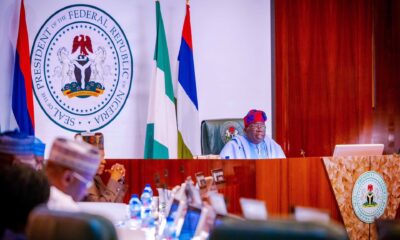
The Senate on Wednesday called for the transfer of the burden of proof in election petitions from aggrieved candidates to the Independent National Electoral Commission — the body that conducts and supervises elections.
The proposal formed a key part of deliberations as lawmakers debated the general principles of a bill seeking to repeal the 2022 Electoral Act and enact a new Electoral Act 2025.
The move, they argued, would make the electoral process more credible, transparent and accountable.
But the Senate’s fresh proposal sharply divided opposition parties, with the Peoples Democratic Party warning that the move could undermine democracy.
The proposal, which formed part of deliberations on the new Electoral Act 2025 Bill debated on Wednesday, seeks to make the electoral umpire — as organiser and regulator of elections — primarily responsible for defending the integrity of polls it conducts.
Lawmakers backing the proposal, including Senate President Godswill Akpabio and Senator Seriake Dickson, argued that INEC should “bear the burden of proving that elections were free, fair, and credible,” describing it as a long-overdue reform to strengthen democracy ahead of the 2027 polls.
The lawmakers also believed, if signed to law, it will mark a turning point in the bid to reform Nigeria’s electoral framework ahead of the 2027 general elections,
Under the current law, petitioners who challenge election results bear the legal burden of proving irregularities — in line with the Evidence Act, which provides that “he who asserts, must prove.”
But several senators, including Senate President Godswill Akpabio, insisted that INEC — as the organiser and regulator of elections — should be held responsible for defending the integrity of the polls it conducts.
Leading the debate, Senator Seriake Dickson (Bayelsa West) argued that the reform was long overdue if Nigeria must strengthen its democracy.
“If there is one major achievement we must secure in this 10th Senate under your leadership, it should be meaningful electoral reform. We have the opportunity to modernise our system — authorise INEC to deploy more technology and back that authorisation with adequate funding.
“Our political parties are among the greatest challenges to our democracy; we must find ways to regulate and control party behaviour so democratic norms are strengthened. Critically, the burden of proof in electoral disputes must be reformed.
“Electoral matters are sui generis and require special treatment.
INEC conducts elections, appoints ad-hoc officials, collates and announces results; it should therefore bear the primary burden of proving that elections were conducted peacefully and in accordance with the law,” Dickson said.
Akpabio backed the proposal, saying the electoral umpire must be held accountable for the conduct of elections.
“I agree with Senator Dickson and other Senators who have called for shifting of burden of proof in electoral litigations from litigants to INEC being the organiser and supervisor of elections,” Akpabio said.
“INEC obviously must be held responsible because it is the one in charge of conduct and logistics, and is in the best position to carry the burden of proof in litigations.”
Beyond the contentious issue of proof, lawmakers also raised other electoral concerns, including the status of delegates at party primaries and the defection of elected officials.
Senator Abdul Ningi (Bauchi Central) urged the inclusion of all elected political office holders as delegates during primaries, while Senator Muntari Dandutse (Katsina South) called for a clause that would compel defecting officeholders to lose their seats — a move he said would “strengthen multi-party democracy and restore Nigeria’s dignity in the international community.”
Contentious proposals
The new Electoral Act bill also proposes transferring the conduct of local government elections from state electoral commissions to INEC — a development expected to stir debate between federal and state authorities.
Another proposal seeks to make the use of the Permanent Voter Card optional for accreditation, alongside provisions for enhanced technology deployment and real-time transmission of results.
Despite the sensitive nature of the proposals, the bill scaled through second reading with minimal opposition following its public presentation, where many of the contentious issues had been discussed.
The fresh debate comes a week after the Senate suspended consideration of the Electoral Act repeal bill to allow for broader consultations.
The decision, led by Senate Leader Opeyemi Bamidele (APC, Ekiti) and Minority Leader Abba Moro (PDP, Benue), was to give senators time to engage stakeholders and fully grasp the bill’s far-reaching implications.
Senator Simon Lalong (APC, Plateau), who sponsored the bill as Chairman of the Senate Committee on INEC, described it as a “comprehensive reform, repeal and enactment — not a mere amendment.”
Lalong noted that while the 2022 Act introduced innovations such as electronic transmission of results, it also exposed deep flaws, including weak enforcement of electoral offences and disputes over result collation and voter registers.
Reform deadline
Last month, Senate Leader Bamidele assured Nigerians that the amendment process would be concluded before December to allow sufficient time for implementation before the 2027 elections.
He explained that previous delays in the transmission of electoral amendment bills had hindered timely presidential assent, as seen under former President Muhammadu Buhari’s administration.
“Between now and December 2025, we will ensure that the amendment of the Electoral Act 2022 is concluded so that it will not be too close to the 2027 elections,” Bamidele said.
He reaffirmed the Senate’s commitment to strengthening Nigeria’s democracy through credible electoral laws and constitutional reforms, adding that “our focus is on rebuilding Nigeria, stabilising our polity and growing our economy — and we will never be distracted from this goal.”
Opposition
The PDP described the move as “dangerous and premature”, warning that INEC’s credibility challenges made such responsibility risky.
PDP Deputy National Youth Leader, Timothy Osadolor, told The PUNCH that the electoral body “cannot yet be trusted to be independent, neutral, or truthful.”
He said, “We don’t want the burden of proof to be on INEC alone because time and time again, we’ve seen that INEC can become even more partisan than political parties themselves.
“God forbid that one is contesting an election and INEC becomes both the sole arbitrator and the only body required to provide proof. That would be a lost cause from the beginning.
“INEC must first reform, purge itself, and rebuild credibility. In a democracy, to give the burden of proof in any capacity whatsoever solely to INEC is dangerous. As it stands today, INEC having such sole responsibility would be too dangerous and too risky for the democratic process.”
Similarly, the Labour Party’s two rival factions expressed mixed feelings.
Prince Tony Akeni, spokesperson of the Nenadi Usman-led faction, said the proposal “sounds great on the surface” but warned that without sincerity and punitive safeguards, it could empower corrupt INEC officials to manipulate results.
“On the surface, the proposed amendment to shift the burden of proof to INEC for the integrity, credibility, and acceptability of electoral results sounds great,” Akeni told The PUNCH. “But our worry is the scarcity of sincerity in the affairs of Nigeria’s political class.
“If they are sincere with this move, they must build in adequate penalties for INEC officials who may cash in on the new law and see election results as trading stock for the highest bidder — whether as petitioners or declared winners.”
Akeni also cited the 2023 presidential election as a cautionary tale, accusing INEC of frustrating the Labour Party’s petition at the tribunal.
He recalled how the Peter Obi legal team was allegedly frustrated by INEC’s refusal to release election materials during the 2023 presidential petitions.
“When the then INEC Chairman, Prof. Mahmood Yakubu, was required by Peter Obi’s legal team to provide IReV and other sensitive result evidences, INEC delayed till the tribunal deadline virtually expired,” he said.
“Under such circumstances, a dishonest and subornable INEC taking over the role of burden of proof would make no difference,” Akeni stated.
The Abure-led LP spokesman, Obiora Ifoh, however, dismissed the plan.
Ifoh cited past irregularities and judicial overreach in elections such as those in Imo and Adamawa states.
He said, “Although I have not seen the full presentation, in Nigeria, we have had situations where institutions beyond INEC determine the outcome of elections. For instance, in Imo State about six years ago, the candidate that came fourth was eventually sworn in as governor.
“Even when INEC proved that the candidate did not win, the court relied on a police document to declare the result. So, how can the same INEC that glossed over irregularities in Adamawa and Imo now be the one to bear the burden of proof?”
The LP spokesman continued, “If you take a look at Adamawa State, where an INEC returning officer snubbed the rightful winner and declared another candidate of the APC governor, even when it was obvious that PDP won — is it the same INEC that should now defend the process? That arrangement is neither here nor there.”
He further argued that only full electronic voting and real-time result uploads could ensure transparency.
“There has to be some modification where electronic voting becomes compulsory in every election,” Ifoh said. “If they allow human interference to remain, I can tell you that the Nigerian factor will still be there.”
However, not all opposition voices rejected the idea.
The National Publicity Secretary of the New Nigeria People’s Party, Ladipo Johnson, threw his weight behind the proposal.
Johnson insisted that aggrieved politicians who bring “spurious or hopeless cases” should face sanctions.
“What if the candidate brings a spurious or hopeless case? Should they still bear no responsibility for wasting everyone’s time? If INEC proves beyond doubt that the results were credible, what happens to the person who brought up the unfounded claim?
“Should he be allowed to go scot-free and cost the country millions in taxpayers’ money?” he queried.
“If anybody wants to go to court, he should be ready to pay for it. If it is justice that you want, then you are entitled to some costs.” Johnson added.
The Obidient Movement, a cult-like followership of LP 2023 presidential candidate, Peter Obi, openly supported the Senate.
Its National Coordinator, Dr. Yunusa Tanko, said the burden of proof “rightly belongs to INEC.”
“I support it completely,” Tanko told The PUNCH. “The proof of these particular election irregularities lies in the hands of INEC. They have the records — whether false or right, they should prove it because they are the institution. Individuals can bring up any kind of result, but INEC has a duty to affirm or contradict it.”
He added, “When it is from INEC, it is more solid and confirmed. So, I am backing the lawmakers because that is the way it is supposed to be.”
The Senate’s debate on the sweeping Electoral Act 2025 Bill — sponsored by Senator Simon Lalong, Chairman of the Senate Committee on INEC — also touched on other reforms such as real-time result transmission, stripping state electoral commissions of local government poll powers, and sanctions for defecting lawmakers.
Senate Leader Opeyemi Bamidele has pledged that the electoral reform process will be concluded before December to allow for implementation well ahead of the 2027 general elections.
If passed into law, analysts say, the proposal to shift the burden of proof to INEC could reshape Nigeria’s post-election litigation landscape — either by deepening transparency or, as critics warn, by placing too much trust in a body still struggling with credibility.