Connect with us

Lifestyle

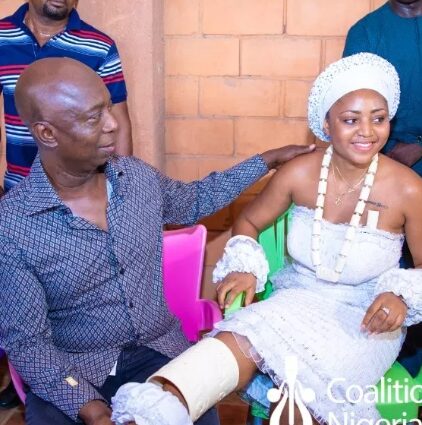
Inside Regina Daniels, Ned Nwoko’s troubled home

Published

on

For years, Nollywood actress Regina Daniels and her husband,  Senator Ned Nwoko, embodied the fantasy of fame and fortune.

But last week, that fairy tale cracked.

Millions of Nigerians on Saturday woke up to a viral video showing Regina weeping outside her Abuja mansion.

“In Ned Nwoko’s house, I am nothing. But in my house, I am a queen,” she said through sobs.

Moments later, men believed to be security aides appeared, trying to calm her and her siblings, while her brother, Sammy, resisted.

The emotional outburst, captured in video clips, shattered the glossy portrait of one of Nigeria’s most talked-about celebrity marriages.

Since then, social media has been awash with counter-allegations of violence, drug abuse, and manipulation.

From power couple to public scandal

Within hours of the video surfacing, Nwoko fired back.

In a lengthy online statement, he denied ever abusing Regina, instead accusing her of being “violent and destructive” due to alleged addiction to drugs and alcohol.

He wrote, “Regina was not always like this. Her current battle with drugs and alcohol abuse is the root of our problem. She must continue her rehabilitation program, or I fear for her life and safety.”

The senator also accused her of attacking his staff and damaging property in his Abuja home, adding that she needed rehabilitation “either in Nigeria or abroad.”

As of press time, Regina had not publicly responded, but her silence has only fuelled speculation and sympathy among fans.

The marriage that broke the Internet

When Regina married Nwoko in 2019, the wedding stunned Nigeria.

She was in her early 20s, a fresh-faced actress adored for her innocence.

He was 38 years older, a wealthy lawyer, businessman, and later a senator.

Their union instantly divided the public.

Critics accused Regina of marrying for wealth; supporters saw her as pragmatic.

Regina herself dismissed the noise.

In interviews, she described Nwoko as “kind and caring,” often posting affectionate photos of their luxury vacations and family life.

See also  DSP George Iyamu: The Police Officer Who Betrayed the Badge

For years, the marriage was portrayed as a perfect blend of tradition and modern glamour.

A May 2024 feature by Modern Ghana titled, ‘Regina Daniels: A Beacon of Respectful Love Worth Emulating’ described their relationship as “built on mutual respect and understanding.”

But beneath the sheen, insiders say, tension had been brewing — the kind that can’t be hidden behind matching designer outfits and smiling Instagram posts.

Old patterns, new cracks

This is not the first time Nwoko’s domestic life has become a public spectacle.

In 2021, his Moroccan wife, Laila Charani, announced on social media that she had divorced him, warning the public to stay away from her private life.

“Hello guys. I have divorced already and there is nothing between me and him. Anybody who followed me because of him can unfollow me, please,” she wrote.

Nwoko’s team quickly countered, accusing Laila of “indecent conduct” during a London trip and undergoing plastic surgery without his consent.

Months later, Laila apologised publicly, saying she had “listened too much to outsiders.”

Their reconciliation was widely reported as proof of “maturity and forgiveness.”

Today, that cycle of conflict and public reconciliation seems to be repeating itself, this time with Regina.

A blogger, Ajemba Stanley, alleged that the current row began with a physical altercation, alleging that Nwoko slapped Regina first and she retaliated by smashing his Ferrari’s windscreen.

The claims remain unverified.

The Jaruma connection

Adding fuel to the chaos is popular kayanmata (aphrodisiac) seller, Hauwa Mohammed, aka Jaruma.

Once friends with Regina, Jaruma has resurfaced with explosive allegations, claiming the actress introduced her to drugs and alcohol.

“She was the one who gave me alcohol,” Jaruma said in an interview with blogger Stella Dimoko Korkus. “Even Ned said she must continue her rehabilitation. He knows she abuses substances.”

Jaruma also accused Nwoko of physically assaulting women he had dated, alleging she had spoken with “seven side chics” who claimed the same.

Family, friends drawn in

The senator’s accusations did not end with his wife. He also blamed Regina’s brother, Sammy West, and a friend, Ann, for influencing her.

See also  Pastor Chris Okafor Takes Break From Ministerial Duties Amid Allegations, Scandal

“Sammy is Regina’s main drug supplier,” Nwoko alleged, describing Ann as “the tiny evil devil.”

Sammy hit back in a now-deleted post, writing, “No marriage is perfect. But Regina Daniels is not affiliated with any drug abuse or misuse.”

Checks by Saturday PUNCH showed that Sammy has long cultivated a bohemian image, with his music often referencing weed and street life.

Another friend, Antoinette Cassidy (known as @casie_snow), whom online users suspect is “Ann,” has remained silent, maintaining only family and business-related posts on her page.

NDLEA, police wave off allegations

Amid the noise, Saturday PUNCH reached out to law enforcement.

A senior official of the National Drug Law Enforcement Agency said the agency would not act based on “social media speculation.”

“Our work is evidence-based. We don’t act on rumours,” the source said.

Similarly, FCT Police Command spokesperson, SP Josephine Adeh, said she had “no comment,” citing the private nature of the matter.

Social media clues and contradictions

While authorities remain silent, the Internet has turned into an unofficial court.

Videos and photos claiming to show Regina drinking and smoking have resurfaced online — some dating back to 2018, before her marriage.

One clip shows her smoking shisha at a club; another shows a Sprite bottle filled with a darker liquid.

Supporters say these are harmless youthful moments; critics see them as proof of deeper issues.

Celebrities take sides

The controversy has split Nollywood.

Actress Yvonne Jegede advised Regina to leave the marriage if violence was involved.

“Regina, you are still very young. If there’s violence in your marriage, please carry your bag,” she wrote.

Her comment sparked an online spat between actresses Angela Okorie and Doris Ogala, with Ogala accusing Okorie of hypocrisy.

“So na Gina wey suppose be your pikin you dey mock?” Ogala fired.

Former Big Brother Naija star Tuoyo also criticised Regina’s brother for speaking out “too late,” while actress Georgina Onuoha called for a formal probe into the allegations of both abuse and substance use.

See also  Colonial Administrative Blocks in Benin City 1905: A Glimpse into Nigeria’s Colonial Past

“This recurring pattern points to control and power dynamics common when older men marry much younger women,” she said, also faulting Regina’s mother, Rita Daniels, for “not protecting her daughter.”

Experts weigh in

Clinical psychologist Dr John Eze said substance use among celebrities is often a maladaptive response to stress, fame, and marital tension.

“When people lose emotional connection in marriage, they sometimes turn to alcohol or drugs to cope,” he explained. “It gives temporary relief but causes lasting harm.”

Another psychologist, Kemi Akintoyese, noted that the constant public scrutiny of celebrities could heighten anxiety, insecurity, and poor decision-making.

“Coercive control in relationships — isolation, manipulation, or disguised care — can worsen substance abuse,” she said. “Low self-esteem and online shame also drive people to seek escape through substances.”

Between love, control, and public judgment

For many Nigerians, the Regina-Nwoko saga is more than celebrity gossip; it’s a reflection of how power, gender, and class play out in modern relationships.

What was once idolised as a Cinderella story has become a cautionary tale about fame and emotional collapse behind closed doors.

A social commentator, Ene Abba, told Saturday PUNCH that the public’s obsession with the couple reveals a deeper societal longing.

She said, “We project our fantasies onto them. When the fairy tale breaks, it feels like betrayal — as if their failure challenges our belief in love and success.”

Family calls for calm

Despite the uproar, sources close to the family say private reconciliation efforts are underway.

Nwoko’s brother, Michael, while appealing for restraint, said, “Whatever is happening between Senator Ned Nwoko and his dear wife is a private family matter. It will be resolved internally.”

But in the court of public opinion, the damage may already be done.

Continue Reading
Click to comment

Leave a Reply

Your email address will not be published. Required fields are marked *

Lifestyle

Nigeria’s ambassador-designate to Algeria, Lele, dies at 50

Published

on

The Federal Government has announced the death of Nigeria’s ambassador-designate to Algeria, Mohammed Mahmud Lele, who died at the age of 50.

The Ministry of Foreign Affairs disclosed this in a statement issued in Abuja on Wednesday by its spokesperson, Kimiebi Ebienfa.

According to the ministry, Lele died in the early hours of April 19, 2026, in Ankara, Türkiye, after a protracted illness.

The ministry described the late diplomat as a dedicated officer who served the country with distinction.

“The late Ambassador Lele, until his death after a protracted illness, was the Director in charge of the Middle East and Gulf Division in the Ministry of Foreign Affairs.

“Ambassador Lele, a career diplomat, was recently appointed by President Bola Ahmed Tinubu as Ambassador-designate to the People’s Democratic Republic of Algeria, following the Nigerian Senate’s confirmation of his nomination,” the statement said.

Born in Gamawa, Bauchi State, in 1976, Lele studied Economics at Bayero University, Kano, and went on to serve in Nigerian missions in Berlin, Lomé and Riyadh.

“Ambassador Lele was known for his intellectual depth, strategic insight and commitment to the advancement of Nigeria’s foreign policy objectives,” the statement added.

The Permanent Secretary of the ministry, Dunoma Umar Ahmed, who received the remains of the late diplomat at the Nnamdi Azikiwe International Airport, Abuja, described him as “a hardworking, humble and fine officer, who will be sorely missed by the ministry.”

The ministry added that his death “is a monumental loss not only to his immediate family but also to the entire Foreign Service community and the Federal Republic of Nigeria.”

See also  Maintain status quo, avoid provocative acts, Okpebholo warns over Okpella stool

Lele was buried on Wednesday in Kano in accordance with Islamic rites.

The ministry extended condolences to his family, associates, and the government and people of Bauchi State, praying for the peaceful repose of his soul and strength for those he left behind.

Continue Reading

Lifestyle

Governor Amuneke reveals party officials offered him dollars to alter anti-govt skits

Published

on

Comedian Kevin Chinedu, popularly known as Kevinblak, has revealed that officials of a political party offered him dollars to change his satirical skits criticising politicians and governance.

He made the disclosure on Monday in an interview on ARISEtv’s Arise 360 programme, where he spoke about the pressures facing content creators who hold public officials accountable through humour.

Chinedu, known for his character Governor Amuneke, said the approach came at a particularly vulnerable moment, shortly after his wife had a Caesarean section and he was under financial strain.

“They said they were going to change my life, that I’m earning crumbs, you know, give me dollars. They mentioned that my colleagues are in the game and all of that,” he said.

He declined to name the party, saying only that it was “Amuneke’s party”, a reference to the fictional political figure in his skits, and cautioned against any attempt to identify it publicly.

“Don’t mention names, trust me, don’t mention names,” he said.

Despite the financial pressure, the comedian said he turned down the offer, recalling how the officials had tried to lure him to Abuja with the promise of a life-changing sum.

“I had a lot of bills on my head and I just heard come, come to Abuja, let’s change your life. Dollars upon dollars,” he said.

He said he ultimately held firm, guided by a personal code he had maintained throughout his career.

“I looked at it, I said, no, I am who I am. I’ve been here for a long time, and I’ve never been in any illegal thing, and I’ve never been somewhere, you know, I’m doing something because I’m being influenced, because of money.

See also  Colonel Shittu Alao: Pioneer of the Nigerian Air Force and Hero of the Civil War

“If I want to do it, it should be something I’m doing because I want to do it. So, you know, it is what it is,” he said.

When asked whether friends had urged him to accept the money, Chinedu said his inner circle was equally principled, and had themselves been approached and refused.

“I don’t have friends that are easily overwhelmed with money. I have people who have principles because they have, you know, approached them, they themselves. So, we always have that conversation,” he said.

punch.ng

FOLLOW US ON:

FACEBOOK

TWITTER

PINTEREST

TIKTOK

YOUTUBE

LINKEDIN

INSTAGRAM

Continue Reading

Lifestyle

Over 4,600 Nigerian doctors relocate to UK in three years – Report

Published

on

Nigeria’s already fragile healthcare system is facing renewed strain as no fewer than 4,691 doctors have relocated to the United Kingdom since President Bola Tinubu assumed office on May 29, 2023, fresh data from the General Medical Council shows.

The UK GMC is a public official register detailing the number of practising doctors in the UK alongside other details such as their areas of speciality, country of training, among others.

The mass migration represents not just a human resource crisis but a significant economic loss.

With the Federal Government estimating that it costs about $21,000 to train a single doctor, Nigeria has effectively lost at least $98.5m in training investments within less than two years.

The figure put the total number of Nigeria-trained doctors currently practising in the UK to about 15,692, making Nigeria one of the largest sources of foreign-trained doctors in Britain, second only to India.

As of May 28, 2025, official records showed that the number of Nigerian-trained doctors in the UK was a little over 11,000. The figure has grown significantly since then.

The exodus of doctors comes as Nigeria’s doctor-to-population ratio hovers around 3.9 per 10,000 people, far below the minimum threshold recommended by the World Health Organisation.

For many health experts, the numbers confirm what has long been visible: a system gradually losing its most critical workforce.

The Nigerian Medical Association has repeatedly warned that poor remuneration, unsafe working conditions, and inadequate infrastructure are pushing doctors out of the country.

“Our members are overworked, underpaid and exposed to unsafe environments daily. Many are simply burnt out,” the NMA said in one of its recent statements addressing workforce migration.

See also  Oba Daniel Anirare Aladesanmi II: The Long-Reigning Ewi of Ado-Ekiti Who Bridged Tradition and Modern Nigeria

Similarly, the National Association of Resident Doctors has consistently highlighted the toll on younger doctors, who form the backbone of Nigeria’s tertiary healthcare system.

“Doctors are leaving because the system is failing them—irregular salaries, excessive workload, and lack of training opportunities,” NARD noted during one of its nationwide engagements.

Ironically, the doctor exodus persists even as Nigeria continues to spend heavily on healthcare abroad.

While official foreign exchange data shows only modest spending on medical tourism in recent years, broader estimates suggest Nigerians still spend hundreds of millions of dollars annually seeking treatment overseas.

For instance, a recent report by The PUNCH revealed that foreign exchange outflow for health-related travel by Nigerians surged to $549.29m in the first nine months of 2025, a 17.96 per cent increase from $465.67m in the same period of 2024, according to official data by Nigeria’s apex bank.

A public health expert, Dr David Adewole, noted that the Federal Government’s national policy on health workforce migration, aimed at curbing the growing trend of health professionals leaving the country—commonly referred to as ‘Japa’—is a good initiative, but may not do much to address the fundamental problems of the shortage of skilled healthcare professionals in Nigeria, particularly in rural and underserved areas.

According to him, many of the push factors for health professionals emigrating to greener pastures, like insecurity, emolument and lack of basic amenities like potable water, health facilities, cost of living and constant electricity, persisted.

He stated: “To make healthcare workers stay here, let the salaries be enough so that what you earn will be much more than the multiples of what you need for basic needs, like food, power supply, housing, and so forth.

See also  Ogun monarch slams Fayose for insulting Obasanjo

“People still look at life after retirement. You might have a good policy, but its implementation is the issue. For example, you are retired, and for your retirement package, you don’t need to know anyone for it to be processed promptly.

“Then subsequently, your monthly pension, without pressing anybody, should be paid. Those things are not here.

“And when you go to the hospital abroad, if you tell them that you are in a hurry, you go to your home; they’ll bring the medicines to your doorstep.”

Continue Reading

Trending