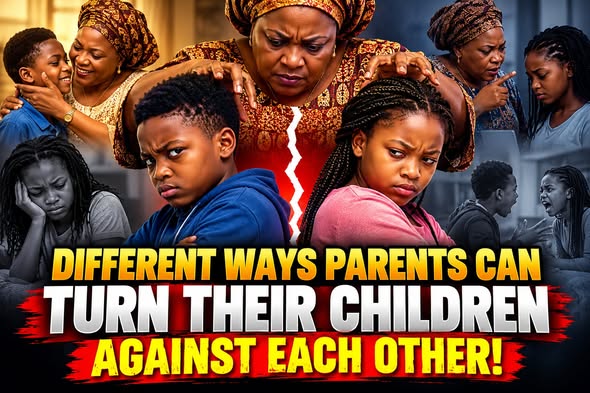
One of the saddest things that can happen in a family is when brothers and sisters grow up seeing each other as enemies—not because they were born with hatred in their hearts, but because of what they were taught, what they witnessed, and how they were treated under their own parents’ roof.
A family should be a place where children learn love, unity, forgiveness, and loyalty. Unfortunately, some parents unknowingly—or deliberately—turn their children into lifelong rivals.
Here are **10 ways parents destroy the bond between their own children.**
**1. SHOWING FAVOURITISM**
When a parent constantly praises one child while humiliating another, resentment begins to grow. One child feels superior, while the other feels unwanted.
Remember, children may forget what you bought for them, but they may never forget how differently you treated them.
**2. COMPARING ONE CHILD TO ANOTHER**
“Look at your brother! Why can’t you be like your sister?”
These words may sound harmless to an adult, but to a child, they can feel like rejection. Instead of inspiring improvement, constant comparison can create jealousy, insecurity, and silent hatred.
**3. TURNING CHILDREN INTO COMPETITORS FOR LOVE**
When children must compete for their parents’ attention, affection, approval, or praise, they may begin to see one another as obstacles rather than family.
**4. DISCUSSING ONE CHILD’S WEAKNESSES WITH ANOTHER**
Some parents reveal one child’s private struggles to their siblings, turning family secrets into weapons. Later, during disagreements, those same weaknesses become tools for mockery and humiliation.
**5. GIVING ONE CHILD EVERYTHING WHILE NEGLECTING THE OTHERS**
When one child receives special treatment, financial support, opportunities, and endless forgiveness while the others are ignored, bitterness can take root.
Fairness does not always mean giving every child exactly the same thing. It means treating each child with love, dignity, and reasonable fairness.
**6. USING ONE CHILD TO PUNISH ANOTHER**
“Your brother is better than you.”
“Your sister will succeed where you have failed.”
A parent who uses one child’s achievements to shame another may unknowingly turn success into a source of family conflict.
**7. CREATING SECRETS AND DIVIDING LOYALTIES**
Some parents tell different stories to different children, manipulate their emotions, or encourage them to take sides in family disagreements.
Before long, siblings stop trusting one another because they no longer know who is telling the truth.
**8. MAKING INHERITANCE A WEAPON**
When parents repeatedly threaten to give everything to one child while using inheritance to control the others, money can become more important than family relationships.
A parent’s property may eventually be shared, but the damage caused by years of manipulation can be difficult to repair.
**9. REFUSING TO CORRECT A FAVOURED CHILD**
When one child can do no wrong in the eyes of a parent, while another is blamed for everything, anger and resentment begin to build.
Children need guidance, not a family justice system where one person is always innocent and another is always guilty.
**10. ENCOURAGING DISRESPECT BETWEEN SIBLINGS**
When parents allow insults, bullying, mockery, and humiliation among their children without intervention, they teach them that disrespect is acceptable.
The consequences may follow those children into adulthood, affecting their marriages, relationships, and even how they raise the next generation.
### 💔 THE TRAGEDY OF IT ALL
Some brothers and sisters who once shared one bedroom, one plate of food, and one childhood eventually become strangers.
They stop visiting each other. They celebrate each other’s failures. They fight over money, property, and parental approval. Some even carry their bitterness into the next generation, teaching their own children to hate their cousins.
And sometimes, the parent who helped create the division is no longer alive when the consequences finally become visible.
**WHAT A TRAGEDY!**
Parents, remember this: You will not live forever. Your children may outlive you by decades, and when you are gone, they will need one another more than ever.
Do not raise children who compete for your love. Raise children who understand that another sibling’s success does not diminish their own worth.
Do not plant jealousy and expect unity to grow.
Do not reward division and later demand peace.
Do not spend years creating rivalry and then wonder why your children cannot stand together.
**YOUR CHILDREN DO NOT HAVE TO BE IDENTICAL TO LOVE ONE ANOTHER. THEY ONLY NEED TO KNOW THAT THERE IS ROOM FOR EVERY ONE OF THEM IN YOUR HEART.**
Parents, your responsibility is not merely to give birth to children. It is also to help build a family bond that can survive disagreements, distance, financial struggles, and even your absence.
### 🔥 NOW, LET US TALK!
**Can a parent destroy the relationship between siblings through favouritism, comparison, manipulation, and unequal treatment—or should adult children take responsibility for refusing to let their parents divide them?**
Who bears the greater responsibility: the parent who creates the division, or the children who allow the division to continue?
**DROP YOUR OPINION IN THE COMMENTS. LET US HAVE AN HONEST CONVERSATION!**
#Parenting #FamilyValues #SiblingRivalry #FamilyUnity #ToxicFamilyDynamics #AfricanFamilies #LifeLessons
FOLLOW US ON:
FACEBOOK
TWITTER
PINTEREST
TIKTOK
YOUTUBE
LINKEDIN
INSTAGRAM