Connect with us

Business

Tinubu approves 15% import duty on petrol, diesel

Published

on

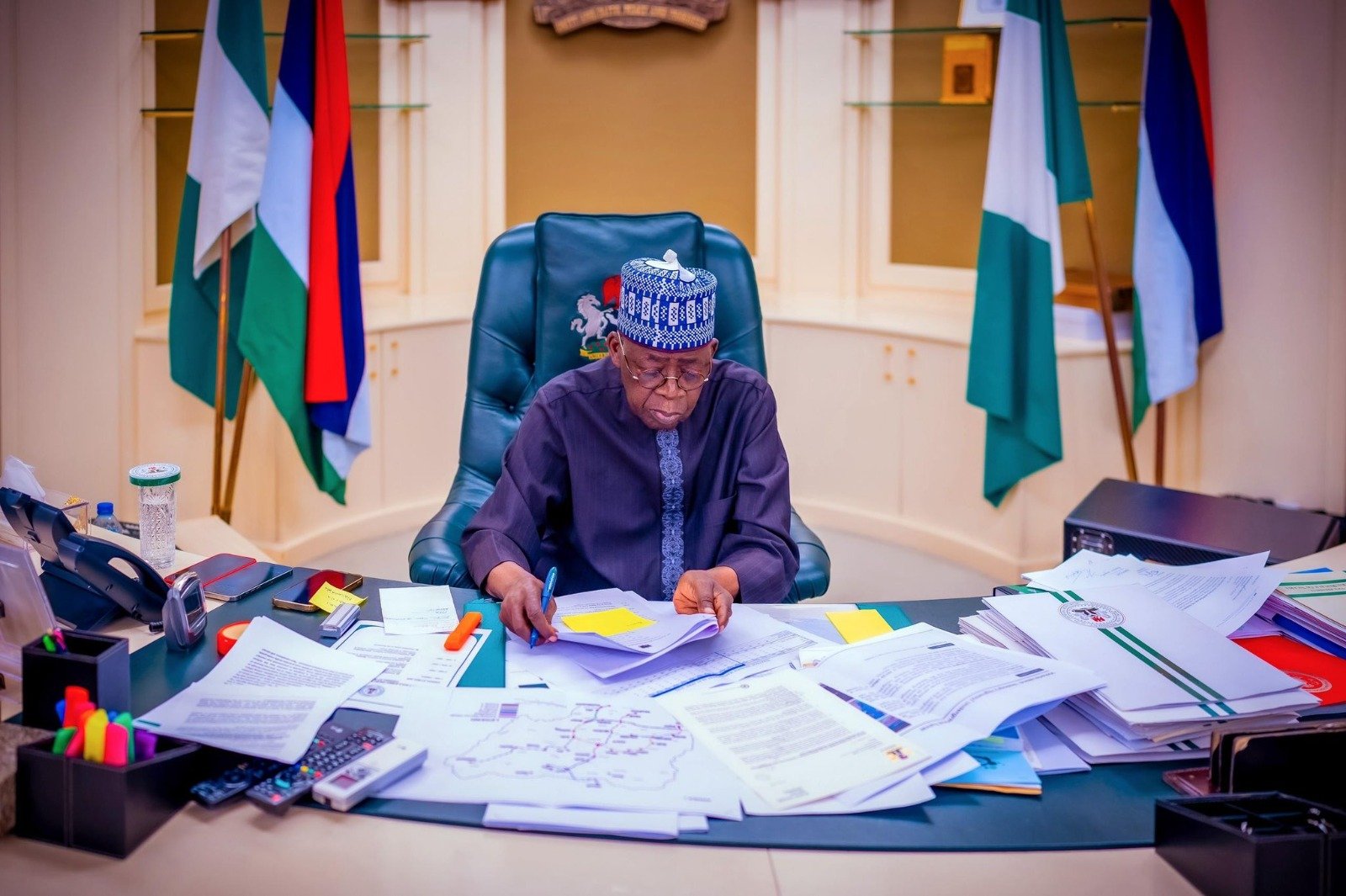
President Bola Tinubu has approved the introduction of a 15 per cent ad-valorem import duty on petrol and diesel imports into Nigeria.

The initiative is aimed at protecting local refineries and stabilising the downstream market, but it is likely to raise pump prices.

In a letter dated October 21, 2025, reported publicly on October 30, 2025, and addressed to the Federal Inland Revenue Service and the Nigerian Midstream and Downstream Petroleum Regulatory Authority, Tinubu directed immediate implementation of the tariff as part of what the government described as a “market-responsive import tariff framework.”

The letter, signed by his Private Secretary, Damilotun Aderemi, and obtained by our correspondent on Wednesday, conveyed the President’s approval following a proposal by the Executive Chairman of the FIRS, Zacch Adedeji.

The proposal sought the application of a 15 per cent duty on the cost, insurance and freight value of imported petrol and diesel to align import costs with domestic market realities.

Adedeji, in his memo to the President, explained that the measure was part of ongoing reforms to boost local refining, ensure price stability, and strengthen the naira-based oil economy in line with the administration’s Renewed Hope Agenda for energy security and fiscal sustainability.

“The core objective of this initiative is to operationalise crude transactions in local currency, strengthen local refining capacity, and ensure a stable, affordable supply of petroleum products across Nigeria,” Adedeji stated.

The FIRS boss also warned that the current misalignment between locally refined products and import parity pricing has created instability in the market.

See also  US expands travel restrictions, adds Nigeria to list of countries

“While domestic refining of petrol has begun to increase and diesel sufficiency has been achieved, price instability persists, partly due to the misalignment between local refiners and marketers,” he wrote.

He noted that import parity pricing- the benchmark for determining pump prices, often falls below cost recovery levels for local producers, particularly during foreign exchange and freight fluctuations, putting pressure on emerging domestic refineries.

Adedeji added that the government’s responsibility was now “twofold, to protect consumers and domestic producers from unfair pricing practices and collusion, while ensuring a level playing field for refiners to recover costs and attract investments.”

He argued that the new tariff framework would discourage duty-free fuel imports from undercutting domestic producers and foster a fair and competitive downstream environment.

According to projections contained in the letter, the 15 per cent import duty could increase the landing cost of petrol by an estimated N99.72 per litre.

“At current CIF levels, this represents an increment of approximately 99.72 per litre, which nudges imported landed costs toward local cost-recovery without choking supply or inflating consumer prices beyond sustainable thresholds. Even with this adjustment, estimated Lagos pump prices would remain in the range of N964.72 per litre ($0.62), still significantly below regional averages such as Senegal ($1.76 per litre), Cote d’Ivoire ($1.52 per litre), and Ghana ($1.37 per litre).”

The policy comes as Nigeria intensifies efforts to reduce dependence on imported petroleum products and ramp up domestic refining.

The 650,000 barrels-per-day Dangote Refinery in Lagos has commenced diesel and aviation fuel production, while modular refineries in Edo, Rivers and Imo states have started small-scale petrol refining.

See also  Petrol exports hit N371bn amid heavy import reliance

However, despite these gains, petrol imports still account for up to 67 per cent of national demand.

punch.ng

FOLLOW US ON:

FACEBOOK

TWITTER

PINTEREST

TIKTOK

YOUTUBE

LINKEDIN

TUMBLR

INSTAGRAM

Continue Reading
Click to comment

Leave a Reply

Your email address will not be published. Required fields are marked *

Business

FG urged to expand grazing reserves nationwide

Published

on

Livestock and agriculture stakeholders have called on the Federal Government to fast-track the phased development of grazing reserves beyond the three pilot locations to at least one reserve in each of the six geopolitical zones. They welcomed the initiative as a step in the right direction.

The call followed the Federal Government’s commencement of a phased grazing reserve development programme, beginning with pilot sites at Wawa-Zange in Gombe State, Wase in Plateau State and Kawu in the Bwari Area Council of the Federal Capital Territory.

The Ministry of Livestock Development had said it was working with other ministries, state governments and the private sector to ensure the reserves have “good public schools for the pastoralists, for their children to attend… access roads and… public healthcare.”

In separate phone interviews with The PUNCH, stakeholders, including the National Secretary of the Miyetti Allah Cattle Breeders Association of Nigeria, Aliyu Gotomo, described the move as overdue but cautioned that the scope remained limited.

“Generally, the development of grazing reserves is the most essential thing that is required for pastoralism development. And I think it’s a welcome development that they have started. At least we have started somewhere,” Gotomo said.

He added that properly developed reserves with water, veterinary services and access roads would reduce transhumance and insecurity. “If these things are provided, the major movement from one state to the other in search of greener pastures will be reduced. So, all the conflicts from farmer-herder and other insecurity issues will also be alleviated,” he said.

See also  133-year old photography company Kodak says it might have to cease operations

However, Gotomo urged the government to expand the programme. He said, “Considering about 417 grazing reserves across the states, I think the number is very, very small. They could have started at least with one in each of the political zones,” stressing that the scale did not match “the population of livestock we have in Nigeria and the number of people engaged in pastoralism.”

He also called for deeper engagement with pastoralists, local governments and traditional rulers to ensure ownership and sustainability.

“The actual beneficiaries, the native pastoralists, should be properly engaged… The local government areas and traditional rulers should also be involved so that proper maintenance and sustainability can be adhered to,” he added.

Chairman of the Lagos Chamber of Commerce and Industry’s Agriculture and Allied Group, Tunde Banjoko, also welcomed the initiative but echoed concerns about regional balance and transparency.

“I think the idea of phased grazing by the Federal Government is a very good initiative. I also believe it will reduce the frequent clashes we are having with farmers,” Banjoko said, adding that it would improve quality and returns for farmers and attract private investment.

He warned, however, that concentration of reserves in limited areas could create new tensions.

“Out of the 417 grazing reserves, except for two in the South-West, I’m not sure there’s any in the South-South or South-East. So, what is the alternative for them?” he asked.

Banjoko urged the government to ensure national spread: “We need to also provide more alternatives in the South-South, South-West and South-East so that we can reduce these frequent clashes in this region as well.”

See also  ECOWAS parliament adopts $26 million for 2026 budget

He further called for openness in implementation. “People want to see the pictures; people want to see how far they have gone. If there’s enough transparency, then the private sector will come in,” he added, while stressing the need for strong regulations, stakeholder engagement and traceability systems in livestock management.

President of the Commercial Dairy Ranchers Association of Nigeria, Muhammadu Abubakar, said the pilot phase should serve as a model for nationwide rollout.

“The government embarking on a phased grazing reserve development is a good idea. At least the first three should serve as a model,” Abubakar said.

The CODARAN chief noted that the pilots would allow the government to test and refine the approach before scaling up.

“That is where you can experiment with the workability… Look at the downs and the ups and then make amends. Then you will have a model that you just pick and plug in other reserves,” he said.

Abubakar expressed confidence in the public-private approach, noting that challenges would become clearer as implementation progresses.

“When that takes off, we from the private sector will be involved, and then we’re likely going to point out areas that should be corrected or amended,” he added.

The stakeholders agreed that while the pilot programme marks a positive start, expanding the reserves across all zones and carrying communities along would be critical to reducing conflicts and modernising Nigeria’s livestock sector.

FOLLOW US ON:

FACEBOOK

TWITTER

PINTEREST

TIKTOK

YOUTUBE

LINKEDIN

TUMBLR

INSTAGRAM

Continue Reading

Business

Bread prices: No significant drop in flour price, variables — Bakers

Published

on

Premium Breadmakers Association of Nigeria, PBAN, has refuted a viral social media post claiming that the price of flour has plummeted to between N35,000 to N40,000 per 50kg bag. The post further accuses bread makers of “wickedly” refusing to reduce the prices of bread to reflect the drop.

A statement by Emmanuel Onyoh, General Secretary, PBAN, said that the claims are false, and a calculated attempt to incite the Nigerian public against “hardworking bakers who are struggling to stay afloat.”

According to the statement, “The Reality of Flour Pricing as of today, December 16, 2025, the price of a 50kg bag of wheat flour is between N55,000 and N62,000(depending on the brand and where you’re buying from) significantly higher than the fabricated figures circulating online. While some flour millers recently announced a marginal price reduction of approximately N2,000, this is a “drop in the ocean” compared to the overall production deficit”.

“Mathematically, a N2,000 reduction on a bag of flour translates to about N20 saving on the family sized loaf. This small margin is immediately swallowed by the skyrocketing costs of other essential inputs such as yeast, improver, margarine and preservative”.

The General Secretary also revealed what he called “The “Hidden” Costs of Your Daily Bread” . He said, “Needless to say, that besides flour, there are other various ingredients required for operational cost and processes in bread. PBAN members are currently battling a “perfect storm” of economic pressures that make a price reduction impossible at this time,”

He also emphasized the cost of electricity and the diesel required to power industrial ovens and generators, adding that 90% of baking machinery are imported. The replacement cost of equipment

See also  NAFDAC bans sachet and small-bottle alcohol in Nigeria

and repairs had increased tremendously in the past few years.

“We are facing unprecedented expenses in fueling and maintaining distribution vehicles to get bread to your neighbourhoods amidst deteriorating road networks. In compliance with the new National Minimum Wage of N70,000, our wage bills have increased significantly. We choose to pay our staff fairly rather than shut down. Bakers are currently burdened by a “spectrum of taxes” from federal, state, and local government agencies, many of which are overlapping and punitive.

“The Premium Breadmakers Association of Nigeria,PBAN, as a responsible association that is mindful of the shrink on disposable income of consumers, we have advised our members to maintain same quality standard and consider introducing bread variants in sizes that falls/fits into various consumer strata.

“We assure the general public that our members shall not hesitate to reduce the prices of bread the moment the cost dynamics and the Nigerian economy reflect a genuine and sustainable downward trend.

“Our primary goal remains the provision of quality, safe, and affordable bread that meets the highest regulatory standards,” he assured.

FOLLOW US ON:

FACEBOOK

TWITTER

PINTEREST

TIKTOK

YOUTUBE

LINKEDIN

TUMBLR

INSTAGRAM

Continue Reading

Business

FG recorded N30tn revenue shortfall in 2025 – Edun

Published

on

The Minister of Finance and Coordinating Minister of the Economy, Wale Edun, opened up on Tuesday that the Federal Government recorded a significant revenue shortfall in the 2025 fiscal year.

He noted that while the Federal Government projected N40.8tn revenue for this year, it ended up making only N10.7tn.

Edun made the disclosure while appearing before the House of Representatives Committees on Finance and National Planning during an interactive session on the 2026–2028 Medium Term Expenditure Framework and Fiscal Strategy Paper.

He recalled that the Federal Government had projected a revenue target of N40.8tn in 2025 to fund the N54.9tn “budget of restoration,” designed to stabilise the economy, secure peace and lay the foundation for long-term prosperity.

However, the minister said current fiscal performance shows that total revenue for the year is likely to end at about N10.7tn.

According to him, the sharp shortfall is largely attributable to weak oil and gas earnings, particularly Petroleum Profit Tax and Company Income Tax from oil and gas companies, alongside persistent underperformance across several revenue subheads.

“The current trajectory indicates that federal revenues for the full year will likely end at around N10.7tn compared to the N40.8tn projection,” Edun told lawmakers.

The minister’s disclosure on Tuesday is in sharp contrast to the declaration by President Bola Tinubu in September that the Federal Government had already met its revenue target

“Today I can stand here before you to brag: Nigeria is not borrowing.

We have met our revenue target for the year and we met it in August,” Tinubu had told members of  The Buhari Organisation who visited him at the Presidential Villa in Abuja.

See also  Dangote refinery - No plan to shut petrol unit

However, speaking on Tuesday, the finance minister admitted that revenue shortfall harmpered the implementation of the N54.9tn 2025 budget.

He explained that although the Federal Government also raised about N14.1tn through borrowing, the combined inflows still fell far short of what was required to fully fund the 2025 budget.

Despite the revenue gap, Edun said the government had continued to meet critical obligations through what he described as prudent treasury management.

He noted that salaries, statutory transfers, as well as domestic and foreign debt service obligations, had been paid as and when due through “skillful, imaginative and creative handling” of available resources.

Providing further insight into expenditure performance, the minister said capital releases to ministries, departments and agencies in 2024 stood at N5.2tn out of a budgeted N7.1tn, representing 73 per cent performance.

He added that total capital expenditure, including multilateral and bilateral-funded projects, reached N11.1tn out of N13.7tn, or 84 per cent.

The minister cautioned that expenditure plans heavily tied to oil revenues must remain flexible, warning against committing the government to spending obligations based on projections that have consistently failed to materialise.

“We must be ambitious, but given the experience of the past two years, spending linked to these revenues must depend on the funds actually coming in,” he said.

Also speaking at the session, the Minister of Budget and National Planning, Atiku Bagudu, said the MTEF and FSP were developed through extensive consultations with key stakeholders, including government agencies, the private sector, civil society organisations and development partners

See also  NSIB - Six injured in Abuja–Kaduna train derailment (PHOTOS)

Bagudu acknowledged that revenue assumptions remained a subject of intense debate within the Economic Management Team, explaining that while some members favoured conservative projections informed by historical performance, others argued for ambitious targets to compel revenue-generating agencies to improve efficiency and collection.

He disclosed that although the government retained an oil production target of 2.06 million barrels per day for policy planning, a more cautious assumption of 1.84 million barrels per day was adopted for revenue calculations in the 2026 budget framework.

Earlier, the Chairman of the House Committee on Finance, James Faleke, called for a more critical and realistic approach to budget preparation, warning against bloated budgets that often face serious implementation challenges.

Nigeria’s revenue performance in 2025 has been undermined by a combination of structural and cyclical factors.

punch.ng

FOLLOW US ON:
FACEBOOK

TWITTER

PINTEREST

TIKTOK

YOUTUBE

LINKEDIN

TUMBLR

INSTAGRAM

Continue Reading

Trending