Connect with us

Education

FG scholars abroad stage protest over unpaid allowances

Published

on

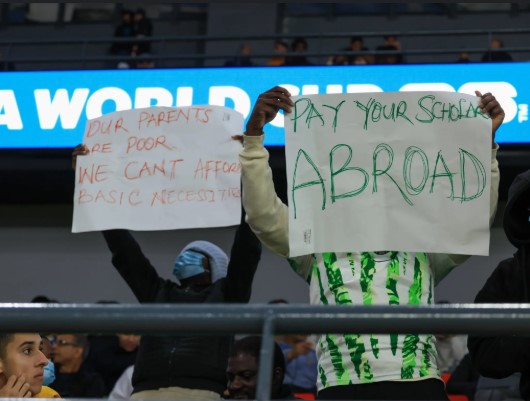
Nigerian students studying abroad under the Federal Government’s Bilateral Education Agreement and their parents are set to stage a protest today (Monday) over the non-payment of scholarship stipends, which they say has pushed many scholars into distress, The PUNCH learnt.

The demonstration, according to a notice issued by the Forum of BEA Scholars, will take place at the Ministry of Finance headquarters in the Central District of Abuja at 10am.

Parents of the affected students, who said they could no longer bear the financial and emotional strain of supporting their stranded children abroad, confirmed they would join the protest.

In the notice, the scholars said they are entitled to monthly stipends of $500 but have not received any payment this year, leaving 11 months outstanding.

They added that the Federal Government cut their 2024 stipends by 56 per cent, paying only $220 instead of the approved $500. According to the notice, the government still owes them arrears for September, October, November and December 2023.

Many of the students, who are studying in countries such as Hungary, Morocco, China, Russia and Serbia, said they were struggling to afford food, accommodation, medical care and transportation due to the prolonged delay.

The Forum of BEA Scholars said several students had taken informal jobs in violation of their scholarship terms, while others had been relying on charity.

The group linked the recent death of a Nigerian student in Morocco to the hardship caused by unpaid allowances, warning that more students were at risk if the government continued to delay payments.

See also  Male student defeats female counterparts in Anambra cooking contest

The PUNCH earlier reported that the Federal Government in April 2025 announced the cancellation of the Bilateral Education Agreement scholarship programme, describing it as an unsustainable and inefficient use of public funds.

The decision followed months of complaints by stranded Nigerian scholars abroad who accused the government of failing to meet its financial obligations under the scheme.

Established through diplomatic agreements with countries such as China, Russia, Algeria, Hungary, Morocco, Egypt, and Serbia, the BEA programme has allowed hundreds of Nigerian students to pursue higher education overseas on government sponsorship.

Despite recent assurances by the Federal Government that all supplementary allowances had been paid up to December 2024—with further funds requested to cover outstanding entitlements affected by exchange rate fluctuations—the Minister of Education, Dr Tunji Alausa, announced a definitive end to the programme.

Speaking during a courtesy visit by newly elected officials of the National Association of Nigerian Students, Alausa said the government would redirect BEA funding to domestic scholarship programmes to reach a broader number of students across the country.

“In 2024, when I assumed office, I was asked to approve N650m for 60 students going to Morocco under the BEA programme. I refused. It’s not fair to Nigerian students,” Alausa said.

Alausa also expressed dissatisfaction with the lack of oversight and performance monitoring under the BEA, noting that the government sponsors annual travel for scholars without tracking their academic progress.

“In 2025 alone, we projected N9bn to fund just 1,200 students abroad. Meanwhile, millions of students in Nigeria get no support. It’s unjust and unsustainable,” the minister stated. “We have evaluated every single course these 1,200 students are studying abroad—every one of them is offered in Nigerian universities.”

See also  Cross River inducts teachers, lauds FG’s support for primary education

He confirmed that while current BEA beneficiaries will be supported to complete their programmes, the scheme will not accept new admissions beyond 2025.

“This programme is not the best use of public funds. That money will now be used to fund local scholarships and support more students,” Alausa concluded.

By May 2025, Alausa lamented that 85 per cent of Nigerian students sent abroad on government scholarships never returned to contribute to national development.

This came as he announced that tertiary institutions with fewer than 2,000 students will no longer be eligible for funding from the Tertiary Education Trust Fund.

On foreign scholarships, Alausa revealed a shift in policy, explaining that more funds would now be invested in building local capacity.

With the Federal Government’s decision not to fund foreign scholarships anymore, several beneficiaries of the BEA scholarship programme have been stranded in foreign countries.

punch.ng

FOLLOW US ON:

FACEBOOK

TWITTER

PINTEREST

TIKTOK

YOUTUBE

LINKEDIN

TUMBLR

INSTAGRAM

Continue Reading
Click to comment

Leave a Reply

Your email address will not be published. Required fields are marked *

Education

UUTH resident doctors join nationwide strike

Published

on

The Association of Resident Doctors, University of Uyo Teaching Hospital, has resolved to join the nationwide strike declared by the National Association of Resident Doctors on Monday, January 12, 2026.

The decision was contained in a communiqué issued after an emergency general meeting of the association held in Uyo, Akwa Ibom State, on Thursday.

The communiqué, endorsed by its President, Dr Ekomobong Udoh, and General Secretary, Dr Kenneth Ikott, and made available to our correspondent in Uyo on Friday, said the centre would undertake a peaceful protest by 9am on Monday within the UUTH premises, in total compliance with the directive of NARD.

It read in part, “Members of the congress gathered for an emergency general meeting to discuss the resolutions issued by the NARD Extra-Ordinary NEC virtual meeting held on Saturday, January 2, 2026. After thorough deliberation and discussion on the resolutions of NARD, the meeting, chaired by the President, resolved as follows.

“The centre fully supports the implementation of the NARD NEC meeting resolutions. The congress immediately agreed to participate in the NARD TIC 2.0 from 12 noon on Monday, in line with the NEC directive, and will undertake a peaceful protest by 9am on Monday within the UUTH premises.”

Udoh said the proposed industrial action followed the failure of the Federal Government to fully implement the Memorandum of Understanding signed with resident doctors in November 2025.

According to him, the strike, tagged TICS (Total, Indefinite and Comprehensive Strike) 2.0, with the slogan, “No Implementation, No Going Back”, would only be suspended after the full implementation of the minimum demands.

See also  Experts knock FG for reversing mother-tongue policy in schools

He listed the demands to include the reinstatement of the FTH Lokoja Five, payment of promotion and salary arrears, full implementation of the professional allowance table with arrears captured in the 2026 budget, and official clarification on skipping and entry-level issues by the Federal Ministry of Health and circulars to chief executives.

Other demands include the reintroduction and implementation of the Specialist Allowance, resolution of house officers’ salary delays and arrears, including the issuance of a pay advisory, recategorisation of membership certificates, and issuance of certificates after Part I by the NPMCN, commencement of locum and work-hours regulation committees, and resumption and timely conclusion of the Collective Bargaining Agreement process.

punch.ng

FOLLOW US ON:

FACEBOOK

TWITTER

PINTEREST

TIKTOK

YOUTUBE

LINKEDIN

TUMBLR

INSTAGRAM

Continue Reading

Education

Nigeria emerges fifth-best English-speaking country in Africa

Published

on

Nigeria has emerged as the fifth-best English-speaking country in Africa, according to the 2025 Education First English Proficiency Index cited by PUNCH Online on EF’s website on Monday.

The report, compiled by global education leader EF, assessed English skills across 123 countries and regions, using data from 2.2 million test takers. This year’s edition also included, for the first time, speaking and writing skills, measured using artificial intelligence technology developed by EF’s education technology arm.

English, Nigeria’s official language, remains central to education, governance, media, and business, helping the country maintain strong proficiency levels. On the African continent, Nigeria trails South Africa, Zimbabwe, Kenya, and Zambia, which lead in English proficiency. The rankings underscore the growing importance of English as a bridge for international communication, education, and commerce.

Top 10 English-Speaking Countries in Africa (EF EPI 2025):

South Africa – Widespread use in government, education, media, and business.

Zimbabwe – English is the primary language of instruction and administration.

Kenya – Official language alongside Swahili, widely used in urban and professional settings.

Nigeria – Official language, central to national communication and commerce.

Ghana – English is used from basic to tertiary education and in public administration.

Uganda – Official language; key role in trade, diplomacy, and professional environments.

Ethiopia – Widely used in education and international affairs, though not official.

Tunisia – Growing adoption among youth and professionals in education, tech, and tourism.

Morocco – Increasing popularity in schools and business for global trade and relations.

Continue Reading

Education

Bandit attacks: Kebbi, Kwara reopen schools

Published

on

Kebbi and Kwara state governments have announced the reopening of schools in selected areas, signaling a gradual return to normal academic activities after months of closures due to rising bandit attacks.

In Kebbi, the state government approved the immediate resumption of selected primary and secondary schools located in major cities and towns.

The state had ordered school closure following bandit attack on Government Girls’ Comprehensive Secondary School, Maga town, Danko/Wasagu Local Government Area in November, during which 25 schoolgirls were abducted and the school guard killed.

The reopening announcement was made on Sunday by the Commissioner for Basic and Secondary Education, Dr. Halimatu Bande, during a briefing in Birnin Kebbi.

According to Bande, the resumption takes effect from Monday, January 5, 2026, and applies only to schools within urban centres. Schools in rural areas will reopen later, following further improvements in security.

“Only schools located within major cities and towns are approved to resume at this stage,” Bande said. “Schools outside these areas will reopen at a later date, which will be communicated in due course.”

The commissioner explained that the phased reopening is aimed at ensuring the safety of students and teachers while gradually restoring full academic activities across the state.

She also directed Education Secretaries and Zonal Directors to enforce compliance and monitor implementation, appealing to parents and guardians to ensure that their children return to school promptly.

Bande commended Governor  Nasir Idris for his sustained support for education, describing his administration as committed to providing safe, inclusive, and quality learning for all children in Kebbi State.

Meanwhile, in Kwara State, the Ministry of Education and Human Capital Development has ordered the resumption of academic activities in all schools from today (Monday).

See also  University of Maiduguri alumni and students reject renaming institution after Buhari

The directive, issued by the ministry’s Press Secretary, Peter Amogbonjaye, quoted the Commissioner for Education, Dr. Lawal Olohungbebe, as saying that learning will resume immediately, except in areas still under “special security measures.”

“Learning activities are to resume immediately in all but areas earlier identified to be under special security surveillance,” the statement said. “Normal school activities will resume in such places very soon.”

The move follows a November 2025 directive that temporarily closed schools in several local government areas, including Ifelodun, Ekiti, Irepodun, Isin, and Oke Ero, in response to escalating insecurity and bandit attacks.

The closures were aimed at safeguarding pupils and teachers and were part of broader emergency responses to violent incidents in the state.

To ensure continuity in learning, especially for pupils in areas still affected by insecurity, the ministry also announced a radio-based learning initiative in collaboration with UNICEF and the Nigeria Learning Passport.

The programme, airing on the state-owned 99.1 Midland FM, will begin on January 5, with scheduled broadcasts at 11 a.m. on Mondays and Tuesdays, 1 p.m. on Wednesdays, and 2:30 p.m. on Fridays. Additional radio stations will be added to expand reach.

“The initiative aims to ensure continuity in learning, especially for pupils in areas where school activities are still limited by security concerns,” the ministry said.

FOLLOW US ON:

FACEBOOK

TWITTER

PINTEREST

TIKTOK

YOUTUBE

LINKEDIN

TUMBLR

INSTAGRAM

Continue Reading

Trending