Connect with us

News

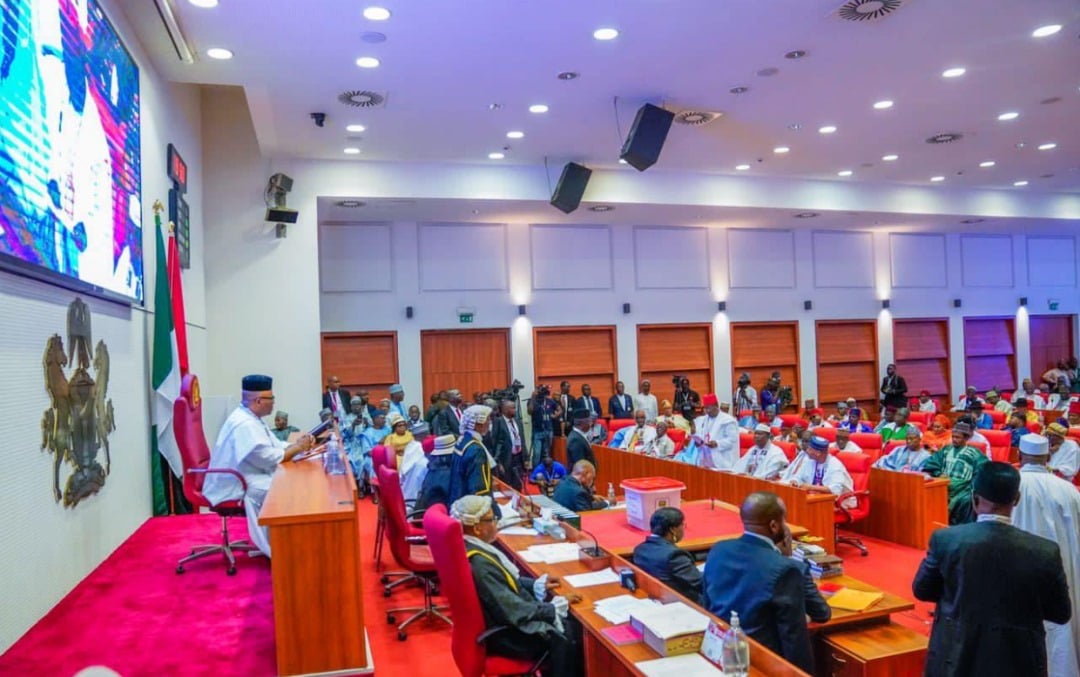
Senate seeks support for farmers over farm produce price crash

Published

on

The Senate on Tuesday called for urgent government intervention to cushion Nigerian farmers from the sharp drop in prices of agricultural produce, warning that the situation, if left unchecked, could threaten millions of livelihoods and worsen the country’s fragile food security.

The call followed the adoption of a motion sponsored by Senator Mohammed Danjuma Goje (Gombe Central), which highlighted the growing imbalance between falling farm-gate prices and the persistently high cost of agricultural inputs.

In its resolutions, the Senate commended the Federal Government for bringing down the cost of foodstuffs across the country by granting waivers and special permissions for large-scale importation of food products, noting that the policy had brought relief to many Nigerians amid the cost-of-living crisis.

However, lawmakers observed that the same policy had created unintended consequences for local farmers.

“The lowering of the cost of food products has brought succour to Nigerians but has at the same time created special problems for the Nigerian farmers.”

“While the prices of farm produce have been going down, those of the farm inputs, especially fertilisers, pesticides and insecticides, have remained extremely high, placing enormous pressure on farmers’ earnings and sustainability,” Goje stated.

According to him, the situation “gravely threatens the livelihood of millions of smallholder farmers who constitute the backbone of Nigeria’s food production system and depend almost entirely on farming, as their primary and sole source of income.”

Seconding the motion, Senator Aliyu Wamakko (Sokoto North) emphasised the need for policies that balance food affordability for consumers with sustainable incomes for farmers, stressing that high input costs must be urgently addressed to boost production.

See also  Primate Ayodele releases prophecies on Cameroon, Uganda, Côte d’Ivoire, others

Senator Dandutse Mohammed (Katsina South) described the motion as timely, noting that over 60 per cent of Nigerians depend on agriculture for their livelihoods.

He lamented that fertiliser prices had reportedly risen above ₦60,000 per bag, while produce prices continued to fall, warning that unchecked food importation and lack of subsidies were devastating local farmers and contributing to insecurity.

Senator Steve Karimi (Kogi West) raised concerns over insecurity in farming communities, describing it as a major threat to food security, while Senator Idiat Adebule (Lagos West) questioned the role of state governments in complementing federal agricultural initiatives.

In his contribution, Senator Victor Umeh (Anambra Central) acknowledged that temporary border relaxation during periods of scarcity might be necessary, but insisted that farmers must be supported with affordable inputs and stable commodity pricing to sustain production.

“Nigeria’s growing dependence on imported food commodities will weaken national food sovereignty, undermine domestic value chain, distort local markets as well as discourage the development of agro-processing industries, thereby exposing the national economy to global price volatility and foreign exchange pressures,” the Senate noted.

The senators added that “effective coordination between MDAs, state governments, commodity boards, agricultural cooperatives and other relevant stakeholders, is critical to ensuring fair pricing, robust storage facilities, efficient transportation system and improved market linkages.”

Consequently, the Senate urged the Federal Government to design and implement a comprehensive Special Emergency Intervention Package for farmers affected by the current collapse in agricultural produce prices to cushion their losses and ensure household stability.

It also called on the government to establish a “Benchmark Minimum Price Framework for major agricultural commodities and implement a Guaranteed Off-take Programme, whereby government purchases produce directly from farmers at the benchmark price to stabilise the market.”

See also  Collapsed Lagos building occupants ignored distress signs – Residents

The Senate further resolved to urge the Federal Government to introduce broad-based agricultural input subsidies, particularly for fertilisers, and other farm inputs, and to prioritise investment in “strategic agricultural infrastructure, including storage facilities, rural roads, processing centres, and irrigation systems to reduce post-harvest losses and boost the profitability of farmers.”

punch.ng

FOLLOW US ON:

FACEBOOK

TWITTER

PINTEREST

TIKTOK

YOUTUBE

LINKEDIN

TUMBLR

INSTAGRAM

Continue Reading
Click to comment

Leave a Reply

Your email address will not be published. Required fields are marked *

News

Tinubu meets labour leaders over proposed protest

Published

on

President Bola Tinubu on Tuesday night met with the leadership of the Nigeria Labour Congress amid plans by organised labour to stage a nationwide protest over unresolved demands.

The meeting, which took place at the State House, Abuja, followed growing tensions between the Federal Government and labour unions over issues bordering on workers’ welfare, rising cost of living and the implementation of previously agreed concessions.

Confirming the meeting in a statement issued on Tuesday night, the Special Adviser on Information and Strategy to the President, Bayo Onanuga, disclosed that key stakeholders were in attendance.

“President Bola Ahmed Tinubu met with the leadership of the NLC, along with the chairman of Progressive Governors Forum, Hope Uzodimma, Governor of Edo State, Monday Okpebholo and Governor of Kebbi State, Dr Nasir Idris and the Minister of State Labour, Honourable Nkeiruka Onyejeocha,” the statement partly read.

According to the statement, the Nigeria Labour Congress was led to the meeting by its national leadership.

“The chairman of the NLC, Comrade Joe Ajaero, led the labour leaders to the meeting on Tuesday night at the State House, Abuja,” it added.

PUNCH Online reports that the meeting comes against the backdrop of the NLC’s recent threat to embark on mass protests nationwide over what it described as the Federal Government’s failure to fully address workers’ demands, including relief measures to cushion the impact of economic reforms, wage-related concerns and broader socio-economic hardships faced by Nigerian workers.

Organised labour had accused the government of delaying the implementation of agreements reached in previous engagements, warning that failure to act decisively could trigger industrial unrest and street protests across major cities.

See also  Nigeria condemns Israeli airstrike in Qatar targeting Hamas leadership

As of the time of filing this report, neither the Federal Government nor the leadership of the NLC had released details of the discussions or the outcome of the meeting.

punch.ng

FOLLOW US ON:

FACEBOOK

TWITTER

PINTEREST

TIKTOK

YOUTUBE

LINKEDIN

TUMBLR

INSTAGRAM

Continue Reading

News

US expands travel restrictions, adds Nigeria to list of countries

Published

on

President Donald Trump on Tuesday signed a Proclamation further restricting entry to the United States for nationals from countries deemed high-risk due to “demonstrated, persistent, and severe deficiencies in screening, vetting, and information-sharing” that threaten U.S. national security and public safety.

Trump. US
File photo: USA flag

Among the 15 additional countries newly subject to partial restrictions is Nigeria.

The announcement comes directly from the White House website, in a fact sheet titled “President Donald J. Trump Further Restricts and Limits the Entry of Foreign Nationals to Protect the Security of the United States”, issued December 16, 2025.

Trump had earlier on October 31 declared Nigeria as a ‘country of particular concern’ in response to allegations of a Christian genocide in the country.

The African Union chief said there was no genocide in Nigeria’s volatile north. And so did ECOWAS addressing the recent surge in terrorist attacks across the region, including Nigeria, while firmly rejecting claims that these acts constitute genocide. Over and over, Tinubu, days ago, again dismissed claims that there is a Christian genocide in the country, insisting that neither Christians nor Muslims are being targeted for killing.

This had prompted series of back and forth and meeting among US Congress and individuals and the Nigerian delegation who have met both in Nigeria and US since. On December 13, a US congressman, Riley Moore, said the US and Nigeria were close to reaching a strategic security agreement aimed at addressing terrorism and sectarian violence in Nigeria.

Days earlier, he stated that the US had concluded its fact-finding mission to Nigeria over alleged genocide and is expected to brief Trump before the end of the month.

However, the latest in the series of ban on Tuesday had the White House described the action as “strengthening national security through common sense restrictions based on data.”

The Proclamation continues full restrictions and entry limitations on nationals from the original 12 high-risk countries under Proclamation 10949: Afghanistan, Burma, Chad, Republic of the Congo, Equatorial Guinea, Eritrea, Haiti, Iran, Libya, Somalia, Sudan, and Yemen.

See also  Nigeria condemns Israeli airstrike in Qatar targeting Hamas leadership

It also adds full restrictions and entry limitations on five additional countries: Burkina Faso, Mali, Niger, South Sudan, and Syria, along with individuals holding Palestinian-Authority-issued travel documents. Laos and Sierra Leone, previously subject to partial restrictions, now face full restrictions.

Nationals from Burundi, Cuba, Togo, and Venezuela remain under partial restrictions.

The Proclamation adds partial restrictions and entry limitations on 15 additional countries, including Angola, Antigua and Barbuda, Benin, Cote d’Ivoire, Dominica, Gabon, The Gambia, Malawi, Mauritania, Nigeria, Senegal, Tanzania, Tonga, Zambia, and Zimbabwe.

The fact sheet notes that “exceptions for lawful permanent residents, existing visa holders, certain visa categories like athletes and diplomats, and individuals whose entry serves U.S. national interests” are included.

It also states that family-based immigrant visa carve-outs that carry “demonstrated fraud risks” have been narrowed, while case-by-case waivers remain possible.

In explaining the rationale, the White House fact sheet emphasizes that the Proclamation is necessary “to prevent the entry of foreign nationals about whom the United States lacks sufficient information to assess the risks they pose, garner cooperation from foreign governments, enforce our immigration laws, and advance other important foreign policy, national security, and counterterrorism objectives.”

The fact sheet quotes Trump directly: “It is the President’s duty to take action to ensure that those seeking to enter our country will not harm the American people.”

It adds that, after consultations with cabinet officials and assessments based on Executive Order 14161, Proclamation 10949, and country-specific information, “President Trump has determined that the entry of nationals from additional countries must be restricted or limited to protect U.S. national security and public safety interests.”

The restrictions are country-specific “in order to encourage cooperation with the subject countries in recognition of each country’s unique circumstances,” the fact sheet says, highlighting challenges such as “widespread corruption, fraudulent or unreliable civil documents and criminal records, and nonexistent birth-registration systems—systemically preventing accurate vetting.”

See also  IPOB Knocks UK Govt Over Silence On Continued Detention Of Nnamdi Kanu

Some countries, it notes, “refuse to share passport exemplars or law-enforcement data,” while others allow Citizenship-by-Investment schemes that conceal identity and bypass vetting requirements.

The fact sheet also cites “high visa-overstay rates and refusal to repatriate removable nationals” and the presence of “terrorist, criminal, and extremist activity” in several restricted countries.

The White House fact sheet frames the move as part of President Trump’s ongoing national security agenda: “President Trump is keeping his promise to restore travel restrictions on dangerous countries and to secure our borders.”

It references the Supreme Court’s prior ruling on similar restrictions, noting that the Court found the policy “is squarely within the scope of Presidential authority” and that it is “expressly premised on legitimate purposes”—specifically “preventing entry of nationals who cannot be adequately vetted and inducing other nations to improve their practices.”

Finally, the fact sheet notes that Turkmenistan, which previously faced restrictions, has made progress in cooperation with the U.S., prompting the new Proclamation to lift the ban on its nonimmigrant visas while maintaining the suspension of entry for Turkmen nationals as immigrants.

From June 5 ban to national guard shooting

Two US National Guard soldiers were shot in November near the White House, officials said, and police said a suspect was detained in an extraordinary security drama likely to fuel controversy over President Donald Trump’s crime crackdown.

Reacting, Trump said that he would suspend migration from what the US leader called “third world countries”, a day after an Afghan national allegedly shot two National Guard soldiers in Washington, killing one.

His angry post, which also threatened to reverse “millions” of admissions granted under his predecessor, Joe Biden, marked a new escalation in the anti-migration stance of a second term that has been dominated by Trump’s mass deportation campaign.

Meanwhile, the Trump administration announced in the first week of December  that it would review the immigration status of all permanent residents, or “Green Card” holders, from Afghanistan and 18 other countries following the attack.

The review follows a June executive order from President Trump classifying 19 countries as “of Identified Concern.”

The order banned entry for nearly all nationals from 12 countries, including Afghanistan. The full list of these countries include: Afghanistan, Myanmar, Chad, Congo-Brazzaville, Equatorial Guinea, Eritrea, Haiti, Iran, Libya, Somalia, Sudan, and Yemen.

Barely two weeks after in June, Trump commenced plans to place a general visa ban on Nigerians.

According to a report by the Washington Post, an internal memo signed by Secretary of State Marco Rubio outlined a proposal that could impose visa restrictions or entry bans on up to 36 additional nations.

These countries were expected to comply with newly established requirements from the U.S. State Department within a 60-day timeframe or face potential travel restrictions.

However, PUNCH Online reports that the timeframe elapsed in August 2025, and it was not until four months later that the new proclamation was issued.

What “Full” and “Partial” Restrictions Mean

  • Full bans/suspensions generally bar citizens of specified countries from entering the U.S. and block the issuance of most new immigrant and non-immigrant visas. Exceptions may still exist for lawful permanent residents, diplomats, or specific exempt categories.

  • Partial restrictions limit or suspend certain classes of visas (e.g., tourist, student, exchange), impose stricter vetting and shorter visa validity, and often require more rigorous screening before entry is permitted.

punch.ng

FOLLOW US ON:

FACEBOOK

TWITTER

PINTEREST

TIKTOK

YOUTUBE

LINKEDIN

TUMBLR

INSTAGRAM

Continue Reading

News

Blackout looms as gas shortfall hits power stations

Published

on

– Gas pipeline vandalism cuts power generation – NISO

Nigerians may celebrate the Yuletide in darkness if the Federal Government takes no further steps to defray the gas-to-power debt, as gas companies have begun cutting supplies to power plants, a development already affecting electricity generation nationwide.

On Tuesday, the Enugu Electricity Distribution Company informed customers across the South-East of the situation in a statement issued by its Group Head, Corporate Communications, Emeka Ezeh.

According to EEDC, the drop in power supply availability is due to low system frequency, said to have been occasioned by gas constraints affecting generation companies. The DisCo disclosed that the situation had necessitated load shedding of available energy by the Transmission Company of Nigeria.

As a result, EEDC said the development had impacted energy allocation to it and reduced the daily service level to customers served by its subsidiary companies — MainPower, TransPower, FirstPower, NewEra, and EastLand.

The statement read, “The Enugu Electricity Distribution Company PLC wishes to inform electricity customers across the South-East region that the recent drop in power supply availability is due to low system frequency, occasioned by gas constraints affecting the generation companies. This development has necessitated the load shedding of available energy by the Transmission Company of Nigeria.

“As a result, this development has impacted energy allocation to EEDC and the daily service level to customers served by its subsidiary companies, namely MainPower, TransPower, FirstPower, NewEra, and EastLand.

“Efforts are currently being made by critical stakeholders in the electricity supply industry to address this challenge and restore normal power distribution. EEDC sincerely apologises for the inconvenience this situation has caused its esteemed customers and appreciates their patience and understanding.”

See also  Collapsed Lagos building occupants ignored distress signs – Residents

Earlier, the Port Harcourt Electricity Distribution Company also issued a notice to customers, stating, “Dear esteemed customer, Kindly be informed that the current load shedding being experienced in all our franchise areas is a result of poor generation and allocation from the generation company and NCC.

“We appeal to our esteemed customers to exercise patience as the GenCo team is working assiduously to improve generation and allocation. All inconveniences are regretted.”

In an interview with our correspondent, generation companies confirmed that gas constraints were affecting their operations. The Chief Executive Officer of the Association of Power Generation Companies, Joy Ogaji, confirmed that gas producers had begun cutting supplies due to debts owed to them.

Recall that Nigerians experienced months of darkness in the first quarter of 2024 after gas companies stopped supplying feedstock to thermal power plants over unpaid debts. Although government intervention resolved the crisis at the time, gas producers said they have continued supplying gas without payment.

On December 4, 2025, the Federal Government announced the approval of N185bn for the payment of outstanding debts owed to natural gas suppliers in a bid to ease liquidity constraints and boost electricity generation nationwide.

The Minister of State for Petroleum Resources (Gas), Ekperikpe Ekpo, disclosed this in a statement issued by his media aide, Louis Ibah, noting that the approval was granted a day earlier by the National Economic Council, chaired by Vice President Kashim Shettima.

However, the decision by gas companies to cut supplies despite the payment approval remains unclear. Bolaji Tunji, spokesman for the Minister of Power, Adebayo Adelabu, had yet to respond to messages sent to him as of the time of filing this report.

See also  IPOB Knocks UK Govt Over Silence On Continued Detention Of Nnamdi Kanu

With gas supplies constrained and power generation yet to recover, electricity distribution across several parts of the country remains under pressure, raising concerns over sustained outages unless the liquidity issues in the gas-to-power chain are urgently resolved.

Gas pipeline vandalism

Meanwhile, the Nigerian Independent System Operator stated on Tuesday that electricity generation on the national grid dropped following gas supply constraints caused by a reported vandalism incident within the upstream gas pipeline network.

NISO disclosed that the incident disrupted gas supply to several gas-fired power plants, leading to a sharp decline in available generation capacity on the grid. In a statement signed by its management, the system operator explained that the reduced gas availability forced multiple thermal power stations to operate at significantly lower output, affecting overall electricity supply nationwide.

It noted that the development once again exposed the vulnerability of Nigeria’s power sector to gas supply disruptions, given that more than 80 per cent of grid-connected power plants rely on natural gas. The clarification followed the recent drop in power supply across the country, attributed to gas supply constraints affecting optimal output and the general operational frequency of the generating companies.

NISO stated, “The Nigerian Independent System Operator wishes to inform the general public and sector stakeholders that electricity generation on the National Grid has dropped due to gas supply constraints arising from the reported incident of gas pipeline vandalisation within the upstream gas supply network.

“The incident affected gas availability to several power generation facilities. Consequently, several gas-fired power stations recorded low output, which resulted in reduced available generation capacity on the national grid. In response to the situation, NISO promptly activated established contingency measures to maintain system stability and reliability.”

See also  ‘If You’re Here Illegally, You’ll Be Deported’ – Kemi Badenoch Declares In Fresh UK Border Plan

According to the operator, emergency actions included increased dispatch from available hydroelectric power stations, continuous generation re-dispatch, voltage control interventions, and other operational adjustments aimed at balancing electricity supply with demand.

NISO added that it was closely monitoring grid conditions, including system frequency and voltage profiles, while working with key stakeholders across the electricity value chain to mitigate the impact of the disruption.

The operator also warned that the timing of the incident was particularly concerning, as the festive season typically places additional pressure on the national grid due to higher electricity demand.

Continue Reading

Trending