The Air Component of the Joint Task Force (North East), Operation HADIN KAI (OPHK), has conducted a precision air strike on a known terrorist enclave and logistics hub located near the abandoned village of Jilli in Gubio Local Government Area of Borno State.
This was contained in a statement made available to defence correspondents in Abuja on Sunday by the Media Information Officer, Headquarters Joint Task Force (North-East) Operation HADIN KAI, Lieutenant Colonel Sani Uba.
According to the statement, the successful strike, executed on Saturday, 11 April 2026, followed sustained Intelligence, Surveillance and Reconnaissance (ISR) missions over the Bindul–Jilli axis, an area long identified as a major terrorist movement corridor and convergence point for Islamic State West Africa Province terrorists and their collaborators.
The statement recalled that in January 2026, troops moving from Gubio towards Damasak came under a major Improvised Explosive Device (IED) attack along the road at Bindul, resulting in the tragic loss of eight soldiers, while several others were wounded in action.
It further explained that more recently, on April 9, coordinated attacks were recorded in Ngamdu and Benisheik, supported by the same terrorist logistics network. This consequently prompted the Theatre to intensify overhead surveillance and intelligence gathering across the area in response to persistent reports of terrorist movement and logistics activity.
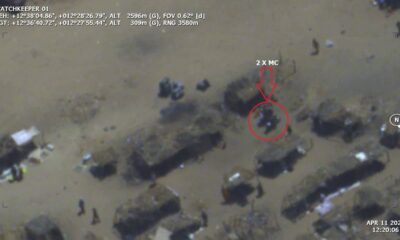
It added that on 11 April 2026, multiple reports were received of ISWAP gun trucks (GT) and motorcycles (MC) moving along the axis. Consequently, ISR coverage over the area was immediately intensified.
According to the statement, during the surveillance mission, a contingent of motorcycles was observed moving in the direction of Jilli, followed shortly by several additional vehicles, all converging on the same location.
The statement reads: “These suspicious movements were subsequently corroborated by credible human intelligence sources, confirming that the converging elements were terrorists, their collaborators, and logistics handlers.
“In line with established operational procedures, a rigorous and professional targeting process was undertaken. Target fidelity was confirmed through multiple credible human intelligence sources, supported by persistent aerial surveillance.
“Upon final validation, the air component executed a series of precision strikes on the objective, while surveillance platforms maintained continuous overwatch for real-time battle damage assessment.”
It further explained that post-strike assessment confirmed that the target area was struck with high accuracy, resulting in the destruction of the identified terrorist logistics enclave.
It pointed out that scores of terrorists were neutralised in the strike, with their vehicles and technicals destroyed, while surviving elements were observed fleeing in multiple directions.
Intelligence further indicated that the neutralised elements were in the final stages of receiving logistics from couriers for coordinated attacks on troop locations within the Gubio axis.
The statement further added: “Instructively, on 12 April 2026, a terrorist logistics courier identified as ‘Turja Bulu’ was arrested in Ngamdu town and, upon preliminary investigation, confessed to taking part in the attack at the 29 Brigade location on 9 April 2026 in Benisheik. He had been dispatched by ISWAP from Jilli, where most of his fellow terrorists were hibernating, to provide food items for another group of terrorists currently hibernating around the Magumeri–Gubio general area.
“This successful strike is yet another demonstration of the resolve and operational capability of OPHK to sustain relentless pressure on terrorist elements, disrupt their logistics networks, and deny them freedom of movement within the Theatre.”
It added that the Theatre Command also reiterated that the use of motorcycles remains strictly prohibited across the North-East operational theatre, particularly in Borno and Yobe states, due to their continued use by terrorist elements for movement, logistics, and attack operations.
“Any such movements in restricted areas are therefore treated with the utmost seriousness in line with existing operational directives,” it added.
The statement reaffirmed that the Joint Task Force (North East) OPHK assured the people of the North East, and indeed all law-abiding Nigerians, that ongoing operations will continue with renewed intensity until all terrorist enclaves are dismantled and lasting peace is restored to the region.
NAF probes alleged civilian casualties
The Nigerian Air Force (NAF) says it has launched an investigation into alleged civilian casualties following an air strike in Jilli, Borno State.
In a statement on Sunday, spokesman, Air Commodore Ehimen Ejodame, said reports suggested that the strike might have hit a local market in Jilli, raising concerns about civilian casualties.
He said the Chief of the Air Staff had ordered the immediate activation of the Civilian Harm Accident and Investigation Cell.
According to him, the cell has been deployed to the location on a fact-finding mission into the allegations.
“The Nigerian Air Force treats all reports of possible civilian harm with the utmost seriousness and empathy.
“The protection of innocent lives remains central to all NAF operations,” he said.
Ejodame said the service remained committed to professionalism, accountability and transparency in its missions.
He added that the force would work with authorities and community representatives to establish the facts.
While the investigation continues, he urged the public and media to avoid speculation and allow due process.
Zulum warns residents against aiding Boko Haram insurgents
Meanwhile, Governor Babagana Zulum of Borno has warned residents against harbouring or providing logistical support to Boko Haram insurgents.
The News Agency of Nigeria (NAN) reports that the warning followed a recent operation conducted by the Air Component of the Joint Task Force (North East), Operation Hadin Kai, in the Jilli general area of Gubio Local Government Area on Saturday.
Zulum, in a statement signed by his spokesperson, Mr Dauda Iliya, described Jilli market as a notorious hub, allegedly used by insurgents and their logistics suppliers.
“I have been properly briefed on the airstrike carried out by the Air Component of Operation Hadin Kai on Jilli market, a border town between Borno and Yobe.
“Let me state categorically that the Borno State government closed Jilli and Gazabure markets five years ago.
“I am in close consultation with the government of Yobe State and the military hierarchy on the matter,” the governor was quoted as saying.
The governor said that the state government had maintained close coordination with the military and other security agencies before resettling any community or reopening markets, particularly in areas affected by insurgency.
He urged residents to remain vigilant and cooperate with security agencies by providing credible information that will aid ongoing military operations.
Military action inevitable, says Buratai
In a related development, a former Chief of Army Staff, Lt-General Tukur Buratai, has described Jilli market, a border town between Borno and Yobe states, as a notorious terrorist hub, saying military action is inevitable.
In a statement issued in Kaduna on Sunday, which he personally signed, the retired army general said, “I must state clearly that I commend the Nigerian Air Force and the intelligence community for the courage and professionalism displayed in this operation.
“The strike was a targeted military action based on credible intelligence that Boko Haram and ISWAP terrorists were using the weekly market at Jilli to collect illegal levies, procure supplies, and plan further attacks.
“The public should understand the history of Jilli Market. It has long been a notorious terrorist logistics hub.
“The Nigerian Army repeatedly raided and shut it down. In 2018, during Operation LAST HOLD, our troops occupied the area and engaged in multiple clashes with insurgents.
“Despite several closures, the terrorists continued to operate the market with the cooperation of some individuals who patronised and supplied them.
“It is deeply regrettable that innocent lives may have been caught in the strike, but the sole responsibility rests with the terrorists who deliberately embed themselves within civilian spaces as human shields.
“No military wishes to harm civilians, but when a market is dominated by terrorist logistics and warnings have been ignored for years, the military has a duty to act.
“I appeal to the people of Geidam, Gubio, Damasak, and Ngamdu to cooperate with the military. Stop patronising or supplying goods to any market where terrorists establish or frequent. Communities that continue to trade with insurgents will inevitably find themselves in harm’s way.
“The armed forces deserve our support. They acted on solid intelligence and struck a legitimate target. While we mourn innocent lives lost, we must not weaken our resolve against an enemy that shows no mercy.”
CISLAC, TI condemn strikes, seek immediate probe
The Civil Society Legislative Advocacy Centre (CISLAC).and Transparency International (TI) in Nigeria on Sunday expressed grave concerns over reports of Nigerian Air Force airstrike that struck a civilian market along the Borno–Yobe boundary, leaving dozens feared dead and many injured.
CISLAC Executive Director, Comrade Auwal Ibrahim Musa Rafisanjani, in a statement, while extending condolences to the victims, called for urgent, transparent, and independent investigation into the circumstances surrounding this attack.
He said: “We find it disturbing that evidence from similar cases shows recurring structural gaps such as weak intelligence verification, lack of precision targeting capacity; pressure for rapid results.
“Airstrikes often rely on single-source or outdated intelligence, especially in environments where insurgents mix with civilians. Just as military units under constant pressure to neutralize insurgents quickly, lowering verification thresholds.
“As a matter of urgency, we demand an independent investigation and accountability with an established credible civilian-led investigative panel comprising the National Human Rights Commission (NHRC), Civil Society, and international observers where necessary; public disclosure of findings and accountability for errors or negligence; and adequate compensation and support to victims and families.”
They also recommended immediate adoption of what it called Civilian Protection Framework to institutionalise Civilian Harm Mitigation and Response used by modern militaries; mandatory civilian risk assessments before strikes; formulation and implementation of comprehensive policy on No-strike lists (markets, hospitals, religious sites); real-time abort protocols when civilian presence is detected.
The statement reads in part: “We call for the review and adoption of best practices from Global Counterterrorism Operations such Multi-Layered Intelligence Verification; Persistent Surveillance Before Engagement; Precision-Guided Munitions (PGMs); Civil-Military Coordination through Civilian Joint Task Force, round verification; Early Warning signals and local intelligence validation; and Post-Strike Civilian Harm Assessment.
“We recommend comprehensive upgrade in Defence critical hardware such as integration of ISR drones with real-time video feeds; facial recognition/pattern-of-life analytics; precision-guided weapons; secured communication systems linking pilots to ground intelligence units.
“We call for a comprehensive Civilian Protection Policy across all armed forces; adequate Civilian Oversight, particularly National Assembly, must enforce regular oversight hearings on military operations; and mandatory reporting of civilian casualty incidents.”
tribuneonlineng.com
FOLLOW US ON:
FACEBOOK
TWITTER
PINTEREST
TIKTOK
YOUTUBE
LINKEDIN