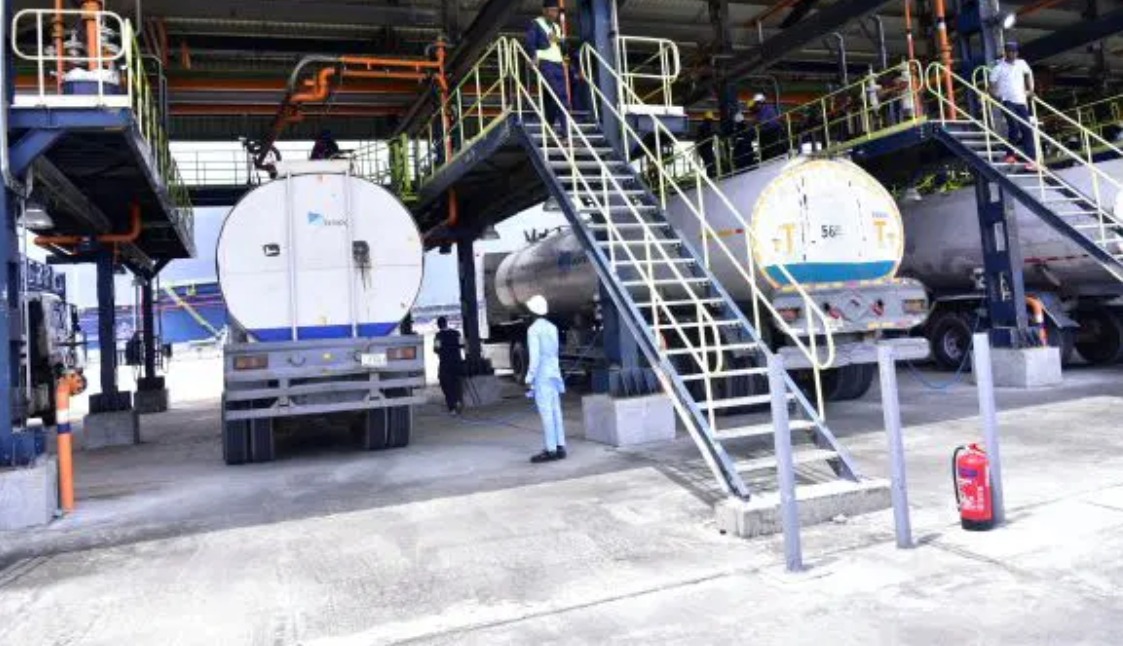
The fuel supply arrangement between the Dangote Petroleum Refinery and 20 major petroleum marketers, under which the parties agreed to offtake 600 million litres of petrol monthly, has collapsed over pricing disagreements, The PUNCH has exclusively learnt.
It was also gathered that the disagreement sparked the surge in petrol importation witnessed in the month of November 2025, with total imports rising to 1.563 billion litres, according to the Nigerian Midstream and Downstream Petroleum Regulatory Authority.
The authority disclosed the import figure in its November 2025 Fact Sheet, titled State of the Midstream and Downstream Sector, which showed a sharp spike in imported volumes during the period the pricing dispute intensified.
Recall that the deal, reached in October 2025, was structured as a pilot arrangement under which 20 depot owners were to collectively offtake about 600 million litres of petrol monthly, with each marketer lifting roughly 30 million litres from the Dangote Refinery.
The National Public Relations Officer of the Independent Petroleum Marketers Association of Nigeria, Chinedu Ukadike, had confirmed in an interview that the refinery set the target after a strategic meeting with key players in the downstream sector.
Ukadike said the agreement was part of efforts to stabilise supply in the domestic market and ease the recent surge in pump prices. According to him, the meeting, which included representatives of A.Y.M. Shafa, A. A Rano, NNPCL Retail, Salbas, and several other major distributors, focused on how to streamline product allocation and reduce the layers of middlemen contributing to price distortions.
“At the meeting, Dangote announced plans to sell to only 20 selected marketers who will serve as primary distributors to other dealers. Each of them will lift a minimum of two million litres, which will translate to about 600 million litres every month,” Ukadike said.
“We believe that once this structure takes effect, petrol availability will improve significantly and retail prices will start to ease,” he added.
However, two industry sources who spoke to The PUNCH on Thursday confirmed that the deal, which lasted barely a month, has now collapsed, attributing the breakdown to the refinery’s reluctance to adjust its gantry price in line with falling international benchmarks.
According to the first source, an industry stakeholder who requested anonymity due to the nature of the matter, the agreement was structured to include monthly price reviews. Products were initially sold to marketers at N806 per litre for coastal delivery and N828 per litre at the gantry.
Under the arrangement, Dangote temporarily suspended direct sales to independent marketers, who could only purchase 250,000 litres or less, forcing them to rely on the 20 approved marketers for supply.
The source said, “The arrangement between Dangote and 20 marketers has collapsed. Remember that there was an agreement in October, and they agreed on a particular price, and that every month, there will be a price review. So in the month of October, the price was shifted for the marketers, and they were given products at N806 per litre and sold gantry at N828 per litre.
“That was fixed, and they now stopped all forms of product sales to independent marketers who were only buying 250,000 litres or less. Due to the agreement, marketers who needed products had to go buy from the 20 marketers. This is because the marketers had mentioned in the agreement that Dangote won’t sell directly to other marketers but only to the approved members, and then the rest would buy from them.”
The official added that the initial system functioned smoothly, with products being loaded through ships and gantries, and additional interested parties gradually added to the approved list.
However, the deal began to unravel in November, when importers noticed that international petrol prices had fallen below Dangote’s selling price.
“But the agreement had a bit of issues in the month of November when importers saw prices at the international benchmark and that it was lower than the price Dangote was selling to them. They said it was supposed to drop to around N750 per litre. But Dangote was reluctant to review. This caused the heavy influx of imported petrol in November.”
In response, Dangote later slashed its gantry price to N699 per litre, the lowest in 2025, but the move came too late to prevent losses.
The source also revealed that depot owners and marketers who had purchased products at N828 per litre in October but had not yet sold were left bearing heavy losses, while smaller marketers also struggled to adjust to the sudden price change.
According to data from the Major Energies Marketers Association of Nigeria and petroleumprice.ng during the period, the average landing cost of imported premium motor spirit dropped to N829.77 per litre, a price lower than the ex-depot price of the fuel produced locally.
The MEMAN data showed that the average landing cost of petrol as of October 30 was N829.77 per litre. This was a further drop in the landing cost, which was an average of N849.61 on October 13, N847.61 on October 14, N841.54 on October 20, and N839.97 per litre on October 21.
In contrast, Dangote refinery’s gantry remained N877/litre as of October 24, 2025.
He further said the dispute boomeranged into a public confrontation between Dangote and the former NMDPRA boss, Farouk Ahmed, over the agency’s issuance of multiple import licences to other marketers, a conflict that eventually led to the ACE’s resignation in December 2025.
“Now there is no agreement or alignment between Depot owners and Dangote. The refinery is now selling to another marketer that can offtake any quantity of products,” the source stated.
Confirming the position of the industry stakeholder, the Chief Executive Officer of petroleumprice.ng, Jeremiah Olatide, said the pricing mechanism for the deal was tied to Eurobob, the international benchmark for European gasoline, with the understanding that prices would be reviewed monthly in line with global crude oil movements. Under the initial arrangement, Dangote published a coastal price of N806 per litre and a gantry price of N828 per litre.
He explained that after the first month, the international crude oil benchmark declined sharply, prompting the depot owners to request a reduction in the gantry price. While Dangote implemented a price adjustment, it fell short of expectations when compared with international prices.
“Yes, it has collapsed. It was agreed that the process would be determined by Eurobob, which primarily refers to the benchmark price for European gasoline (petrol), that is the international benchmark. That for every benchmark, the price would be discussed and agreed to be adjusted.
“They agreed on N806 coastal rate and N828 gantry price as published by Dangote refinery. After the first month, the international crude oil benchmark dropped, and the private depot owners requested a reduction in the Dangote gantry price. The reduction was effected but not what they expected in comparison with international prices. It was this difference that made the marketers turn to imports in the month of November 2025.
“Importation surged in November, and there were a large number of vessels at berth. So when Dangote noticed the new development, he slashed the price from N828 per litre to N699 per litre, a 129 per cent reduction and the highest in 2025. Days later, he had a press conference, making allegations against the former NMDPRA ACE, Farouk Ahmed, on the issuance of licenses to marketers.
“So the relationship between depot owners and Dangote lasted for just a month before falling apart. Now the refinery doesn’t have a choice but to sell to independent marketers who buy in bits.”
Confirming the collapse, the National Publicity Secretary of IPMAN, Chinedu Ukadike, told The PUNCH that the agreement was no longer in force.
“No, it is no longer in place. Dangote has decided to liberalise the buying options. Marketers are now free to buy products, even down to those who can lift as little as 250,000 litres,” Ukadike said.
He added that the refinery had specifically invited independent marketers to come forward and load products directly. “These are market strategies. You don’t want unnecessary issues in distribution or artificial price hikes. The market is now open. It is also about competition,” he said.
Ukadike explained that tensions also arose because some marketers continued importing petrol even after signing the October agreement, undermining the exclusivity clause.
“Even after the agreement was signed, some marketers still went ahead to start importing petroleum products, which is against the agreement signed. So he decided that since they are keeping to it or evacuating products well, he has decided to allow all marketers to take products. That is the situation on the ground,” he added.
For now, the refinery has reverted to open-market sales, offering product sales from as low as 250,000 litres to any interested marketer, a departure from the offer given in October.
When contacted, Dangote spokesperson, Anthony Chiejina, did not respond to calls and messages sent to his phone number by our correspondent for an official reaction.
Meanwhile, fresh market data show that the spot price of imported petrol into Nigeria has dropped to about N696 per litre, according to the latest energy bulletin released by the Major Energies Marketers Association of Nigeria.
The price, calculated at the Apapa jetty, is below Dangote’s current gantry price of N699 per litre. This was the 30-day average import parity price of N772.65 per litre, reflecting a temporary easing in international crude oil costs and foreign exchange stability.
The bulletin, obtained on Thursday, showed that the difference between the on-spot import price and the 30-day average, currently about N76 per litre, creates opportunities for marketers to optimise inventory and timing, especially as local refiners adjust gantry prices.
For instance, Dangote Petroleum’s gantry petrol price is currently N699 per litre, slightly above the import parity spot price, which could incentivise competitive pricing in the downstream market.
The spot price for petrol in Apapa had fallen steadily alongside a slight decline in Brent and WTI crude prices, which currently trade at $63.75 and $60.14 per barrel, respectively. Similarly, Bonny Light crude fluctuated around $66.22 per barrel, reflecting global market adjustments following a period of relative stability.
According to MEMAN, the decline in spot prices has been driven by a combination of lower international benchmark prices, reduced shipping costs, and a stronger naira, which currently trades at N1,419.07 against the dollar, down from N1,450 earlier in December. The association noted that diesel and kerosene have also experienced downward pressure, with spot prices for diesel at N844.88 per litre and kerosene at N882.94 per litre.
The report also highlighted that average 30-day import parity prices are calculated using Platts commodity prices, freight charges, insurance, and terminal costs, providing a benchmark for local marketers and regulators in the Nigerian downstream sector. According to MEMAN, fluctuations in these prices directly impact retail pump prices, the profitability of depot owners, and the viability of local refining operations.
punch.ng
FOLLOW US ON: