
Connect with us

Politics

2027: We’ll not support non-Muslim guber candidate – Lagos Muslims

Published

on

The Muslim Community of Lagos State (MCLS) has expressed deep concern over what it described as the marginalisation of Muslims in political appointments and governance within the state, vowing not to support any political party that presents a non-Muslim for governor in the next general election.

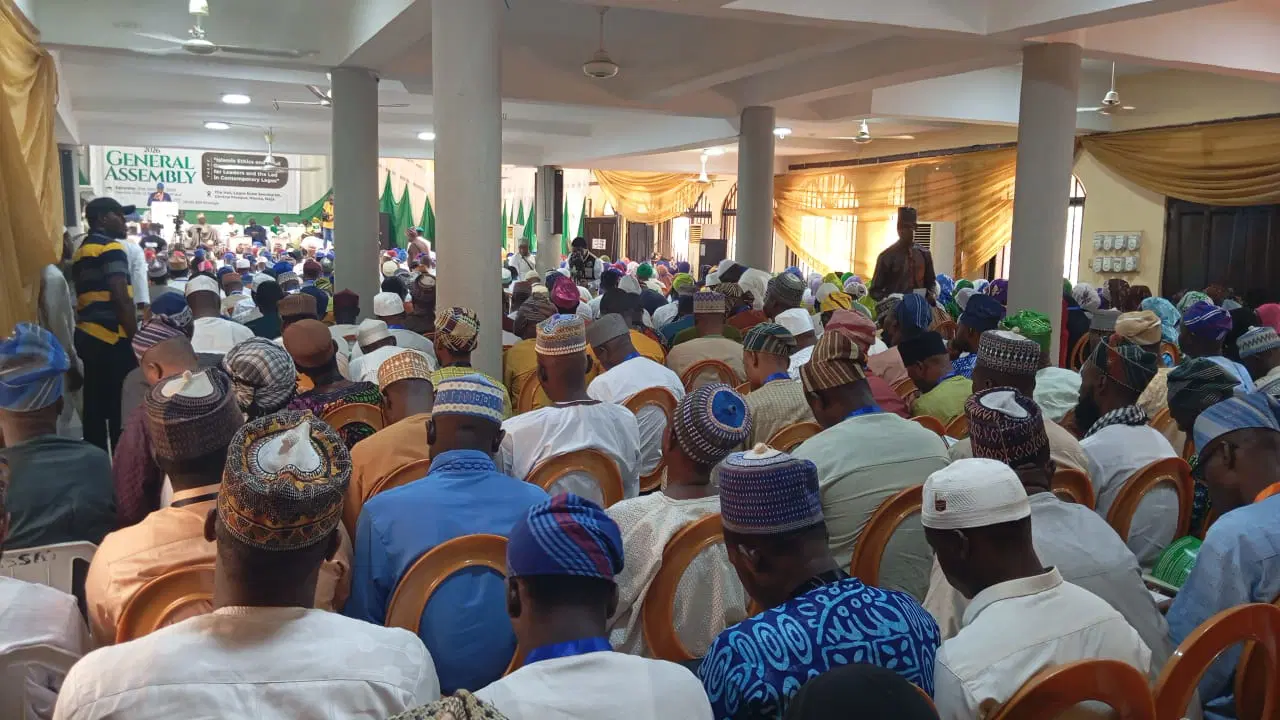
At its maiden General Assembly held last Saturday at the Lagos State Secretariat Mosque Hall, Alausa, Ikeja, the group lamented the exclusion of Muslims in key sectors, particularly education, and called for the recruitment of Arabic and Islamic Studies teachers in public schools.

In a strongly worded resolution, the Assembly declared that Muslims would not support any political party that fields a non-Muslim candidate in the 2027 governorship election. “We cannot continue to be sidelined in our own state. The Muslim community will only support a candidate who represents our values and interests,” the communique stated.

The gathering, which drew over 1,000 Muslims from various divisions and local governments across Lagos, was marked by passionate debates, motions, and unanimous resolutions. Members adopted the provisional financial report for 2024 and 2025 pending audit, ratified trustee nominations, and endorsed the new constitution of the community, which introduces the Islamic system of Shurah for electing officers.

Speakers at the event underscored the need for Muslims to unite and participate actively in politics. The Assembly urged the Lagos State Government to ensure religious balance in the appointment of Tutors General and Permanent Secretaries across the six educational districts, and to recruit Arabic and Islamic Studies teachers in public schools. It also appealed to the government to respect the Supreme Court’s ruling on the use of hijab by female Muslim students and to address what it described as the marginalisation of Muslims in health institutions and political appointments.

See also  I won’t betray your trust, Adeleke assures supporters

Delivering the keynote address on behalf of the Deputy Governor of Lagos State, Dr. Obafemi Hamzat, Alhaji Tajudeen Afolabi highlighted the problem of poor followership, noting that selfishness, unethical conduct, and indifference among citizens have contributed to bad governance. “The followers must rise above laid-back attitudes and unwholesome acts if we are to achieve meaningful change,” he said.

Prof. Saheed Timehin of Lagos State University (LASU) stressed the importance of value change, collective responsibility, and active participation in governance. Prof. Nasir Onibon added that good leadership reflects good followership, urging citizens to embrace self-reappraisal and sincerity of purpose. “Once the followers are good, the leaders will get it right,” he remarked. Prof. AbdulKabir Paramole, also of LASU, illustrated how dishonesty and corruption among followers undermine development, warning against the culture of inflating costs and misrepresenting facts. He cautioned against cursing leaders over policies perceived to be harsh, insisting that followers must also play their part in nation-building.

The Assembly ratified the nomination of trustees, including Tajudeen Oluyole Olusi, Prof. Tajudeen Gbadamosi, Chief Bode Oyedele, Imam Yahyah Ishola, Dr. Abdulkareem Seriki, Alhaja Muhibat Wonu Folami, Ramlat Muri Okunola, and Alhaja Rasaqat Tobun. The new constitution was presented by Barr. Mubashir Ojelade, Chairman of the Constitution Review Committee, explained that it clearly defines eligibility, tenure, and procedures for electing officers.

The four-hour event was highly participatory, with members raising questions, offering insights, and adopting motions through voice votes. The Assembly concluded with a strong call for Muslims in Lagos to unite, entrench Islamic values in their families, and play a decisive role in shaping the political future of the state.

See also  Ivorian president Ouattara, 83, wins fourth presidential term

FOLLOW US ON:

FACEBOOK

TWITTER

PINTEREST

TIKTOK

YOUTUBE

LINKEDIN

TUMBLR

INSTAGRAM

Continue Reading
Click to comment

Leave a Reply

Your email address will not be published. Required fields are marked *

Politics

Poor communication making APC achievements invisible, says party chair

Published

on

The National Chairman of the All Progressives Congress, Prof. Nentawe Yilwatda, has lamented that poor communication is rendering the party’s achievements invisible despite significant infrastructure projects delivered by the Bola Tinubu administration and state governments.

Yilwatda made the observation on Tuesday at the Progressive Governors’ Forum-Renewed Hope Ambassadors Summit held at the State House Banquet Hall, Abuja.

“Good governance without communication is invisible. I’ve visited many states. I’ve seen beautiful projects, beautiful things being done, but they’re invisible and not communicated,” the APC chairman lamented.

He emphasised that effective communication is critical to translating governance achievements into political capital ahead of the 2027 general elections.

“Communication without structure is noise. Politics without grassroots mobilisation is organised defeat,” Yilwatda said, explaining the rationale for establishing the Renewed Hope Ambassadors structure.

The party chairman listed major infrastructure achievements that have not received adequate publicity, including the Lagos-Calabar Coastal Road, the Badagry-Sokoto Road with over 300 dams for irrigation agriculture, the Red Line rail project, and the Ajaokuta-Kaduna-Kano gas pipeline project.

“Is it the Coastal Road or the Badagry-Sokoto Road with over 300 dams spread across the route for irrigation agriculture to boost food security in the country?

“Or the Red Line, or the AKK project, which is the biggest and most expensive project ever in the country? But have they been heard loud and clear?” he asked.

Yilwatda said Tuesday’s summit is meant to address this communication gap by ensuring that governance achievements translate to public gratitude and ultimately electoral victory.

See also  PDP slams FG over US disclosure of terror strikes before Nigeria

“We’re here to ensure that governance translates to gratitude, gratitude by the people for the projects, and gratitude also translates to loyalty. And loyalty translates to our victory in 2027,” he stated.

He added, “When the President speaks, let the governors reimport it. When the governors deliver, let the ambassadors amplify it. When the party decides, let the members defend it.”

The chairman warned against what he called “contradictory narratives, internal sabotage, and freelance communication,” insisting that unity in messaging is strategic power for the party.

“One party means one message, no contradictory narratives, no internal sabotage, and no freelance communication. Unity is not optional. Unity is strategic power as a party,” he emphasised.

Yilwatda dismissed opposition attempts to exploit the administration’s economic reforms for political gain, saying opponents “whisper confusion where we speak in clarity.”

He argued, “The opposition always hopes that our difficult reforms will weaken us.

“They are waiting for temporary discomfort. They refuse to acknowledge the long-term benefits to this country.”

He expressed confidence that Nigerians will reward performance over rhetoric in 2027.

“In 2027, Nigerians will not vote noise. Rather, they will vote for the results they will see on the streets and across the country,” the APC chairman declared.

Yilwatda said the party has chosen “reform over rhetoric, restructuring over recycling of failure, and building the economy and making reforms over cosmetic solutions.”

He described the summit as “a defining gathering that will define our vision, our conviction, and our purpose as a political party.”

The chairman outlined the summit’s dual purpose as strengthening governance communication under the Renewed Hope agenda and laying structural foundations for victory in 2027.

See also  Secondus, Omehia, Opara, Others Now Ready To Support Tinubu — Fubara

“Today begins the future of our party and our country. The future is not something that we await. Rather, it is something that we organise, and today is the starting point,” he stated.

The summit, themed “Taking Renewed Hope to the Grassroots: One Party, One Message, One Mobilisation Framework,” brought together Renewed Hope Ambassadors from the 36 states and the FCT, zonal coordinators, and members of the Federal Executive Council.

Imo State Governor, Hope Uzodimma, who serves as Chairman of the Progressive Governors’ Forum and Director-General of Renewed Hope Ambassadors, delivered the welcome address.

Vice President Kashim Shettima presented the Renewed Hope Compendium, while Tinubu gave the keynote address and officially opened the summit.

According to the programme, the Renewed Hope Ambassadors initiative is a grassroots mobilisation structure designed to communicate the administration’s achievements and build support ahead of the 2027 elections.

Zonal coordinators appointed include Senator Anyim Pius Anyim (South-East), Senator Tanko Al-Makura (North Central), Isa Yuguda (North East), Senator Ifeanyi Okowa (South-South), Senator Adedayo Adeyeye (South-West), and Aminu Masari (North-West).

The management team comprises Senator Uba Sani of Kaduna State as Deputy Director-General, Governor Inuwa Yahaya of Gombe State as Secretary, and James Faleke as Assistant Secretary.

The summit featured technical sessions, panel discussions, and a commitment ceremony aimed at aligning party structures for the 2027 electoral contest.

punch.ng

FOLLOW US ON:

FACEBOOK

TWITTER

PINTEREST

TIKTOK

YOUTUBE

LINKEDIN

TUMBLR

INSTAGRAM

Continue Reading

Politics

Court adjourns ruling in ADC deregistration suit to March 24

Published

on

The Federal High Court sitting in Abuja has fixed March 24, 2026, for ruling on a joinder application in the suit seeking the deregistration of the African Democratic Congress, Accord Party, Zenith Labour Party and Action Alliance over alleged non-compliance with constitutional requirements.

The development follows a suit marked FHC/ABJ/CS/2637/25, instituted by the Incorporated Trustees of the National Forum of Former Legislators against the Independent National Electoral Commission, the Attorney-General of the Federation and the affected political parties.

The originating summons initially targeted only the ADC for deregistration, but was later amended to include the other parties, whose continued existence the plaintiffs contend breaches the provisions of the 1999 Constitution (as amended).

At Tuesday’s proceedings before Justice Peter Lifu, counsel announced appearances for the parties, except for Action Alliance, which had two different lawyers from separate law firms claiming to represent it.

The two lawyers — Ibrahim Yakubu and Bello Lukman — maintained that they had valid letters of instruction to appear for the party.

In the exchange that followed, Justice Lifu asked whether both counsel were acting together. They responded negatively, insisting they had separate mandates.

The judge directed them to reconcile their positions, warning that the court would “do the needful” if they failed to resolve the representation issue.

In another application, counsel to the Accord Party, Musibau Adetunbi (SAN), sought leave of court to file a further counter-affidavit in opposition to the amended originating summons joining the party in the suit.

Adetunbi, who brought the motion pursuant to Order 26 Rule 1 and Order 66 Rule 8, argued that the further counter-affidavit was necessary to address salient facts allegedly omitted in the earlier process. He urged the court to grant the application in the interest of justice and to enable it reach a just determination.

See also  Babachir labels APC fugitives’ haven as ex-gov candidate joins ADC

However, counsel to the plaintiff, Yakubu Abdullahi Ruba (SAN), opposed the application, arguing that no new facts were introduced in the amended originating summons to warrant a further counter-affidavit.

Ruba described the application as incompetent and unknown to the law, urging the court to refuse the request.

However, some of the counsel, including S.E. Aruwa (SAN), also applied for an extension of time to regularise their processes and filed a motion on notice challenging the jurisdiction of the court to entertain the suit.

While Ruba opposed the application for enlargement of time, one of the counsels told the court that he had just been briefed and sought time to respond.

After listening to arguments, Justice Lifu granted the application for extension of time and deemed the plaintiff’s reply on points of law as properly filed.

The court subsequently adjourned the matter to March 24 for ruling on the joinder application and other pending motions.

Speaking with journalists after the proceedings, Ruba reiterated that the suit seeks a judicial interpretation of constitutional and statutory provisions governing the registration and continued recognition of political parties in Nigeria.

According to court documents, the action was commenced pursuant to Section 225(a) of the 1999 Constitution (as amended), Section 75(4) of the Electoral Act, 2022, and relevant provisions of the Federal High Court (Civil Procedure) Rules, 2019.

The plaintiffs contend that INEC is constitutionally bound to deregister political parties that fail to meet minimum electoral performance thresholds, including securing at least 25 per cent of votes cast in one state in a presidential election, or winning at least one elective seat at any level of government.

See also  PDP slams AbdulRazaq over school closure on insecurity in Kwara

The plaintiffs are seeking declaratory orders compelling INEC to enforce constitutional thresholds, as well as mandatory and perpetual injunctions restraining the commission from recognising or giving effect to the political activities of the affected parties pending compliance.

They further argued that permitting such parties to participate in the 2027 general elections would clog ballot papers, waste public resources and undermine electoral integrity.

Continue Reading

Politics

Why Tinubu Lost 2023 Presidential Election In Lagos – Obanikoro

Published

on

Former Minister of State for Defence, Musiliu Obanikoro, has shared his views on why President Bola Tinubu lost Lagos in the 2023 presidential election.

It was reports that Obanikoro spoke during an interview with Vanguard on Monday, February 23, 2026.

He said several political factors worked against Tinubu during the election period. According to him, although party supporters made strong efforts during the campaign, some issues shaped how voters made their choices.

The former senator pointed to the Muslim-Muslim presidential ticket as one of the reasons behind the outcome.

He explained that it was the first time such a ticket was presented at the national level in Nigeria. He said many Nigerians were used to seeing a balance between Muslims and Christians on presidential tickets. When that pattern changed, it created concerns among some voters.

Obanikoro noted that Lagos has a large Christian population. He described the state as a major base for many Christian organisations in the country.

He said several churches and religious groups have their headquarters in Lagos or in nearby areas. Because of this, he said religion became an important topic during the election in the state. He stated that some voters were worried that having candidates from the same religion at the top level could affect religious balance in leadership.

According to him, Nigerian politics has for many years followed an informal arrangement where both major religions are represented in key positions. When this long-standing pattern was altered, it led to different reactions from parts of the electorate.

See also  Secondus, Omehia, Opara, Others Now Ready To Support Tinubu — Fubara

“Asiwaju lost Lagos for so many reasons, one it was a Muslim/Muslim ticket. Two, Lagos, whether you like it or not, is the capital of the Christian religious groups in Nigeria. All these religious associations or religious groups are all headquartered in Lagos or outskirts of Lagos, and they have a huge population,” he said.

FOLLOW US ON:

FACEBOOK

TWITTER

PINTEREST

TIKTOK

YOUTUBE

LINKEDIN

TUMBLR

INSTAGRAM

Continue Reading

Trending