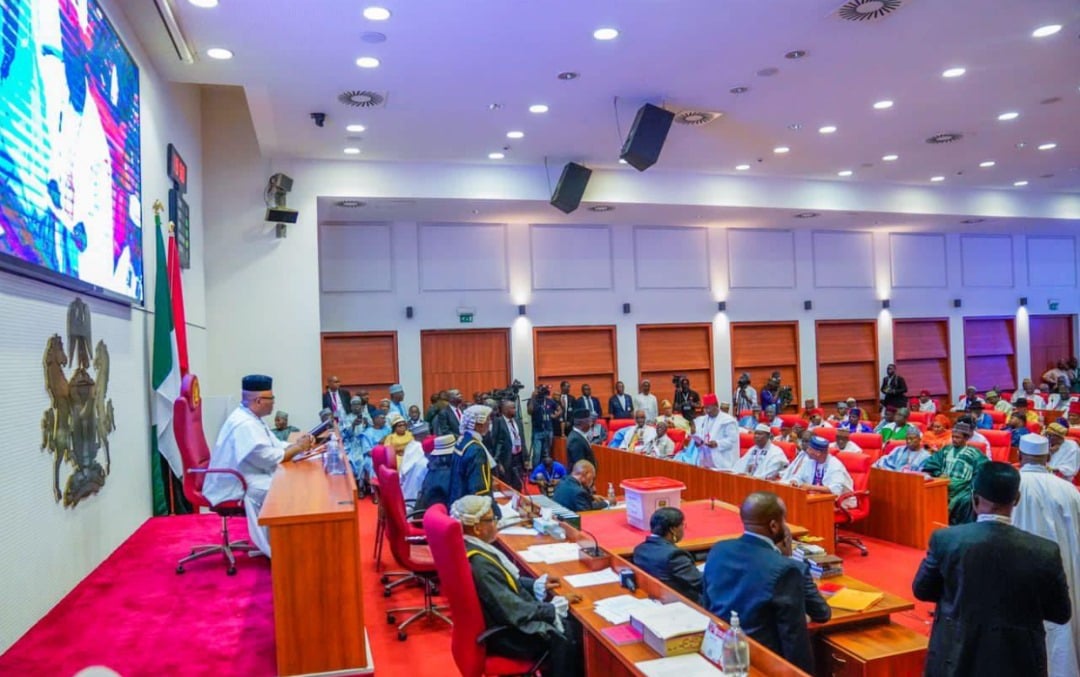
The Senate has announced an emergency plenary sitting for Tuesday amid mounting public outrage over its recent passage of the Electoral Act (Amendment) Bill, particularly the rejection of a clause mandating real-time electronic transmission of election results.
The decision was disclosed on Sunday in a statement signed by the Clerk of the Senate, Emmanuel Odo, who said all senators have been directed to reconvene for the session.
“The President of the Senate, Godswill Akpabio, has directed the reconvening of plenary for an emergency sitting on Tuesday, February 10th, 2026,” the statement read.
According to the notice, the emergency plenary will commence at 12 noon.
This comes as the Nigeria Labour Congress warned of potential nationwide protests and election boycotts over what it described as confusion and contradictory positions by the Senate on amendments to the Electoral Act, particularly regarding electronic transmission of election results.
The labour union accused the Senate of undermining public confidence in Nigeria’s electoral process by failing to clearly state whether electronic transmission of results would be mandatory.
Also, a newly formed coalition of political activists under the banner of the Movement for Credible Elections strongly condemned the National Assembly’s decision to remove mandatory electronic transmission of election results from the proposed Electoral Act Amendment Bill 2026, describing the move as a “deliberate act of democratic sabotage.”
As part of its response, the coalition announced plans for a mass protest tagged “Occupy NASS”, scheduled for Monday (today) in Abuja.
This is happening a few days after the Senate passed the amendment bill on February 4 but voted down Clause 60(3), which sought to make it mandatory for presiding officers to electronically transmit election results directly from polling units to the Independent National Electoral Commission’s Result Viewing portal in real time.
The clause was designed to strengthen transparency and reduce manipulation in the collation process by ensuring immediate electronic upload of results.
Instead, lawmakers retained the existing discretionary provision on the “transfer” of results, which allows electronic transmission only after votes have been counted and publicly announced at polling units.
The decision has sparked widespread condemnation from civil society organisations, election observers and opposition figures, who described it as a major setback to electoral credibility and democratic reforms.
Furthermore, the House of Representatives’ bipartisan Conference Committee on the Electoral Act Amendment Bill is set to meet with its Senate counterpart this week to resolve outstanding differences in the versions of the bill passed by both chambers.
A member of the committee and lawmaker representing Bida/Gbako/Katcha Federal Constituency of Niger State, Mr Saidu Abdullahi, disclosed this in an interview with The PUNCH.
The bipartisan committee was constituted last week by the leadership of the House in line with legislative procedure for harmonising areas of disagreement between bills passed separately by the Senate and the House of Representatives.
The committee, chaired by Lagos lawmaker, Mr Adebayo Balogun, is mandated to engage with its Senate counterpart to reconcile divergent provisions of the Electoral Act (Amendment) Bill, ahead of final consideration and passage by the National Assembly.
Speaking briefly with our correspondent, Abdullahi said, “We will meet within the week and discuss.”
The planned meeting comes amid sustained agitation by civil society organisations, opposition parties and sections of the public for further amendments to the Electoral Act 2022, which was signed into law after a prolonged legislative-executive process.
The Act was widely hailed for introducing reforms aimed at improving the credibility of elections, including clearer timelines for party primaries and provisions strengthening the independence of the Independent National Electoral Commission.
But allegations of inconsistencies between polling unit results and uploaded figures have further intensified calls for legislative clarity.
The NLC President, Joe Ajaero, in a statement on Sunday, stated, “The Nigeria Labour Congress expresses deep concern over the confusion and contradictory narratives emerging from the Senate regarding the amendment to the 2022 Electoral Act, particularly on electronic transmission of results
According to the NLC, the lack of clarity surrounding the Senate’s decision threatens electoral integrity and public trust, stressing that “Nigerians deserve a transparent system where votes are not only counted but seen to be counted.”
“Public records suggest the proposed amendment to mandate the Independent National Electoral Commission to transmit results electronically in real time was not adopted, with the existing discretionary provision retained.
“This has generated nationwide apprehension, and subsequent explanations have only added to the confusion,” the union added.
It warned that “legislative ambiguity” at a critical period following the 2023 general elections could institutionalise doubt within the electoral system.
The labour body demanded that the Senate issue an “immediate, official, and unambiguous account” of the exact provisions passed, including the final wording and the rationale behind its decision.
“The National Assembly leadership must also ensure the harmonisation process produces a final bill with crystal-clear provisions; any ambiguity in the transmission and collation of results is a disservice to our democracy,” the statement read.
The NLC insisted that the amended Electoral Act must provide a clear mandate compelling INEC to electronically transmit and collate results from polling units in real time, warning that failure to do so could trigger mass action.
“Failure to add electronic transmission in real time will lead to mass action before, during and after the election, or total boycott of the election,” the Congress said.
“Nigerian workers and citizens are watching closely. Our nation must choose the path of clarity and integrity. We need to avoid the same confusion that trailed the new Tax Acts. The time for honest, people-focused legislation is now.”
Civil society groups and opposition figures condemned the Senate’s decision, labelling it a setback for Nigeria’s democratic progress.
Senate President Akpabio has, however, defended the chamber’s actions, insisting during a public event that the Senate did not reject electronic transmission and vowing not to be intimidated.
In a statement on Saturday by James Ezema, the MCE said the Senate’s action amounted to an “assault on the right of Nigerians to freely choose their leaders” and warned that it would deepen electoral fraud ahead of the 2027 general elections.
“By rejecting the mandatory electronic transmission of election results from polling units, the National Assembly has chosen opacity over transparency, manipulation over credibility, and elite conspiracy over the sovereign will of the Nigerian people,” the group declared.
It added, “We call on all our partners and allies to mobilise and proceed peacefully to defend the popular yearnings of Nigerians and resist any attempt to return the country to the dark days of manual manipulation and backroom results.’’
MCE also urged Nigerians across the country and the international community to speak out.
“Students, workers, traders, professionals, women, youth, community leaders, the media and the global community must stand up and be counted,” it stated.
The coalition is convened by prominent activists, including Ayuba Wabba, Dr Usman Bugaje, Femi Falana (SAN), Dr Oby Ezekwesili, Prof Pat Utomi, Dr Bilikisu Magoro, Amb Nkoyo Toyo, Shehu Sanni, Ene Obi and Olawale Okunniyi, among others.
MCE said electronic transmission of results was not controversial but a basic safeguard against election rigging.
“Mandatory electronic transmission of results is a minimum protection against result tampering, ballot rewriting and post-election fraud. Any legislature that blocks it is openly defending a system that thrives on stolen mandates and manufactured elections,” the statement read.
According to the coalition, there is no legitimate justification for rejecting the provision.
“There is no acceptable reason for opposing mandatory electronic transmission except fear—fear of the genuine votes and true mandate of the electorate,” MCE stated.
The group warned that the decision would have far-reaching consequences for Nigeria’s democracy, including continued manipulation of results between polling units and collation centres, growing voter apathy, and declining public trust in elections.
“If transparency is denied, apathy will grow, and citizens will begin to express their votes in other ways. This is dangerous for democracy,” the coalition warned.
MCE further alleged that flawed electoral processes had empowered impunity and compromised the judiciary.
“The failure of transparent elections has rewarded electoral fraud and enabled the courts to become tools for mandate purchase by the highest bidders, rather than independent institutions upholding the rule of law,” it said.
The coalition accused the political elite of resisting technology because it exposes corruption.
“This decision confirms what Nigerians already know—that the political class is afraid of technological transparency because it exposes their shady dealings during elections,” the group added.
Describing itself as a non-partisan citizens’ movement, MCE said it comprises Nigerians from all walks of life, including youths, women, persons with disabilities, professionals, civil society organisations, faith-based groups and Nigerians in the diaspora.
“We are united by one simple principle: every vote must count and must be protected,” the statement stressed.
MCE emphasised that it was not aligned with any political party.
“This movement belongs to Nigerian citizens whose votes have been rigged and stolen repeatedly since 1999. We will not be beholden to any party or politician,” it said.
The group issued three key demands to the National Assembly, including the immediate reinstatement of mandatory electronic transmission of results in the Electoral Act Amendment Bill 2026.
It also demanded public accountability from lawmakers who opposed the clause.
“Those who rejected this provision must explain their positions openly to Nigerians instead of hiding under the cover of the Senate or House of Representatives,” MCE insisted.
The coalition further advocated the adoption of a Voter Verifiable Paper Audit Trail alongside electronic transmission, citing India’s electoral model.
“Electronic transmission must align with polling unit documentation. Democracy dies when votes are allowed to be stolen. It is time to end electoral rigging in Nigeria,” MCE concluded.
Afenifere demands acceptance
The pan-Yoruba socio-political organization Afenifere led by Oba Oladipo Olaitan has called on the Joint Committee of the National Assembly set up to harmonise the differing versions of the Electoral Act Amendment Bill passed by the Senate and the House of Representatives to accept mandatory real-time electronic transmission of election results.
Afenifere said the survival of Nigeria’s democracy depended on the legislature embracing a credible, technology-driven electoral framework ahead of the 2027 General Elections, including compulsory real-time transmission of results from polling units to the INEC Result Viewing portal.
The organisation warned that failure to do so would send a clear signal that the National Assembly was unwilling to fully embrace electoral transparency and accountability, thereby further eroding public trust in the country’s democratic process.
The statement was released on Saturday by the Afenifere leader, Oba Oladipo Olaitan and National Publicity Secretary, Justice Faloye.
“Afenifere cautions that care must be taken not to completely lose the people’s trust in the current democratic disposition. Let democracy breathe,” the group stated.
Afenifere also condemned the Senate’s passage, on February 4, 2026, of the Electoral Act 2022 (Repeal and Re-enactment) Amendment Bill 2026, in which lawmakers rejected provisions for mandatory real-time electronic transmission of results and digital voter identification earlier approved by the House of Representatives in December 2025.
According to Afenifere, the Senate’s decision amounts to a betrayal of constitutionalism and multiparty democracy, as it places political incumbency above democratic integrity.
The group described the move as self-serving and a dangerous drift towards a one-party state, allegedly tele-guided by the executive, as has been witnessed over the years in Lagos State.
The statement added, “Afenifere expresses shock at the Senate’s rejection of critical amendments, including mandatory electronic transmission of results and downloadable electronic voter cards embedded with QR codes.”
The group dismissed claims that electronic transmission remained permissible under existing law, noting that the Supreme Court had ruled that such transmission was not mandatory because it was not expressly provided for in the Electoral Act 2022.
“By refusing to codify electronic transmission as a legal requirement in the 2026 amendment, the Senate has deliberately left the process vulnerable to administrative ‘glitches’ and selective non-compliance,” Afenifere said, warning that this undermines the constitutional guarantee of free and fair elections.
The group noted that Section 78 of the 1999 Constitution empowers the National Assembly to legislate for credible federal elections.
It accused the Senate of subverting this responsibility by rejecting amendments to Clause 60(3), which would have compelled INEC to transmit results from polling units to the IReV portal in real time.
“The rejection of Clause 47, which proposed downloadable electronic voter cards with QR codes is regressive,” the statement further read.
According to Afenifere, continued dependence on physical Permanent Voter Cards disenfranchises voters who lose their cards and ignores global advances in digital identification.
It faulted the Senate for ignoring international best practices, noting that countries, ranging from the United States to newer democracies like Estonia, deploy end-to-end verifiable electronic systems that enhance transparency and auditability.
“By keeping electronic transmission optional, Nigeria is lagging behind global standards and choosing opacity over trust,” the statement further read.